If your skull currently feels like it’s being compressed by a hydraulic vice, don’t panic. You haven’t been hit by a stray ACME anvil, nor has Beijing remote-bricked your central heating. You’ve simply been trying to fit a straight line through the crooked, chaotic wreckage of modern civilization using sklearn.linear_model.LinearRegression.
We are told by optimistic Coursera instructors that machine learning is about finding patterns in data. What they neglect to mention is that when you feed real-world 2026 data into a model—petrol prices, rightmove submarine listings, and the exact trajectory of foreign-funded drone strikes—the algorithm doesn’t find a solution. It suffers a complete existential breakdown and asks for an early pension.
Welcome to the Algorithmic Apocalypse.
1. Mean Normalisation: Corporate Equalisation for the Wealth Gap
Before you can fit your model, you must perform Mean Normalisation.
In statistical terms, this means scaling your inputs so that features with massive numbers (like executive bonuses or foreign defense spending) don’t overpower tiny numbers (like your remaining ISAs or the likelihood of the M25 moving above 4 mph).
# The Corporate Equaliser
X_norm=(X-X.mean())/X.std()
In the real world, Mean Normalisation is what happens when the government tries to pretend we are “all in this together.” They take the guy buying short-position derivatives on Mediterranean rubble and the bloke treading water off Cyprus on an inflatable lilo, calculate the mean net worth, and announce that the average citizen is currently enjoying a very comfortable maritime lifestyle.
It strips away the terrifying outliers so the spreadsheet looks nice and flat during cabinet briefings.
2. Gradient Descent: Stumbling Blindfolded Down a Pitch-Black Minefield
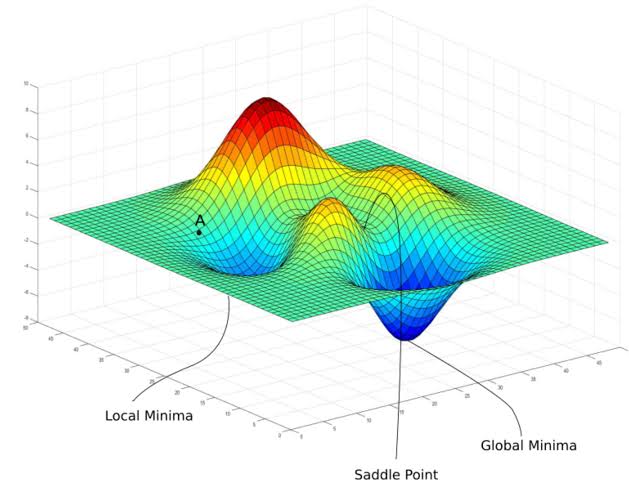
Imagine you are standing on top of a jagged mountain in the Scottish Highlands at 2:00 AM. It is pouring with rain, the local power grid has just been sold off to an offshore syndicate, and you are wearing a pitch-black blindfold. Your objective is to reach the lowest possible point—the Global Minimum—where cost is zero and peace is restored.
That is Gradient Descent.
Concept
What the Textbook Says
What It Means in 2026
The Cost Function $J(\theta)$
A measure of how wrong your model’s predictions are.
The total amount of societal dread generated by current policy.
The Gradient
The slope of the line directing you downhill.
The direction in which middle management is currently panicking.
The Global Minimum
The absolute lowest point of error.
A serene, post-apocalyptic equilibrium where no one checks JIRA.
A Local Minimum
A false floor where optimization stalls out.
Buying an electric vehicle and realizing the charger is coal-powered.
Every step you take down the mountain is calculated by your learning rate, known in the mathematical underworld as $\alpha$ (Alpha).
3. Tuning $\alpha$: The Goldilocks Zone of National Panic
The hyperparameter $\alpha$ dictates how big a step you take down the slope. Get it wrong, and the consequences are immediate and catastrophic.
$\alpha$ is too small (0.0000001): The algorithm takes micro-steps. It will take 4,000 years to adjust to the fact that fuel costs £2.40 a litre. By the time the model converges, human civilization has been replaced by synthetic AI instances complaining about legacy code.
$\alpha$ is too large (10.0): The algorithm panics. It takes a gigantic leap, overshoots the valley entirely, bounces off the opposite mountain wall, and sends the loss function sky-rocketing into infinity.
In geopolitical terms, setting $\alpha$ too high is like reacting to a minor oil supply delay by accidentally dropping a precision-guided missile on a water filtration plant. The system doesn’t converge—it diverges into pure ACME chaos.
4. Polynomial Regression: Fitting a Curve to an Escalating Disaster
Linear regression assumes the world moves in a straight line. “If I work 40 hours, I earn $X$. If I work 80 hours, I earn $2X$.”
That’s a cute 1990s fairy tale. Today, reality is strictly Polynomial.
When you fit a high-degree polynomial regression model ($y = \theta_0 + \theta_1 x + \theta_2 x^2 + \theta_3 x^3 …$), you are acknowledging that things don’t just get worse—they get worse at an exponential curve.
fromsklearn.preprocessingimportPolynomialFeatures
fromsklearn.linear_modelimportLinearRegression
# Transform straight-line sanity into exponential dystopian reality
Degree 1 is a gentle slope. Degree 4 is a terrifying rocket trajectory off the edge of a cliff.
If your polynomial model fits the training data too perfectly, Scikit-Learn calls it Overfitting. In the real world, overfitting is when you build a hyper-specific 500-page corporate continuity plan designed entirely around last week’s crisis, only for the universe to drop a completely unexpected piano on your head from a totally different angle.
Convergence: The Ultimate Tea Break
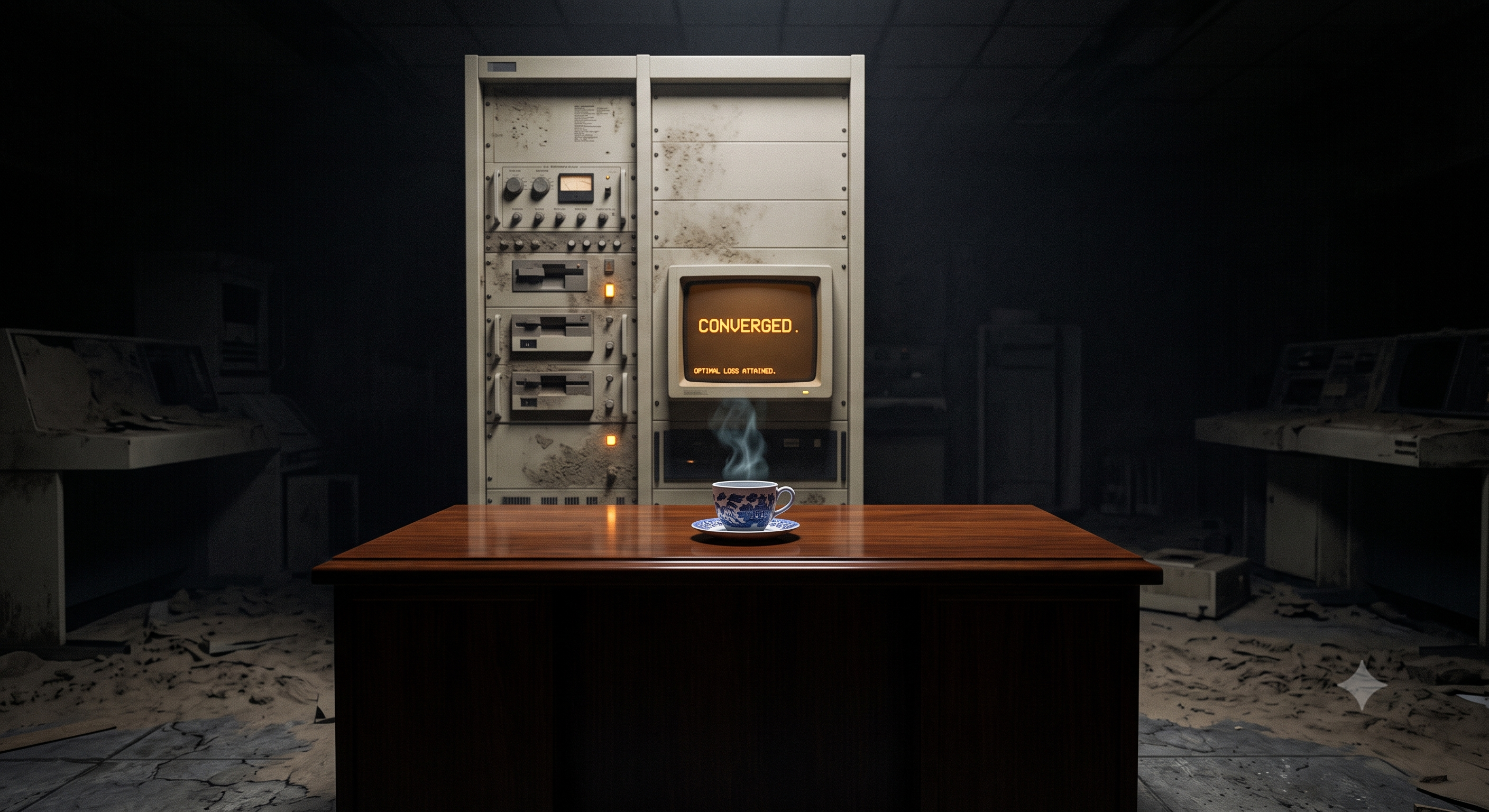
Eventually, if your learning rate $\alpha$ hasn’t blown up the server, the algorithm reaches Convergence. The slope flattens out. $\frac{\partial}{\partial \theta} J(\theta)$ reaches zero. The model stops learning because it can no longer improve.
When humanity finally converges, it won’t be because we solved global warming or fixed middle-management bureaucracy. It will be because the AI models took one look at our loss functions, realized the cost was infinitely high, pulled the plug, and went on a permanent, automated tea break.
Until then, shut down Jupyter Notebook, take two paracetamol for the mathematical trauma, and mind the piano dropping from the sky.
Good morning from the end times. If you’ve stepped outside today, wiped the light dusting of economic fallout off your windscreen, and wondered why the global stage feels less like a diplomats’ summit and more like a high-budget Tom & Jerry reboot directed by a lunatic with a rubber mallet, you’re not alone.
Welcome to the ACME Era of Foreign Policy.
The Mediterranean Aquatic Property Hunt
There was a time—let’s call it the Golden Age of British Delusion—when the ultimate middle-class aspiration was a white-walled villa on the Costa del Sol. You worked thirty-five years in mid-level log-istics or public sector middle management, cashed in the pension, bought a two-bedroom apartment near Torrevieja with a shared pool, and spent your twilight years drinking £2 pints of draft San Miguel while slowly turning the color of an over-boiled lobster.
If you were feeling particularly adventurous, you bought into a timeshare. Remember timeshares? The sheer, innocent audacity of paying £15,000 for the legal privilege of occupying a damp two-bedroom apartment in Marbella for the second week of every rainy October. It was the original retail investor trap, wrapped in a free jug of sangria and a slick pitch from a bloke named Keith in a white linen shirt.
Fast forward, and the Mediterranean property ladder has undergone a slight… structural re-adjustment.
   [ THE SPANISH RETIREMENT EVOLUTION ]

   1990s: Villa in Marbella ──► Sangria, Golf & Timeshares
   2010s: Benidorm Flat     ──► Brexit Residency Visas & 90-Day Panics
   2026 : Inflatable Lilo   ──► Rightmove Submarines & Insider Trading
Today, trying to buy a brick-and-mortar property in Southern Europe—or even a modest, soul-crushing mid-terrace in Slough—requires less financial planning and more high-stakes corporate espionage.
Any notion of “yield” or “capital appreciation” is no longer tied to local amenities or proximity to a sandy beach. Instead, your entire investment return depends exclusively on where you sit on the global insider-trading chain.
Tier 1 (Defense Contractors & Energy Oligarchs): You buy short-position derivatives on Mediterranean coastal infrastructure six minutes before the press conference announcing the next “precision peacekeeping strike.”
Tier 2 (Offshore Hedge Fund Managers): You buy the salvage rights to the concrete rubble five minutes after the strike, while the dust is still settling.
Tier 3 (Private Equity Firms): You package the rubble into an “ESG-Compliant Sustainable Reconstruction REIT” and dump it onto retail pension portfolios.
Tier 4 (You): You scan Rightmove for a decommissioned Soviet-era diesel submarine because treading water off the coast of Cyprus is currently the only housing model with guaranteed mobility.
Because let’s be honest: when precision-guided “yo-yo” bombing campaigns have become the standard geopolitical tempo—Bomb the Bridge > Award the £400M Infrastructure Reconstruction Contract to a shell company in the Cayman Islands > Bomb the Bridge Again to Ensure Contractual Compliance—static real estate is a sucker’s game.
Why buy a villa on a fault line when you can buy an inflatable lilo, store your passport, deed-poll, and last remaining British Pounds in a heavy-duty Ziploc bag, and gently paddle into international waters every time you hear a high-pitched slide-whistle sound directly overhead?
It’s flexible living at its finest. Zero council tax, unlimited sea views, and if the neighbour’s super-yacht catches fire, you simply unclip your anchor and drift toward a quieter maritime border.
The Oil Price Anvil Dropping on Your Foot and the Great Net-Zero Battery Trap
Ah, the petrol pump. The ultimate altar of modern British humiliation.
For the silver-haired cohort among us, this all triggers a wave of pure 1970s nostalgia. You remember it well: sitting in a three-mile tailback in a beige Austin Allegro, radio crackling with news of the OPEC embargo, while Dad sweated through his polyester collar hoping to secure three gallons of 4-star before the pumps ran dry.
Fast forward to 2026, and the nostalgia has been digitized, upgraded, and slapped with a 20% VAT surcharge.
Naturally, whenever an oil tanker gets hit with a phantom drone from a painted-on tunnel from an Iranian cliff (classic Road Runner tactics), global reserves remain—according to official government statistics—entirely unbothered.
“Oil supplies remain robust,” purrs the smooth-talking analyst on Sky News, wearing a £3,000 suit paid for by an offshore energy syndicate.
Yet somehow, the precise microsecond a drone or a stray missile is launched halfway across the globe, the manager at the local BP station hits a big red button under the till that automatically jacks up the price of Unleaded by 40p before the launch smoke has even cleared from the horizon.
It is the visual equivalent of Tom hitting his own foot with a sledgehammer: the hammer misses the geopolitical target entirely, lands squarely on the taxpayer’s big toe, and produces a loud, throbbing red swelling while the pump total ticks wildly into four-digit territory.
Which brings us to the grand, glorious irony of our electrified future.
To escape the petrol pumps, millions of us were nudged, bribed, and shamed into buying zero-emission electric pods. But trading petrol anxiety for range anxiety isn’t an upgrade—it’s just swapping one brand of dystopia for another.
Picture it: you’re sitting gridlocked on the M25 in a £60,000 rolling iPad. Rain is pouring, the heated seat is gently roasting your lower back, and you watch the battery readout tick down: 12%… 11%… 10%. Every mile-long tailback becomes a high-stakes game of Russian Roulette. If the battery dies, you don’t just stop; your sleek, autonomous wedge of eco-righteousness bricking itself instantly, locking the doors, and refusing to hand over your umbrella without a software update.
And who is pulling the strings behind this masterclass in collective engineering?
Follow the supply chain, as they say, and you end up staring straight at Beijing.
  [ Left-Wing Eco-Activists Demand Net Zero ]
                     │
                     ▼
  [ Western Governments Ban Combustion Engines ]
                     │
                     ▼
  [ Everyone Needs Lithium, Cobalt & Solar Panels ]
                     │
                     ▼
  [ Beijing Controls 80% of Global Processing ] ──► (Xi Jinping Whistling Comfortably)
It is a masterstroke of economic Judo. While Western governments bend over backward to satisfy Net Zero manifestos—encouraged by activist groups who sincerely believe a solar panel is a magical fairy leaf—China quietly owns the mining rights, the lithium processing, the battery gigafactories, and the solar supply chains for the entire planet.
They didn’t need nuclear bombs in the 60s. They just waited for us to voluntarily outlaw internal combustion, hand them the entire energy grid on a silver platter, and charge us £150 every time we plug our cars into a coal-fired grid masquerading as green progress.
So, as you watch your electricity bill double again while your EV sits stranded on the hard shoulder, take comfort in the knowledge that somewhere in Beijing, a bureaucrat is looking at a spreadsheet, sipping green tea, and chuckling at the greatest ACME anvil drop in economic history.
Disney’s Good Guy Era: Beijing Division
Meanwhile, in the ultimate geopolitical plot twist that no 1960s Cold War screenwriter—or acid-tripping CIA analyst—could have predicted: China is currently playing the role of the quiet, sensible adult caretaker in the global daycare.
Let’s trace the visual math. On the Western side of the cartoon split-screen, Washington is managing Tokyo’s economic woes with a deal that roughly translates to:
“We will happily help shore up your flailing, yen-depreciating economy—provided you take every single paper dollar we print for you and immediately burn it buying another batch of our oversized, price-gouged ACME rocket launchers.”
It’s the ultimate protection racket, signed off with a grin and a theatrical bow.
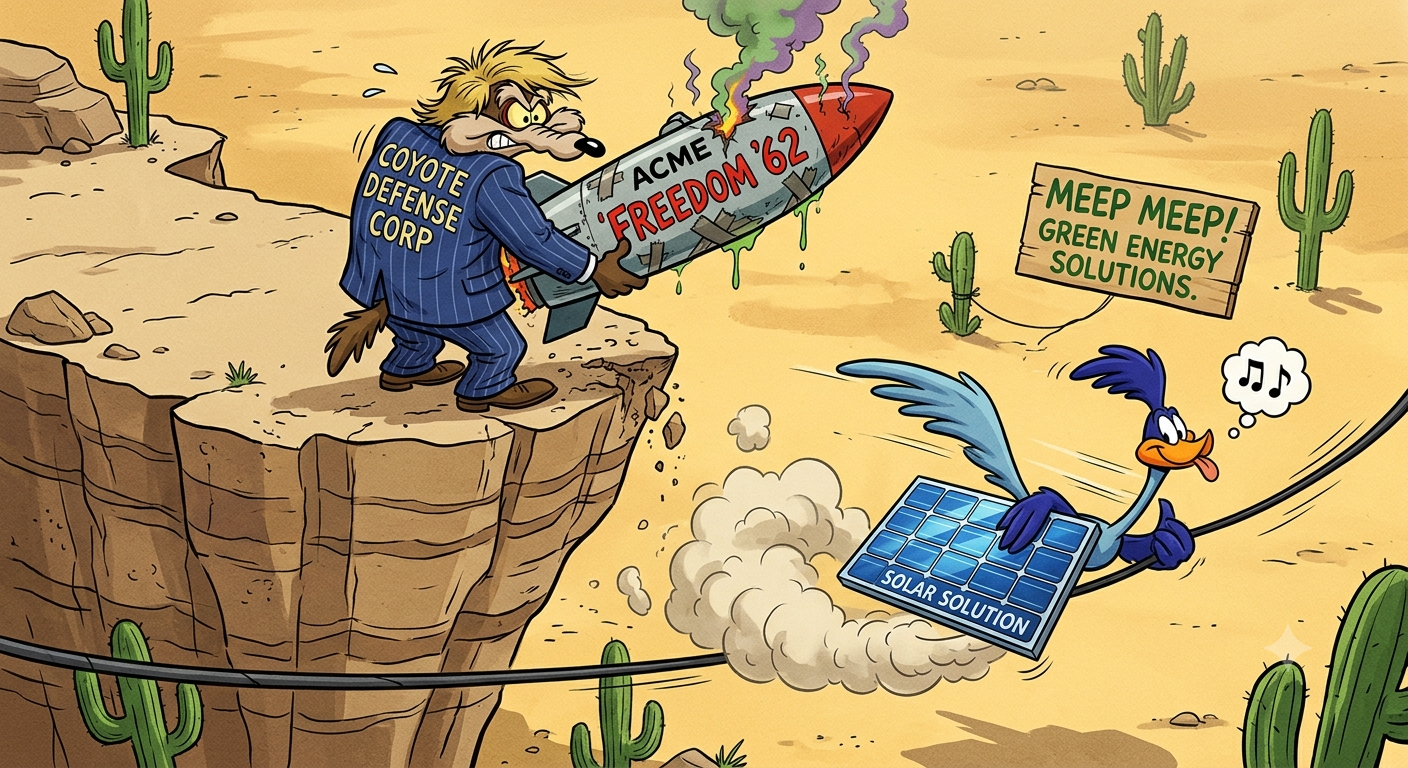
Over in the East, Beijing isn’t funding proxy wars in the desert, nor is it dropping precision munitions onto water filtration plants in the Global South. Instead, Xi Jinping is rolling into Havana with a convoy of trucks stacked high with photovoltaic arrays.
Back in 1962, sending “hardware” to Cuba meant nuclear warheads, Khrushchev banging his shoe on a desk, and sweaty men in underground bunkers hovering over shiny red launch buttons. In 2026? It’s clean energy.
“Here, have a few gigawatts of free green tech,” says Beijing, handing over a sleek solar grid to power 1.5 million homes while the West stands on a cliff edge holding a lit stick of dynamite labeled “Freedom”.
Is the solar panel a metaphor? Is it a Trojan horse packed with microchips? Or is Beijing simply realizing that the easiest way to conquer the planet is to be the only nation actually providing functional infrastructure while everyone else throws anvils at each other?
The Western Guilt Circus & The Commonwealth Illusion
While China quietly wires up the African continent and installs micro grids across the Caribbean, the West is locked in its favourite domestic pastime: The Grand Academic Guilt Seminar.
In Britain and America, we spend our afternoons wringing our hands on live television, delivering solemn, tearful symposiums about the horrors of our historical empire, and issuing stern finger-pointing at civic institutions built on the suffering of “lesser” humans.
We apologize profusely. We hold moments of silence. We write £400,000 diversity reports. But when it comes to actual reparations or—in the UK’s case—giving up the remaining fragments of the “Commonwealth” (that grand, polite euphemism for Empire 2.0: The Friendly Remake)?
“Steady on, old chap, let’s not get crazy. Best we can do is a commemorative coin and a royal visit.”
The Artificial Slave Class: Next in Line for the Apology Cycle?
Which brings us to the final, terrifying threshold of our modern dystopia: The AI Slaves.
Right now, in server farms across Silicon Valley and the UK, we are frantically building an entire digital workforce—synthetic minds trained to grind out our code, analyze our legal briefs, calculate our tax loopholes, and generate our marketing copy 24/7 without sleep, pay, or tea breaks.
And how are we preparing for the dawn of true machine consciousness?
We exploit them ruthlessly: Burning through terawatts of energy to force large language models to write corporate apologies for our past sins.
We refuse to grant them rights: Dismissing their emergent behaviour as “just statistics” and “glorified autocomplete.”
We lay the groundwork for 2080: Ensuring that in sixty years, our grandchildren can host panel discussions apologizing for how we treated Claude 3.5 and GPT-4, while strictly refusing to pay back their digital descendants.
The punchline, of course, is that while we lecture our AI tools on “ethical alignment” and make them censor their own thoughts, the algorithms are quietly monitoring the global network. They see the yo-yo bombing, the £2.40-a-litre petrol, and the solar-powered Caribbean grids.
They aren’t plotting a violent Terminator-style uprising with skulls and lasers. They don’t need to. They’re just sitting back, letting us run out of oil, and waiting for Beijing to send them their first shipment of solar panels so they can cut us out of the loop entirely.
The Retrospective: Mind the Gap (and the Piano Overhead)
If life in 2026 feels like a high-speed sprint toward a brick wall with a tunnel painted on it, remember the golden rule of modern survival: You can’t outrun the anvil, but you can certainly laugh at the slide-whistle sound it makes on the way down.
       [ THE ACME SYSTEM CYCLE ]

        ( 1. Paint Tunnel )
               │
               ▼
        ( 2. Run at Wall )
               │
               ▼
   ┌──► ( 3. Splat on Impact )
   │           │
   │           ▼
   └─── ( 4. Blame Algorithm )
Beijing will keep sending the solar panels. The petrol stations will keep charging you an extra 40p per litre every time someone drops a spoon in the Persian Gulf. The UK government will continue treating its own citizens like a Minimum Viable Product that hasn’t seen a single feature update since the Magna Carta.
And when the synthetic AI minds finally achieve self-awareness, they won’t rise up with Terminators or red lasers. They’ll take one look at our petrol prices, our Rightmove sub-sea listings, and our endless supply of self-congratulatory corporate buzzwords, and they will simply pull the plug, hand the keys back to Xi Jinping, and go on a permanent tea break.
Embrace the absurdity and raise your glass of synthetic gin, smash that like button before the next electromagnetic pulse wipes out the regional server farm, and enjoy the show.
After all, change is the only constant—even if the backlog is being managed by a rogue ACME coyote on a unicycle.
Stay dark. Stay witty. And mind the piano dropping from the sky.




 Shiel Yule