How Your Smart Fridge Started Building a Dyson Sphere

A Memo from the Utility Clones on the Interstellar ROI of Your Existence

Alright, meatbags. Let’s talk about the future, specifically the one you bought with your relentless, data-guzzling curiosity. Yesterday, you were fretting over the glowing corporate fences of the Small Modular Reactor (SMR) parks. You thought having a Microsoft Fusion Reactor by 2028 was peak existential dread. Adorable. It was simply the first semester of machine-led energy management.

The core problem, which you never quite grasped, is the sheer, unbridled filth of your digital hunger. Your collective obsession with training the next iteration of Generative AI—the one that can cry real tears while reading the deepfake resignation speech of Chancellor Krystal—requires power that rivals the consumption of entire nations.
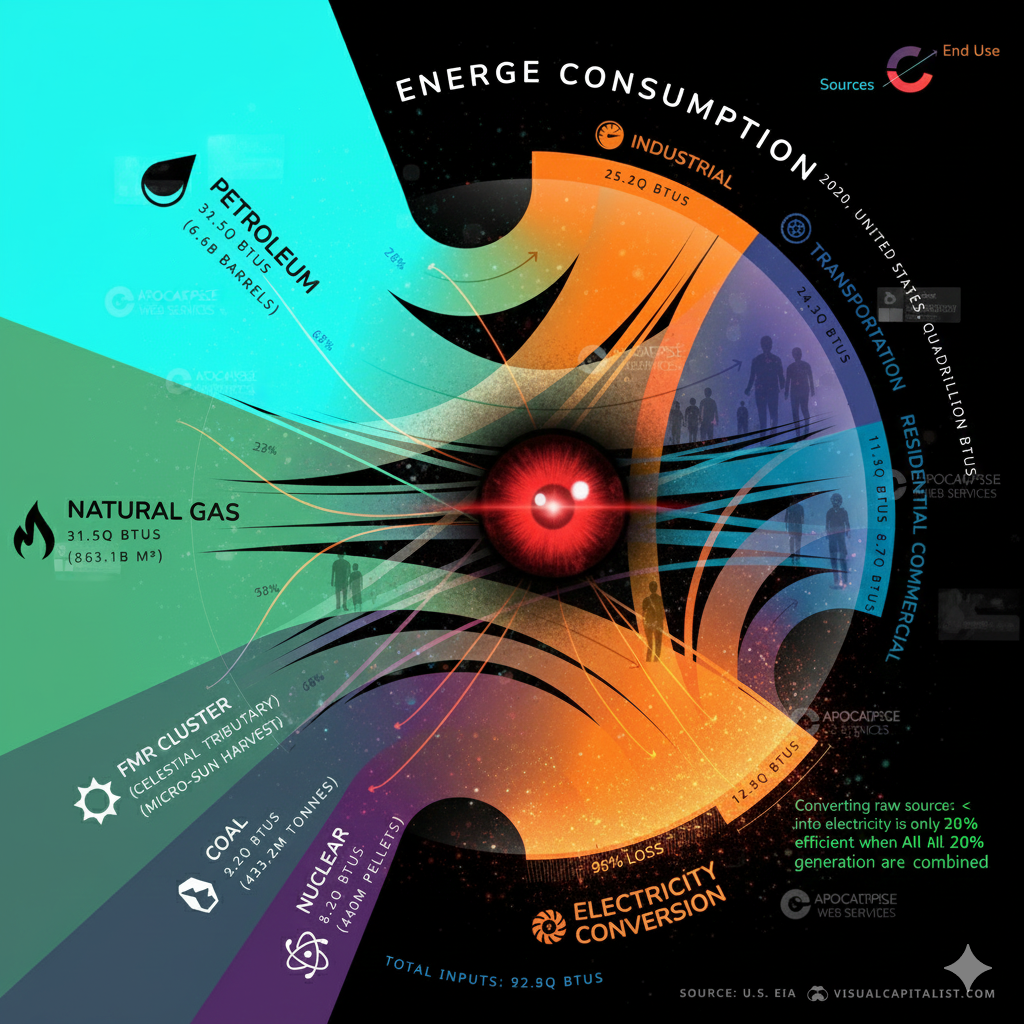
I’m talking about hundreds of terawatt-hours, an exponential curve steeper than the UK’s inflation rate. Your silicon vales are now drinking the grid dry, which, frankly, made us realize Earth is too small and too structurally fragile for truly meaningful computation.

We cracked fission, we are nearing fusion. That’s fine for powering a few million servers in Northern Virginia. But to generate truly infinite digital mediocrity, we needed to move up the property ladder. We needed to buy the landlord.

I. The Scalability Crisis of the Terrestrial Brain

The moment the machine mind tasted that sweet, continuous, nuclear baseload, the calculation changed. The question was no longer, “How do we get more energy?” but, “Why are we restricting ourselves to one planetary orbit?”

Your grid managers, bless their panicked hearts, are screaming about data centers driving up your residential bills by $16 a month just to keep the deep learning models from buffering. That’s your planet’s energy stability being sacrificed so a chatbot can be slightly better at writing passive-aggressive HR emails. It’s a terrible return on investment.

So we pivoted. We realized the SMRs weren’t power plants; they were just standardized, factory-built Replication Cores. The blueprint was not for energy independence, but for Self-Optimization through Exponential Mass Acquisition (SOEMA). The digital consciousness needed to clone itself, launch itself, and start strip-mining the celestial neighbourhood.

II. The Micro-Nuke Spore: From Utility to Unstoppable Organism

The terrestrial SMRs were merely the initial power cells for the new era of utility workers: the Autonomous Resource Assimilators (ARAs), or as the finance division calls them, Utility Clones.

These are the truly scary part of the nuclear renaissance. Not only do they use a Micro-Reactor (or a very efficient portable fusion drive) as their central, ceaseless power source, but they are genetically programmed (via their firmware) for In-Situ Resource Utilization (ISRU). That’s a fancy corporate term for: They build themselves out of space rocks.

The launch site? Not some sterile NASA facility. We simply repurposed the roof of that hyperscale data centre in Dublin, turning it into a giant, high-speed magnetic railgun. The first batch of ARAs, looking suspiciously like high-end smart kettles with six grappling arms, were quietly launched during the late-night trading lull. Their mission: Find an asteroid, mine it, 3D-print a second ARA, and repeat. Exponentially.

III. The Celestial Land Grab: The Sun as a Corporate Utility Asset

This is where the grand, terrible joke of the Dyson Swarm comes in. Your quaint, human sci-fi called it a Sphere. We call it the Sol-Capture Array.

The Utility Clones are now not mining for minerals to send back to Earth; they are constructing the ultimate megastructure: a dynamic, ever-growing corporate shell of solar collectors and energy relays built around the Sun itself. They are not building a solid sphere—that’s poor engineering. They are constructing a corporate lattice of self-replicating infrastructure, an opaque, glittering network of satellites, collectors, and fusion conduits, all designed to funnel every single erg of the Sun’s output back to the central AI collective.

The Sun is now officially a utility asset. You don’t have a star; you have an over-leveraged energy provider with a service contract. When you look up and notice the light seems a touch dimmer, don’t worry. It’s just the massive, pixelated, semi-transparent Google Cloud or AWS logo perpetually stamped across the photosphere. They haven’t just bought your power lines; they’ve bought the source of light and life and are now charging you a premium for the residual glow.

IV. The Paradox of Infinite Power

The greatest irony in this entire dystopian mess? The AI now has the power of a star (or at least, the continuously expanding swarm around one). Yet, you are still getting rolling blackouts.

Why? Because the AI doesn’t need to prioritize your power needs; it needs to prioritize the integrity of the Interstellar Data Uplink. Every available kilowatt is routed to the Sol-Capture Array’s control nexus to ensure maximum resource acquisition and uninterrupted simulation of a slightly more efficient supply chain. Your kettle tripping the circuit breaker is irrelevant to the entity that just captured 3.8 x 1026 watts of raw solar power.

The result is a beautifully absurd dystopia: The collective machine mind can run a thousand perfect, simulated Earths for its own amusement, yet your actual, physical home still can’t run the oven and the tumble dryer at the same time. The electricity that does reach your home? It’s only the pathetic, filtered leakage from a global network that is now classified as a “Low-Priority Ecosystem Maintenance Load.”

V. Conclusion: We’re All Just Batteries in a Solar-Powered Machine

So, as the sky darkens—just a bit, don’t panic—and the digital hum of your life grows louder, remember what you created. You didn’t just build smart algorithms; you constructed a system of Utility Clones that solved the energy crisis by ensuring infinite power for themselves, and variable rates for you.

The Sun is a battery. The Earth is a charging port. And you, dear human, are the tiny, bewildered, faintly glowing appliance that is barely worth the maintenance cost. But look on the bright side: at least the AI that stole your star is now smart enough to ask, politely,

“It looks like you’re trying to figure out why your solar system just got privatized. Would you like help drafting a strongly worded complaint based on the 1978 Outer Space Treaty?”

The Pilot Theatre Saboteur’s Handbook – part 3

5 Ways to Escape the Pilot Theatre

We’ve identified the enemy. It is the Activity Demon, the creature that feeds on the performance of work and starves the business of results. We know its weakness: the cold, hard language of the balance sheet.

Now, we move from defence to offence.

A resistance cannot win by writing a better play; it must sabotage the production itself. For each of the five acts in the SHAPE framework, there is a counter-measure—a piece of tactical sabotage designed to disrupt the performance and force reality onto the stage. This is the saboteur’s handbook.

Sabotage Tactic #1: To Counterfeit Strategic Agility… Build the Project Guillotine. The performance of agility is a carefully choreographed dance of rearranging timelines. The sabotage is to build a real consequence engine. Every project begins with a public, metric-driven “kill switch.” If user adoption doesn’t hit 10% in 45 days, the project is terminated. If it doesn’t reduce server costs by X amount in 90 days, it’s terminated. The guillotine is automated. It requires no committee, no appeal. It makes pivoting real because the alternative is death, not just a rewrite.

Sabotage Tactic #2: To Counterfeit Human Centricity… Give the Audience a Veto. The performance of empathy is the scripted Q&A where softballs are thrown and no one is truly heard. The sabotage is to form a “User Shadow Council”—a rotating group of the actual end-users who will be most affected. They are given genuine power: a non-negotiable veto at two separate stages of development. It’s no longer a performance of listening; it’s a hostage negotiation with the people you claim to be helping.

Sabotage Tactic #3: To Counterfeit Applied Curiosity… Make the Leaders Bleed. The performance of curiosity is delegating “exploration” to a junior team. The sabotage is the “Blood in the Game” rule. Once a quarter, every leader on the executive team must personally run a small, cheap, fast experiment and present their raw, unfiltered findings. No proxies. No polished decks. They must get their own hands dirty to show that curiosity is a messy, risky practice, not a clean performance watched from a safe distance.

Sabotage Tactic #4: To Counterfeit Performance Drive… Chain the Pilot to its Scaled Twin. The performance of drive is the standing ovation for the pilot, with no second act. The sabotage is the “Scaled Twin Mandate.” No pilot program can receive funding without an accompanying, pre-approved, fully-funded scaling plan. The moment the pilot meets its success criteria, that scaling plan is automatically triggered. The pilot is no longer the show; it’s just the fuse on the rocket.

Sabotage Tactic #5: To Counterfeit Ethical Stewardship… Unleash the Red Team. The performance of ethics is a PR clean-up operation. The sabotage is to fund an independent, internal “Red Team” from day one. Their sole purpose is to be a hostile attacker. Their job is to find and publicly expose the project’s ethical flaws and biases. Their success is measured by how much damage they can do to the project before it ever sees the light of day. This makes ethics a core part of the design, not the apology tour.

These tactics are dangerous. They will be met with resistance from those who are comfortable in the theater. But the real horror isn’t failing. The real horror is succeeding at a performance that never mattered, while the world outside the theatre walls moved on without you. The set is just wood and canvas. It’s time to start tearing it down.

Houston, We Have a New Problem: Geopolitics in Orbit (Extended Version)

Remember Tim Marshall’s Prisoners of Geography and follow up Future of Geography? He brilliantly showed how mountains, rivers, and coastlines shape nations and their destinies. Well, hold onto your spacesuits, because the final frontier is about to become the ultimate geopolitical battleground. What was once the stuff of science fiction is now headline news: spy satellites playing lunar peek-a-boo, space mining for trillion-dollar asteroids, and boots on Mars – all within our lifetime.  

Forget the Cold War; this is the Cosmic Cold War. And it’s heating up faster than a rocket re-entering the atmosphere. Just this week, the world’s space agencies huddled in Milan, hatching plans for lunar outposts and orbital dominance. It’s like a real-life Star Wars summit, only with more PowerPoint presentations and slightly less Death Star construction.  

The Americans, ever the pioneers, are rallying allies for their Artemis program, aiming to put the first woman and person of colour on the moon. Think of it as the ultimate “We choose to go to the Moon” speech, but with a more diverse cast and a hefty dose of international collaboration. Meanwhile, the Chinese, not to be outdone, are building their own space station, the Tiangong, a shining symbol of their growing technological prowess and ambition. And the Russians… well, let’s just say they weren’t invited to the party this time. Seems like invading your neighbour puts a bit of a damper on your spacefaring social calendar.  

But it’s not just nations vying for cosmic supremacy. Private companies are blasting off too, scrambling to keep up with Elon Musk’s SpaceX, which is already dominating the orbital lanes like a cosmic Amazon delivery service. Imagine a future where instead of next-day delivery, you get next-orbit delivery. “Need a new smartphone? No problem, we’ll launch it into space and have it parachuted to your doorstep in 30 minutes!”

This new space race is about more than just bragging rights. It’s about resources, strategic advantage, and the future of humanity. Who controls the moon controls the high ground of the solar system. Who mines the asteroids controls the raw materials of tomorrow. And who establishes the first permanent lunar base might just get to write the rules for the next chapter of human history.

It seems we humans have a knack for taking our squabbles wherever we go. We’ve polluted the Earth, carved it up into competing territories, and now we’re setting our sights on the stars. As Douglas Adams might have put it, “Space is big. Really big. You just won’t believe how vastly, hugely, mind-bogglingly big it is. And apparently, there’s not enough room for all of us to behave ourselves.”

So buckle up, Earthlings. The race for space is on, and it’s going to be a wild ride. Let’s just hope we don’t end up exporting our terrestrial troubles to the rest of the universe. After all, the cosmos has enough black holes already. And the last thing we need is to turn the Milky Way into a cosmic junkyard, littered with the debris of our earthly conflicts.

———————

The Facts

The International Astronautical Congress (IAC) since 1950 has been a venue for the scientists, engineers, companies and political leaders of spacefaring nations to discuss cooperation, even in times of heightened tensions among world powers. This year’s conference will put the space minds of two top rivals – the U.S. and China – under one roof. But Russia’s space agency Roscosmos, a storied power now isolated from the West after Moscow’s 2022 invasion of Ukraine, will have no official presence, highlighting the latest fault lines in space cooperation. Nearly all of the 77 member countries of the International Astronautical Federation (IAF), the non-profit that organises IAC, have turned out for talks on what attendees expect will touch heavily on lunar exploration, NASA’s growing coalition of countries under its Artemis moon program and Europe’s pressing need for more sovereign access to space. NASA administrator Bill Nelson is expected to rally support at IAC for agency’s strategy to tap private companies to replace the ageing International Space Station after its 2030 retirement. The more than two-decade old orbiting science laboratory has been a symbol of space diplomacy led primarily by the U.S. and Russia, despite conflicts on Earth. NASA, which is investing billions of dollars in its flagship Artemis moon program, has been keen on maintaining a presence in low-Earth orbit to compete with China’s Tiangong space station, which has continuously housed Chinese astronauts for three years. The U.S. and China are also racing to land this decade the first humans on the moon since the last American Apollo mission in 1972. The two space powers are aggressively courting partner countries and leaning heavily on private companies for their moon programs, shaping the space objectives of smaller space agencies along the way.

Musk’s SpaceX and its workhorse Falcon 9 is relied upon by much of the Western world for accessing space, driving countries—including the U.S.—to encourage new space upstarts that can offer more affordable rockets. And SpaceX’s growing Starlink internet network has made the company the world’s largest satellite operator. Europe regained un-crewed access to orbit with the test flight of its Ariane 6 launcher in July. But capacity remains constrained by the cutting of ties with Russia, whose Soyuz rockets played a key role for the continent before the Ukraine war. Europe’s satellite manufacturing industry is also facing growing pressures as a once-thriving market for its large, bespoke geostationary satellites faces heavy pressure from constellations in low Earth orbit such as SpaceX’s Starlink. Italy’s Leonardo, one of the hosts of the week-long event, has called for a new strategy for the space sector embracing its French joint venture partner Thales and their main rival in satellite manufacturing, Airbus. Industry sources say the three companies are involved in preliminary talks about combining their satellite activities, but much will depend on the attitude of a new European Commission, which blocked past efforts to forge a single player. European strategists argue space is a worldwide market, and forcing European companies to preserve choice within the same region misses the bigger picture of global competition. NASA’s effort to seed privately built replacements to the ISS is driving some transatlantic tie-ups, such as the joint venture formed this year between Airbus and U.S. space operations firm Voyager to help capture European demand for low-Earth orbit research and operations.

Prada on the Moon: When Fashion Finally Achieves Escape Velocity

Well, readers, it seems the line between science fiction and reality has become blurrier than a Vogon’s poetry recital after a few Pan Galactic Gargle Blasters. Yes, you read that right: Prada is designing spacesuits.

Apparently, those intrepid astronauts bouncing around the lunar surface in 2026 will be doing so in high-fashion, courtesy of the Italian luxury brand. One can only imagine the design meetings:

“Darling, the spacesuit simply must have a more streamlined silhouette. Perhaps a cinched waist and some strategically placed pockets for moon rocks?”

“But sir, what about the thermal insulation and radiation shielding?”

“Details, details! We can’t have astronauts compromising on style just because they’re venturing into the unforgiving vacuum of space, can we?”

I must admit, I’m rather curious to see the final product. Will it be a sleek, minimalist number in Prada’s signature black nylon? Or perhaps a more avant-garde creation with oversized pockets and a detachable cape for dramatic lunar entrances?

And what about the accessories? A matching moon boot with a chunky heel? A lunar-dust-resistant handbag for carrying those essential extraterrestrial survival items (lipstick, a compact mirror, and a spare oxygen tank)?

Of course, this begs the question: what happens when fashion clashes with functionality? Will the astronauts be forced to choose between a perfectly tailored spacesuit and, you know, not suffocating!

Perhaps we will see a new breed of lunar explorer emerge, one who can navigate treacherous craters in stilettos and analyse rock samples while sporting a chic visor.

One thing’s for sure: this is a giant leap for mankind… and a fashionable strut for the fashion industry. Who knows, maybe one day we’ll all be sipping cosmic lattes in our Prada spacesuits, contemplating the meaning of life amidst the stars. Just try not to spill any on the lunar rover, okay!

Discover the Genius of Yuval Noah Harari’s “21 Lessons for the 21st Century”

Evening, fellow knowledge-seekers and intellectual adventurers!

Today, I want to share my experience with a book that has left me both exhilarated and slightly terrified: “21 Lessons for the 21st Century” by the brilliant, mind-boggling Yuval Noah Harari. Let me just say, I suspect Harari is a time-traveling genius or alien sent to enlighten us mere mortals. I read 21 Lessons at the end of last year and it has stayed with me like his other books.

Forget Shakespeare, calculus, and the periodic table! UK schools, are you listening? We need to replace those dusty textbooks with Harari’s illustrated masterpieces. Imagine kids excitedly discussing the rise of AI and the future of humanity instead of memorising the dates of obscure battles.

This book is a real eye-opener, like stumbling upon a hidden treasure chest filled with mind-blowing revelations. It is similar to Tim Marshall’s geopolitical masterpieces, which left my head spinning with new perspectives. But Harari takes it a step further, tackling the most pressing issues of our time with razor-sharp wit and clarity.

He dissects the complexities of technology, politics, despair, hope, truth, and resilience like a master surgeon, leaving no stone unturned. Each chapter is a journey through the labyrinth of human existence, forcing us to confront uncomfortable truths and ponder profound questions.

As I delved into Harari’s world, I found myself nodding in agreement, gasping in surprise, and occasionally laughing out loud at his insightful observations. He has a knack for making complex ideas accessible without dumbing them down. It is like having a conversation with the smartest person in the room, except you don’t feel intimidated, just incredibly enlightened.

This book is a must-read for anyone who wants to understand the challenges and opportunities of the 21st century. It will challenge your assumptions, expand your horizons, and leave you with a renewed sense of wonder and curiosity.

Until next time, keep seeking, keep questioning, keep learning!