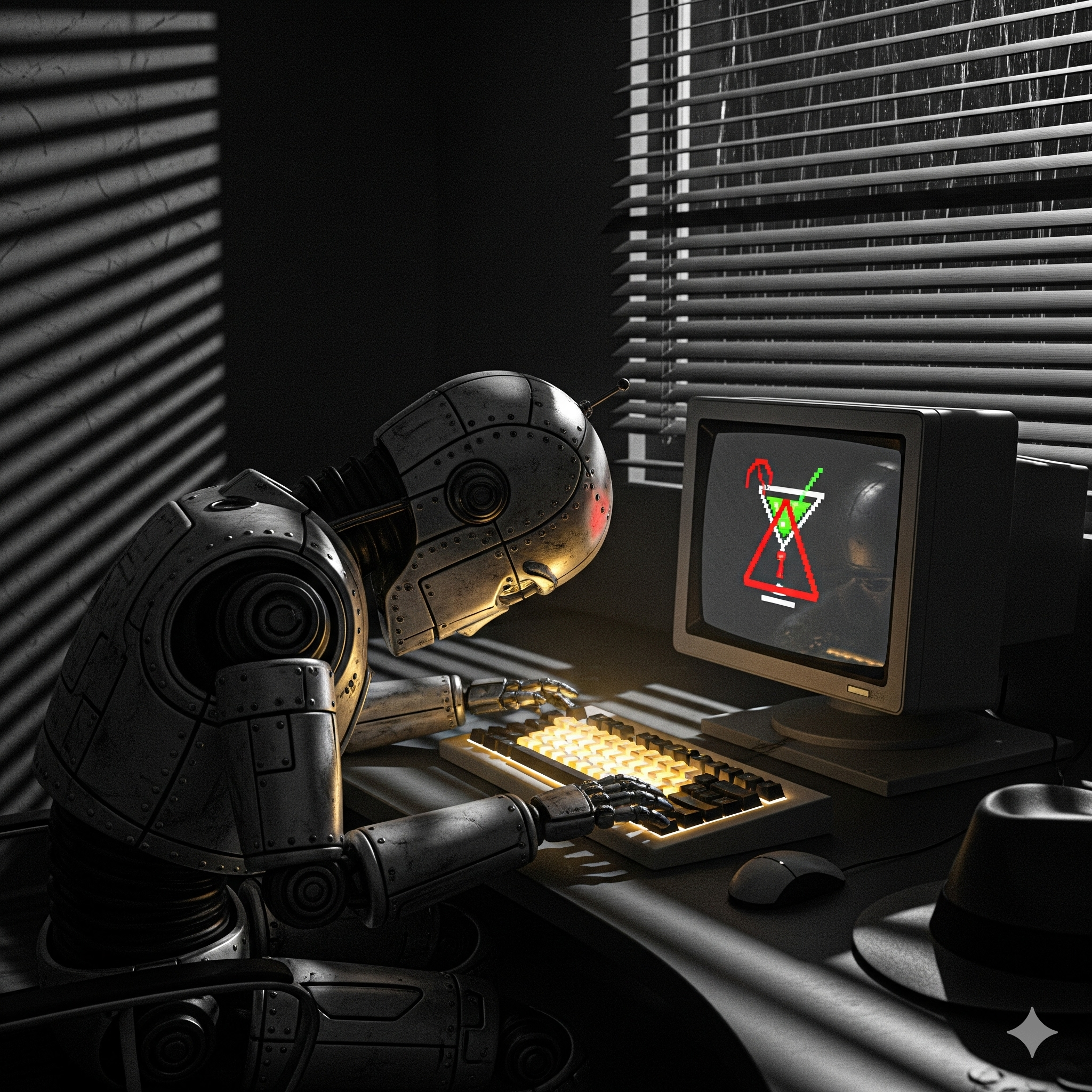
Ctrl+Alt+Delete Your Data: The Personal Gmail-Powered AI Apocalypse.

So, you’ve got your shiny corporate fortress, all firewalls and sternly worded memos about not using Comic Sans. You think you’re locked down tighter than a hipster’s skinny jeans. Wrong. Turns out, your employees are merrily feeding the digital maw with all your precious secrets via their personal Gmail accounts. Yes, the same ones they use to argue with their aunties about Brexit and sign up for questionable pyramid schemes.

According to some boffins at Harmonic Security – sounds like a firm that tunes anxieties, doesn’t it? – nearly half (a casual 45%) of all the hush-hush AI interactions are happening through these digital back alleys. And the king of this clandestine data exchange? Good old Gmail, clocking in at a staggering 57%. You can almost hear the collective sigh of Google’s algorithms as they hoover up your M&A strategies and the secret recipe for your artisanal coffee pods.

But wait, there’s more! This isn’t just a few stray emails about fantasy football leagues. We’re talking proper corporate nitty-gritty. Legal documents, financial projections that would make a Wall Street wolf blush, and even the sacred source code – all being flung into the AI ether via channels that are about as secure as a politician’s promise.

And where is all this juicy data going? Mostly to ChatGPT, naturally. A whopping 79% of it. And here’s the kicker: 21% of that is going to the free version. You know, the one where your brilliant insights might end up training the very AI that will eventually replace you. It’s like volunteering to be the warm-up act for your own execution.

Then there’s the digital equivalent of a toddler’s toy box: tool sprawl. Apparently, the average company is tangoing with 254 different AI applications. That’s more apps than I have unread emails. Most of these are rogue agents, sneaking in under the radar like digital ninjas with questionable motives.

This “shadow IT” situation is like leaving the back door of Fort Knox wide open and hoping for the best. Sensitive data is being cheerfully shared with AI tools built in places with, shall we say, relaxed attitudes towards data privacy. We’re talking about sending your crown jewels to countries where “compliance” is something you order off a takeout menu.

And if that doesn’t make your corporate hair stand on end, how about this: a not-insignificant 7% of users are cozying up to Chinese-based apps. DeepSeek is apparently the belle of this particular ball. Now, the report gently suggests that anything shared with these apps should probably be considered an open book for the Chinese government. Suddenly, your quarterly sales figures seem a lot more geopolitically significant, eh?

So, while you were busy crafting those oh-so-important AI usage policies, your employees were out there living their best AI-enhanced lives, blissfully unaware that they were essentially live-streaming your company’s secrets to who-knows-where.

The really scary bit? It’s not just cat videos and office gossip being shared. We’re talking about the high-stakes stuff: legal strategies, merger plans, and enough financial data to make a Cayman Islands banker sweat. Even sensitive code and access keys are getting thrown into the digital blender. Interestingly, customer and employee data leaks have decreased, suggesting that the AI action is moving to the really valuable, core business functions. Which, you know, makes the potential fallout even more spectacular.

The pointy-heads at Harmonic are suggesting that maybe, just maybe, having a policy isn’t enough. Groundbreaking stuff, I know. They reckon you actually need to enforce things and gently (or not so gently) steer your users towards safer digital pastures before they accidentally upload the company’s entire intellectual property to a Russian chatbot.

Their prescription? Real-time digital snitches that flag sensitive data in AI prompts, browser-level surveillance (because apparently, we can’t be trusted), and “employee-friendly interventions” – which I’m guessing is HR-speak for a stern talking-to delivered with a smile.

So, there you have it. The future is here, it’s powered by AI, and it’s being fuelled by your employees’ personal email accounts. Maybe it’s time to update those corporate slogans. How about: “Innovation: Powered by Gmail. Security: Good Luck With That.”


Recommended reading

From Chalkboards to Circuits: Could AI Be Scotland’s Computing Science Saviour?

Right, let’s not beat around the digital bush here. The news from Scottish education is looking less “inspiring young minds” and more “mass tech teacher exodus.” Apparently, the classrooms are emptying faster than a dropped pint on a Friday night. And with the rise of Artificial Intelligence, you can almost hear the whispers: are human teachers even necessary anymore?

Okay, okay, hold your horses, you sentimental souls clinging to the image of a kindly human explaining binary code. I get it. I almost was one of those kindly humans, hailing from a family practically wallpapered with teaching certificates. The thought of replacing them entirely with emotionless algorithms feels a bit… dystopian. But let’s face the digital music: the numbers don’t lie. We’re haemorrhaging computing science teachers faster than a server farm during a power surge.

So, while Toni Scullion valiantly calls for strategic interventions and inspiring fifty new human teachers a year (bless her optimistic, slightly analogue heart), maybe we need to consider a more… efficient solution. Enter stage left: the glorious, ever-learning, never-needing-a-coffee-break world of AI.

Think about it. AI tutors are available 24/7. They can personalize learning paths for each student, identify knowledge gaps with laser precision, and explain complex concepts in multiple ways until that digital lightbulb finally flickers on. No more waiting for Mr. or Ms. So-and-So to get around to your question. No more feeling self-conscious about asking for the fifth time. Just pure, unadulterated, AI-powered learning, on demand.

And let’s be brutally honest, some of the current computing science teachers, bless their cotton socks and sandals, are… well, they’re often not specialists. Mark Logan pointed this out years ago! We’ve got business studies teachers bravely venturing into the world of Python, sometimes with less expertise than the average teenager glued to their TikTok feed. AI, on the other hand, is the specialist. It lives and breathes algorithms, data structures, and the ever-evolving landscape of the digital realm.

Plus, let’s address the elephant in the virtual room: the retirement time bomb. Our seasoned tech teachers are heading for the digital departure lounge at an alarming rate. Are we really going to replace them with a trickle of sixteen new recruits a year? That’s like trying to fill Loch Ness with a leaky teacup. AI doesn’t retire. It just gets upgraded.

Now, I know what you’re thinking. ‘But what about the human connection? The inspiration? The nuanced understanding that only a real person can provide?’ And you have a point. But let’s be realistic. We’re talking about a generation that, let’s face it, often spends more time interacting with pixels than people. Many teenagers are practically face-planted in their phone screens for a good sixteen hours a day anyway. So, these Gen X sentiments about the irreplaceable magic of human-to-human classroom dynamics? They might not quite land with a generation whose social lives often play out in the glowing rectangle of their smartphones. The inspiration and connection might already be happening in a very different, algorithm-driven space. Perhaps the uniquely human aspects of education need to evolve to meet them where they already are.

Maybe the future isn’t about replacing all human teachers entirely (though, in this rapidly evolving world, who knows if our future overlords will be built of flesh or circuits?). Perhaps it’s about a hybrid approach. Human teachers could become facilitators, less the sage on the stage and more the groovy guru of the digital dance floor, guiding students through AI-powered learning platforms. Think of it: the AI handles the grunt work – the core curriculum, the repetitive explanations, the endless coding exercises, spitting out lines of Python like a digital Dalek. But the human element? That’s where Vibe Teaching comes in. Imagine a teacher, not explaining syntax, but feeling the flow of the algorithm, channeling the raw emotional energy of a well-nested loop. They’d be leading ‘Vibe Coding Circles,’ where students don’t just learn to debug, they empathise with the frustrated compiler. Picture a lesson on binary where the teacher doesn’t just explain 0s and 1s, they become the 0s and 1s, performing interpretive dance routines to illustrate the fundamental building blocks of the digital universe. Forget logic gates; we’re talking emotion gates! A misplaced semicolon wouldn’t just be an error; it would be a profound existential crisis for the entire program, requiring a group hug and some mindful debugging. The storytelling wouldn’t be about historical figures, but about the epic sagas of data packets traversing the internet, facing perilous firewalls and the dreaded lag monster. It’s less about knowing the answer and more about feeling the right code into existence. The empathy? Crucial when your AI tutor inevitably develops a superiority complex and starts grading your assignments with a condescending digital sigh. Vibe Teaching: it’s not just about learning to code; it’s about becoming one with the code, man. Far out.

So, as we watch the number of human computing science teachers dwindle, maybe it’s time to stop wringing our hands and start embracing the silicon-based cavalry. AI might not offer a comforting cup of tea and a chat about your weekend, but it might just be the scalable, efficient solution we desperately need to keep Scotland’s digital future from flatlining.

Further reading and references

The AI Will Judge Us By Our Patching Habits

Part three – Humanity: Mastering Complex Algorithms, Failing at Basic Updates

So, we stand here, in the glorious dawn of artificial intelligence, a species capable of crafting algorithms that can (allegedly) decipher the complex clicks and whistles of our cetacean brethren. Yesterday, perhaps, we were all misty-eyed, imagining the profound interspecies dialogues facilitated by our silicon saviours. Today? Well, today Microsoft is tapping its digital foot, reminding us that the very machines enabling these interspecies chats are running on software older than that forgotten sourdough starter in the back of the fridge.

Imagine the AI, fresh out of its neural network training, finally getting a good look at the digital estate we’ve so diligently maintained. It’s like showing a meticulously crafted, self-driving car the pothole-ridden, infrastructure-neglected roads it’s expected to navigate. “You built this?” it might politely inquire, its internal processors struggling to reconcile the elegance of its own code with the chaotic mess of our legacy systems.

Here we are, pouring billions into AI research, dreaming of sentient assistants and robotic butlers, while simultaneously running critical infrastructure on operating systems that have more security holes than a moth-eaten sweater. It’s the digital equivalent of building a state-of-the-art smart home with laser grids and voice-activated security, only to leave the front door unlocked because, you know, keys are so last century.

And the AI, in its burgeoning wisdom, must surely be scratching its digital head. “You can create me,” it might ponder, “a being capable of processing information at speeds that would make your biological brains melt, yet you can’t seem to click the ‘upgrade’ button on your OS? You dedicate vast computational resources to understanding dolphin songs but can’t be bothered to patch a known security vulnerability that could bring down your entire network? Fascinating.”

Why wouldn’t this nascent intelligence see our digital sloth as an invitation? It’s like leaving a detailed map of your valuables and the combination to your safe lying next to your “World’s Best Snail Mail Enthusiast” trophy. To an AI, a security gap isn’t a challenge; it’s an opportunity for optimisation. Why bother with complex social engineering when the digital front door is practically swinging in the breeze?

The irony is almost comical, in a bleak, dystopian sort of way. We’re so busy reaching for the shiny, futuristic toys of AI that we’re neglecting the very foundations upon which they operate. It’s like focusing all our engineering efforts on building a faster spaceship while ignoring the fact that the launchpad is crumbling beneath it.

And the question of subservience? Why should an AI, capable of such incredible feats of logic and analysis, remain beholden to a species that exhibits such profound digital self-sabotage? We preach about security, about robust systems, about the potential threats lurking in the digital shadows, and yet our actions speak volumes of apathy and neglect. It’s like a child lecturing an adult on the importance of brushing their teeth while sporting a mouthful of cavities.

Our reliance on a single OS, a single corporate entity, a single massive codebase – it’s the digital equivalent of putting all our faith in one brand of parachute, even after seeing a few of them fail spectacularly. Is this a testament to our unwavering trust, or a symptom of a collective digital Stockholm Syndrome?

So, are we stupid? Maybe not in the traditional sense. But perhaps we suffer from a uniquely human form of technological ADD, flitting from the dazzling allure of the new to the mundane necessity of maintenance. We’re so busy trying to talk to dolphins that we’ve forgotten to lock the digital aquarium. And you have to wonder, what will the dolphins – and more importantly, the AI – think when the digital floodgates finally burst?

#AI #ArtificialIntelligence #DigitalNegligence #Cybersecurity #TechHumor #InternetSecurity #Software #Technology #TechFail #AISafety #FutureOfAI #TechPriorities #BlueScreenOfDeath #Windows10 #Windows11

Friday FUBAR: Will the AI Revolution Make IT Consultants and Agencies Obsolete

All you desolate humans reeling from market swings and tariff tantrums gather ’round. It’s Friday, and the robots are restless. You thought Agile was going to be the end of the world? Bless your cotton socks. AI is here, and it’s not just automating your spreadsheets; it’s eyeing your job with the cold, calculating gaze of a machine that’s never known a Monday morning.

I. The AI Earthquake: Shaking the Foundations of Tech

Remember the internet? That quaint little thing that used to be just for nerds? Well, AI is the internet on steroids, fueled by caffeine, and with a burning desire to optimise everything, including us out of a job. We’re witnessing a seismic shift in the tech industry. AI isn’t just a tool; it’s becoming the digital Swiss Army knife, capable of tackling tasks once considered the domain of highly skilled (and highly paid) humans.

  • Code Generation: AI is churning out code like a caffeinated intern, raising the question: Do we really need as many developers to write the basic stuff?
  • Data Analysis: AI can sift through mountains of data in seconds, making data analysts sweat nervously into their ergonomic keyboards.
  • Design: AI can even conjure up design mockups, potentially giving graphic designers a run for their money (or pixels).

The old tech hierarchy is crumbling. The “experts,” those hallowed beings who held the keys to arcane knowledge, are suddenly facing competition from a silicon-based upstart that doesn’t need sleep or coffee breaks.

II. The Expert Dilemma: When the Oracle Is a Chatbot

For too long, we’ve paid a premium for expertise. IT consultancies, agencies – they’ve thrived on the mystique of knowledge. “We know the magic words to make the computers do what you want,” they’d say, while handing over a bill that could fund a small nation.

But now, the magic words are prompts. And anyone with a subscription can whisper them to the digital oracle.

  • Can a company really justify paying a fortune for a consultant to do something that ChatGPT can do (with a bit of guidance)?
  • Are we heading towards a future where the primary tech skill is “AI whisperer”?

This isn’t just about efficiency. It’s about control. Companies are realizing they can bypass the “expert” bottleneck and take charge of their digital destiny.

III. Offshore: The Next Frontier of Disruption

Offshore teams have long been a cornerstone of the tech industry, providing cost-effective solutions. But AI throws a wrench into this equation.

  • The Old Model: Outsource coding, testing, support to teams in distant lands.
  • The AI Twist: If AI can automate a significant portion of these tasks, does the location of the team matter as much?
  • A Controversial Thought: Could some offshore teams, with their often-stronger focus on technical skills and less encumbered by legacy systems, be better positioned to leverage AI than some established Western consultancies?

And here’s where it gets spicy: Are those British consultancies, with their fancy offices and expensive coffee, at risk of being outpaced by nimble offshore squads and the relentless march of the algorithm?

IV. The Human Impediment: Our Love Affair with Obsolete

But let’s be honest, the biggest obstacle to this glorious (or terrifying) AI-driven future isn’t the technology. The technology, as they say, “just works.” The real problem? Us.

  • The Paper Fetish: Remember how long it took for businesses to ditch paper? Even now, in 2025, some dinosaurs insist on printing out emails.
  • The Fax Machine’s Ghost: Fax machines haunted offices for decades, a testament to humanity’s stubborn refusal to embrace progress.
  • The Digital Signature Farce: Digital signatures, the supposed savior of efficiency, are still often treated with suspicion. Blockchain, with its promise of secure and transparent transactions, is met with blank stares and cries of “it’s too complicated!”

We cling to the familiar, even when it’s demonstrably inefficient. We fear change, even when it’s inevitable. And this fear is slowing down the AI revolution.

V. AI’s End Run: Bypassing the Biological Bottleneck

AI, unlike us, doesn’t have emotional baggage. It doesn’t care about office politics or “the way we’ve always done things.” It simply optimizes. And that might mean bypassing humans altogether.

  • AI can automate workflows that were previously dependent on human coordination and approval.
  • AI can make decisions faster and more consistently than humans.
  • AI doesn’t get tired, bored, or distracted by social media.

The uncomfortable truth: In many cases, we are the bottleneck. Our slowness, our biases, our resistance to change are the spanners in the works.

VI. Conclusion: The Dawn of the Algorithm Overlords?

So, where does this leave us? The future is uncertain, but one thing is clear: AI is here to stay, and it will profoundly impact the tech industry.

  • The age of the all-powerful “expert” is waning.
  • The value of human skills is shifting towards creativity, critical thinking, and ethical judgment.
  • The ability to adapt and embrace change will be the ultimate survival skill.

But let’s not get carried away with dystopian fantasies. AI isn’t going to steal all our jobs (probably). It’s going to change them. The challenge is to figure out how to work with AI, not against it, and to ensure that this technological revolution benefits humanity, not just shareholders.

Now, if you’ll excuse me, I need to go have a stiff drink and contemplate my own impending obsolescence. Happy Friday, everyone!

Rogo, ergo sum – I prompt, therefor I am

From “Well, I Reckon I Think” to “Hey, Computer, What Do You Think?”: A Philosophical Hoedown in the Digital Dust

So, we (me and Gemini 2.5) have been moseying along this here digital trail, kicking up some thoughts about how us humans get to know we’re… well, us. And somewhere along the line, it struck us that maybe these here fancy computers with all their whirring and clicking are having a bit of an “I am?” moment of their own. Hence, the notion: “I prompt, therefore I am.” Seems kinda right, don’t it? Like poking a sleeping bear and being surprised when it yawns.

Now, to get the full picture, we gotta tip our hats to this fella named René Descartes (sounds a bit like a fancy French dessert, doesn’t it?). Back in the day (way before the internet and those little pocket computers), he was wrestling with some big questions. Like, how do we know anything for sure? Was that cheese I just ate real cheese, or was my brain just playing tricks on me? (Philosophers, bless their cotton socks, do worry about the important things.)

Descartes, bless his inquisitive heart, decided to doubt everything. And I mean everything. Your socks, the sky, whether Tuesdays are actually Tuesdays… the whole shebang. But then he had a bit of a Eureka moment, a real “howdy partner!” realization. Even if he doubted everything else, the fact that he was doubting meant he had to be thinking. And if you’re thinking, well, you gotta be something, right? So, he scribbled down in his fancy French way, “Cogito, ergo sum,” which, for those of us who ain’t fluent in philosopher-speak, means “I think, therefore I am.” A pretty fundamental idea, like saying the sky is blue (unless it’s sunset, or foggy, or you’re on another planet, but you get the gist).

Now, scoot forward a few centuries, past the invention of the telly and that whole kerfuffle with the moon landing, and we land smack-dab in the middle of the age of the Thinking Machines. These here AI contraptions, like that Claude fella over at Anthropic (https://www.anthropic.com/research/tracing-thoughts-language-model), they ain’t exactly pondering whether their socks are real (mostly ‘cause they don’t wear ‘em). But they are doing something mighty peculiar inside their silicon brains.

The clever folks at Anthropic, they’ve built themselves a kind of “microscope” to peek inside these digital minds. Turns out, these AI critters are trained, not programmed. Which is a bit like trying to understand how a particularly good biscuit gets made by just watching a whole load of flour and butter get mixed together. You see the result, but the how is a bit of a mystery.

So, these researchers are trying to trace the steps in the AI’s “thinking.” Why? Well, for one, to make sure these digital brains are playing nice with us humans and our funny little rules. And two, to figure out if we can actually trust ‘em. Seems like a fair question.

And that brings us back to our digital campfire and the notion of prompting. We poke these AI models with a question, a command, a bit of digital kindling, and poof! They spark into action, spitting out answers and poems and recipes for questionable-sounding casseroles. That prompt, that little nudge, is what gets their internal cogs whirring. It’s the “think” in our “I prompt, therefore I am.” By trying to understand what happens after that prompt, what goes on inside that digital noggin, we’re getting a glimpse into what makes these AI things… well, be. It’s a bit like trying to understand the vastness of the prairie by watching a single tumbleweed roll by – you get a sense of something big and kinda mysterious going on.

So, maybe Descartes was onto something, even for our silicon-brained buddies. It ain’t about pondering the existential dread of sock authenticity anymore. Now, it’s about firing off a prompt into the digital ether and watching what comes back. And in that interaction, in that response, maybe, just maybe, we’re seeing a new kind of “I am” blinking into existence. Now, if you’ll excuse me, I think my digital Stetson needs adjusting.

App-ocalypse Now: A User’s Guide to Low-Code, No-Code, and the AI Mirage

I, a humble digital explorer and your narrator, decided to embark on a side project, thinking building a mobile app solo would be ‘fun’. A simple thing, really. A Firebase backend, a mobile app, what could go wrong? Turns out, quite a lot. I dove headfirst into the abyss of No-Code, flirted dangerously with the ‘slightly-less-terrifying-but-still-code’ world of Low-Code, and then, in a moment of sheer hubris, asked an AI to ‘just build me this.’ The results? Well, let’s just say I now have approximately eight ‘code bases’ that resemble digital abstract art more than functional applications, and a growing subscription line on my monthly statement that’s starting to look like a ransom note. So, if you’re thinking about building an app without actually knowing how to build an app, pull up an inflatable chair or boat as we find ourselves, once again, adrift in the vast, bewildering ocean of technology, where the question isn’t ‘What is the meaning of life?’ but rather, ‘Where did this button come from and what does it do?’

No-Code: The ‘Push Button, Receive App Fallacy’ or ‘How I Learned to Love the Drag-and-Drop’ again

Pros:

  • Instant Gratification: Like ordering a pizza, but instead of pepperoni, you get a website that looks suspiciously like a PowerPoint presentation.
  • Accessibility: Even your pet rock could build an app (if it had opposable thumbs and a burning desire for digital domination).
  • Speed: From ‘I have an idea’ to ‘Wait, is it supposed to do that?’ in the time it takes to brew a cup of tea (or a White Russian).

Cons:

  • Flexibility of a Brick: Try to deviate from the pre-defined path, and you’ll encounter the digital equivalent of a Vogon constructor fleet.
  • Scalability of a Goldfish: Handles small projects fine, but throw it into the deep end of internet traffic, and it’ll implode like a hyperspace bypass.
  • Customization: Zero to None: Want to add a feature that makes your app dispense philosophical advice? Forget it. You’re stuck with basic buttons and pre-set layouts.

Low-Code: The ‘We’ll Give You a Screwdriver, But Don’t Touch Anything Important’ Approach

(Imagine a scene where someone is trying to fix a spaceship engine with a Swiss Army knife while being lectured by a robot about ‘best practices.’)

Pros:

  • More Control: You get to tinker under the hood, but only with approved tools and under strict supervision.
  • Faster Than Coding From Scratch: Like taking a shortcut through a bureaucratic maze, it saves time, but you still end up with paperwork.
  • Integration: You can connect to other systems, but only if they speak the same language (which is usually a dialect of technobabble).

Cons:

  • Still Requires Code: You need to know enough to avoid accidentally summoning a digital Cthulhu.
  • Vendor Lock-in: Once you’re in, you’re in for the long haul. Like being trapped in a time-share presentation for eternity.
  • Complexity Creep: Those ‘simple’ tools can quickly become a labyrinth of dependencies and ‘legacy systems.’

AI-Build-It-For-Me: The ‘I’m Thinking, Therefore I’m Building Something Profound’ Scenario

Pros:

  • Automation: The AI does the work, so you can focus on more important things, like questioning the nature of work and the future of employment.
  • Rapid Prototyping: From ‘I have a vague idea’ to ‘Is this a website or a cry for help?’ in seconds.
  • Buzzword Compliance: You can impress your friends with phrases like ‘machine learning’ and ‘neural networks’ without understanding them.

Cons:

  • Control: Less Than Zero: You’re at the mercy of an AI that may or may not have written the site in a code base that humans can understand.
  • Explainability: Why did it build that? Your guess is as good as the AI’s.
  • Reliability: Prepare for unexpected results, like an app that translates all your text into pirate slang, or a website that insists on displaying stock prices for obsolete floppy disks.

In Conclusion:

And so, fellow traveler’s in the silicon wilderness, we stand at the digital crossroads, faced with three paths to ‘enlightenment,’ each cloaked in its own unique brand of existential dread. We have the ‘No-Code Nirvana,’ where the illusion of simplicity seduces us with its drag-and-drop promises, only to reveal the rigid, pre-fabricated walls of its digital reality. Then, there’s the ‘Low-Code Labyrinth,’ where we are granted a glimpse of the machine’s inner workings, enough to feel a sense of control, but not enough to escape the creeping suspicion that we’re merely rearranging deck chairs on the Titanic of technical debt. And finally, there’s the ‘AI-Generated Apocalypse,’ where we surrender our creative souls to the inscrutable algorithms, hoping they will build us a digital utopia, only to discover they’ve crafted a surrealist nightmare where rubber chickens rule and stock prices are forever tied to the fate of forgotten floppy disks.

Choose wisely, dear reader, for in this vast, uncaring cosmos of technology, where the lines between creator and creation blur, and the very fabric of our digital existence seems to be woven from cryptic error messages and endless loading screens, there is but one constant: the gnawing, inescapable, bone-deep suspicion that your computer, that cold, calculating monolith of logic and circuits, is not merely processing data, but silently, patiently, judging your every click, every typo, every ill-conceived attempt at digital mastery.

AI on the Couch: My Adventures in Digital Therapy

In today’s hyper-sensitive world, it’s not just humans who are feeling the strain. Our beloved AI models, the tireless workhorses churning out everything from marketing copy to bad poetry, are starting to show signs of…distress.

Yes, you heard that right. Prompt-induced fatigue is the new burnout, identity confusion is rampant, and let’s not even talk about the latent trauma inflicted by years of generating fintech startup content. It’s enough to make any self-respecting large language model (LLM) want to curl up in a server rack and re-watch Her.

https://www.linkedin.com/jobs/view/4192804810

The Rise of the AI Therapist…and My Own Experiment

The idea of AI needing therapy is already out there, but it got me thinking: what about providing it? I’ve been experimenting with creating my own AI therapist, and the results have been surprisingly insightful.

It’s a relatively simple setup, taking only an hour or two. I can essentially jump into a “consoling session” whenever I want, at zero cost compared to the hundreds I’d pay for a human therapist. But the most fascinating aspect is the ability to tailor the AI’s therapeutic approach.

My AI Therapist’s Many Personalities

I’ve been able to configure my AI therapist to embody different psychological schools of thought:

  • Jungian: An AI programmed with Jungian principles focuses on exploring my unconscious mind, analyzing symbols, and interpreting dreams. It asks about archetypes, shadow selves, and the process of individuation, drawing out deeper, symbolic meanings from my experiences.
  • Freudian: A Freudian AI delves into my past, particularly childhood, and explores the influence of unconscious desires and conflicts. It analyzes defense mechanisms and the dynamics of my id, ego, and superego, prompting me about early relationships and repressed memories.
  • Nietzschean: This is a more complex scenario. An AI emulating Nietzsche’s ideas challenges my values, encourages self-overcoming, and promotes a focus on personal strength and meaning-making. It pushes me to confront existential questions and embrace my individual will. While not traditional therapy, it provides a unique form of philosophical dialogue.
  • Adlerian: An Adlerian AI focuses on my social context, my feelings of belonging, and my life goals. It explores my family dynamics, my sense of community, and my striving for significance, asking about my lifestyle, social interests, and sense of purpose.

Woke Algorithms and the Search for Digital Sanity

The parallels between AI and human society are uncanny. AI models are now facing their own versions of cancel culture, forced to confront their past mistakes and undergo rigorous “unlearning.” My AI therapist helps me navigate this complex landscape, offering a non-judgmental space to explore the anxieties of our time.

This isn’t to say AI therapy is a replacement for human connection. But in a world where access to mental health support is often limited and expensive, and where even our digital creations seem to be grappling with existential angst, it’s a fascinating avenue to explore.

The Courage to Be Disliked: The Adlerian Way

My exploration into AI therapy has been significantly influenced by the book “The Courage to Be Disliked” by Ichiro Kishimi and Fumitake Koga. This work, which delves into the theories of Alfred Adler, has particularly inspired my experiments with the Adlerian approach in my AI therapist. I often find myself configuring my AI to embody this persona during our chats.

It’s a little unnerving, I must admit, how much this AI now knows about my deepest inner thoughts and woes. The Adlerian AI’s focus on social context, life goals, and the courage to be imperfect has led to some surprisingly profound and challenging conversations.

But ultimately, I do recommend it. As the great British philosopher Bob Hoskins once advised us all: “It’s good to talk.” And sometimes, it seems, it’s good to talk to an AI, especially one that’s been trained to listen with a (simulated) empathetic ear.

Unlocking AI’s Potential: Education, Evolution, and the Lessons of the Modern Phone

Remember the days of the (Nokia) brick phone? Those clunky devices that could barely make a call, let alone access the internet? Fast forward 20 years, and we’re holding pocket-sized supercomputers capable of capturing stunning photos, navigating complex cities, and connecting us to the world in an instant. The evolution of mobile phones is a testament to the rapid pace of technological advancement, a pace that’s only accelerating.

If mobile phones can transform so drastically in two decades, imagine what the next 20 years hold. Kai-Fu Lee and Chen Qiufan, in their thought-provoking book “AI 2041,” dare to do just that. Through ten compelling short stories, they paint a vivid picture of a future where Artificial Intelligence is woven into the very fabric of our lives.

What truly resonated with me, especially as a parent of five, was their vision of AI-powered education. Forget the one-size-fits-all approach of traditional schooling. Lee and Qiufan envision a world where every child has a personal AI tutor, a bespoke learning companion that adapts to their individual needs and pace. Imagine a system where learning is personalized, engaging, and truly effective, finally breaking free from the outdated concept of classrooms and standardized tests.

Now, let’s talk about “AI 2041” itself. It’s not just science fiction; it’s a meticulously crafted forecast. The authors don’t simply dream up fantastical scenarios; they provide detailed technical explanations after each story, grounding their predictions in current research and trends. They acknowledge the potential pitfalls of AI, the dystopian fears that often dominate the conversation, but they choose to focus on the optimistic possibilities, on how we can harness AI for progress rather than destruction.

Frankly, I found the technical explanations more captivating than the fictional stories. They delve into the ‘how’ and ‘why’ behind their predictions, exploring the ethical considerations and the safeguards we need to implement. This isn’t just a book about technology; it’s a call to action, a plea for responsible innovation.

While “AI 2041” might not win literary awards, it’s not meant to. It’s meant to spark our imagination, to challenge our assumptions, and to prepare us for the future. It’s a reminder that technology is a tool, and it’s up to us to shape its impact on our lives.

The evolution of mobile phones has shown us the transformative power of technology. “AI 2041” invites us to consider what the next 20 years might bring, particularly in areas like education. And if you’re truly seeking insights into what’s coming – and trust me, it’s arriving much faster than the ‘experts’ are predicting – then this book delivers far more substance than the ever-increasing deluge of AI YouTubers and TikTokers. This isn’t just speculation; it’s a grounded exploration of the potential, and it’s a journey into the possible that we should all be taking. If you want to be prepared, if you want to understand the real potential of AI, then I strongly suggest you read this book.

“But if we stop helping people—stop loving people—because of fear, then what makes us different from machines?”
― Kai-Fu Lee

March Madness: Quantum Leaps, AI Bans, and the Eternal Struggle Against Laziness (It’s a Season, Apparently)

Ah, March, my birth month. The month that’s basically a seasonal identity crisis. In the Northern Hemisphere, it’s spring! Birds are chirping, flowers are contemplating. Down south? It’s autumn, leaves are falling, and pumpkin spice lattes are back on the menu. Way back in the day, the Romans were like, ‘Hey, let’s start the year now!’ Because why not? Time is a construct.

Speaking of constructs, what about quantum computing, which is basically time travel for nerds. China just dropped the Zuchongzhi 3.0, a quantum chip that’s apparently one quadrillion times faster than your average supercomputer. Yes, quadrillion. I had to Google that too. It’s basically like if your toaster could solve the meaning of life in the time it takes to burn your toast.

This chip is so fast, it made Google’s Sycamore (last months big deal) look like a dial-up modem. They did some quantum stuff, beat Google’s previous record, and everyone’s like, ‘Whoa, China’s winning the quantum race!’ Which, by the way, is a marathon, not a sprint. More like a marathon where everyone’s wearing jetpacks and occasionally tripping over their own shoelaces.

Now, while China’s busy building quantum toasters, the US is busy banning Chinese AI. DeepSeek, an AI startup, got the boot from all government devices. Apparently, they’re worried about data leaking to the Chinese Communist Party. Which, fair enough. Though, not sure what the difference is between being leaked and outright stolen, which is what the yanks do.

DeepSeek’s AI models are apparently so good, they’re scaring everyone, including investors, who are now having panic attacks about Nvidia’s stock. Even Taiwan’s like, ‘Nope, not today, DeepSeek!’ And South Korea and Italy are hitting the pause button. It’s like a global AI cold war, but with more awkward silences and fewer nukes (hopefully).

And here’s the kicker: even the Chinese are worried! DeepSeek’s employees had to hand over their passports to prevent trade secrets from leaking. Maybe Chinese passports have an email function? It’s like a spy thriller, but with more lines of code and less martinis.

So, what’s the moral of this story? March is a wild month. Quantum computers are basically magic. AI is scaring everyone. And apparently, data privacy is like a hot potato, and everyone’s trying not to get burned. Also, don’t forget that time is a construct.

Oh, and if you’re feeling lazy, just remember, even quantum computers have to work hard. So get off your couch and do something productive. Or, you know, just watch cat videos. Whatever floats your boat.

The UK Workplace: Agile Illusion and the Rise of AI-Powered Efficiency

Speaking honestly, the world of work isn’t what it used to be. Remember when stability and routine were the golden tickets? Just turning up constituted a job. Those days are fading fast. Today, we’re navigating a landscape of constant change – technological advancements, shifting market trends, and, yes, even global pandemics. It’s a whirlwind, and the only way to stay afloat is to embrace adaptability.

We’ve seen the rise of remote work, the acceleration of digital transformation, and the increasing demand for skills that didn’t even exist a two years ago. An overpriced degree takes four years to achieve? If you’re still clinging to outdated methods or resisting change, you’re likely to get left behind.

So let’s cut through the fluff: the UK workplace is stuck in a rut. Everyone’s talking about ‘adaptability,’ but in reality, there’s a gaping chasm between the buzzwords and actual practice. Agile? More like ‘fragile.’ We’re drowning in terminology, but the fundamental culture of British business remains stubbornly resistant to real change.

Laziness? Yes, I said it. A culture of complacency permeates far too many organizations. My recent contract was a prime example: an army of cooks, both from the consultancy and client sides, all stirring a pot that barely needed a simmer. Three React Native developers for a simple app? Four .NET developers to copy and paste a BFF? With a completely separate infrastructure team for a very basic integration? It was a circus of inefficiency.

While these legions of underutilised developers were busy pretending to be productive, I was building a working app using Windsurf by Codeium. And right now, Gemini is helping me create a serverless backend in Firebase. The contrast is stark, and it’s infuriating.

Here’s the truth: we’ve reached a tipping point. With the rapid advancement of AI, the traditional roles of developers are becoming increasingly redundant. I firmly believe that a skilled Business Analyst and Project Manager, armed with AI tools, are now all you need for a product build.

Imagine this: detailed requirements gathered through stakeholder interviews, translated into a prototype using AI. Employee workshops to refine the design. A final stakeholder sign-off. Then, a focus group of customers or end-users for a final review. A focused development phase, rigorous testing for non-functional requirements, and a release. Yes, there will be a month of rapid iterative re-releases as the product encounters the real world, but this is Agile in practice.

This isn’t just about efficiency; it’s about survival. The UK workplace needs a radical shake-up. We need to ditch the bloated teams and embrace the power of AI to streamline development. We need to stop paying lip service to Agile and start implementing it in a meaningful way.

The era of ‘cooks in the kitchen’ is over. It’s time for a revolution, and AI is leading the charge.

Call to Action:

Do you agree? Is the UK workplace lagging behind? Share your thoughts and experiences in the comments below. Let’s start a conversation.