Maggie Smith: A Farewell to a Legend Who Made Me Laugh, Cry, and Believe in Magic

I found out yesterday about the passing of Dame Maggie Smith, a true icon of the stage and screen. But even as I grieve, I can’t help but celebrate the incredible legacy she leaves behind. Her performances were a masterclass in acting, her characters etched in my memories, her wit as sharp as a Hogwarts professor’s reprimand.

Where do I begin? Maggie Smith was a chameleon, effortlessly inhabiting roles that spanned genres and generations. She was the formidable Professor McGonagall in Harry Potter, guiding young wizards with a stern yet loving hand. She was the Dowager Countess of Grantham in Downton Abbey, delivering those iconic one-liners with impeccable timing and aristocratic flair.

Who could forget her portrayal of Muriel Donnelly in The Best Exotic Marigold Hotel? She brought depth and humour to a character grappling with aging and rediscovering herself in a foreign land. And let’s not forget her captivating performance in Death on the Nile, where she navigated the complexities of a murder mystery with grace and wit.

Maggie Smith’s talent was undeniable. She could command a scene with a single glance, a subtle gesture, or a perfectly delivered line. She made me laugh, she made me cry, and she made me believe in the magic of storytelling.

But beyond her acting prowess, there was something undeniably captivating about her persona. She exuded intelligence, grace, and a mischievous sense of humour. She was a force to be reckoned with, a true original who defied expectations and blazed her own trail.

As we bid farewell to this remarkable woman, l remember the joy she brought me, the characters she brought to life, and the indelible mark she left on the world of entertainment. Her legacy will live on, inspiring generations of actors and reminding us of the power of storytelling to touch our hearts and minds.

Thank you, Dame Maggie Smith, for the laughter, the tears, and the magic. You will be deeply missed.

On this day in 1998 Two Dudes in a Garage Accidentally Invented the Future – Happy Birthday Google

Evening, fellow humans and AI bots! Today we journey back to the prehistoric digital age of 1998. Remember dial-up modems? Blocky websites with flashing GIFs? The agonising wait for a single image to load? Ah, simpler times. Yet, amidst this technological wilderness, a momentous event occurred: two Stanford PhD students, Larry Page and Sergey Brin, unleashed Google upon the world.

Picture this: two dudes, fuelled by ramen noodles and an insatiable thirst for knowledge, tinkering away in a cluttered garage (classic startup origin story, right?). The mission? To organise the world’s information. Their weapon? A revolutionary algorithm called PageRank. The impact? Well, let’s just say they kinda changed everything.

Before Google, searching the internet was like navigating a labyrinth blindfolded. You would stumble upon irrelevant websites, encounter countless dead ends, and emerge feeling more confused than when you started. But then Google arrived, like a digital Gandalf, illuminating the path with its magical search bar. Suddenly, we could find answers to our burning questions in milliseconds.

Want to know the capital of Bhutan? Boom! Google it. Need a recipe for vegan lasagna? Bam! Google it. Curious about the mating habits of the Peruvian mountain tapir? Don’t ask me why, but sure, Google it!

But Google’s impact goes beyond mere information retrieval. It has reshaped our lives in ways we never imagined. Remember those dusty encyclopaedias gathering dust on our shelves? Thanks to Google, they’re now relics of a bygone era. Remember memorising phone numbers? Google remembers them for us (and probably knows our favourite fetish too, but let’s not dwell on that).

Google has also become our digital confidante, the silent witness to our deepest desires and darkest fears. We confess our anxieties to the search bar, seek solace in its vast knowledge base, and trust it to guide us through life’s uncertainties.

But with great power comes great responsibility, right? Google’s dominance has raised concerns about privacy, misinformation, and the very nature of knowledge itself. Are we becoming too reliant on this digital oracle? Are we sacrificing our critical thinking skills at the altar of instant answers? These are questions we must grapple with as we navigate the ever-evolving digital landscape.

So, as we celebrate Google’s birthday, let’s take a moment to appreciate its profound impact on our lives. It has democratised information, connected us globally, and empowered us with knowledge. But let’s also remember to use it wisely, critically, and responsibly. After all, even the most sophisticated search engine can’t replace the power of human curiosity and critical thinking.

Until next time, keep searching, keep questioning, and keep your browser history clean!

Discover the Genius of Yuval Noah Harari’s “21 Lessons for the 21st Century”

Evening, fellow knowledge-seekers and intellectual adventurers!

Today, I want to share my experience with a book that has left me both exhilarated and slightly terrified: “21 Lessons for the 21st Century” by the brilliant, mind-boggling Yuval Noah Harari. Let me just say, I suspect Harari is a time-traveling genius or alien sent to enlighten us mere mortals. I read 21 Lessons at the end of last year and it has stayed with me like his other books.

Forget Shakespeare, calculus, and the periodic table! UK schools, are you listening? We need to replace those dusty textbooks with Harari’s illustrated masterpieces. Imagine kids excitedly discussing the rise of AI and the future of humanity instead of memorising the dates of obscure battles.

This book is a real eye-opener, like stumbling upon a hidden treasure chest filled with mind-blowing revelations. It is similar to Tim Marshall’s geopolitical masterpieces, which left my head spinning with new perspectives. But Harari takes it a step further, tackling the most pressing issues of our time with razor-sharp wit and clarity.

He dissects the complexities of technology, politics, despair, hope, truth, and resilience like a master surgeon, leaving no stone unturned. Each chapter is a journey through the labyrinth of human existence, forcing us to confront uncomfortable truths and ponder profound questions.

As I delved into Harari’s world, I found myself nodding in agreement, gasping in surprise, and occasionally laughing out loud at his insightful observations. He has a knack for making complex ideas accessible without dumbing them down. It is like having a conversation with the smartest person in the room, except you don’t feel intimidated, just incredibly enlightened.

This book is a must-read for anyone who wants to understand the challenges and opportunities of the 21st century. It will challenge your assumptions, expand your horizons, and leave you with a renewed sense of wonder and curiosity.

Until next time, keep seeking, keep questioning, keep learning!

Backside Ollie to Backside Disaster: DIY Skateboarding in an Hidden Playground

Evening, fellow adventurers in the realm of skateboarding and life!

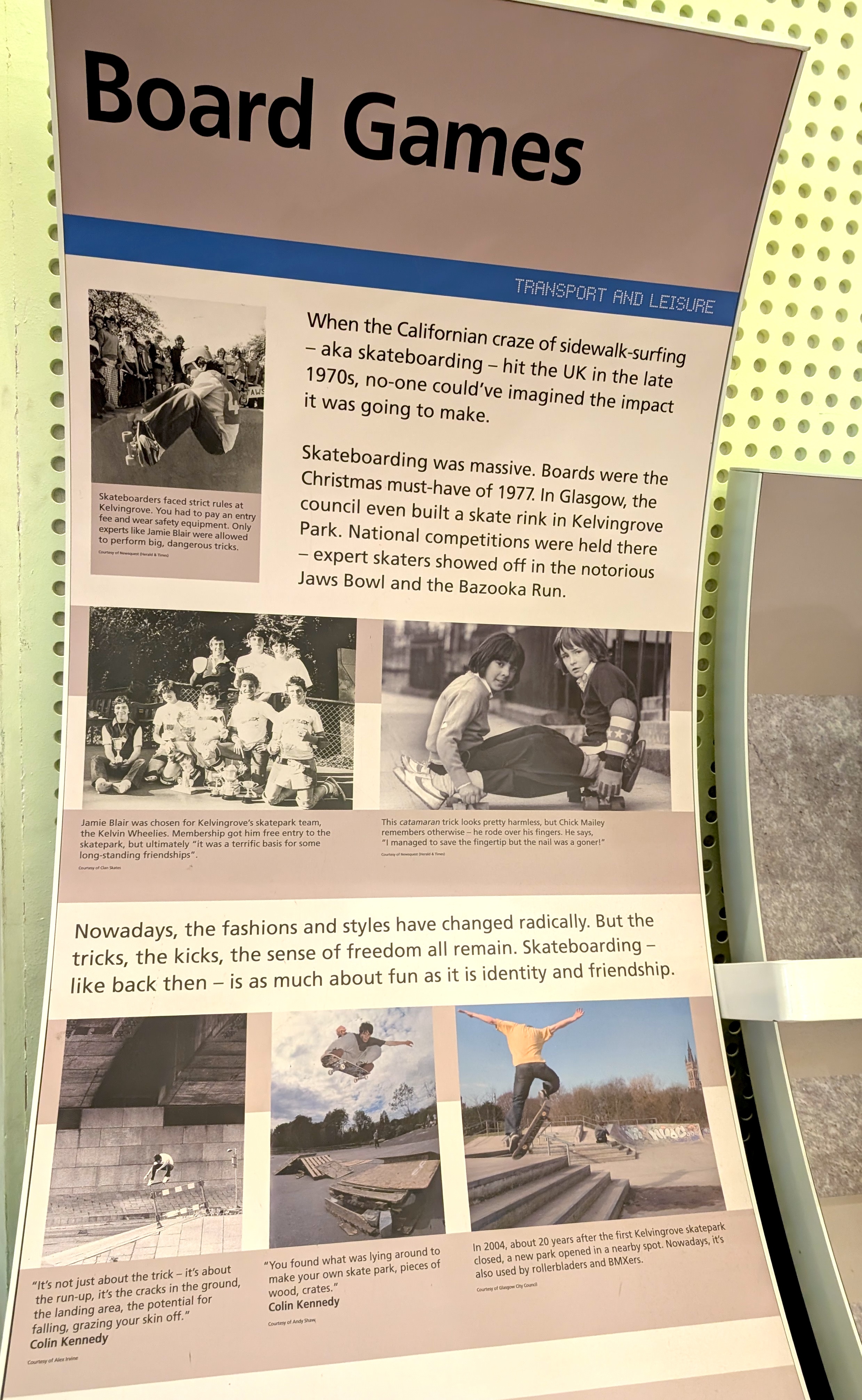
Today, I stumbled upon a relic from my misspent youth – a photograph capturing a glorious moment of airborne triumph to disaster. The setting? A makeshift ramp, lovingly cobbled together from “liberated” lumber in the forgotten annex of the old Boroughmuir High School.

A clandestine haven for Edinburgh’s skateboarding, tucked away from prying eyes like a secret playground. We were a motley crew of dreamers and daredevils, united by a shared passion for defying gravity and pushing the limits of what was possible on four wheels. With youthful ingenuity and a healthy disregard for authority, we scavenged wood from construction sites and alleyways, transforming discarded planks into a ramp of dreams.

Many hours were spent hammering, sawing, and fine-tuning our creation until it stood proudly in the central courtyard. It was a thing of beauty, a testament to our collective resourcefulness and determination. Word spread quickly, and soon, the annex became a popular spot for skaters.

I remember the day the photo was taken. The sun was beating down, casting long shadows across the courtyard. The air was thick with anticipation as I stood at the top of the ramp, with a deep breath and a surge of adrenaline, I launched myself into the air, my body twisting and turning in a graceful arc. For a fleeting moment, I was weightless, defying the laws of physics. The world below seemed to shrink as I soared above it, a bird in flight.

Then, gravity asserted its dominance.

As I gaze upon that old photograph, a wave of nostalgia washes over me. It’s a reminder of a time when life was simpler, when our biggest concerns were landing tricks and evading the watchful eyes of authority. It’s also a reminder that the journey is often more rewarding than the destination. The spills, the thrills, the friendships forged in the crucible of shared passion – these are the moments that truly shape us.

So, to all the young skaters out there, building ramps and chasing dreams: keep pushing, keep falling, keep getting back up. And remember, even the most epic backside disasters can become cherished memories, reminding us of the boundless spirit of youth and the enduring power of skateboarding.

Until next time, keep rolling!

Exploring Tim Marshall’s Insights on Geography

Today, we embark on a chilling journey through the pages of two books that have shaken me to my core: Tim Marshall’s “Prisoners of Geography” and its sequel, “The Power of Geography.” These works offer a stark, unflinching look at how the physical world shapes – and often constrains – human destiny.

Marshall’s books are a wake-up call, exposing the naïveté many of us harbour about how the world truly operates. Forget the rosy picture of global cooperation and progress. The truth, as laid bare in these pages, is far more brutal. It’s a world of competing nations, clashing ambitions, and enduring conflicts – all played out on the vast chessboard of geography.

“Prisoners of Geography” highlights how mountains, rivers, and coastlines can act as both barriers and gateways, influencing everything from trade routes to military strategies. It’s a world where access to warm-water ports can make or break a nation, and where vast plains can become battlefields for empires.

“The Power of Geography,” meanwhile, zooms in on specific regions, revealing how their unique geographic features have shaped their history and continue to influence their present-day struggles. We see how Russia’s sprawling expanse fuels its sense of insecurity, how China’s control of the South China Sea is a strategic power play, and how the Sahel’s harsh climate breeds instability.

These books left me feeling both enlightened and deeply unsettled. It’s terrifying to realise how vulnerable we all are to the whims of geography. But even more disturbing is the realisation that human greed, racial hatred, and religious zealotry often exacerbate these geopolitical tensions.

I must admit, I’m grateful to be living in what many might consider the “back end” of the UK, far removed from the hotspots of conflict and geopolitical manoeuvring. It’s a place where I can enjoy relative peace and security, away from the shadow of looming threats.

But even in my tranquil corner of the world, I can’t escape the knowledge that we are all interconnected. The ripple effects of conflict and instability can reach even the most remote corners of the globe. And the reality is, no one is truly safe in a world where geography and human folly collide.

I yearn for a world where we transcend these limitations, where we recognise our shared humanity and work towards a future of peace and prosperity. A world where greed and prejudice give way to compassion and understanding. A world where we break free from the chains of geography and embrace a brighter, more hopeful future.

Until that day arrives, we must remain vigilant, informed, and engaged. We must challenge those who seek to exploit our fears and divisions. And we must strive to create a world where the power of geography is harnessed for the betterment of all, not just the privileged few.

Thank you for joining me on this unsettling but essential journey. Until next time, stay curious, stay informed, and never lose hope for a better world.

From New Amsterdam to New York: The 1664 Transformation

Hey everyone, and welcome to another episode of “History with a Twist”! Today, we are diving deep into a pivotal moment that shaped the destiny of one of the world’s most iconic cities. We are talking about the “surrender” of New Amsterdam to the English in 1664, an event that led to its renaming as New York.

Now, as someone who has had the pleasure of living amongst the charming canals of old Amsterdam and exploring the bustling streets of New York, I can’t help but be fascinated by this historical turning point. It is like two of my favourite cities are connected by a thread woven in 1664.

So, what exactly went down back then? Simply put, it was not exactly a bloody battle. New Amsterdam, established in 1624 by the Dutch West India Company on the southern tip of Manhattan Island, flourished as a bustling entrepôt for the fur trade. However, its vulnerable position at the mouth of the Hudson River made it a tempting prize for the expanding English empire, which coveted control of this vital waterway.

In the late summer of 1664, a formidable English armada, comprising four warships and several hundred soldiers under the command of the audacious Colonel Richard Nicolls, materialised off the shores of New Amsterdam. The city, its defences dilapidated and its garrison undermanned, was ill-prepared for a siege. Peter Stuyvesant, the irascible yet stalwart Director-General of New Netherland, found himself in a dire predicament. His appeals for reinforcements from the Dutch West India Company had gone unheeded, leaving him with a meagre force to confront the overwhelming English might. The prospect of a protracted and bloody conflict against a superior adversary loomed ominously, casting a pall of despair over the once-thriving colony.

After some negotiations, and perhaps a bit of pragmatic thinking, Stuyvesant decided to surrender the city without a shot being fired. It was a strategic move to avoid bloodshed and protect the inhabitants.

And so it was, with a stroke of a quill and the lowering of a flag, that New Amsterdam, the once-proud bastion of Dutch enterprise in the New World, was unceremoniously rechristened New York, in honour of the Duke of York, the future King James II. No cannon fire rent the air, no blood stained the cobblestones; the transition was as swift and quiet as the turning of an autumn leaf. Peter Stuyvesant, his face etched with a mixture of defiance and resignation, surrendered the city without a fight, his pragmatism prevailing over any lingering hopes of resistance.

Now, some might label this a capitulation, a meek submission to a superior force. But history, as ever, offers a more nuanced perspective. The Dutch, though outnumbered and outgunned, had secured favourable terms in the handover, safeguarding their property rights and religious freedoms. This “strategic transition”, as we might call it, paved the way for New York’s astonishing metamorphosis. The seeds of its future greatness, its cosmopolitan spirit and its unyielding ambition, were already sown in the fertile soil of Manhattan Island. The Dutch legacy, though overshadowed by the Union Jack, continued to pulse beneath the surface, shaping the city’s unique character and contributing to the vibrant tapestry of its identity. New York, the phoenix rising from the ashes of New Amsterdam, was poised to embark on its extraordinary journey towards becoming the global powerhouse we know today.

The Dutch influence, much like the intricate network of canals that crisscross their homeland, remains deeply ingrained in the fabric of New York. It’s there in the street grid, the place names like Brooklyn (once the charming village of “Breukelen”), and even in the city’s spirit of tolerance and entrepreneurial zeal.

Beyond the well-known example of Harlem, originally named Nieuw Haarlem, the Dutch imprint on New York’s map is surprisingly widespread. Brooklyn, the bustling borough across the East River, echoes the Dutch town of “Breukelen.” The Bronx, pays homage to Jonas Bronck, a settler who established a farm there during the Dutch era. Staten Island, once known as “Staaten Eylandt,” translates to “States’ Island,” a nod to the governing body of the Netherlands. Even Coney Island, famed for its amusement parks and boardwalk, likely derives its name from the Dutch word “konijn,” meaning rabbit, due to the abundance of these creatures once found there.

Delving deeper into the city’s street grid, particularly in Lower Manhattan, further reveals the Dutch legacy. Broadway, the iconic thoroughfare, was once the “Breede weg,” or “broad way.” The Bowery, now a bustling hub, stems from “bouwerij,” meaning “farm” or “plantation.” Beaver Street serves as a reminder of the lucrative fur trade that underpinned New Amsterdam’s economy. These linguistic echoes, along with architectural remnants and the enduring presence of the Dutch Reformed Church, paint a picture of a city whose roots run deep into Dutch soil, a testament to the enduring impact of those early settlers.

So, next time you are strolling through Central Park or gazing at the skyscrapers, remember that 1664 moment. It was a “surrender” that paved the way for something truly extraordinary.

Thats all for today, folks. Stay tuned for more historical deep dives and unexpected connections. Until next time, keep exploring, keep questioning, and keep embracing the twists and turns of history!i

The Agile Apocalypse: Daily Scrum Survival – Balancing Collaboration and Corporate Nightmare

Behold the scrum: a tangled mass of caffeine fuelled coders, their postures suggesting a desperate attempt to escape the clutches of the dreaded Daily Standup. The Scrum Master, our fearless referee, blows the whistle, signalling the start of another gruelling Daily Standup.

“Yesterday, I worked on the login feature, but I encountered a blocker…” groans the first zombie developer, his voice a monotonous drone.

“I’m still debugging the payment gateway,” mumbles the second, eyes glazed over as he stares into the abyss of his coffee mug.

“I completed my tasks, but I’m waiting for code review,” mutters the third, swaying slightly as if fighting off the urge to take a nap right there on the spot.

And so it continues, a litany of half-finished tasks, unresolved dependencies, and vague promises of future progress. The scrum board looms overhead, a colorful mosaic of sticky notes that seems to mock their collective inertia.

The Scrum Master, ever optimistic, tries to inject some life into the proceedings. “Remember, folks, we are a team! Let’s work together to overcome these challenges!”

But his words fall on deaf ears. The zombie developers, their brains addled by endless sprints and Jira tickets, can only muster a collective grunt in response.

The Daily Standup drags on, a mind-numbing ritual that seems to sap the last vestiges of life from its participants. Finally, the whistle blows again, signaling the end of the ordeal. The zombie developers shuffle back to their desks, leaving a trail of unfinished tasks and unanswered questions in their wake.

Is this the Agile utopia we were promised? A world of collaboration, transparency, and continuous improvement? Or is it just another corporate nightmare, where productivity has been sacrificed on the altar of process?

Perhaps it is time to re-evaluate our approach to Agile. Maybe we need to inject a little more humanity into our daily routines. Or maybe we just need to accept that some days, we are all just zombies, stumbling through the motions until the coffee kicks in.

All the Pretty Horses: A Poignant Journey through 1949 Mexico

Another from late summer 2023, recommended by Jake after a chat about East of Eden.

Cormac McCarthy’s All the Pretty Horses is a bittersweet elegy to a vanishing way of life. Set in 1949, it follows John Grady Cole, a young Texan cowboy, as he and his friend Lacey Rawlins ride south into Mexico, seeking work and adventure.

A poignant journey, filled with both beauty and brutality. McCarthy’s prose, stark and poetic, paints a vivid picture of the vast landscapes they traverse and the harsh realities they encounter.

This is not a story of easy triumphs. It is a tale of loss, disillusionment, and the painful transition from adolescence to adulthood. As the boys confront the complexities of love, violence, and the unforgiving nature of the world, they come to understand that the romantic ideals of the cowboy life are fading into the past.

“Scars have the strange power to remind us that our past is real.”

All the Pretty Horses is a haunting and unforgettable novel that lingers in the mind long after the final page is turned.

The Agile Apocalypse: Unveiling the Three Amigos’ Ritual of Quality

In the flickering candlelight of the Agile underworld, three amigos gather, their faces painted in the vibrant hues of the Day of the Dead. The Product Owner, adorned with a skeletal grin, clutches a tattered backlog, whispering tales of user desires and market demands. The Developer, a patchwork of exposed components, humming with digital life, dances with code and logic, conjuring code to manifest ethereal visions. The Tester, eyes gleaming like polished obsidian, prowls the edges, seeking vulnerabilities and imperfections in the nascent creation. This unholy trinity, united in their shared quest for quality, engages in a macabre ballet of collaboration. They dissect user stories, challenge assumptions, and unearth hidden flaws, all while honouring the sacred tradition of the three amigos – a ritual of refinement, ensuring that each increment of work rises from the development grave, flawless and ready to delight the living.

Through this macabre dance of collaboration, the project emerges not as a shambling corpse of missed deadlines and buggy code, but as a vibrant, polished gem, ready to dazzle stakeholders and users alike. The company, once plagued by the lumbering gait of waterfall development, now sprints with newfound agility, delivering value faster than a hungry zombie chasing brains. This harmonious union of business, development, and testing will finally lead to software so intuitive, so user-friendly, that even the most technologically challenged among us can navigate it without turning into mindless, keyboard-mashing zombies ourselves. A small step for Agile, a giant leap for humanity’s sanity.

September 15th, 2008: The Day Lehman Brothers Fell, and the World Economy Trembled

On this day in 2008, the financial world was shaken to its core as Lehman Brothers, a 158-year-old investment bank, filed for bankruptcy. This event, unprecedented in its scale, sent shockwaves across the globe and triggered the most severe financial crisis since the Great Depression. The collapse of Lehman Brothers was a stark reminder of the interconnectedness of the global financial system and the devastating consequences of excessive risk-taking and unchecked leverage.

The Aftermath: A Global Recession and its Lingering Impact on the UK

The bankruptcy of Lehman Brothers set off a chain reaction that plunged the world into a deep recession. Banks stopped lending, businesses struggled to survive, and millions lost their jobs and homes. The UK was hit particularly hard, with its economy contracting sharply and unemployment soaring.

The recession had a profound and long-lasting impact on the UK. The government was forced to bail out several major banks to prevent a complete collapse of the financial system. This led to a massive increase in public debt, which continues to burden the economy today. Austerity measures were introduced to reduce the deficit, leading to cuts in public spending and services.

The housing market also suffered a significant downturn, with property prices plummeting and many homeowners facing negative equity. The impact on consumer confidence was severe, leading to a sharp decline in spending and investment.

Even today, the scars of the financial crisis are still visible in the UK. The economy has recovered slowly, and many people are still struggling to make ends meet. The crisis also led to a loss of trust in the financial system and increased calls for greater regulation and oversight.

The Lehman Brothers bankruptcy serves as a cautionary tale about the dangers of unchecked financial risk and the importance of maintaining a stable and resilient economic system.