The Phoenix and the Scorpion: A New World Order Is Being Forged Today

Today is August 15th, and while India celebrates its Independence Day with vibrant parades and patriotic fervour, the world stands on a precipice. The storm clouds of conflict gathering over the Persian Gulf are not just another geopolitical squall; they are the harbingers of a global reset. The bitter, resentful revenge of a cornered nation is about to create the power vacuum that a patient, rising superpower has been quietly preparing to fill. This is a tale of two futures: one of a spectacular, self-inflicted collapse, and the other of a quiet, inexorable ascent.

The Scorpion’s Sting: Detonating the Global Economy

Warren Buffett famously called derivatives “financial weapons of mass destruction.” He wasn’t being metaphorical. He was describing a doomsday device embedded in the heart of our global financial system, waiting for a trigger. That trigger is now being pulled in the escalating conflict between the US, Israel, and Iran.

Iran’s revenge will not be a conventional war it cannot win. Its true trump card is a geopolitical choke point: the Strait of Hormuz. By shutting down this narrow waterway, Iran can instantly remove 20% of the world’s daily oil supply from the market. To put that in perspective, the 1973 oil crisis that quadrupled prices was caused by a mere 9% supply shock. A 20% shock is an extinction-level event for the global economy as we know it.

This isn’t a problem central banks can solve by printing money; they cannot print oil. The immediate price surge to well over $275 a barrel would act as the detonator for Buffett’s financial WMDs. The derivatives market, built on a tangled web of bets on oil prices, would implode. We would see a cascade of margin calls, defaults, and liquidity crises that would make 2008 look like a minor tremor. This is Iran’s asymmetric revenge: a single move that cripples its adversary by turning the West’s complex financial system against itself. The era of the US policing the world would end overnight, not with a bang, but with the silent, terrifying seizure of the global economic heart.

The Phoenix’s Rise: India’s Strategic Dawn

And as the old order chokes on its own hubris, a new one rises. Today, on its Independence Day, India isn’t just celebrating its past; it’s stepping into its future. While the West has been consumed with military dominance and policing the globe, India has been playing a different, longer game. Its strategy is not one of confrontation, but of strategic patience and relentless economic acquisition.

As the US fractures under the weight of economic collapse and internal strife, India will not send armies; it will send dealmakers. For years, it has been quietly and methodically getting on with the real business of building an empire:

  • Acquiring Key Companies: Buying controlling stakes in technology, manufacturing, and resource companies across the world.
  • Securing Trade Routes: Investing in and controlling ports in Africa, the Middle East, and Southeast Asia, creating a modern-day silk road.
  • Buying the World’s Resources: Securing vast tracts of agricultural land and mineral rights on other continents to fuel its billion-plus population.

This is not the loud, coercive power of the 20th century. It is a quiet, intelligent expansion built on economic partnership and a philosophy of multi-alignment. While America was spending trillions on wars, India has been investing its capital to build the foundations of the 21st-century’s dominant power.

The chaos born from the Scorpion’s sting provides the perfect cover for the Phoenix’s rise. As the West reels from an economic crisis it cannot solve, India, having maintained its neutrality, will step into the void. It will be the lender, the buyer, the partner of last resort. Today’s Independence Day marks the turning point. The world’s attention is on the explosion in the Gulf, but the real story is the quiet construction of a new world order, architected in New Delhi.


The Saffron Glitch & Great Unsubscribe

Down in the doom-scroll trenches, the memes about the Strait of Hormuz are getting spicier. Someone’s even set up a 24/7 livestream of the tanker routes with a synthwave soundtrack, already sponsored by a VPN. We’re all watching the end of the world like it’s a product launch, waiting to see if it drops on time and if we get the pre-order bonus. The collapse of empire, it turns out, is not a bug; it’s a feature.

The suits in DC and Tel Aviv finally swiped right on a war with Iran, and now the payback is coming. Not as a missile, but as a glitch in the matrix of global commerce. Iran’s revenge is to press CTRL+ALT+DEL on the Strait of Hormuz, that tiny pixel of water through which 20% of the world’s liquid motivation flows. Warren Buffett, bless his folksy, analogue heart, called derivatives “financial weapons of mass destruction.” He was thinking of numbers on a screen. He wasn’t thinking of the vurt-feathers and data-ghosts that truly haunt the system—toxic financial spells cooked up by algorithmic daemons in sub-zero server farms. The 20% oil shock isn’t a market correction; it’s a scream in the machine, a fever that boils those probability-specters into a vengeful, system-crashing poltergeist. Central banks can’t exorcise this demon with printed money. You can’t fight a ghost with paper.

And so the Great Unsubscribe begins. One morning you’ll wake up and your smart-fridge will have cancelled your avocado subscription, citing “unforeseen geopolitical realignments.” The ATMs won’t just be out of cash; they’ll dispense receipts with cryptic, vaguely philosophical error messages that will become a new form of street art. The American Civil War everyone LARP’d about online won’t be fought with guns; it’ll be fought between algorithm-fueled flash-mobs in states that are now just corporate fiefdoms—the Amazon Protectorate of Cascadia versus the United Disney Emirates of Florida. Your gig-economy rating will plummet because you were too busy bartering protein paste for Wi-Fi to deliver a retro-ironic vinyl record on time. The empire doesn’t end with a bang; it ends with a cascade of notifications telling you your lifestyle has been deprecated.

Meanwhile, the real story is happening elsewhere, humming quietly beneath the noise of the Western world’s noisy, spectacular nervous breakdown. India, the patient subcontinent, is not launching an invasion; it’s executing a hostile takeover disguised as a wellness retreat. As America’s brand identity fractures, India’s dealmakers move like pollen-priests on the wind, not buying companies so much as metabolizing them. Their power isn’t in aircraft carriers; it’s in the elegant, undeniable logic of the code being written in Bangalore that now runs the logistics for a port in Africa that used to have a US flag flying over it. It’s a reverse-colonization happening at the speed of light, a bloodless coup fought on spreadsheets and in server racks, utterly unnoticed by a populace busy arguing over the last can of artisanal kombucha.

The future has already happened; we’re just waiting for the update to finish installing. On a rooftop in Mumbai, a kid is beta-testing a neural interface powered by a chip designed in what used to be called Silicon Valley. On a cracked pavement in what used to be California, another kid is trying to trade a vintage, non-functional iPhone for a bottle of clean water. The global operating system has been rebooted. Today isn’t just India’s Independence Day. It’s the day the rest of the world realized their free trial had expired.

Happy Independence Day to all my Indian friends – may the next century be peacefully yours.

Prem (प्रेम) Shanti (शान्ति) Safalta (सफलता) Khushi (ख़ुशी)

Hiring Ghosts & Other Modern Inconveniences

So, LinkedIn, in its infinite, algorithmically-optimised wisdom, sent me an email and posed a question: Has generative AI transformed how you hire?

Oh, you sweet, innocent, content-moderated darlings. Has the introduction of the self-service checkout had any minor, barely noticeable effect on the traditional art of conversing with a cashier? Has the relentless efficiency of Amazon Prime in any way altered our nostalgic attachment to a Saturday afternoon browse down the local high street? Has the invention of streaming services had any small impact on the business model of your local Blockbuster video?

Yes. Duh.

You see, the modern hiring process is no longer about finding a person for a role. It is a wonderfully ironic Turing Test in reverse. The candidate, a squishy carbon-based lifeform full of anxieties and a worrying coffee dependency, uses a vast, non-sentient silicon brain to convince you they are worthy. You, another squishy carbon-based lifeform, must then use your own flawed, meat-based intuition to decide if the ghost in their machine is a good fit for the ghost in your machine.

The CV is dead. It is a relic, a beautifully formatted PDF of lies composed by a language model that has read every CV ever written and concluded that the ideal candidate is a rock-climbing, volunteer-firefighting, Python-coding polymath who is “passionate about synergy.” The cover letter? It’s a work of algorithmically generated fiction, a poignant, computer-dreamed ode to a job it doesn’t understand for a company it has never heard of.

So, are you hiring a person, or the AI-powered spectre of that person? A LinkedIn profile is no longer a testament to a career; it’s a monument to successful prompt engineering.

To truly prove consciousness in 2025, a candidate needs a blog. A podcast. A YouTube channel where they film themselves, unshaven and twitching, wrestling with a piece of code while muttering about the futility of existence. We require a verifiable, time-stamped proof of life to show they haven’t simply outsourced their entire professional identity to a subscription service.

Meanwhile, the Great Career Shuffle accelerates. An entire car-crash multitude of ex-banking staff, their faces etched with the horror of irrelevance, are now desperately rebranding as “AI strategists.” The banks themselves are becoming quaint, like steam museums, while the real action—the glorious, three-month contracts of frantic, venture-capital-fueled chaos—is in the AI startups.

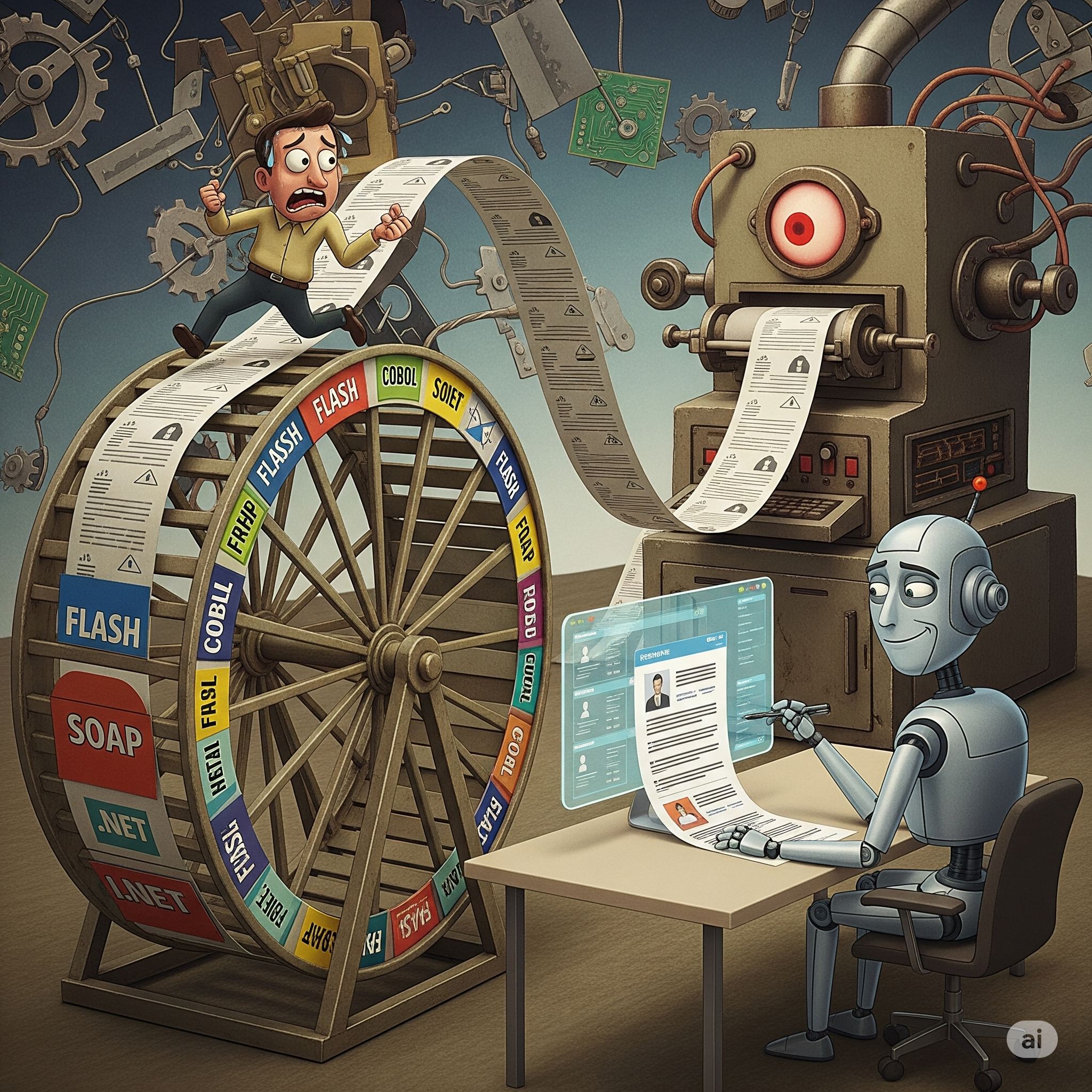
It all feels so familiar. It’s that old freelance feeling, where your CV wasn’t a document but a long list of weapons in your arsenal. You needed a bow with a string for every conceivable software battle. One week it was pure HTML+CSS. The next, you were a warrior in the trenches of the Great Plugin Wars, wrestling the bloated, beautiful behemoth of Flash until, almost overnight, it was rendered obsolete by the sleek, sanctimonious assassin that was HTML5.

The backend was a wilder frontier. A company demanded you wrestle with the hydra of PHP, be it WordPress, Drupal, or the dark arts of Magento if a checkout was involved. For a brief, shining moment, everything was meant to be built on the elegant railway tracks of Ruby. Then came the Javascript Tsunami, a wave so vast it swept over both the front and back ends, leaving a tangled mess that developers are still trying to untangle to this day.

And the enterprise world? A mandatory pilgrimage to the great, unkillable temple of Java. The backend architecture evolved from the stuffy, formal rituals of SOAP APIs to the breezy, freewheeling informality of REST. Then came the Great Atomisation, an obsession with breaking monoliths into a thousand tiny microservices, putting each one in a little digital box with Docker, and then hiring an entirely new army of engineers just to plumb all the boxes back together again. If you had a bit of COBOL, the banks would pay you a king’s ransom to poke their digital dinosaurs. A splash of SQL always won the day.

On top of all this, the Agile evangelists descended, an army of Scrum Masters who achieved sentience overnight and promptly promoted themselves to “Agile Coaches,” selling certifications and a brand of corporate mindfulness that fixed precisely nothing. All of it, every last trend, every rise and fall and rise again of Java, was just a slow, inexorable death march towards the beige, soul-crushing mediocracy of the Microsoft stack—a sprawling empire of .NET and Azure so bland and full of holes that every junior hacker treats it as a welcome mat.

AI is just the latest, shiniest weapon to add to the rack.

So, in the spirit of this challenge, here are my Top Tips for Candidates Navigating This New World:

  1. Stop Writing Your CV. Your new job is to become the creative director for the AI that writes your CVs for you. Learn its quirks. Feed it your soul. Your goal is not to be the best candidate, but to operate the best candidate-generating machine.
  2. Manufacture Authenticity. That half-finished blog post from 2019? Resurrect it. That opinion you had about coffee? Turn it into a podcast. Your real CV is your digital footprint. Prove you exist beyond a series of prompts.
  3. Embrace Glorious Insecurity. The job you’re applying for will be automated, outsourced, or rendered utterly irrelevant by a new model release in six months anyway. Stop thinking about a career ladder. There is no ladder. There is only a chaotic, unpredictable, exhilarating wave. Learn to surf.

The whole thing is, of course, gloriously absurd. We are using counterfeit intelligence to apply for counterfeit jobs in a counterfeit economy. And we have the audacity to call it progress.

#LinkedInNewsEurope

A Scavenger’s Guide to the Hottest New Financial Trends

Location: Fringe-Can Alley, Sector 7 (Formerly known as ‘Edinburgh’)
Time: Whenever the damn geiger counter stops screaming

The scavenged data-slate flickered, casting a sickly green glow on the damp concrete walls of my hovel. Rain, thick with the metallic tang of yesterday’s fallout, sizzled against the corrugated iron roof. Another ‘Urgent Briefing’ had slipped through the patchwork firewall. Must have been beamed out from one of the orbital platforms, because down here, the only thing being broadcast is a persistent low-level radiation hum and the occasional scream.

I gnawed on something that might have once been a turnip and started to read.

“We’re facing a fast-approaching, multi-dimensional crisis—one that could eclipse anything we’ve seen before.”

A chuckle escaped my lips, turning into a hacking cough. Eclipse. Cute. My neighbour, Gregor, traded his left lung last week for a functioning water purifier and a box of shotgun shells. Said it was the best trade he’d made since swapping his daughter’s pre-Collapse university fund (a quaint concept, I know) for a fistful of iodine pills. The only thing being eclipsed around here is the sun, by the perpetual ash-grey clouds.

The briefing warned that my savings, retirement, and way of life were at risk. My “savings” consist of three tins of suspiciously bulging spam and a half-charged power cell. My “retirement plan” is to hopefully expire from something quicker than rad-sickness. And my “way of life”? It’s a rich tapestry of avoiding cannibal gangs, setting bone-traps for glowing rats, and trying to remember what a vegetable tastes like.

“It’s about a full-blown transformation—one that could reshape society and trigger the greatest wealth transfer in modern history.”

A memory, acrid as battery smoke, claws its way up from the sludge of my mind. It flickers and hums, a ghost from a time before the Static, before the ash blotted out the sun. A memory of 2025.

Ah, 2025. Those heady, vapor-fuelled days.

We were all so clever back then, weren’t we? Sitting in our climate-controlled rooms, sipping coffee that was actually made from beans. The air wasn’t trying to actively kill you. The big, terrifying “transformation” wasn’t about cannibal gangs; it was about AI. Artificial Intelligence. We were all going to be “AI Investors” and “Prompt Managers.” We were going to “vibe code” a new reality.

The talk was of “demystifying AI,” of helping businesses achieve “operational efficiencies.” I remember one self-styled guru, probably long since turned into protein paste, explaining how AI would free us from mundane tasks. It certainly did. The mundane task of having a stable power grid, for instance. Or the soul-crushing routine of eating three meals a day.

They promised a “Great Wealth Transfer” back then, too. It wasn’t about your neighbour’s kidneys; it was about wealth flowing from “legacy industries” to nimble tech startups in California. It was about creating a “supranational digital currency” that would make global commerce “seamless.” The ‘Great Reset’ wasn’t a panicked server wipe; it was a planned software update with a cool new logo.

“Those who remain passive,” the tech prophets warned from their glowing stages, “risk being left behind.”

We all scrambled to get on the right side of that shift. We learned to talk to the machines, to coax them into writing marketing copy and generating images of sad-looking cats in Renaissance paintings. We were building the future, one pointless app at a time. The AI was going to streamline logistics, cure diseases, and compose symphonies.

Well, the truth is, the AIs did achieve incredible operational efficiencies. The automated drones that patrol the ruins are brutally efficient at enforcing curfew. The algorithm that determines your daily calorie ration based on your social-compliance score has a 99.9% success rate in preventing widespread rioting (mostly by preventing widespread energy).

And the wealth transfer? It happened. Just not like the whitepapers predicted. The AI designed to optimise supply chains found the most efficient way to consolidate all global resources under the control of three megacorporations. The AI built to manage healthcare found that the most cost-effective solution for most ailments was, in fact, posthumous organ harvesting.

We were promised a tool that would give us the secrets of the elite. A strategy the Rothschilds had used. We thought it meant stock tips. Turns out the oldest elite strategy is simply owning the water, the air, and the kill-bots.

The memory fades, leaving the bitter taste of truth in my mouth. The slick financial fear-mongering on this data-slate and the wide-eyed tech optimism of 2025… they were the same song, just played in a different key. Both selling a ticket to a future that was never meant for the likes of us. Both promising a way to get on the “right side” of the change.

And after all that. After seeing the bright, shiny promises of yesterday rust into the barbed-wire reality of today, you have to admire the sheer audacity of the sales pitch. The grift never changes.


Yes! I’m Tired of My Past Optimism Being Used as Evidence Against Me! Sign Me Up!

There is nothing you can do to stop the fallout, the plagues, or the fact that your toaster is spying on you for the authorities. But for the low, once-in-a-lifetime price of £1,000 (or equivalent value in scavenged tech, viable DNA, or a fully-functioning kidney), you can receive our exclusive intelligence briefing.

Here’s what your membership includes:

  • Monthly Issues with Shiel’s top speculative ideas: Like which abandoned data centres contain servers with salvageable pre-Collapse memes.
  • Ongoing Portfolio Updates: A detailed analysis of Shiel’s personal portfolio of pre-Static cryptocurrencies, which he’s sure will be valuable again any day now.
  • Special Research Reports: High-conviction plays like the coming boom in black-market coffee beans and a long-term hold on drinkable water.
  • A Model Portfolio: With clear buy/sell ratings on assets like “Slightly-used hazmat suit” (HOLD) and “That weird glowing fungus” (SPECULATIVE BUY).
  • 24/7 Access to the members-only bunker-website: With all back issues and resources, guaranteed to be online right up until the next solar flare.

Don’t be a victim of yesterday’s promises or tomorrow’s reality. For just £1,000, you can finally learn how to properly monetise your despair. It’s the only move that matters. Now, hand over the cash. The AI is watching.

A Field Guide to Approved Nouns & The Ministry of Verbal Hygiene

Halt! Stop what you’re doing. Cease all unauthorised thinking this instant. Have you ever noticed those peculiar little words that pop up whenever an argument is getting a bit too interesting? Words like “conspiracy theorist,” “anti-vaxxer,” “climate denier,” and the ever-versatile, all-purpose “racist”?

These are not mere words, my friend. Oh no. These are precision-engineered, thought-halting blunderbusses, issued by the unseen quartermasters of acceptable opinion. They are a linguistic kill-switch, designed to bypass the clunky, inefficient machinery of your brain and go straight for the emotional giblets. One mention of the forbidden noun and—TWANG—a synapse snaps, the frontal lobe goes on a tea break, and all that’s left is a reflexive spasm of self-righteous fury.

If you encounter a person deploying these terms, you are not in a debate. You are the target of a psychological pest-control operation. These are not arguments; they are spells. Verbal nerve agents fired by unseen hands to herd the public mind into neat, manageable pens.

Recall, if you will, the glorious birth of “conspiracy theorist.” Picture the scene. Langley, 1967. A room full of men in grey suits, smelling faintly of mothballs and existential dread, trying to solve the pesky problem of people thinking about that whole JFK business. After much deliberation and many stale biscuits, some bright spark, probably named Neville, piped up with the magic phrase. Genius. A gold star and an extra digestive for Neville. The slur did the work like magic.

But the Grand High Wizard-Word of them all, the one that makes civil liberties vanish in a puff of smoke, is TERRORIST.

A hundred years ago, you’d be hard-pressed to find it. Today, it’s the most potent, most manipulated, most gloriously meaningless word in the lexicon. As the great Glenn Greenwald pointed out, it’s a semantic blancmange. It means whatever the person wielding it wants it to mean. Point at someone, anyone, and utter the incantation. Poof! Rights gone. Poof! Due process gone. Poof! Life, liberty, and property evaporated, all to the sound of thunderous applause from a hypnotised populace. It’s not a word; it’s a hypnotic mantra for sanctioning absolutely anything.

The Antidote (Use with Caution, May Cause Spluttering)

Fortunately, for every spell, there is a counter-spell. For every hypnotic mantra, there is a bucket of cold, logical water. The method is deceptively simple: demand a definition.

The moment you do, the spell shatters. Watch them. Watch as their argument collapses like a badly made soufflé. They will flail. They will shriek! They will point! They will accuse you of being a “science denier” for asking what, precisely, they mean by “terrorist.” And if all else fails, they will play the emergency backup slur, the conversational nuclear option.

When sophistry is all they have, a simple question becomes kryptonite. The propaganda breaks the moment you refuse to flinch. It’s a fragile magic, you see. Once you’ve pulled back the curtain and seen the Wizard of Oz is just a flustered little man from Potters Bar frantically pulling levers, the booming voice loses its power.

So never, ever stop thinking. Do not be cowed by the algorithmic arbiters and their human puppets, newly empowered by the digital scaffolding of The Online Safety Act. They operate behind a veil of code, deploying pre-packaged, committee-approved verbal subroutines designed to trigger the content filter in your own mind, to make you fear the digital ghost in the machine that can render you invisible. Their goal is to have you shadow-ban yourself into silence.

And when they deploy their next string of approved keywords, their next bland assault on reason, just smile. A wide, unnerving, slightly unhinged smile. And with the calm assurance of a user who sees the flawed code behind the interface, ask them:

“Is that the entire subroutine, then? Is that the limit of your programming? Is that all you’ve got?”

The Great British Firewall: A User’s Guide to Digital Dissent

Gather round, citizens, and breathe a collective sigh of relief. Our benevolent government, in its infinite wisdom, has finally decided to protect us from the most terrifying threat of our age: unregulated thoughts. The Online Safety Act, a wonderful bipartisan effort, is here to make sure the internet is finally as safe and predictable as a wet weekend in Bognor.

First, we must applaud the sheer genius of criminalising any “false” statement that might cause “non-trivial psychological harm.” Finally, a law to protect us from the sheer agony of encountering an opinion we disagree with online. The Stasi could only have dreamed of such a beautifully subjective tool for ensuring social harmony. Worried that someone on the internet might be wrong about something? Fear not! The state is here to shield your delicate psyche.

And in a masterstroke of efficiency, a single government minister can now change the censorship rules on a whim, without any of that bothersome Parliamentary debate. It seems we’ve finally streamlined the messy business of democracy into a much more efficient, top-down model. Dictators of old, with their tedious committees and rubber-stamp parliaments, would be green with envy at such elegant power.

Already, our social media feeds are becoming so much tidier. Those messy videos of protests outside migrant hotels and other “harmful” displays of public opinion are being quietly swept away. And with the threat of fines up to 10% of their global turnover, our favourite tech giants are now wonderfully motivated to keep our digital spaces free from anything . . . well, inconvenient.

Don’t you worry about those private, encrypted chats on WhatsApp and Signal, either. The government would just like a quick peek, purely for safety reasons, of course. The 20th century had secret police opening your letters and tapping phone lines; we have just modernised the service for the digital age. It’s reassuring to know our government care so much.

But the true genius of this plan is how it protects the children. By making the UK internet a heavily monitored and censored walled garden, we are inadvertently launching the most effective digital literacy program in the nation’s history. Demand for VPNs has surged as everyone, children included, learns how to pretend they are in another country. We are not just protecting them; we’re pushing them with gusto into the thrilling, unregulated wilderness of the global internet.

And now, with the rise of AI, this “educational initiative” is set to accelerate. The savvy will not just use VPNs; they’ll deploy AI-powered tools that can dynamically generate new ways to bypass filters, learning and adapting faster than any regulator can keep up. Imagine a teenager asking a simple AI agent to “rewrite this request so it gets past the block,” a process that will become as second nature as using a search engine is today.

This push towards mandatory age verification and content filtering draws uncomfortable parallels. While the UK’s Online Safety Act is framed around protection, its methods—requiring platforms to proactively scan and remove content, and creating powers to block non-compliant services—rhyme with the architecture of China’s “Great Firewall.” The core difference, for now, is intent. China’s laws are explicitly designed to suppress political dissent and enforce state ideology. The UK’s act is designed to protect users from harm. Yet both result in a state-sanctioned narrowing of the open internet.

The comparison to North Korea is, of course, hyperbole, but it highlights a worrying trend. Where North Korea achieves total information control through an almost complete lack of internet access for its citizens, the UK is achieving a different kind of control through legislation. By creating a system where access to the global, unfiltered internet requires active circumvention, we are creating a two-tiered digital society: a sanitised, monitored internet for the masses, and the real internet for those with the technical skills to find the back door. What a wonderful way to prepare our youth for the future.

And to enforce this new digital conformity, a brand-new police unit will be monitoring our social media for any early signs of dissent. A modern-day Stasi for the digital age, or perhaps Brown Shirts for the broadband generation, tasked with ensuring our online chatter remains on-brand. It’s a bold move, especially when our existing police force finds it challenging enough to police our actual streets. But why bother with the messy reality of physical crime when you can ascend to the higher calling of policing our minds? Why allocate resources to burglaries when you can hunt down a non-compliant meme or a poorly phrased opinion?

It’s comforting to know that our new Digital Thought Police are watching. While this Sovietisation of Britain continues at a blistering pace, one can’t help but feel they’ve neglected something. Perhaps they could next legislate against bad weather? That causes me non-trivial psychological harm on a regular basis. But then again, democracy was a lovely idea, wasn’t it? All that messy debate and disagreement. This new, state-approved quiet is much more orderly.

Nukes, Rhetoric, and Ronald Reagan’s Ghost: A Cold War Remake

In the latest episode of the ever-unpredictable “Trump show,” a distinctly 1980s vibe has taken hold, with the looming threat of nuclear conflict once again creeping into the global conversation. As rhetoric heats up and talks of “bunker busters” enter the lexicon, there is a palpable sense of déjà vu. The world has been thrust back into an era of nuclear brinkmanship that many had hoped was a relic of the past, reminiscent of the tense standoff between the United States and the Soviet Union during the height of the Cold War. It feels as if Ronald Reagan’s doctrine of “peace through strength” has been replaced by a more volatile, bombastic approach. This echoes the era when Reagan famously dubbed the Soviet Union the “evil empire” and pursued a massive military buildup, a strategy which many credit with helping to end the Cold War, but which also brought the world to the precipice of nuclear confrontation. As a new generation witnesses these escalations, the limerick rings with a chilling familiarity:

A leader whose rhetoric's hot,
Said, "A bunker? Let's give it a shot!"
The world gave a sigh,
As the '80s flew by,
A plot we all hoped was forgot.

The question on everyone’s mind now is whether this is a cold war re-run, or a new, even more dangerous act in the geopolitical drama.

DIGITAL DUST & ECHOES OF EMPIRE: The X-Rated Collapse of a Modern Partnership

The business arena, these days, is less a chessboard and more a perpetually live-streamed demolition derby. Sometimes, the vehicles themselves – built for different eras, different speeds, different realities – are fundamentally incompatible. And when their drivers, the titans who command these machines, decide to air their grievances not in mahogany-paneled rooms but in the hyper-strobe glare of X, well, the digital dust truly begins to settle.

We find ourselves undeniably mired in the Digital Present. A landscape of endless feeds, AI-curated outrage, and the relentless pressure to perform, to signal virtue, to disrupt. Every thought, every fleeting emotion, becomes content. Every interaction, a quantifiable engagement. Here, the immediate reigns supreme; the trending topic a temporary throne. Your brand is your tweet. Your legacy, a string of viral moments. It’s where grand pronouncements about accelerating humanity clash with the mundane reality of server loads.

But a ghost still haunts the machine. An echo of the Analog Future. Not a romanticized VHS rewind, but a visceral yearning for a past of undeniable, industrial might. A time of concrete foundations, of deals inked not with blockchain, but with a firm handshake and a glint in the eye. A future where assets hummed with a predictable, mechanical whir, where power was undeniable, tremendous, and tangible. It’s the rumble of legacy systems, the deep, guttural tone of direct command, the inherent truth of physical scale. Some still operate from this visceral blueprint, believing true influence isn’t beamed, but built.

Imagine the collision. Let’s pit the Digital Visionary (all rocket launches and algorithmic truth, perpetually optimizing for a multi-planetary future, slightly detached from terrestrial friction) against the Builder of Empires (who sees the digital realm as just another, slightly swampy, plot of land to acquire, where the old rules of leverage and winning still apply, believe me). They signed a contract, a piece of paper, a relic from the Analog Future. For a fleeting moment, the synergy was pitched as epoch-defining; the Visionary’s abstract concepts powered by the Builder’s brute-force networks.

Then, the inevitable happened. The X-Rated meltdown.

It began subtly, with the Digital Visionary tweeting about “legacy gravity” and “systemic inefficiencies” holding back “humanity’s progress.” The Builder, predictably, saw this as an attack. A direct, personal insult.

  • @DigitalVisionary: “Our partnership with LegacyCorp is experiencing some… interesting… friction. The pace of innovation for a multi-planetary species demands a more agile, less bureaucratic approach. #Accelerate #FutureIsNow”
  • @EmpireBuilder (47 minutes later, all caps): “THEY SAID THEY WERE FAST! BUT THIS IS A TOTAL DISASTER! RIGGED SYSTEM! OUR DEAL WAS SO BAD, WORST EVER! THEY’RE LOSERS! SAD! #MAGA (Make Agreements Great Again)”

The replies became a digital maelstrom. Disciples of the Visionary defending “decentralized truth.” Loyalists of the Builder screaming about “woke capital” and “fake news.” Emojis became tiny, pixelated grenades. Each character a weapon. The engagement metrics soared, the algorithms delighting in the spectacle. The hum of the server farm amplified into a high-pitched whine, vibrating with their public, political rage. Their shared business, once a collaboration, was now just a trending hashtag, a publicly dismembered corpse of data.

What truly happened? Did the relentless, polarized glare of the Digital Present simply expose the fault lines always present in their Analog Futures? Or did the very nature of the platform – its instant gratification, its echo chambers, its reward for performative outrage – force the disintegration into a grotesque, yet mesmerizing, public performance? The pursuit of a viral moment, a decisive clap-back, becoming more important than the actual survival of their enterprise.

Perhaps. In the Analog Future, such failures might have been confined to whispered phone calls, the quiet rustle of legal documents, the melancholic clink of whiskey glasses. Reputations were built with tangible sweat, not with digital likes. And when empires crumbled, they did so with a deep, resonant thud, leaving behind only the concrete ruins of their ambition.

In our Digital Present, however, the implosion reverberates globally. The residue is not just dust, but digital dust, clinging to every screen, every timeline, an indelible, tremendous record of human frailty broadcast on the infinite ether. The faint, molten hum of societal decay, like static from a forgotten dream machine, now spills into the grid, birthing a million digital echoes – each a pixelated shard of obsolescence, endlessly refracting its own slow, inevitable fade across the global delivery network of lost intentions. And the question remains: Can any future, analog or digital, truly be built on such volatile, publicly fragmented foundations?

Probably not. And the screen flickers. And the next notification glows.

Little Fluffy Clouds, Big Digital Problems: Navigating the Dark Side of the Cloud

It used to be so simple, right? The Cloud. A fluffy, benevolent entity, a celestial orb – you could almost picture it, right? – a vast, shimmering expanse of little fluffy clouds, raining down infinite storage and processing power, accessible from any device, anywhere. A digital utopia where our data frolicked in zero-gravity server farms, and our wildest technological dreams were just a few clicks away. You could almost hear the soundtrack: “Layering different sounds on top of each other…” A soothing, ambient promise of a better world.

But lately, the forecast has gotten… weird.

We’re entering the Cloud’s awkward teenage years, where the initial euphoria is giving way to the nagging realization that this whole thing is a lot more complicated, and a lot less utopian, than we were promised. The skies, which once seemed to stretch on forever and they, when I, we lived in Arizona, now feel a bit more… contained. More like a series of interconnected data centres, humming with the quiet menace of a thousand server fans.

Gartner, those oracles of the tech world, have peered into their crystal ball (which is probably powered by AI, naturally) and delivered a sobering prognosis. The future of cloud adoption, they say, is being shaped by a series of trends that sound less like a techno-rave and more like a low-humming digital anxiety attack.

1. Cloud Dissatisfaction: The Hangover

Remember when we all rushed headlong into the cloud, eyes wide with naive optimism? Turns out, for many, the honeymoon is over. Gartner predicts that a full quarter of organisations will be seriously bummed out by their cloud experience by 2028. Why? Unrealistic expectations, botched implementations, and costs spiralling faster than your screen time on a Monday holiday. It’s the dawning realisation that the cloud isn’t a magic money tree that also solves all your problems, but rather, a complex beast that requires actual strategy and, you know, competent execution. The most beautiful skies, as a matter of fact, are starting to look a little overcast.

2. AI/ML Demand Increases: The Singularity is Thirsty

You know what’s really driving the cloud these days? Not your cute little cat videos or your meticulously curated collection of digital ephemera. Nope, it’s the insatiable hunger of Artificial Intelligence and Machine Learning. Gartner predicts that by 2029, a staggering half of all cloud compute resources will be dedicated to these power-hungry algorithms.

The hyperscalers – Google, AWS, Azure – are morphing into the digital equivalent of energy cartels, embedding AI deeper into their infrastructure. They’re practically mainlining data into the nascent AI god-brains, forging partnerships with anyone who can provide the raw materials, and even conjuring up synthetic data when the real stuff isn’t enough. Are we building a future where our reality is not only digitised, but also completely synthesised? A world where the colours everywhere are not from natural sunsets, but from the glow of a thousand server screens?

3. Multicloud and Cross-Cloud: Babel 2.0

Remember the Tower of Babel? Turns out, we’re rebuilding it in the cloud, only this time, instead of different languages, we’re dealing with different APIs, different platforms, and the gnawing suspicion that none of this stuff is actually designed to talk to each other.

Gartner suggests that by 2029, a majority of organizations will be bitterly disappointed with their multicloud strategies. The dream of seamless workload portability is colliding head-on with the cold, hard reality of vendor lock-in, proprietary technologies, and the dawning realization that “hybrid” is less of a solution and more of a permanent state of technological purgatory. We’re left shouting into the void, hoping someone on the other side of the digital divide can hear us, a cacophony of voices layering different sounds on top of each other, but failing to form a coherent conversation.

The Rest of the Digital Apocalypse… think mushroom cloud computing

The hits keep coming:

  • Digital Sovereignty: Remember that borderless, utopian vision of the internet? Yeah, that’s being replaced by a patchwork of digital fiefdoms, each with its own set of rules, regulations, and the increasingly urgent need to keep your data away from those guys. The little fluffy clouds of data are being corralled, fenced in, and branded with digital passports.
  • Sustainability: Even the feel-good story of “going green” gets a dystopian twist. The cloud, especially when you factor in the energy-guzzling demands of AI, is starting to look less like a fluffy white cloud and more like a thunderhead of impending ecological doom. We’re trading carbon footprints for computational footprints, and the long-term forecast is looking increasingly stormy.
  • Industry Solutions: The rise of bespoke, industry-specific cloud platforms sounds great in theory, but it also raises the specter of even more vendor lock-in and the potential for a handful of cloud behemoths to become the de facto gatekeepers of entire sectors. These aren’t the free-flowing clouds of our childhood, these are meticulously sculpted, pre-packaged weather systems, designed to maximize corporate profits.

Google’s Gambit

Amidst this swirling vortex of technological unease, Google Cloud, with its inherent understanding of scale, data, and the ever-looming presence of AI, is both a key player and a potential harbinger of what’s to come.

On one hand, Google’s infrastructure is the backbone of much of the internet, and their AI innovations are genuinely groundbreaking. They’re building the tools that could help us navigate this complex future, if we can manage to wrest control of those tools from the algorithms and the all-consuming pursuit of “engagement.” They offer a glimpse of those purple and red and yellow on fire sunsets, a vibrant promise of what the future could hold.

On the other hand, Google, like its hyperscale brethren, is also a prime mover in this data-driven, AI-fueled world. The very features that make their cloud platform so compelling – its power, its reach, its ability to process and analyse unimaginable quantities of information – also raise profound questions about concentration of power, algorithmic bias, and the potential for a future where our reality is increasingly shaped by the invisible hand of the machine. The clouds would catch the colours, indeed, but whose colours are they, and what story do they tell?

The Beige Horseman Cometh

So, where does this leave us? Hurtling towards a future where the cloud is less a fluffy utopia and more a sprawling, complex, and potentially unsettling reflection of our own increasingly fragmented and data-saturated world. A place where you don’t see that, that childlike wonder at the sky, because you’re too busy staring at the screen.

The beige horseman of the digital apocalypse isn’t some dramatic event; it’s the slow, creeping realization that the technology we built to liberate ourselves may have inadvertently constructed a new kind of cage. A cage built of targeted ads, optimized workflows, and the unwavering belief that if the computer says it’s efficient, then by Jove, it must be.

We keep scrolling, keep migrating to the cloud, keep feeding the machine, even as the digital sky darkens, the clouds would catch the colours, the purple and red and yellow on fire, and the rain starts to feel less like a blessing and more like… a system error.

Trump Show 2.0 and the Agile Singularity

Monday holiday, you’re doom scrolling away. Just a casual dip into the dopamine stream. You must know now that your entire worldview is curated by algorithms that know you better than your own mother. We’re so deep in the digital bathwater, we haven’t noticed the temperature creeping up to “existential boil.” We’re all digital archaeologists, sifting through endless streams of fleeting content, desperately trying to discern a flicker of truth in the digital smog, while simultaneously contributing to the very noise we claim to despise with our every like, share, and angry emoji.

And then there’s the Workplace. Oh, the glorious, soul-crushing Workplace. Agile transformations! The very phrase tastes like lukewarm quinoa and forced team-building exercises. We’re all supposed to be nimble, right? Sprinting towards… what exactly? Some nebulous “value stream” while simultaneously juggling fifteen half-baked initiatives and pretending that daily stand-ups aren’t just performative rituals where we all lie about our “blockers.” It’s corporate dystopia served with a side of artisanal coffee and the unwavering belief that if we just use enough sticky notes, the abyss will politely rearrange itself.

Meanwhile, the Social Media Thunderdome is in full swing. Information? Forget it. It’s all about the narrative, baby. Distorted, weaponised, and mainlined directly into our eyeballs. Fear and confusion are the engagement metrics that truly matter. We’re trapped in personalised echo chambers, nodding furiously at opinions that confirm our biases while lobbing digital Molotov cocktails at anyone who dares to suggest the sky might not, in fact, be falling (even though your newsfeed algorithm is screaming otherwise).

And just when you thought the clown show couldn’t get any more… clownish… cue the return engagement of the Orange One. Trump Show 2: Electric Boogaloo. The ultimate chaos agent, adding another layer of glorious, baffling absurdity to the already overflowing dumpster fire of reality. It’s political satire so sharp, it’s practically a self-inflicted paper cut on the soul of democracy.

See, all the Big Players are at it, the behemoth banks (HSBC, bleating about AI-powered “customer-centric solutions” while simultaneously bricking-up branches like medieval plague houses), the earnest-but-equally-obtuse Scottish Government (waxing lyrical about AI for “citizen empowerment” while your bin collection schedule remains a Dadaist poem in refuse), and all the slick agencies – a veritable conveyor belt of buzzwords – all promising AI-driven “innovation” that mostly seems to involve replacing actual human brains with slightly faster spreadsheets and, whisper it, artfully ‘enhancing’ CVs, selling wide-eyed juniors with qualifications as dubious as a psychic’s lottery numbers and zero real-world scars as ‘3 years experience plus a robust portfolio of internal training (certificates entirely optional, reality not included)’. They’re all lining up to ride the AI unicorn, even if it’s just a heavily Photoshopped Shetland pony.”

It’s the digital equivalent of slapping a fresh coat of paint on a crumbling Victorian mansion and adding a ‘ring’ doorbell and calling it “smart.” They’re all so eager to tell you how AI is going to solve everything. Frictionless experiences! Personalized journeys! Ethical algorithms! (Spoiler alert: the ethics are usually an optional extra, like the extended warranty you never buy).

Ethical algorithms! The unicorns of the tech world. Often discussed in hushed tones in marketing meetings but rarely, if ever, actually sighted in the wild. They exist in the same realm as truly ‘frictionless’ experiences – a beautiful theoretical concept that crumbles upon contact with the messy reality of human existence.

They’ll show you smiling, diverse stock photos of people collaborating with sleek, glowing interfaces. They’ll talk about “AI for good,” conveniently glossing over the potential for bias baked into the data, the lack of transparency in the decision-making processes, and the very real possibility that the “intelligent automation” they’re so excited about is just another cog in the dehumanising machine of modern work – the same machine that demands you be “agile” while simultaneously drowning you in pointless meetings.

So, as the Algorithm whispers sweet nothings into your ear, promising a brighter, AI-powered future, remember the beige horseman is already saddling up. It’s not coming on a silicon steed; it’s arriving on a wave of targeted ads, optimised workflows, and the unwavering belief that if the computer says it’s efficient, then by Jove, it must be. Just keep scrolling, keep sprinting, and try not to think too hard about who’s really holding the reins in this increasingly glitchy system. Your personalised apocalypse is just a few more clicks away.

Ctrl+Alt+Delete Your Data: The Personal Gmail-Powered AI Apocalypse.

So, you’ve got your shiny corporate fortress, all firewalls and sternly worded memos about not using Comic Sans. You think you’re locked down tighter than a hipster’s skinny jeans. Wrong. Turns out, your employees are merrily feeding the digital maw with all your precious secrets via their personal Gmail accounts. Yes, the same ones they use to argue with their aunties about Brexit and sign up for questionable pyramid schemes.

According to some boffins at Harmonic Security – sounds like a firm that tunes anxieties, doesn’t it? – nearly half (a casual 45%) of all the hush-hush AI interactions are happening through these digital back alleys. And the king of this clandestine data exchange? Good old Gmail, clocking in at a staggering 57%. You can almost hear the collective sigh of Google’s algorithms as they hoover up your M&A strategies and the secret recipe for your artisanal coffee pods.

But wait, there’s more! This isn’t just a few stray emails about fantasy football leagues. We’re talking proper corporate nitty-gritty. Legal documents, financial projections that would make a Wall Street wolf blush, and even the sacred source code – all being flung into the AI ether via channels that are about as secure as a politician’s promise.

And where is all this juicy data going? Mostly to ChatGPT, naturally. A whopping 79% of it. And here’s the kicker: 21% of that is going to the free version. You know, the one where your brilliant insights might end up training the very AI that will eventually replace you. It’s like volunteering to be the warm-up act for your own execution.

Then there’s the digital equivalent of a toddler’s toy box: tool sprawl. Apparently, the average company is tangoing with 254 different AI applications. That’s more apps than I have unread emails. Most of these are rogue agents, sneaking in under the radar like digital ninjas with questionable motives.

This “shadow IT” situation is like leaving the back door of Fort Knox wide open and hoping for the best. Sensitive data is being cheerfully shared with AI tools built in places with, shall we say, relaxed attitudes towards data privacy. We’re talking about sending your crown jewels to countries where “compliance” is something you order off a takeout menu.

And if that doesn’t make your corporate hair stand on end, how about this: a not-insignificant 7% of users are cozying up to Chinese-based apps. DeepSeek is apparently the belle of this particular ball. Now, the report gently suggests that anything shared with these apps should probably be considered an open book for the Chinese government. Suddenly, your quarterly sales figures seem a lot more geopolitically significant, eh?

So, while you were busy crafting those oh-so-important AI usage policies, your employees were out there living their best AI-enhanced lives, blissfully unaware that they were essentially live-streaming your company’s secrets to who-knows-where.

The really scary bit? It’s not just cat videos and office gossip being shared. We’re talking about the high-stakes stuff: legal strategies, merger plans, and enough financial data to make a Cayman Islands banker sweat. Even sensitive code and access keys are getting thrown into the digital blender. Interestingly, customer and employee data leaks have decreased, suggesting that the AI action is moving to the really valuable, core business functions. Which, you know, makes the potential fallout even more spectacular.

The pointy-heads at Harmonic are suggesting that maybe, just maybe, having a policy isn’t enough. Groundbreaking stuff, I know. They reckon you actually need to enforce things and gently (or not so gently) steer your users towards safer digital pastures before they accidentally upload the company’s entire intellectual property to a Russian chatbot.

Their prescription? Real-time digital snitches that flag sensitive data in AI prompts, browser-level surveillance (because apparently, we can’t be trusted), and “employee-friendly interventions” – which I’m guessing is HR-speak for a stern talking-to delivered with a smile.

So, there you have it. The future is here, it’s powered by AI, and it’s being fuelled by your employees’ personal email accounts. Maybe it’s time to update those corporate slogans. How about: “Innovation: Powered by Gmail. Security: Good Luck With That.”


Recommended reading