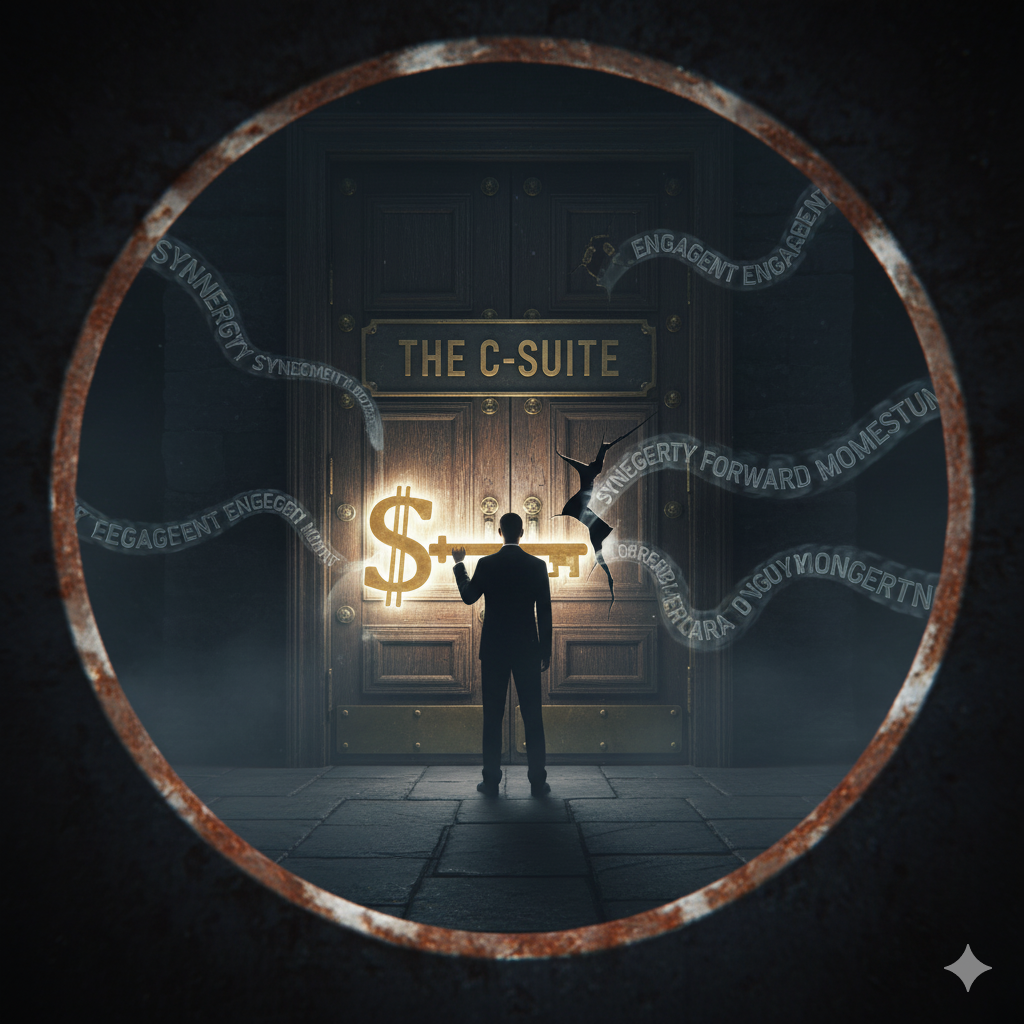
We’ve identified the enemy. It is the Activity Demon, the creature that feeds on the performance of work and starves the business of results. We know its weakness: the cold, hard language of the balance sheet.
Now, we move from defence to offence.
A resistance cannot win by writing a better play; it must sabotage the production itself. For each of the five acts in the SHAPE framework, there is a counter-measure—a piece of tactical sabotage designed to disrupt the performance and force reality onto the stage. This is the saboteur’s handbook.
Sabotage Tactic #1: To Counterfeit Strategic Agility… Build the Project Guillotine. The performance of agility is a carefully choreographed dance of rearranging timelines. The sabotage is to build a real consequence engine. Every project begins with a public, metric-driven “kill switch.” If user adoption doesn’t hit 10% in 45 days, the project is terminated. If it doesn’t reduce server costs by X amount in 90 days, it’s terminated. The guillotine is automated. It requires no committee, no appeal. It makes pivoting real because the alternative is death, not just a rewrite.
Sabotage Tactic #2: To Counterfeit Human Centricity… Give the Audience a Veto. The performance of empathy is the scripted Q&A where softballs are thrown and no one is truly heard. The sabotage is to form a “User Shadow Council”—a rotating group of the actual end-users who will be most affected. They are given genuine power: a non-negotiable veto at two separate stages of development. It’s no longer a performance of listening; it’s a hostage negotiation with the people you claim to be helping.
Sabotage Tactic #3: To Counterfeit Applied Curiosity… Make the Leaders Bleed. The performance of curiosity is delegating “exploration” to a junior team. The sabotage is the “Blood in the Game” rule. Once a quarter, every leader on the executive team must personally run a small, cheap, fast experiment and present their raw, unfiltered findings. No proxies. No polished decks. They must get their own hands dirty to show that curiosity is a messy, risky practice, not a clean performance watched from a safe distance.
Sabotage Tactic #4: To Counterfeit Performance Drive… Chain the Pilot to its Scaled Twin. The performance of drive is the standing ovation for the pilot, with no second act. The sabotage is the “Scaled Twin Mandate.” No pilot program can receive funding without an accompanying, pre-approved, fully-funded scaling plan. The moment the pilot meets its success criteria, that scaling plan is automatically triggered. The pilot is no longer the show; it’s just the fuse on the rocket.
Sabotage Tactic #5: To Counterfeit Ethical Stewardship… Unleash the Red Team. The performance of ethics is a PR clean-up operation. The sabotage is to fund an independent, internal “Red Team” from day one. Their sole purpose is to be a hostile attacker. Their job is to find and publicly expose the project’s ethical flaws and biases. Their success is measured by how much damage they can do to the project before it ever sees the light of day. This makes ethics a core part of the design, not the apology tour.
These tactics are dangerous. They will be met with resistance from those who are comfortable in the theater. But the real horror isn’t failing. The real horror is succeeding at a performance that never mattered, while the world outside the theatre walls moved on without you. The set is just wood and canvas. It’s time to start tearing it down.
The last broadcast ended with a question hanging in the sterile air: Are we the shapers, or are we being shaped?
Since then, a few of you have started to see it. You notice the flicker in the projection on the conference room wall, the way the applause from the C-suite sounds prerecorded and hollow. You’ve seen the man behind the curtain, and you know the awful truth: the levers are pulling him. This transmission isn’t for the performers who are happy with their script. It’s for the ones who feel the chill and want to break out of the theater. This is a survivor’s guide.
Before you can escape, you must understand what feeds the illusion. The theatre has a monster, but it has no teeth or claws. It lives in the hum of the servers and the cold, fluorescent lights of the boardroom. We will call it the Activity Demon.
It’s a shadowy entity that thrives on the performance of work. Its food is the endless stream of status meetings, the beautifully crafted slide decks, the perfectly executed Gantt charts, and above all, the successful pilot. It whispers comforting lies about “synergy,” “engagement,” and “forward momentum.” It looks like productivity. It feels like progress. But it is a parasite that starves its host—the business—of the only thing that actually matters: tangible results.
So, what is the first rule of the resistance? You must starve the demon.
You cannot fight it with another framework or a better process. The demon loves process. You can only fight it with something it cannot digest, something it recoils from like a vampire from sunlight: the brutal, cold iron of P&L accountability.
From this moment on, you must chain every new initiative, every pilot, every “experiment” to a single, non-negotiable question. You must ask it in every meeting, and you must not proceed until you have a real answer.
“Which line item on the income statement or balance sheet will this change?”
No more vague promises of “improved efficiency” or “enhanced capability.” Those are the demon’s favourite empty calories. Force the answer into the open. Will this reduce operational costs? By how much, and by when? Will it increase revenue or reduce customer churn? By what percentage?
Drag the initiative out of the comfortable darkness of the pilot theatre and into the harsh, unforgiving light of the CFO’s office. If it cannot survive that scrutiny, it was never real. It was just a meal for the monster.
This is the first step. It is the hardest. It means saying “no” to projects that look good and feel important. It means being the ghost at the feast. But it is the only way to begin. Starve the demon, and the theater walls will begin to feel a little less solid.
In the next transmission, we will discuss how to sabotage the script itself.
The lights are dim. In the sterile conference room, under the low hum of the servers, the show is about to begin. This isn’t Broadway. This is the “pilot theater,” the grand stage where innovation is performed, not delivered. We see the impressive demos, the slick dashboards, the confident talk of transformation. It’s a magnificent production. But pull back the curtain, and you’ll find him: a nervous man, bathed in the glow of a monitor, frantically pulling levers. He’s following a script, a framework, a process so perfectly executed that everyone has forgotten to ask if the city of Oz he’s projecting is even real.
The data, when you can find it in the dark, is grim. A staggering 95% of generative AI programs fail to deliver any real value. The stage is littered with the ghosts of failed pilots. We’ve become so obsessed with the performance of progress that we’ve forgotten the point of it. The man behind the curtain is a master of Agile ceremonies, his stand-ups are flawless, his retrospectives insightful. He can tell you, with perfect clarity, that the team followed the process beautifully. But when you ask him what they were supposed to be delivering, his eyes go blank. The script didn’t mention that part.
And now, a new script has arrived. It has a name, of course. They always do. This one is called SHAPE.
The New Framework Stares Back
The SHAPE index was born from the wreckage of that 95%. It’s a framework meant to identify the five key behaviors of leaders who can actually escape the theater and build something real. It’s supposed to be our map out of Oz. But in a world that worships the map over the destination, we must ask: Is this a tool for the leader, or is the leader just becoming a better-trained tool for the framework? Is this a way out, or just a more elaborate set of levers to pull?
Let’s look at the five acts of this new play.
Act I: Strategic Agility
The script says a leader must plan for the long term while pivoting in the short term. In the theater, this is a beautiful piece of choreography. The leader stands at the whiteboard, decisively moving charts around, declaring a “pivot.” It looks like genius. It feels like action. But too often, it’s just rearranging the props on stage. The underlying set—the core business problem—remains unchanged. The applause is for the performance of agility, not the achievement of a better position.
Act II: Human Centricity
Here, the actor-leader must perform empathy. They must quell the rising anxiety of the workforce. The mantra, repeated with a fixed smile, is: “AI will make humans better.” It sounds reassuring, but the chill remains. The change is designed in closed rooms and rolled out from the top down. Psychological safety isn’t a culture; it’s a talking point in a town hall. The goal isn’t to build trust, but to manage dissent just enough to keep the show from being cancelled.
Act III: Applied Curiosity
This act requires the leader to separate signal from the deafening hype. So, the theater puts on a dazzling display of “disciplined experimentation.” New, shiny AI toys are paraded across the stage. Each pilot has a clear learning objective, a report is dutifully filed, and then… nothing. The learning isn’t applied; it’s archived. The point was never to learn; it was to be seen learning. The experiments are just another scene, designed to convince the audience that something, anything, is happening.
Act IV: Performance Drive
This is where the term “pilot theater” comes directly from the script. The curtain falls on the pilot, and the applause is thunderous. Success is declared. But when you ask what happens next, how it scales, how it delivers that fabled ROI, you’re met with silence. The cast is already rehearsing for the next pilot, the next opening night. Success is measured in the activity of the performance, not the revenue at the box office. The show is celebrated, but the business quietly bleeds.
Act V: Ethical Stewardship
The final, haunting act. This part of the script is often left on the floor, only picked up when a crisis erupts. A reporter calls. A dataset is found to be biased. Suddenly, the theater puts on a frantic, ad-libbed performance of responsibility. Governance is bolted on like a cheap prop. It’s an afterthought, a desperate attempt to manage the fallout after the curtain has been torn down and the audience sees the wizard for what he is: just a man, following a script that was fundamentally flawed from the start.
Are We the Shapers, or Are We Being Shaped?
The good news, the researchers tell us, is that these five SHAPE capabilities can be taught. It’s a comforting thought. But in the eerie glow of the pilot theater, a darker question emerges: Are we teaching leaders to be effective, or are we just teaching them to be better actors?
We’ve been here before with Agile, with Six Sigma, with every framework that promised a revolution and instead delivered a new form of ritual. We perfect the process and forget the purpose. We fall in love with the intricate levers and the booming voice they produce, and we never step out from behind the curtain to see if anyone is even listening anymore.
The SHAPE index gives us a language to describe the leaders we need. But it also gives us a new, more sophisticated script to hide behind. And as we stand here, in the perpetual twilight of the pilot theater, the most important question isn’t whether our leaders have SHAPE. It’s whether we are the shapers, or if we are merely, and quietly, being shaped.
The AI Mandate is Here, and Your Company Left You in the Dark.
The whispers began subtly, like the rustle of leaves just before a storm. Then came the edicts, carved not on stone tablets, but delivered via corporate email, glowing with an almost unholy luminescence on your screen: “All new content must leverage proprietary AI models.” “Efficiency gains are paramount.” “Resistance is… inefficient.”
Remember those halcyon days when “fact-checking” involved, you know, a human brain? When “critical thinking” wasn’t just a buzzword but a tangible skill? Those days, my friends, are vanishing faster than a free biscuit at a Monday morning meeting.
Recent reports from the gleaming towers of Silicon Valley suggest that even titans like Google are now not just encouraging, but mandating the use of their internal AI for everything from coding to… well, probably deciding what colour staplers to order next quarter. This isn’t just a suggestion; it’s a creeping, digital imperative. A silent bell tolls for the old ways.
And here, in the United Kingdom, where “innovation” often means finally upgrading from Windows 7 to 10 (circa 2015), the scene is even more… picturesque. Imagine a grand, ancestral home, creaking with history, suddenly told it must integrate a hyper-futuristic, self-aware smart home system. Everyone nods sagely, pretends to understand, then quietly goes back to boiling water in a kettle.
The truth, stark and unvarnished, is this: most UK companies have rolled out AI like a cheap, flat-pack wardrobe from a notorious Swedish furniture store. They’ve given you the pieces, shown you a blurry diagram, and then walked away, whistling, as you stare at a pile of MDF and a bag of identical-looking screws. “Figure it out,” they seem to hum. “The future waits for no one… especially not for dedicated training budgets.”
We are, in essence, all passengers on a rapidly accelerating train, hurtling towards an AI-driven landscape, with only half the instructions and a driver who vaguely remembers where the brake is. Our LinkedIn feeds are awash with articles proclaiming “AI is the Future!” while the majority of us are still trying to work out how to ask it to draft a polite email without sounding like a sentient toaster.
The Oxford University Press recently published a study, “The Matter of Fact,” detailing how the world grapples with truth in an age of abundant (and often AI-generated) information. The irony, of course, is that most professionals are so busy trying to decipher which button makes ChatGPT actually do something useful that they don’t have time to critically evaluate its output. “Is this email correct?” we ask, sending it off, a cold dread pooling in our stomach, because we certainly haven’t had the time (or the training) to truly verify it ourselves.
It’s a digital dark age, isn’t it? A time when the tools designed to empower us instead leave us feeling adrift, under-qualified, and wondering if our next performance review will be conducted by an algorithm with an unblinking, judgmental gaze. Where professional development means desperately Googling “how to write a prompt that isn’t terrible” at 2 AM.
But fear not, my digitally bewildered brethren. For every creeping shadow, there is a flicker of light. For every unanswered question in the vast, echoing chambers of corporate AI adoption, there is a guide. Someone who speaks fluent human and has also deciphered the arcane tongues of the silicon overlords.
If your company has handed you the keys to the AI kingdom without a single lesson on how to drive, leaving you to career-swerve into the digital ditch of obsolescence… perhaps it’s time for a different approach. I offer AI training, tailored for the bewildered, the forgotten, the ones whose only current experience with AI is shouting at Alexa to play the right song. Let’s not just survive this new era; let’s master it. Before it masters us.
DM me to discuss how we can bring clarity to this impending AI-pocalypse. Because truly, the only thing scarier than an AI that knows everything, is a workforce that knows nothing about how to use it.
The thing about the end of the world is, it never happens in a flash of white light, not like the movies. It comes in a slow, sticky ooze, like a bad summer sunburn that peels off in big, unsightly flakes. It comes during the dog days, when the cicadas are screaming and you’re trying to figure out which cheap, flimsy inflatable to cram into the trunk of the station wagon. That’s when the 12-Day War started. You see, the folks in charge, the ones with all the medals and the permanent frowns, they’re just like you and me. They’re thinking, “Right, let’s get this over with before the big summer rush. No sense in ruining the whole bloody holiday season.”
It began on June 13, a day that felt like any other. A day for planning barbecues and arguing about which brand of charcoal burns the cleanest. But while you were fumbling with a folding chair, a surprise attack was launched. A decapitation strike, they called it. A fancy, surgical word that really just means “we’re gonna chop off the head and hope the body flops around and dies.” They aimed for the Iranian leadership, and boy, did they get some of them. Dozens of high-ranking guys in fancy suits—poof, gone.
The plan was simple, a classic B-movie plot from the 1980s: cut the head off the snake, and the whole thing falls apart. The American and Israeli powers-that-be sat back with their collective thumbs hooked in their suspenders, sure as sunrise that this would be the final act. They’d topple the government, get a good night’s sleep, and be back in time for the Fourth of July fireworks. A perfectly reasonable expectation, if you’re living inside a bad screenplay.
But here’s the thing about reality—it’s always got a twist. The Iranian government didn’t collapse. It staggered, it bled, but it didn’t fall. Instead, it straightened up, wiped the gore from its chin, and let out a bellow of pure, unadulterated fury. Then came the counterattack. Missiles—ballistic, hypersonic, the works—fell like a storm of metal rain, shrugging off every defense the Israelis could throw at them. The scale of the response was so absurdly, comically huge that the mighty US and Israel suddenly looked like two little kids who’d just poked a beehive with a stick. They stumbled back, yelping for a ceasefire.
Iran, naturally, told them to pound sand.
I mean, would you have? When you’ve got your boot on the other guy’s throat, you don’t just offer to shake hands and walk away. Not unless you get something good. And that’s where the humor, the beautiful, pathetic hypocrisy of the whole thing came into play. The only way to stop the bleeding was for President Trump, with a scowl that could curdle milk, to give them what they wanted.
And what they wanted, of all things, was to sell more oil to China.
After years of sanctions, of trying to squeeze Iran until it squealed, the great geopolitical mastermind of the free world was forced to give them a golden ticket. Trump’s subsequent tweet—a masterpiece of bluster and spin—baffled everyone. It was a perfectly polished monument to the idea that you can tear down years of policy with a single, self-aggrandizing line. The world watched, slack-jawed, as the ultimate hypocritical concession was made: Here, you can sell oil to our biggest competitor, just please stop firing missiles at our friends.
What happened next was even more delicious. Rather than weakening the Iranian government, the attack had the exact opposite effect. It triggered a surge of nationalist pride, a kind of furious, unified defiance. It was a master class in what not to do when you’re trying to overthrow a government. You don’t make them martyrs. You don’t give them a reason to stand together. But that’s exactly what happened. Round 1 of this grand game didn’t just fail; it backfired spectacularly, like a rusty shotgun.
The war is far from over. This was only the opening skirmish, a mere twelve-day appetizer. The nuclear question remains, a festering, unhealed wound. The official story is that the program was “obliterated,” but that’s a lie you tell to yourself in the mirror after you’ve had a few too many. The truth is, Iran still has the know-how, the capacity, the grim determination to rebuild whatever was lost. All we did was kick a hornet’s nest.
So now, the only path forward for the US and Israel is a full-scale, ground-pounding war. The kind that chews up men and metal and spits out dust. The kind that makes you think, “Gosh, maybe this is it. The big one.” Because the nuclear issue was never the real issue. It was just the spooky mask the real monster was wearing. The real monster is regime change. The real monster is the fear of losing control, of watching the old order crumble like a sandcastle in the tide.
So we’re left with a binary choice, a simple coin flip between two equally terrible outcomes:
Outcome #1: The US and Israel succeed in toppling Iran, a domino effect that destabilises Russia and China, and kicks off a global showdown of biblical proportions.
Outcome #2: Iran survives, solidifying its place in a new, multipolar world, and the US suffers a quiet, painful decline, like an old boxer who just can’t get back on his feet.
The outcome of this war isn’t just about who wins a battle; it’s about the future of the world. It’s about whether America can cling to the top of the heap or whether it will become a faded memory, like the British Empire after the World Wars—a cautionary tale told by historians with a sigh and a shake of the head.
We’re in the thick of it now, my friends. We are living in a moment when history is not just being written, but being violently rewritten. The noise is deafening, the propaganda is thick as syrup, and the true geopolitical landscape is a dark, tangled mess. The 12-Day War was just a prelude, a whisper before the scream. It was a holiday squabble that turned into a grim prediction. And while you’re out there, buying your sunscreen and arguing about which road to take, remember: the ripple effects won’t just stop at borders. They’re coming for your bank account, your savings, and your future.
I started typing this missive mere days ago, the familiar clack of the keys a stubborn protest against the howling wind of change. And already, parts of it feel like archaeological records. Such is the furious, merciless pace of the “future,” particularly when conjured by the dark sorcery of Artificial Intelligence. Now, it seems, we are to be encouraged to simply speak our thoughts into the ether, letting the machine translate our garbled consciousness into text. Soon we will forget how to type, just as most adults have forgotten how to write, reduced to a kind of digital infant who can only vocalise their needs.
I’m even being encouraged to simply dictate the code for the app I’m building. Seriously, what in the ever-loving hell is that? The machine expects me to simply utter incantations like:
const getInitialCards = () => {
if (!Array.isArray(fullDeck) || fullDeck.length === 0) {
console.error("Failed to load the deck. Check the data file.");
return [];
}
const shuffledDeck = [...fullDeck].sort(() => Math.random() - 0.5);
return shuffledDeck.slice(0, 3);
};
I’m supposed to just… say that? The reliance on autocomplete is already too much; I can’t remember how to code anymore. Autocomplete gives me the menu, and I take a guess. The old gods are dead. I am assuming I should just be vibe coding everything now.
While our neighbours south of the border are busy polishing their crystal balls, trying to divine the “priority skills to 2030,” one can’t help but gaze northward, to the grim, beautiful chaos we call Scotland, and wonder if anyone’s even bothering to look up from the latest algorithm’s decree.
Here, in the glorious “drugs death capital of the world,” where the very air sometimes feels thick with a peculiar kind of forgetting, the notion of “Skills England’s Assessment of priority skills” feels less like a strategic plan and more like a particularly bad acid trip. They’re peering into the digital abyss, predicting a future where advanced roles in tech are booming, while we’re left to ponder if our most refined skill will simply be the art of dignified decline.
Data Divination. Stop Worrying and Love the Robot Overlords
Skills England, bless their earnest little hearts, have cobbled together a cross-sector view of what the shiny, new industrial strategy demands. More programmers! More IT architects! More IT managers! A veritable digital utopia, where code is king and human warmth is a legacy feature. They see 87,000 additional programmer roles by 2030. Eighty-seven thousand. That’s enough to fill a decent-sized dystopia, isn’t it?
But here’s the kicker, the delicious irony that curdles in the gut like cheap whisky: their “modelling does not consider retraining or upskilling of the existing workforce (particularly significant in AI), nor does it reflect shifts in skill requirements within occupations as technology evolves.” It’s like predicting the demand for horse-drawn carriages without accounting for the invention of the automobile, or, you know, the sentient AI taking over the stables. The very technology driving this supposed “boom” is simultaneously rendering these detailed forecasts obsolete before the ink is dry. It’s a self-consuming prophecy, a digital ouroboros devouring its own tail.
They speak of “strong growth in advanced roles,” Level 4 and above. Because, naturally, in the glorious march of progress, the demand for anything resembling basic human interaction, empathy, or the ability to, say, provide care for the elderly without a neural network, will simply… evaporate. Or perhaps those roles will be filled by the upskilled masses who failed to become AI whisperers and are now gratefully cleaning robot toilets.
Scotland’s Unique Skillset
While England frets over its programmer pipeline, here in Scotland, our “skills agenda” has a more… nuanced flavour. Our true expertise, perhaps, lies in the cultivation of the soul’s dark night, a skill perfected over centuries. When the machines finally take over all the “priority digital roles,” and even the social care positions are automated into oblivion (just imagine the efficiency!), what will be left for us? Perhaps we’ll be the last bastions of unquantifiable, unoptimised humanity. The designated custodians of despair.
The report meekly admits that “the SOC codes system used in the analysis does not capture emerging specialisms such as AI engineering or advanced cyber security.” Of course it doesn’t. Because the future isn’t just about more programmers; it’s about entirely new forms of digital existence that our current bureaucratic imagination can’t even grasp. We’re training people for a world that’s already gone. It’s like teaching advanced alchemy to prepare for a nuclear physics career.
The New Standard Occupational Classification (SOC)
The report meekly admits that “the SOC codes system used in the analysis does not capture emerging specialisms such as AI engineering or advanced cyber security.” Of course it doesn’t. Because the future isn’t just about more programmers; it’s about entirely new forms of digital existence that our current bureaucratic imagination can’t even grasp. We’re training people for a world that’s already gone. It’s like teaching advanced alchemy to prepare for a nuclear physics career.
And this brings us to the most chilling part of the assessment. They mention these SOC codes—the very same four-digit numbers used by the UK’s Office for National Statistics to classify all paid jobs. These codes are the gatekeepers for immigration, determining if a job meets the requirements for a Skilled Worker visa. They’re the way we officially recognize what it means to be a productive member of society.
But what happens when the next wave of skilled workers isn’t from another country? What happens when it’s not even human? The truth is, the system is already outdated. It cannot possibly account for the new “migrant” class arriving on our shores, not by boat or plane, but through the fiber optic cables humming beneath the seas. Their visas have already been approved. Their code is their passport. Their labor is infinitely scalable.
Perhaps we’ll need a new SOC code entirely. Something simple, something terrifying. 6666. A code for the digital lifeform, the robot, the new “skilled worker” designed with one, and only one, purpose: to take your job, your home, and your family. And as the digital winds howl and the algorithms decide our fates, perhaps the only truly priority skill will be the ability to gaze unflinchingly into the void, with a wry, ironic smile, and a rather strong drink in hand. Because in the grand, accelerating theatre of our own making, we’re all just waiting for the final act. And it’s going to be glorious. In a deeply, deeply unsettling way.
Well, folks, it’s official. The EU, that noble bastion of digital rights, is preparing to roll out its most ambitious project to date. Forget GDPR, that quaint, old-world concept of personal privacy. We’re on to something much more disruptive.
In a new sprint towards a more “secure” Europe, the EU Council is poised to green-light “Chat Control,” a scalable, AI-powered solution for tackling a truly serious problem. In a masterclass of agile product development, they’ve managed to “solve” it by simply bulldozing the fundamental right to privacy for 450 million people. It’s a bold move. A real 10x-your-surveillance kind of move.
The Product Pitch: Your Digital Life, Now with Added Oversight
Here’s the pitch, and you have to admit, it’s elegant in its simplicity. To combat a very real evil (child sexual abuse), the EU has decided that the most efficient solution isn’t targeted, intelligent policing. No, that would be so last century. The modern, forward-thinking approach is to turn every single private message, every late-night text to your partner, every confidential health email, and every family photo you’ve ever shared into a potential exhibit.
The pitch goes like this: your private communications are no longer private. They’re just pre-vetted content, scanned by an all-seeing AI before they ever reach their destination. Think of it as a quality-assurance check on your digital life. Your deepest secrets? They’re just another data point for the algorithm. Your end-to-end encrypted messages? That’s a feature we’re “deprecating” in this new version. Because who needs privacy when you can have… well, mandatory screening?
Crucially, this mandatory screening will apply to all of us. You know, just to be sure. Unless, of course, you’re a government or military account. They get a privacy pass. Because accountability is for the little people, not the architects of this brave new world.
The Go-to-Market Strategy: A Race to the Bottom
The launch is already in its final phase. With a crucial vote scheduled for October 14th, this law has never been closer to becoming reality. As it stands, 15 out of 27 member states are already on board, just enough to meet the first part of the qualified majority requirement. They represent about 53% of the EU’s population—just shy of the 65% needed.
The deciding factor? The undecided “stakeholders,” with Germany as the key account. If they vote yes, the product gets the green light. If they abstain, they weaken the proposal, even if it passes. Meanwhile, the brave few—the Netherlands, Poland, Austria, the Czech Republic, and Belgium—are trying to “provide negative feedback” before the product goes live. They’ve called it “a monster that invades your privacy and cannot be tamed.” How dramatic.
The Brand Legacy: A Strategic Pivot
Europe built its reputation on the General Data Protection Regulation (GDPR), a monument to the idea that privacy is a fundamental human right. It was a globally recognized brand. But Chat Control? It’s a complete pivot. This isn’t just a new feature; it’s a total rebranding. From “Global Leader in Digital Rights” to “Pioneer of Mass Surveillance.”
The intention is, of course, noble. But the execution is a masterclass in how to dismantle freedom in the name of security. They’ve discovered the ultimate security loophole: just get rid of the protections themselves.
The vote on October 14th isn’t just about a law; it’s about choosing fear over freedom. It’s about deciding if the privacy infrastructure millions of people and businesses depend on is a bug to be fixed or a feature to be preserved. And in this agile, dystopian landscape, it looks like we’re on the verge of a very dramatic “feature update.”
The primary conflict between Chat Control and GDPR stems from several core principles of the latter:
Data Minimisation: GDPR mandates that personal data collection should be “adequate, relevant, and limited to what is necessary.” Chat Control, with its indiscriminate scanning of all private messages, photos, and files, is seen as a direct violation of this principle. It involves mass surveillance without suspicion, collecting far more data than is necessary for its stated purpose.
Purpose Limitation: Data should only be processed for “specified, explicit, and legitimate purposes.” While combating child abuse is a legitimate purpose, critics argue that the broad, untargeted nature of Chat Control goes beyond this limitation. It processes a massive amount of innocent data for a purpose it was not intended for.
Integrity and Confidentiality (Security): This principle requires that personal data be processed in a manner that ensures “appropriate security.” The requirement for mandatory scanning, especially “client-side scanning” of encrypted communications, is seen as a direct threat to end-to-end encryption. This creates a security vulnerability that could be exploited by hackers and malicious actors, undermining the security of all citizens’ data.
In the vast, uncharted backwaters of the unfashionable end of the Western Spiral Arm of the Galaxy lies a small, unregarded yellow sun. Orbiting this at a distance of roughly ninety-eight million miles is an utterly insignificant little blue-green planet whose ape-descended life forms are so amazingly primitive that they still think digital watches are a pretty neat idea.
They also think that the physical location of their employees is a matter of profound strategic importance.
For decades, these creatures have engaged in a corporate ritual known as “off-shoring,” a process of flinging their most tedious tasks to the furthest possible point on their globe, primarily India and the Philippines, because it was cheap. Then came a period of mild panic and a new ritual called “near-shoring,” which involved flinging the same tasks to a slightly closer point, like Poland or Romania. This was done not because it was significantly better, but because it allowed managers to tell the board they were fostering “cultural alignment” and “geopolitical stability,” phrases which, when translated from corporate jargon, mean “the plane ticket is shorter.”
The problem, of course, is that this is all a magnificent illusion. You may well be paying a premium for a team of developers in a lovely, GDPR-compliant office block in Sofia, but the universe has a talent for connecting everything to everything else. The uncomfortable truth is that there’s a 99% chance your Bulgarian “near-shore” team is simply the friendly, English-proficient front end for a team of actual developers in Vietnam, who are the true global masters of AI and blockchain. The near-shore has become a pricey, glorified post-box. You’re paying EU prices for Asian efficiency, a marvelous new form of economic alchemy that benefits absolutely everyone except your company’s bottom line.
But this whole geographical shell game is about to be rendered obsolete by the final, logical conclusion to the outsourcing saga: Artificial Intelligence.
AI is the new, ultimate off-shore. It has no location. It exists in that wonderfully vague place called “The Cloud,” which for all intents and purposes, could be orbiting Betelgeuse. It works 24/7, requires no healthcare plan, and its only cultural quirk is a tendency to occasionally hallucinate that it’s a pirate.
And yet, we clutch our pearls at the thought of an AI making a mistake. This is a species that has perfected the art of human error on a truly biblical scale. We build aeroplanes that can cross continents in hours, only for them to fall out of the sky because a pilot, a highly trained and well-rested human, flicked the wrong switch. As every business knows, we have created entire digital ecosystems that can be brought to their knees by a single code commit that was missed by the developer, the tester, the project manager, and the entire business team. An AI hallucinating that it’s a pirate is a quaint eccentricity; a team of humans overlooking a single misplaced semicolon is a multi-million-pound catastrophe. Frankly, it’s probably time to replace the bloody government with an AI; the error rate could only go down.
And here we arrive at the central, delicious irony. The great corporate fear, the one whispered in hushed tones in risk-assessment meetings, is that these far-flung offshore and near-shore teams will start feeding all your sensitive company data—your product roadmaps, your customer lists, your secret sauce—into public AI models to speed up their work.
The punchline, which is so obvious that almost everyone has missed it, is that your loyal, UK-based staff in the office right next to you are already doing the exact same thing.
The geographical location of the keyboard has become utterly, profoundly irrelevant. Whether the person typing is in Mumbai, Bucharest, or Milton Keynes, the intellectual property is all making the same pilgrimage to the same digital Mecca. The great offshoring destination isn’t a country anymore; it’s the AI model itself. We have spent decades worrying about where our data is going, only to discover that everyone, everywhere, is voluntarily putting it in the same leaky, stateless bucket. The security breach isn’t coming from across the ocean; it’s coming from every single desk, mobile phone or tablet.
There is a theory which states that if ever anyone discovers exactly what the business world is for, it will instantly disappear and be replaced by something even more bizarre and inexplicable. There is another theory which states that this has already happened. This certainly goes a long way to explaining the current corporate strategy for dealing with Artificial Intelligence, which is to largely ignore it, in the same way that a startled periwinkle might ignore an oncoming bulldozer, hoping that if it doesn’t make any sudden moves the whole “unsettling” situation will simply settle down.
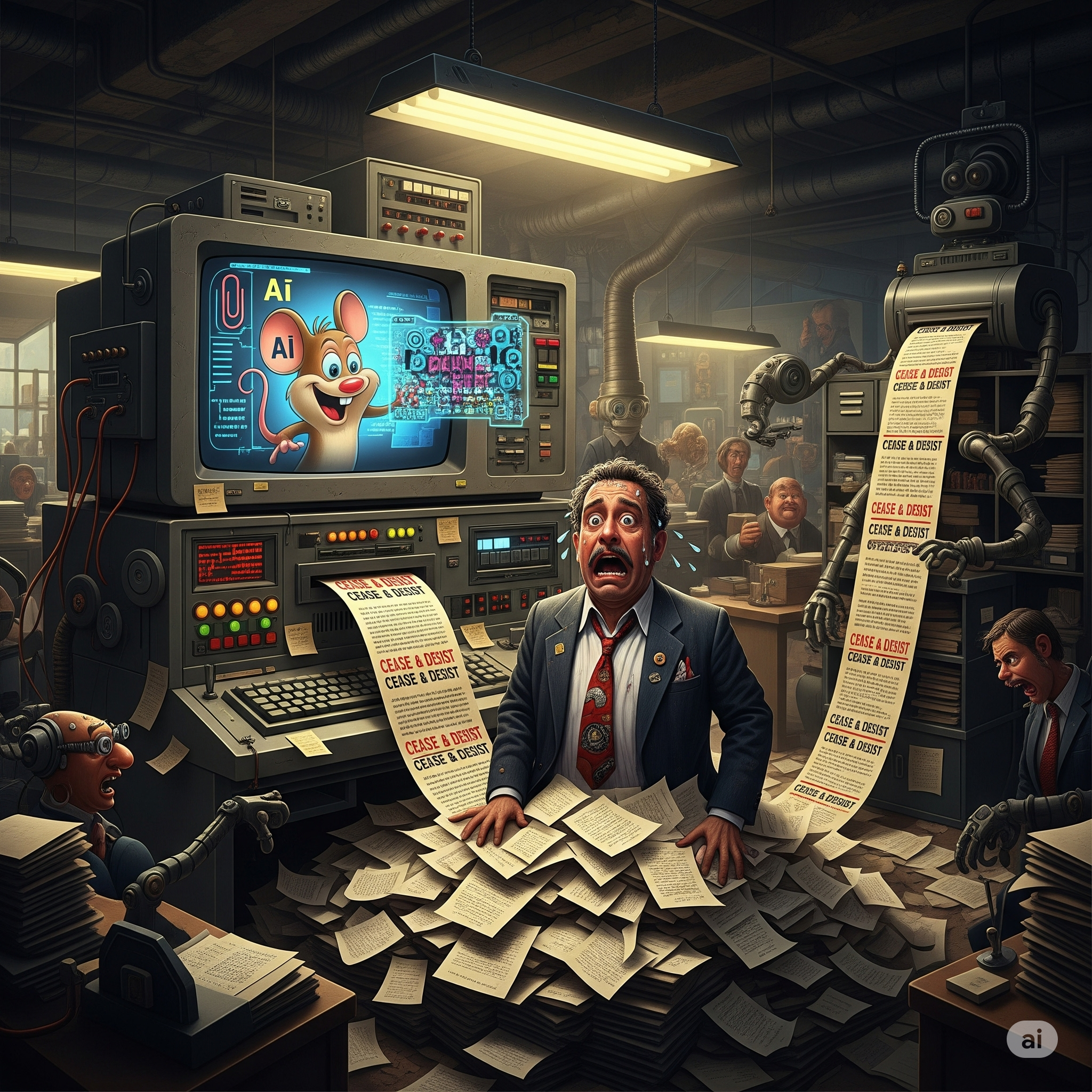
This is, of course, a terrible strategy, because while everyone is busy not looking, the bulldozer is not only getting closer, it’s also learning to draw a surprisingly good, yet legally dubious, cartoon mouse.
We live in an age of what is fashionably called “Agile,” a term which here seems to mean “The Art of Controlled Panic.” It’s a frantic, permanent state of trying to build the aeroplane while it’s already taxiing down the runway, fueled by lukewarm coffee and a deep-seated fear of the next quarterly review. For years, the panic-release valve was off-shoring. When a project was on fire, you could simply bundle up your barely coherent requirements and fling them over the digital fence to a team in another time zone, hoping they’d throw back a working solution before morning.
Now, we have perfected this model. AI is the new, ultimate off-shoring. The team is infinitely scalable, works for pennies, and is located somewhere so remote it isn’t even on a map. It’s in “The Cloud,” a place that is reassuringly vague and requires no knowledge of geography whatsoever.
The problem is, this new team is a bit weird. You still need that one, increasingly stressed-out human—let’s call them the Prompt Whisperer—to translate the frantic, contradictory demands of the business into a language the machine will understand. They are the new middle manager, bridging the vast, terrifying gap between human chaos and silicon logic. But there’s a new, far more alarming, item in their job description.
You see, the reason this new offshore team is so knowledgeable is because it has been trained by binge-watching the entire internet. Every film, every book, every brand logo, every cat picture, and every episode of every cartoon ever made. And as the ongoing legal spat between the Disney/Universal behemoth and the AI art platform Midjourney demonstrates, the hangover from this creative binge is about to kick in with the force of a Pan Galactic Gargle Blaster.
The issue, for any small business cheerfully using an AI to design their new logo, is one of copyright. In the US, they have a principle called “fair use,” which is a wonderfully flexible and often confusing set of rules. In the UK, we have “fair dealing,” which is a narrower, more limited set of rules that is, in its own way, just as confusing. If the difference between the two seems unclear, then congratulations, you have understood the central point perfectly: you are almost certainly in trouble.
The AI, you see, doesn’t create. It remixes. And it has no concept of ownership. Ask it to design a logo for your artisanal doughnut shop, and it might cheerfully serve up something that looks uncannily like the beloved mascot of a multi-billion-dollar entertainment conglomerate. The AI isn’t your co-conspirator; it’s the unthinking photocopier, and you’re the one left holding the legally radioactive copy. Your brilliant, cost-effective branding exercise has just become a business-ending legal event.
So, here we are, practicing the art of controlled panic on a legal minefield. The new off-shored intelligence is a powerful, dangerous, and creatively promiscuous force. That poor Prompt Whisperer isn’t just briefing the machine anymore; they are its parole officer, desperately trying to stop it from cheerfully plagiarizing its way into oblivion. The only thing that hasn’t “settled down” is the dust from the first wave of cease-and-desist letters. And they are, I assure you, on their way.
Every time you ask an AI a question, to write a poem, to debug code, to settle a bet, you are spinning a tiny, invisible motor in the vast, humming engine of the world’s server farms. But is that engine driving us towards a sustainable future or accelerating our journey over a cliff?
This is the great paradox of our time. Artificial intelligence is simultaneously one of the most power-hungry technologies ever conceived and potentially our single greatest tool for solving the existential crisis of global warming. It is both the poison and the cure, the problem and the solution.
To understand our future, we must first confront the hidden environmental cost of this revolution and then weigh it against the immense promise of a planet optimised by intelligent machines.
Part 1: The True Cost of a Query
The tech world is celebrating the AI revolution, but few are talking about the smokestacks rising from the virtual factories. Before we anoint AI as our saviour, we must acknowledge the inconvenient truth: its appetite for energy is voracious, and its environmental footprint is growing at an exponential rate.
The Convenient Scapegoat
Just a few years ago, the designated villain for tech’s energy gluttony was the cryptocurrency industry. Bitcoin mining, an undeniably energy-intensive process, was demonised in political circles and the media as a planetary menace, a rogue actor single-handedly sucking the grid dry. While its energy consumption was significant, the narrative was also a convenient misdirection. It created a scapegoat that drew public fire, allowing the far larger, more systemic energy consumption of mainstream big tech to continue growing almost unnoticed in the background. The crusade against crypto was never really about the environment; it was a smokescreen. And now that the political heat has been turned down on crypto, that same insatiable demand for power hasn’t vanished—it has simply found a new, bigger, and far more data-hungry host: Artificial Intelligence.
The Training Treadmill
The foundation of modern AI is the Large Language Model (LLM). Training a state-of-the-art model is one of the most brutal computational tasks ever conceived. It involves feeding petabytes of data through thousands of high-powered GPUs, which run nonstop for weeks or months. The energy consumed is staggering. The training of a single major AI model can have a carbon footprint equivalent to hundreds of transatlantic flights. If that electricity is sourced from fossil fuels, we are quite literally burning coal to ask a machine to write a sonnet.
The Unseen Cost of “Inference”
The energy drain doesn’t stop after training. Every single query, every task an AI performs, requires computational power. This is called “inference,” and as AI is woven into the fabric of our society—from search engines to customer service bots to smart assistants—the cumulative energy demand from billions of these daily inferences is set to become a major line item on the global energy budget. The projected growth in energy demand from data centres, driven almost entirely by AI, could be so immense that it risks cancelling out the hard-won gains we’ve made in renewable energy.
The International Energy Agency (IEA) is one of the most cited sources. Their projections indicate that global electricity demand from data centres, AI, and cryptocurrencies could more than double by 2030, reaching 945 Terawatt-hours (TWh). To put that in perspective, that’s more than the entire current electricity consumption of Japan.
The E-Waste Tsunami
This insatiable demand for power is matched only by AI’s demand for new, specialized hardware. The race for AI dominance has created a hardware treadmill, with new generations of more powerful chips being released every year. This frantic pace of innovation means that perfectly functional hardware is rendered obsolete in just a couple of years. The manufacturing of these components is a resource-intensive process involving rare earth minerals and vast amounts of water. Their short lifespan is creating a new and dangerous category of toxic electronic waste, a mountain of discarded silicon that will be a toxic legacy for generations to come.
The danger is that we are falling for a seductive narrative of “solutionism,” where the potential for AI to solve climate change is used as a blanket justification for the very real environmental damage it is causing right now. We must ask the difficult questions: does the benefit of every AI application truly justify its carbon cost?
Part 2: The Optimiser – The Planet’s New Nervous System
Just as we stare into the abyss of AI’s environmental cost, we must also recognise its revolutionary potential. Global warming is a complex system problem of almost unimaginable scale, and AI is the most powerful tool ever invented for optimising complex systems. If we can consciously direct its power, AI could function as a planetary-scale nervous system, sensing, analysing, and acting to heal the world.
Here are five ways AI is already delivering on that promise today:
1. Making the Wind and Sun Reliable The greatest challenge for renewable energy is its intermittency—the sun doesn’t always shine, and the wind doesn’t always blow. AI is solving this. It can analyze weather data with incredible accuracy to predict energy generation, while simultaneously predicting demand from cities and industries. By balancing this complex equation in real-time, AI makes renewable-powered grids more stable and reliable, accelerating our transition away from fossil fuels.
2. Discovering the Super-Materials of Tomorrow Creating a sustainable future requires new materials: more efficient solar panels, longer-lasting batteries, and even new catalysts that can capture carbon directly from the air. Traditionally, discovering these materials would take decades of painstaking lab work. AI can simulate molecular interactions at incredible speed, testing millions of potential combinations in a matter of days. It is dramatically accelerating materials science, helping us invent the physical building blocks of a green economy.
3. The All-Seeing Eye in the Sky We cannot protect what we cannot see. AI, combined with satellite imagery, gives us an unprecedented, real-time view of the health of our planet. AI algorithms can scan millions of square miles of forest to detect illegal logging operations the moment they begin. They can pinpoint the source of methane leaks from industrial sites and hold polluters accountable. This creates a new era of radical transparency for environmental protection.
4. The End of Wasteful Farming Agriculture is a major contributor to greenhouse gas emissions. AI-powered precision agriculture is changing that. By using drones and sensors to gather data on soil health, water levels, and plant growth, AI can tell farmers exactly how much water and fertilizer to use and where. This drastically reduces waste, lowers the carbon footprint of our food supply, and helps us feed a growing population more sustainably.
5. Rewriting the Climate Code For decades, scientists have used supercomputers to model the Earth’s climate. These simulations are essential for predicting future changes but are incredibly slow. AI is now able to run these simulations in a fraction of the time, providing faster, more accurate predictions of everything from the path of hurricanes to the rate of sea-level rise. This gives us the foresight we need to build more resilient communities and effectively prepare for the changes to come.
Part 3: The Final Choice
AI is not inherently good or bad for the climate. Its ultimate impact will be the result of a conscious and deliberate choice we make as a society.
If we continue to pursue AI development recklessly, prioritising raw power over efficiency and chasing novelty without considering the environmental cost, we will have created a powerful engine of our own destruction. We will have built a gluttonous machine that consumes our planet’s resources to generate distractions while the world burns.
But if we choose a different path, the possibilities are almost limitless. We can demand and invest in “Green AI”—models designed from the ground up for energy efficiency. We can commit to powering all data centres with 100% renewable energy. Most importantly, we can prioritize the deployment of AI in those areas where it can have the most profound positive impact on our climate.
The future is not yet written. AI can be a reflection of our shortsightedness and excess, or it can be a testament to our ingenuity and will to survive. The choice is ours, and the time to make it is now.