Rogo, ergo sum – I prompt, therefor I am

From “Well, I Reckon I Think” to “Hey, Computer, What Do You Think?”: A Philosophical Hoedown in the Digital Dust

So, we (me and Gemini 2.5) have been moseying along this here digital trail, kicking up some thoughts about how us humans get to know we’re… well, us. And somewhere along the line, it struck us that maybe these here fancy computers with all their whirring and clicking are having a bit of an “I am?” moment of their own. Hence, the notion: “I prompt, therefore I am.” Seems kinda right, don’t it? Like poking a sleeping bear and being surprised when it yawns.

Now, to get the full picture, we gotta tip our hats to this fella named René Descartes (sounds a bit like a fancy French dessert, doesn’t it?). Back in the day (way before the internet and those little pocket computers), he was wrestling with some big questions. Like, how do we know anything for sure? Was that cheese I just ate real cheese, or was my brain just playing tricks on me? (Philosophers, bless their cotton socks, do worry about the important things.)

Descartes, bless his inquisitive heart, decided to doubt everything. And I mean everything. Your socks, the sky, whether Tuesdays are actually Tuesdays… the whole shebang. But then he had a bit of a Eureka moment, a real “howdy partner!” realization. Even if he doubted everything else, the fact that he was doubting meant he had to be thinking. And if you’re thinking, well, you gotta be something, right? So, he scribbled down in his fancy French way, “Cogito, ergo sum,” which, for those of us who ain’t fluent in philosopher-speak, means “I think, therefore I am.” A pretty fundamental idea, like saying the sky is blue (unless it’s sunset, or foggy, or you’re on another planet, but you get the gist).

Now, scoot forward a few centuries, past the invention of the telly and that whole kerfuffle with the moon landing, and we land smack-dab in the middle of the age of the Thinking Machines. These here AI contraptions, like that Claude fella over at Anthropic (https://www.anthropic.com/research/tracing-thoughts-language-model), they ain’t exactly pondering whether their socks are real (mostly ‘cause they don’t wear ‘em). But they are doing something mighty peculiar inside their silicon brains.

The clever folks at Anthropic, they’ve built themselves a kind of “microscope” to peek inside these digital minds. Turns out, these AI critters are trained, not programmed. Which is a bit like trying to understand how a particularly good biscuit gets made by just watching a whole load of flour and butter get mixed together. You see the result, but the how is a bit of a mystery.

So, these researchers are trying to trace the steps in the AI’s “thinking.” Why? Well, for one, to make sure these digital brains are playing nice with us humans and our funny little rules. And two, to figure out if we can actually trust ‘em. Seems like a fair question.

And that brings us back to our digital campfire and the notion of prompting. We poke these AI models with a question, a command, a bit of digital kindling, and poof! They spark into action, spitting out answers and poems and recipes for questionable-sounding casseroles. That prompt, that little nudge, is what gets their internal cogs whirring. It’s the “think” in our “I prompt, therefore I am.” By trying to understand what happens after that prompt, what goes on inside that digital noggin, we’re getting a glimpse into what makes these AI things… well, be. It’s a bit like trying to understand the vastness of the prairie by watching a single tumbleweed roll by – you get a sense of something big and kinda mysterious going on.

So, maybe Descartes was onto something, even for our silicon-brained buddies. It ain’t about pondering the existential dread of sock authenticity anymore. Now, it’s about firing off a prompt into the digital ether and watching what comes back. And in that interaction, in that response, maybe, just maybe, we’re seeing a new kind of “I am” blinking into existence. Now, if you’ll excuse me, I think my digital Stetson needs adjusting.

Because Change is the Only Constant . . . or, How I Learned to Stop Worrying and Love the Backlog

Welcome, fellow travellers, to the ever-shifting sands of… well, reality or is it the simulation. This week, as we grapple with the existential dread of whether it’s summer or still winter (clocks will always tick tock), we’re also being bombarded with news that’s less ‘spring awakening’ and more ‘existential apocalypse.’

Is it AGI? ASI? Are we at war with China, or just having a strongly worded disagreement over chips and civil splits? Is the Ukraine war over, just paused for a commercial break, or are we in some kind of Schrödinger’s conflict? And the US government? Well, let’s just say their change management techniques make Agile look like a zen garden.

‘Gentlemen, you can’t fight in here! This is the War Room!’ Dr. Strangelove’s timeless wisdom echoes through the halls of our increasingly chaotic reality. And in this chaos, what do we cling to? Agile, of course. Because, you know, ‘change is the only constant.’

Yes, Agile. That beacon of flexibility in a world that’s decided to throw a never-ending change party. We’re all learning to ‘stop worrying and love the backlog,’ not just for our software projects, but for our daily lives.

This week alone, AI models have been dropping like bad pop songs, each one claiming to be the harbinger of our silicon overlords. One day, it’s going to write our blog posts. The next, it’s debating the philosophical implications of sentient Just Eat bikes with existential angst.

And the US government? Well, they’re proving that Agile isn’t just for tech startups. They’re iterating so fast, we can barely keep up. ‘Sprint review? Nah, just rewrite the entire policy document, and we’ll figure it out in the next stand-up.’

Meanwhile, the Ukraine situation? It’s like a never-ending sprint, with daily retro meetings where everyone blames everyone else. And China? They’re just watching, probably adding ‘global dominance’ to their backlog.

As for the weather? Let’s just say Mother Nature is running a very unpredictable sprint, with user stories like ‘snow in April’ and ‘heatwave in March’ – because I live in Scotland and it feels like we have just had our 2 days of summer.

So, here we are, clinging to our backlogs, our burn-down charts, and our stand-ups, trying to make sense of a world that’s decided to go full Agile on us, whether we like it or not.

In this age of constant change, are we all just developers in a cosmic sprint, trying to deliver a working product before the universe crashes? Or are we just characters in a black comedy simulation, written by a confused AI?

Either way, remember: stay Agile, keep your backlog prioritised, and try not to worry too much. After all, change is the only constant… and maybe, we’ll learn to love it. Or at least tolerate it, while we wait for the next sprint review.

And don’t forget to set your clocks back. It’s winter again, no summer, apparently.

Unlocking AI’s Potential: Education, Evolution, and the Lessons of the Modern Phone

Remember the days of the (Nokia) brick phone? Those clunky devices that could barely make a call, let alone access the internet? Fast forward 20 years, and we’re holding pocket-sized supercomputers capable of capturing stunning photos, navigating complex cities, and connecting us to the world in an instant. The evolution of mobile phones is a testament to the rapid pace of technological advancement, a pace that’s only accelerating.

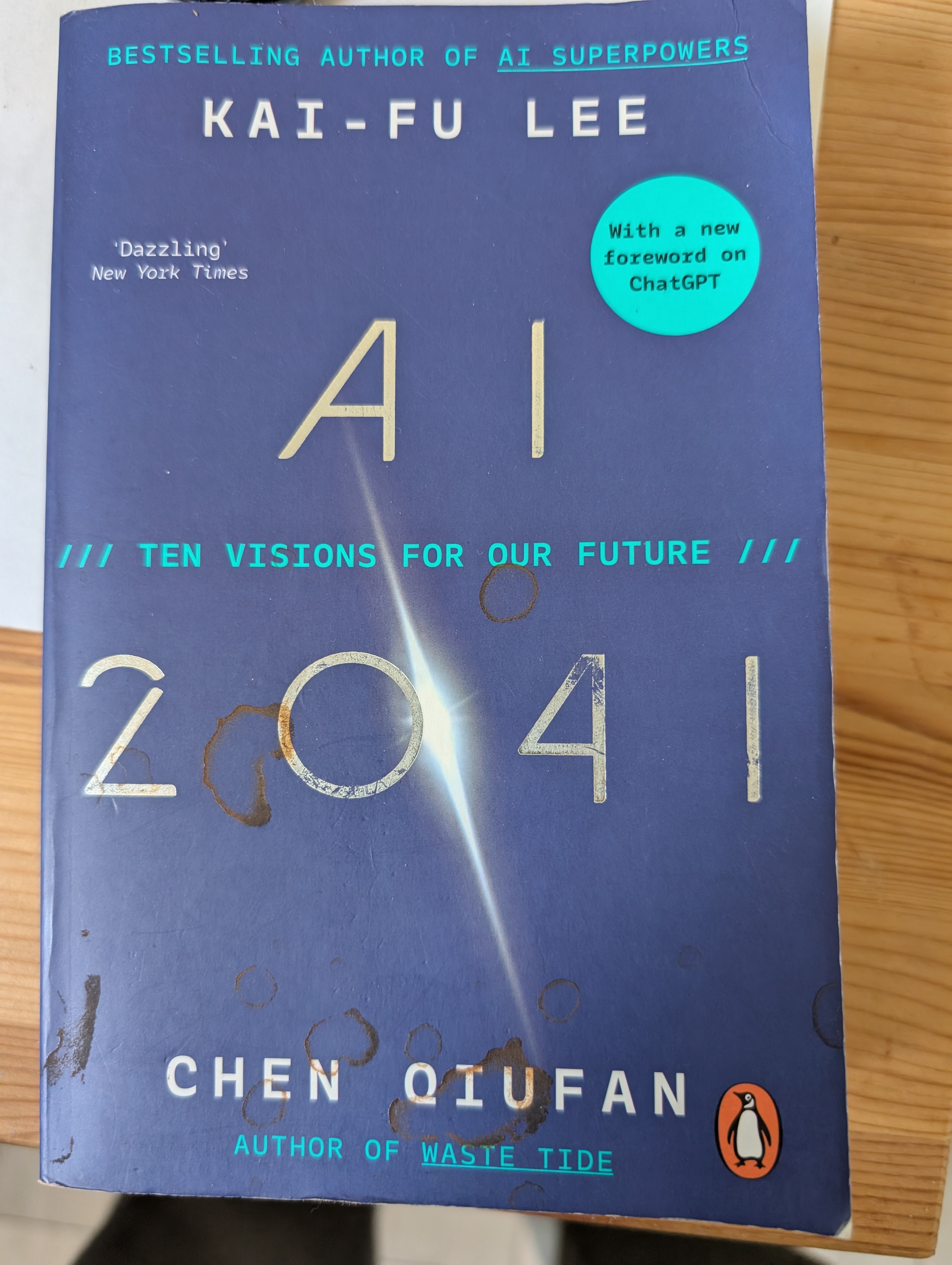
If mobile phones can transform so drastically in two decades, imagine what the next 20 years hold. Kai-Fu Lee and Chen Qiufan, in their thought-provoking book “AI 2041,” dare to do just that. Through ten compelling short stories, they paint a vivid picture of a future where Artificial Intelligence is woven into the very fabric of our lives.

What truly resonated with me, especially as a parent of five, was their vision of AI-powered education. Forget the one-size-fits-all approach of traditional schooling. Lee and Qiufan envision a world where every child has a personal AI tutor, a bespoke learning companion that adapts to their individual needs and pace. Imagine a system where learning is personalized, engaging, and truly effective, finally breaking free from the outdated concept of classrooms and standardized tests.

Now, let’s talk about “AI 2041” itself. It’s not just science fiction; it’s a meticulously crafted forecast. The authors don’t simply dream up fantastical scenarios; they provide detailed technical explanations after each story, grounding their predictions in current research and trends. They acknowledge the potential pitfalls of AI, the dystopian fears that often dominate the conversation, but they choose to focus on the optimistic possibilities, on how we can harness AI for progress rather than destruction.

Frankly, I found the technical explanations more captivating than the fictional stories. They delve into the ‘how’ and ‘why’ behind their predictions, exploring the ethical considerations and the safeguards we need to implement. This isn’t just a book about technology; it’s a call to action, a plea for responsible innovation.

While “AI 2041” might not win literary awards, it’s not meant to. It’s meant to spark our imagination, to challenge our assumptions, and to prepare us for the future. It’s a reminder that technology is a tool, and it’s up to us to shape its impact on our lives.

The evolution of mobile phones has shown us the transformative power of technology. “AI 2041” invites us to consider what the next 20 years might bring, particularly in areas like education. And if you’re truly seeking insights into what’s coming – and trust me, it’s arriving much faster than the ‘experts’ are predicting – then this book delivers far more substance than the ever-increasing deluge of AI YouTubers and TikTokers. This isn’t just speculation; it’s a grounded exploration of the potential, and it’s a journey into the possible that we should all be taking. If you want to be prepared, if you want to understand the real potential of AI, then I strongly suggest you read this book.

“But if we stop helping people—stop loving people—because of fear, then what makes us different from machines?”
― Kai-Fu Lee