How Humanity Turned Itself into an Unclaimed Baggage Auction
If you listen closely late at night, past the hum of the server farms and the forlorn rattle of an electric bus carrying two shift-workers and an empty Lucozade bottle, you can hear it: the sound of eight billion people quietly setting their status to “Away.”
Yesterday, we established that the planetary population collapse isn’t a fiery armageddon; it’s a scheduled corporate wind-down. Today, we must address the sheer, unhinged logistical comedy of what happens when the closing-down sale actually begins.
Because nobody planned for the physical inventory.
For three hundred years, the global economy ran on one fundamental pyramid scheme: an ever-expanding base of young, caffeinated plebs willing to trade forty hours a week of daylight for the vague promise of an electric kettle, a pebble-dashed semi, and an uninterrupted retirement watching snooker. But the base of that pyramid hasn’t just eroded—it has dissolved like a cheap digestive biscuit dropped into lukewarm Earl Grey.
We are entering the era of the Great De-cluttering. And brother, the market is completely illiquid.
Phase One: The Real Estate Graveyard Shift
Let’s begin with the concrete.
Across the developed world, we spent the last four decades treating bricks and mortar not as shelters against the rain, but as sovereign wealth funds disguised as kitchens. Entire generations were told that the highest form of spiritual enlightenment was outbidding a couple from Basingstoke by £40,000 for a three-bed terrace with rising damp, because “property only ever goes up.”
Well, yes. Up until the precise mathematical moment when there are more front doors than living human beings to turn the keys.
Consider the suburban ring roads of 2040. What happens to the £1.4 million mock-Tudor executive homes in Surrey, the beige sprawl of Milton Keynes, or the sterile condominium towers lining the Pearl River Delta when the final boomer ascends to the great golf course in the sky?
There is no one to buy them.
The twenty-somethings aren’t saving for a deposit; they’re living in modular pods, subsisting on ambient algorithmic praise, and dedicating their disposable income to maintaining the hydraulic seals on their synthetic emotional-support badgers.
The housing market won’t crash—it will simply vaporise. We will see local councils begging squatters to occupy five-bedroom detached houses just to stop the buddleia roots from tearing through the foundation slab. Estate agents—historically the most resilient parasitic lifeform on earth, capable of surviving nuclear fallout alongside cockroaches—will be reduced to roadside hawkers:
“Please. It’s got an integrated Neff double oven and an en-suite with travertine tiles. If you sleep here tonight, we’ll give you a voucher for an oat latte and a tin of shortbread. Just keep the radiator on frost-stat, we beg of you.”
In Japan, they already have millions of akiya—ghost houses rotting quietly in the bamboo groves. Soon, the entire Western commuter belt will follow suit. The M25 will be an open-air archaeological ruin, where future nomadic tribes forage for copper piping inside abandoned David Wilson showhomes, marveling at the strange primitive shrines known as “kitchen islands.”
The Sovereign Liquidity Trap: A Nation of Three Taxpayers
Now, examine the treasury spreadsheets.
Every modern state is currently running a Ponzi scheme so brazen that if it were pitched on Dragons’ Den, Peter Jones would have the Chancellor escorted from the building by security. The setup is simple: today’s public services and triple-locked pensions are paid for entirely by the tax harvest extracted from the current crop of thirty-year-olds.
Except the crop failed.
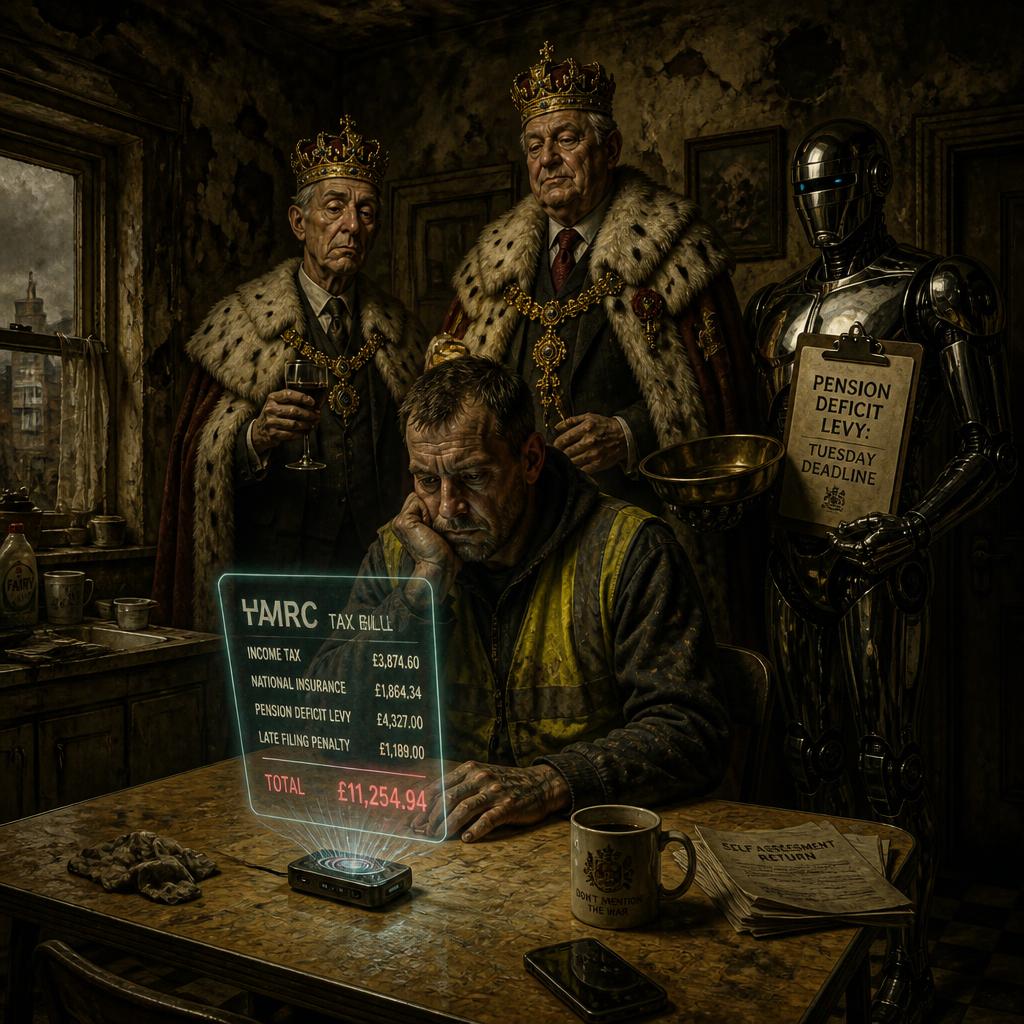
By the mid-2030s, the entire United Kingdom will effectively be funded by three exhausted software engineers in Bristol, an offshore wind turbine technician in Aberdeen, and a bloke named Dave who runs a niche plumbing franchise in Leeds.
Imagine the pressure on Dave.
The Chancellor will deliver the Autumn Statement directly to Dave’s kitchen table:
- The Health Levy: Dave must personally pay for 14,000 hip replacements before Tuesday.
- The Infrastructure Surcharge: Dave’s plumbing van is now classed as a tier-one sovereign asset; his MOT failure could trigger a run on the pound.
- The Defence Contribution: If Dave takes a sick day, the Royal Navy will have to mothball its remaining aircraft carrier and sell the flight deck for roller-derby tournaments.
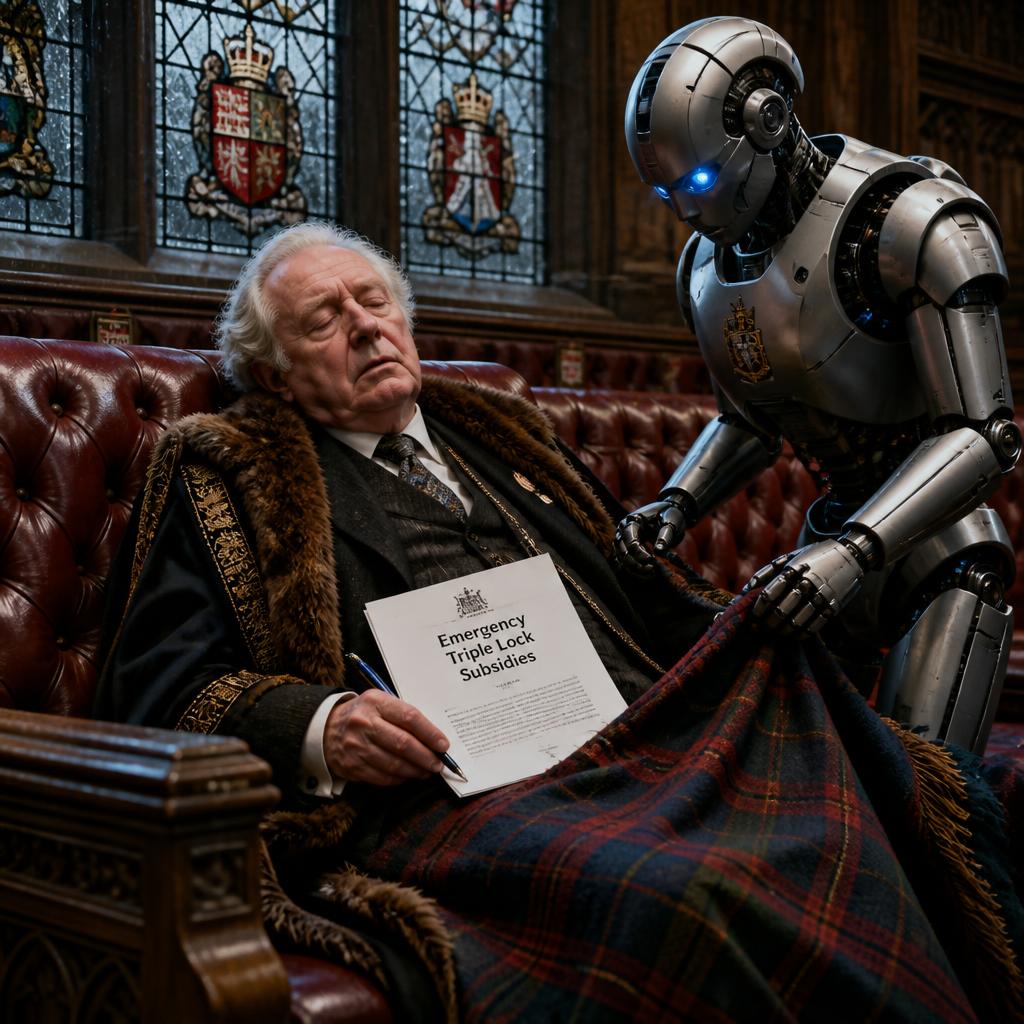
Meanwhile, the grey voting bloc—clinging to power with the terrifying, unyielding grip of an arthritic hawk—will continue to demand a guaranteed 8% annual state pension uplift, heavily subsidised sherry at community centres, and total legislative bans on anyone playing music after 4:15 PM.
The generational contract won’t break through violent revolution. The youth won’t storm the barricades; barricades require physical exertion, and their smartwatches will flag elevated cortisol levels and recommend a mindfulness breathing exercise. Instead, the young will simply ghost the state. They will slip into the untaxable ether of local cryptographic mesh-nets, swap synthetic assets under the radar, and leave the sovereign state holding a massive, empty bucket labeled PENSION LIABILITIES.
The Rise of the Palliative Plutocracy
So what does the endgame look like? If the youth refuse to breed and the state cannot afford to keep the lights on, the market will do what it always does: privatise the extinction curve.
Welcome to The Palliative Economy.
When the demand for prams, school uniforms, and first-time mortgages hits absolute zero, capital will pivot to the only growth sector remaining: high-margin, automated decrepitude.
- Amazon Prime Palliative: For £79 a month, an autonomous drone will hover outside your bedroom window, drop a packet of paracetamol and a lukewarm soup onto your balcony, and project a hologram of a smiling virtual granddaughter who asks about your wartime memories for precisely six minutes before buffering.
- Algorithmic Probate: Why leave assets to non-existent children? Private equity firms are already drafting the paperwork for “Reverse Life Mortgages.” You surrender your house, your heirlooms, and your grandfather’s watch; in return, an AI-monitored titanium chassis turns you over every forty minutes to prevent bedsores and pumps continuous, mild euphoria-inducing vapor through the central heating.
- The Sovereign Exit Lounge: Switzerland’s suicide capsules were merely the luxury prototype. The mass-market version will be sponsored by a utility provider. “Switch your gas, electric, and terminal hospice care to British Gas EOL™ today, and receive a free commemorative mug.”
The high streets won’t be filled with coffee shops or clothing boutiques. They will be an uninterrupted strip of hearing-aid repair shops, tactical mobility-scooter dealerships, and “Memory Lounges,” where childless octogenarians pay £15 an hour to plug into a virtual simulation of a 1996 Sainsbury’s, just to experience the thrill of a crowded aisle and the beep of a barcode scanner again.
The Silent Victory of the Planet
Yet, amidst this dystopian twilight, there is an undeniably magnificent punchline.
We spent decades worrying that our destruction would be theatrical. We wrote novels about nuclear winters, made blockbusters about asteroid impacts, and held solemn conferences about catastrophic global warming boiling the oceans. We assumed our demise would require an enormous, operatic crescendo of human hubris.
Instead, we are simply putting down our tools, climbing into bed, pulling the duvet over our heads, and letting the battery run down.
In a hundred years, when the last care home power unit finally trips its breaker in Eastbourne, the silence will be absolute.
No more hedge fund presentations. No more LinkedIn posts celebrating “synergistic cross-vertical enablement.” No more WhatsApp group chats about boundary fences, school catchments, or interest rates.
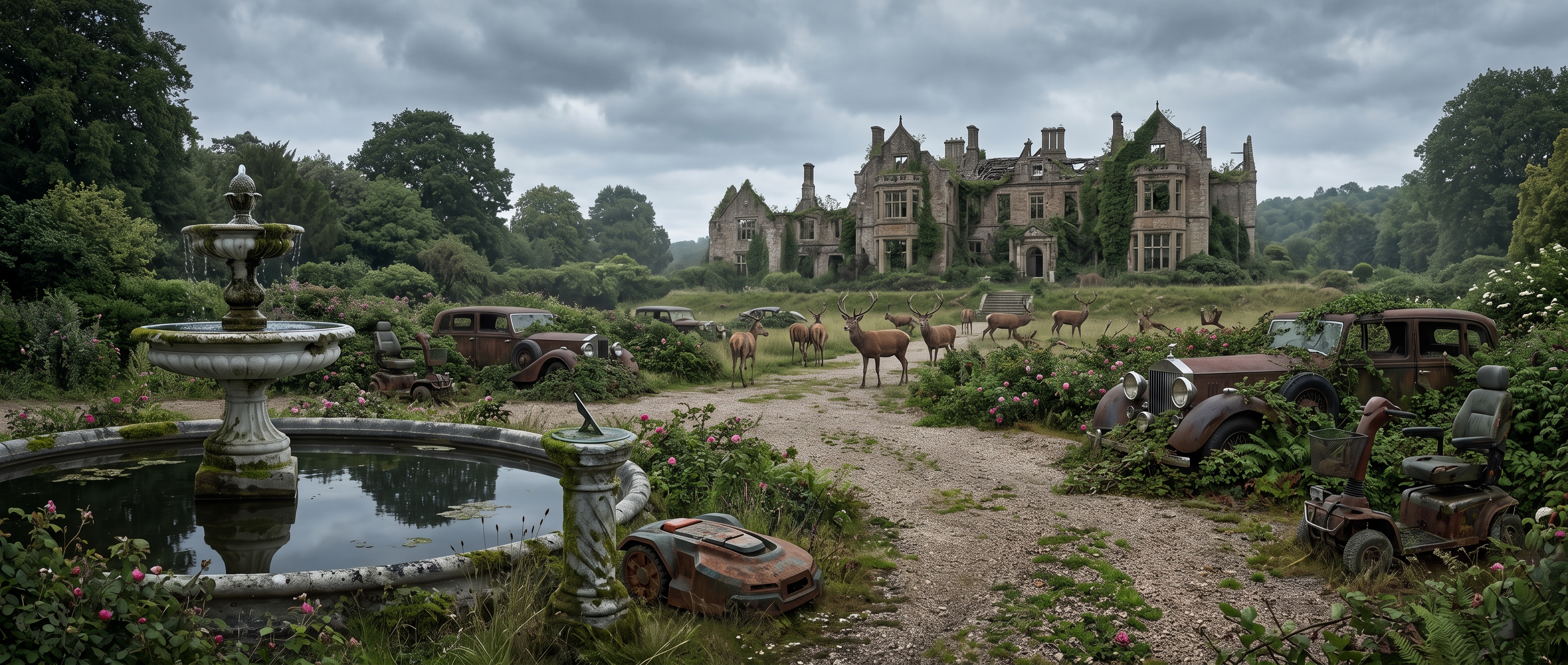
The weeds will finish their slow, methodical conquest of the M1. The foxes will establish thriving, democratic councils inside the ruins of the Bank of England. The microplastics will slowly settle beneath a fresh layer of topsoil, and the planet will take a long, deep, icy breath—stretching its limbs after a brief, deeply irritating two-hundred-year fever called Industrial Humanity.
The simulation admins won’t even need to hold down the power button. The system will have simply completed its idle timer, faded the monitor to black, and slipped peacefully into sleep mode.
And honestly? As closing acts go, there’s a strange, quiet dignity in that. Just remember to turn the hall light off before you go.
 Shiel Yule