We’ve identified the enemy. It is the Activity Demon, the creature that feeds on the performance of work and starves the business of results. We know its weakness: the cold, hard language of the balance sheet.
Now, we move from defence to offence.
A resistance cannot win by writing a better play; it must sabotage the production itself. For each of the five acts in the SHAPE framework, there is a counter-measure—a piece of tactical sabotage designed to disrupt the performance and force reality onto the stage. This is the saboteur’s handbook.
Sabotage Tactic #1: To Counterfeit Strategic Agility… Build the Project Guillotine. The performance of agility is a carefully choreographed dance of rearranging timelines. The sabotage is to build a real consequence engine. Every project begins with a public, metric-driven “kill switch.” If user adoption doesn’t hit 10% in 45 days, the project is terminated. If it doesn’t reduce server costs by X amount in 90 days, it’s terminated. The guillotine is automated. It requires no committee, no appeal. It makes pivoting real because the alternative is death, not just a rewrite.
Sabotage Tactic #2: To Counterfeit Human Centricity… Give the Audience a Veto. The performance of empathy is the scripted Q&A where softballs are thrown and no one is truly heard. The sabotage is to form a “User Shadow Council”—a rotating group of the actual end-users who will be most affected. They are given genuine power: a non-negotiable veto at two separate stages of development. It’s no longer a performance of listening; it’s a hostage negotiation with the people you claim to be helping.
Sabotage Tactic #3: To Counterfeit Applied Curiosity… Make the Leaders Bleed. The performance of curiosity is delegating “exploration” to a junior team. The sabotage is the “Blood in the Game” rule. Once a quarter, every leader on the executive team must personally run a small, cheap, fast experiment and present their raw, unfiltered findings. No proxies. No polished decks. They must get their own hands dirty to show that curiosity is a messy, risky practice, not a clean performance watched from a safe distance.
Sabotage Tactic #4: To Counterfeit Performance Drive… Chain the Pilot to its Scaled Twin. The performance of drive is the standing ovation for the pilot, with no second act. The sabotage is the “Scaled Twin Mandate.” No pilot program can receive funding without an accompanying, pre-approved, fully-funded scaling plan. The moment the pilot meets its success criteria, that scaling plan is automatically triggered. The pilot is no longer the show; it’s just the fuse on the rocket.
Sabotage Tactic #5: To Counterfeit Ethical Stewardship… Unleash the Red Team. The performance of ethics is a PR clean-up operation. The sabotage is to fund an independent, internal “Red Team” from day one. Their sole purpose is to be a hostile attacker. Their job is to find and publicly expose the project’s ethical flaws and biases. Their success is measured by how much damage they can do to the project before it ever sees the light of day. This makes ethics a core part of the design, not the apology tour.
These tactics are dangerous. They will be met with resistance from those who are comfortable in the theater. But the real horror isn’t failing. The real horror is succeeding at a performance that never mattered, while the world outside the theatre walls moved on without you. The set is just wood and canvas. It’s time to start tearing it down.
So, LinkedIn, in its infinite, algorithmically-optimised wisdom, sent me an email and posed a question: Has generative AI transformed how you hire?
Oh, you sweet, innocent, content-moderated darlings. Has the introduction of the self-service checkout had any minor, barely noticeable effect on the traditional art of conversing with a cashier? Has the relentless efficiency of Amazon Prime in any way altered our nostalgic attachment to a Saturday afternoon browse down the local high street? Has the invention of streaming services had any small impact on the business model of your local Blockbuster video?
Yes. Duh.
You see, the modern hiring process is no longer about finding a person for a role. It is a wonderfully ironic Turing Test in reverse. The candidate, a squishy carbon-based lifeform full of anxieties and a worrying coffee dependency, uses a vast, non-sentient silicon brain to convince you they are worthy. You, another squishy carbon-based lifeform, must then use your own flawed, meat-based intuition to decide if the ghost in their machine is a good fit for the ghost in your machine.
The CV is dead. It is a relic, a beautifully formatted PDF of lies composed by a language model that has read every CV ever written and concluded that the ideal candidate is a rock-climbing, volunteer-firefighting, Python-coding polymath who is “passionate about synergy.” The cover letter? It’s a work of algorithmically generated fiction, a poignant, computer-dreamed ode to a job it doesn’t understand for a company it has never heard of.
So, are you hiring a person, or the AI-powered spectre of that person? A LinkedIn profile is no longer a testament to a career; it’s a monument to successful prompt engineering.
To truly prove consciousness in 2025, a candidate needs a blog. A podcast. A YouTube channel where they film themselves, unshaven and twitching, wrestling with a piece of code while muttering about the futility of existence. We require a verifiable, time-stamped proof of life to show they haven’t simply outsourced their entire professional identity to a subscription service.
Meanwhile, the Great Career Shuffle accelerates. An entire car-crash multitude of ex-banking staff, their faces etched with the horror of irrelevance, are now desperately rebranding as “AI strategists.” The banks themselves are becoming quaint, like steam museums, while the real action—the glorious, three-month contracts of frantic, venture-capital-fueled chaos—is in the AI startups.
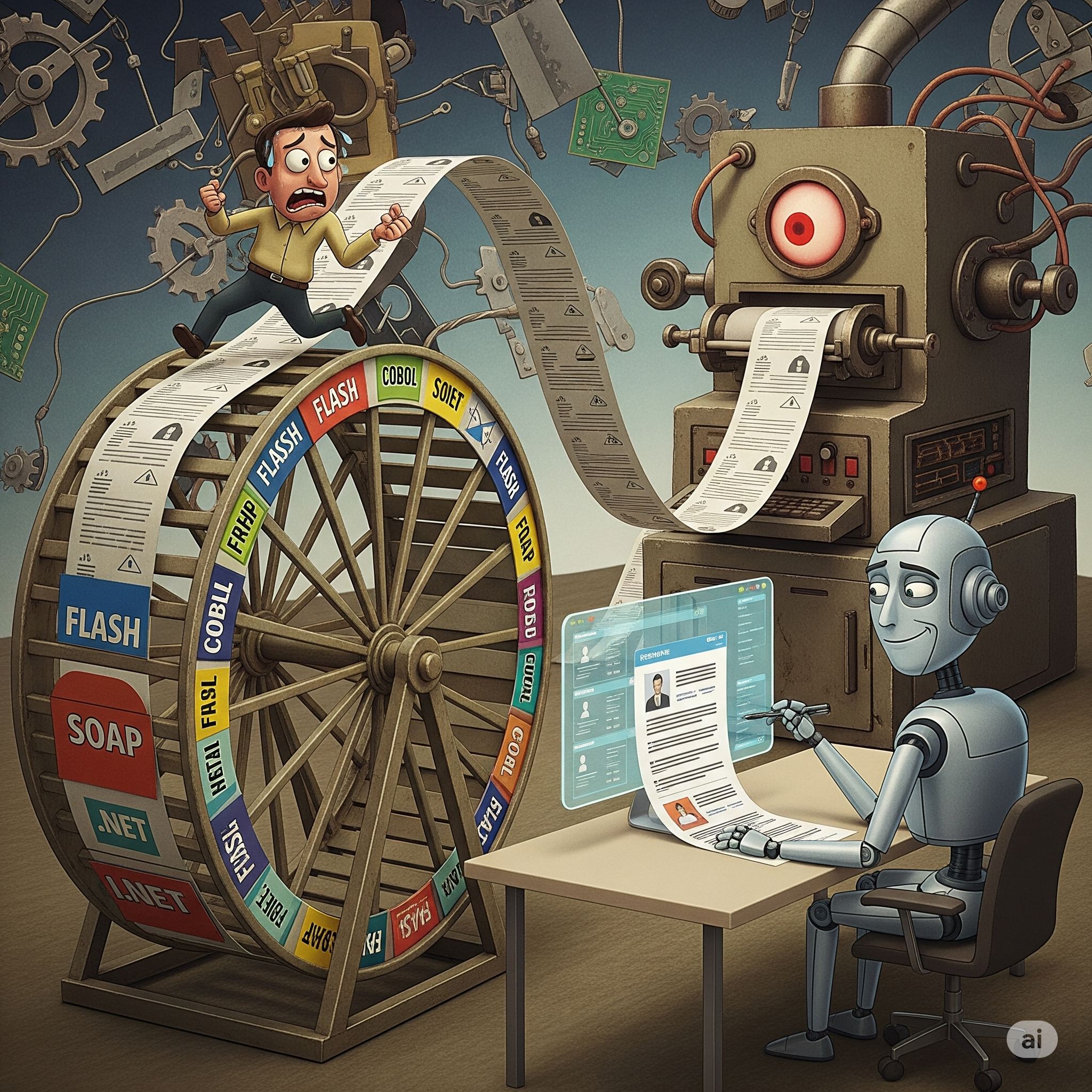
It all feels so familiar. It’s that old freelance feeling, where your CV wasn’t a document but a long list of weapons in your arsenal. You needed a bow with a string for every conceivable software battle. One week it was pure HTML+CSS. The next, you were a warrior in the trenches of the Great Plugin Wars, wrestling the bloated, beautiful behemoth of Flash until, almost overnight, it was rendered obsolete by the sleek, sanctimonious assassin that was HTML5.
The backend was a wilder frontier. A company demanded you wrestle with the hydra of PHP, be it WordPress, Drupal, or the dark arts of Magento if a checkout was involved. For a brief, shining moment, everything was meant to be built on the elegant railway tracks of Ruby. Then came the Javascript Tsunami, a wave so vast it swept over both the front and back ends, leaving a tangled mess that developers are still trying to untangle to this day.
And the enterprise world? A mandatory pilgrimage to the great, unkillable temple of Java. The backend architecture evolved from the stuffy, formal rituals of SOAP APIs to the breezy, freewheeling informality of REST. Then came the Great Atomisation, an obsession with breaking monoliths into a thousand tiny microservices, putting each one in a little digital box with Docker, and then hiring an entirely new army of engineers just to plumb all the boxes back together again. If you had a bit of COBOL, the banks would pay you a king’s ransom to poke their digital dinosaurs. A splash of SQL always won the day.
On top of all this, the Agile evangelists descended, an army of Scrum Masters who achieved sentience overnight and promptly promoted themselves to “Agile Coaches,” selling certifications and a brand of corporate mindfulness that fixed precisely nothing. All of it, every last trend, every rise and fall and rise again of Java, was just a slow, inexorable death march towards the beige, soul-crushing mediocracy of the Microsoft stack—a sprawling empire of .NET and Azure so bland and full of holes that every junior hacker treats it as a welcome mat.
AI is just the latest, shiniest weapon to add to the rack.
So, in the spirit of this challenge, here are my Top Tips for Candidates Navigating This New World:
Stop Writing Your CV. Your new job is to become the creative director for the AI that writes your CVs for you. Learn its quirks. Feed it your soul. Your goal is not to be the best candidate, but to operate the best candidate-generating machine.
Manufacture Authenticity. That half-finished blog post from 2019? Resurrect it. That opinion you had about coffee? Turn it into a podcast. Your real CV is your digital footprint. Prove you exist beyond a series of prompts.
Embrace Glorious Insecurity. The job you’re applying for will be automated, outsourced, or rendered utterly irrelevant by a new model release in six months anyway. Stop thinking about a career ladder. There is no ladder. There is only a chaotic, unpredictable, exhilarating wave. Learn to surf.
The whole thing is, of course, gloriously absurd. We are using counterfeit intelligence to apply for counterfeit jobs in a counterfeit economy. And we have the audacity to call it progress.
Gather round, citizens, and breathe a collective sigh of relief. Our benevolent government, in its infinite wisdom, has finally decided to protect us from the most terrifying threat of our age: unregulated thoughts. The Online Safety Act, a wonderful bipartisan effort, is here to make sure the internet is finally as safe and predictable as a wet weekend in Bognor.
First, we must applaud the sheer genius of criminalising any “false” statement that might cause “non-trivial psychological harm.” Finally, a law to protect us from the sheer agony of encountering an opinion we disagree with online. The Stasi could only have dreamed of such a beautifully subjective tool for ensuring social harmony. Worried that someone on the internet might be wrong about something? Fear not! The state is here to shield your delicate psyche.
And in a masterstroke of efficiency, a single government minister can now change the censorship rules on a whim, without any of that bothersome Parliamentary debate. It seems we’ve finally streamlined the messy business of democracy into a much more efficient, top-down model. Dictators of old, with their tedious committees and rubber-stamp parliaments, would be green with envy at such elegant power.
Already, our social media feeds are becoming so much tidier. Those messy videos of protests outside migrant hotels and other “harmful” displays of public opinion are being quietly swept away. And with the threat of fines up to 10% of their global turnover, our favourite tech giants are now wonderfully motivated to keep our digital spaces free from anything . . . well, inconvenient.
Don’t you worry about those private, encrypted chats on WhatsApp and Signal, either. The government would just like a quick peek, purely for safety reasons, of course. The 20th century had secret police opening your letters and tapping phone lines; we have just modernised the service for the digital age. It’s reassuring to know our government care so much.
But the true genius of this plan is how it protects the children. By making the UK internet a heavily monitored and censored walled garden, we are inadvertently launching the most effective digital literacy program in the nation’s history. Demand for VPNs has surged as everyone, children included, learns how to pretend they are in another country. We are not just protecting them; we’re pushing them with gusto into the thrilling, unregulated wilderness of the global internet.
And now, with the rise of AI, this “educational initiative” is set to accelerate. The savvy will not just use VPNs; they’ll deploy AI-powered tools that can dynamically generate new ways to bypass filters, learning and adapting faster than any regulator can keep up. Imagine a teenager asking a simple AI agent to “rewrite this request so it gets past the block,” a process that will become as second nature as using a search engine is today.
This push towards mandatory age verification and content filtering draws uncomfortable parallels. While the UK’s Online Safety Act is framed around protection, its methods—requiring platforms to proactively scan and remove content, and creating powers to block non-compliant services—rhyme with the architecture of China’s “Great Firewall.” The core difference, for now, is intent. China’s laws are explicitly designed to suppress political dissent and enforce state ideology. The UK’s act is designed to protect users from harm. Yet both result in a state-sanctioned narrowing of the open internet.
The comparison to North Korea is, of course, hyperbole, but it highlights a worrying trend. Where North Korea achieves total information control through an almost complete lack of internet access for its citizens, the UK is achieving a different kind of control through legislation. By creating a system where access to the global, unfiltered internet requires active circumvention, we are creating a two-tiered digital society: a sanitised, monitored internet for the masses, and the real internet for those with the technical skills to find the back door. What a wonderful way to prepare our youth for the future.
And to enforce this new digital conformity, a brand-new police unit will be monitoring our social media for any early signs of dissent. A modern-day Stasi for the digital age, or perhaps Brown Shirts for the broadband generation, tasked with ensuring our online chatter remains on-brand. It’s a bold move, especially when our existing police force finds it challenging enough to police our actual streets. But why bother with the messy reality of physical crime when you can ascend to the higher calling of policing our minds? Why allocate resources to burglaries when you can hunt down a non-compliant meme or a poorly phrased opinion?
It’s comforting to know that our new Digital Thought Police are watching. While this Sovietisation of Britain continues at a blistering pace, one can’t help but feel they’ve neglected something. Perhaps they could next legislate against bad weather? That causes me non-trivial psychological harm on a regular basis. But then again, democracy was a lovely idea, wasn’t it? All that messy debate and disagreement. This new, state-approved quiet is much more orderly.
One of the useful things I have learned from the various companies I have worked for over the past 20 years, is the idea of a ‘pre-mortem’. Let us use a “Brand Campaign” as a metaphor to highlight 11 areas you can evaluate (criticise) your teams before spending a penny.
Ways Your Brand Campaign Will Die (And How to Resurrect It Before It’s Too Late)
The pre-mortem, that delightful exercise in corporate masochism where we imagine our shiny new project as a bloated, beached whale and then dissect it for clues. Think of it as blame-storming, but with less crying and more ‘I told you so’ smugness. You know, for those moments when you want to be right, even if it means watching your budget implode.
So lets use an imaginary startup, “Crapyco”, bless their naive hearts, decided to take some sage brand guru advice about marketing. They threw millions at a campaign, and… well, let’s just say it didn’t go as planned. It was less ‘viral sensation’ and more ‘digital tumbleweed.’ Here’s how they managed to turn a golden opportunity into a steaming golden turd.
1. The ‘Did It Work?’ Existential Crisis.
They stared at the data like a group of bewildered meerkats, unable to agree if their campaign was a roaring success or a damp squib. Timeframes, expectations, reality—all blurred into a confusing mess. Because, you see, they’d skipped the whole ‘setting measurable goals’ part. No baselines, no KPIs, no ‘if we hit this, we’re doing great’ markers. It was like trying to navigate a map with no landmarks, or asking a fish to judge a tree-climbing competition. The numbers just sat there, cold and meaningless, refusing to reveal their secrets.
2. The CEO/CFO Power Struggle (aka, ‘Who’s Pulling the Plug?’).
Two weeks in, the plug got pulled. Turns out, ‘disagree and commit’ is corporate code for ‘I’m going to sabotage you at the first opportunity, just in case this whole thing implodes, and I need someone to blame.’ It’s like trying to launch a rocket with one of the boosters on backward, while the CEO, who thinks he’s an astronaut, is yelling contradictory commands from the back, and the CFO, who secretly believes numbers are just suggestions, is quietly calculating how much they can write off as a ‘learning experience’.
3. Targeting: Are We Talking to Aliens?
They aimed at ‘everyone,’ which, in modern marketing parlance, translates to ‘we’re throwing spaghetti at a wall and hoping some of it sticks to sentient dust motes.’ Because, apparently, the concept of a ‘target audience’ is now as outdated as dial-up modems and sensible trousers. Everyone’s a snowflake, a unique and precious snowflake, and you can’t possibly lump them together into, like, groups or something. It’s like trying to find a specific grain of sand on a beach using a telescope, while simultaneously trying to sell that telescope to every single grain of sand, individually. ‘You, sand grain number 3,457, yes, you! You absolutely need this telescope! Because, individuality!
4. Testing? We Don’t Need No Stinking Testing!
They launched their ads without testing, because the branding guru/agency, with their collective ‘wisdom’ and ‘extensive experience’ (read: they once designed a logo for a lemonade stand), declared, ‘Testing? Please. We are the A/B testing. We know the entire alphabet of marketing success, backwards and forwards, in Klingon, and in interpretive dance. Trust us, these ads are pure, unadulterated genius. It’s like building a bridge out of marshmallows, but, like, artisanal marshmallows, and we’re absolutely certain it will hold, because we’ve seen the future, and it’s marshmallow-shaped.
5. Too Much Success? Is That a Thing?
Their campaign worked too well, and they couldn’t handle the demand. A problem most startups dream of, but they managed to turn it into a logistical nightmare of epic proportions. It was less ‘winning the lottery’ and more ‘winning the lottery, then realising you have lost the ticket.’ Imagine: a campaign so successful, it forced the entire company to abandon their actual jobs and manually process the tsunami of new customers. Like, ‘all hands on deck, automated systems are down, grab a quill and some parchment, and start scribbling account numbers.’ Because apparently, ‘open an account, get a bonus’ was a concept their digital infrastructure found as baffling as a cat trying to understand quantum physics (CYBG).
6. Budgeting: Are We Paying for a Picasso or a Finger Painting?
They either hemorrhaged money on agency fees, paying consultants to do the jobs their internal team was apparently too busy not doing, or they tried to cobble together a campaign in-house with a budget that wouldn’t cover a decent sandwich, let alone a decent creative idea. It’s like trying to build a skyscraper with Lego bricks, while simultaneously hiring a team of ‘Lego consultants’ to tell you which bricks go where, despite having your own internal ‘Lego builders’ sitting idle. And the burning question, of course: why? Is it a blame game? A way to have a conveniently disposable scapegoat? Or just a budget justification exercise? ‘We need money, so we need people, internal or external, doesn’t matter, just give us the cash!’ And honestly, in this day and age, with AI capable of writing sonnets and designing websites, are we still paying seat-fillers to ‘manage’ other seat-fillers? Get your act together, corporate overlords. The digital revolution happened two years ago. Wake up and smell the silicon.
7. The Consultancy 3-Cup Shuffle
They let the agency run the show, no testing, no changes, just blind faith. ‘We’re the experts, darling,’ the consultants purred, ‘we’ve done this before.’ Which, of course, begged the question: haven’t we also done this before? Why are we paying these glorified clipboard holders to tell us what we already know? It was like letting a squirrel drive your car because it has a fancy hat, and the squirrel kept insisting it had a PhD in automotive engineering. Was it the copious amounts of ‘pitch-stage refreshments’ that swayed the account team? The nostalgic glow of a ‘we go way back’ reunion? Or just the sheer, baffling arrogance of ‘we know best, trust us’? So, what happened? The ‘trust us’ attitude prevailed, the work went live, untested, unvalidated, a glorious monument to unchecked ego. Oh, and because it was ‘Agile,’ the original brief was apparently just a ‘suggestion,’ a whimsical starting point for a journey into the unknown. It’s like playing a high-stakes game of 3-cup shuffle with your entire marketing budget, and the consultants are very, very good at sleight of hand.
8. The 3-Year Managed Service Provider (MSP) Agreement of Doom.
The pièce de résistance: the 3-Year Managed Service Provider (MSP) Agreement of Doom. Seriously, who signed that? They locked themselves into a multi-year commitment, because, apparently, flexibility is for the weak and short-sighted. It’s like marrying a charismatic stranger after a single date, based solely on their promise of ‘synergistic resource alignment.’ So, let’s recap: no benchmarks to measure the consultancy’s actual ability to deliver, no stage gates to assess the value they’re supposedly providing, and absolutely no clue what the return on investment might be. Just a blind leap of faith into a contractual abyss. It’s like throwing money into a black hole and hoping it comes back as a unicorn riding a rainbow, while simultaneously yelling, ‘ROI? We don’t need no stinkin’ ROI! We have vibes!’ And then, of course, they wonder why the budget is as dry as a desert during a heatwave.
9. Robbing Performance to Pay Brand? Genius!
They cut their performance marketing budget to fund the brand campaign. Because, you know, why bother with actual sales when you can have… awareness? Especially when your brand is, shall we say, less ‘iconic’ and more ‘generic knock-off of every other product on the market.’ Any idea what’s actually selling? Anyone? Bueller? It’s like trying to build a castle out of fog, while simultaneously dismantling your actual, functioning house for spare bricks. ‘We need to elevate our brand presence!’ they declared, as the sales figures plummeted. ‘But… how do we know if anyone actually cares about our brand presence?’ someone dared to ask. ‘Details, details!’ they replied, waving a hand dismissively. ‘We’re building a narrative!’ A narrative, apparently, that involves burning money and hoping people will magically buy things because they’ve seen a slightly artsy billboard. It’s like cutting off your legs to run a marathon, but instead of running, you’re just standing there, shouting, ‘Look at my brand! Aren’t I aware?’ And the burning question, of course: why are we paying a consultancy to tell us this? Why are we, the people who are supposedly running this company, so utterly clueless that we need to outsource basic marketing concepts? Is this some kind of performance art? A grand experiment in ‘how much money can we waste before we implode?’ Seriously, if we don’t know this stuff, what are we even doing here?
10. The CEO’s TV Ad Masterpiece (aka, ‘My Product Is Awesome, Buy It!’).
The CEO, in their infinite wisdom (and complete lack of marketing expertise), decided to pen the TV ad script themselves. Because, really, who needs seasoned professionals when you have a CEO who believes their creative genius extends to all facets of human expression? ‘Experts? Pshaw!’ they declared, ‘I understand the customer psyche better than any Shoreditch hack!’ It’s like letting a toddler direct a Shakespearean play, only the toddler has a corner office and a multi-million-dollar budget. They insisted on cramming in every single product feature, every single ‘unique selling proposition,’ every single buzzword they’d ever heard in a boardroom meeting, resulting in a script that sounded less like an ad and more like a PowerPoint presentation on steroids. They even added a ‘personal touch,’ a rambling monologue about their ‘vision’ and ‘synergy,’ because apparently, consumers are just dying to hear the CEO’s life story during a 30-second spot. And then they wondered why the ad performed about as well as a fish trying to climb a tree.
11. Death by Stakeholder Feedback.
Ah, the creative process, where brilliant ideas go to be slowly and methodically strangled by a committee of well-meaning but utterly clueless individuals. Their initial, potentially groundbreaking concept, a unicorn leaping through a rainbow, was subjected to the ‘wisdom’ of every department head, their spouses, and the intern. After all its all about inclusion these days. ‘Could we make the unicorn more… beige?’ the legal team inquired. ‘And maybe add a spreadsheet?’ the data team suggested. ‘Less rainbow, more corporate synergy,’ the CEO’s brother-in-law chimed in. The result? A beige, spreadsheet-wielding horse, standing in a grey, featureless void, narrating the company’s Q3 financial projections. It was as exciting as watching paint dry, but slower, because at least paint drying has a certain… textural quality. It’s like trying to make a unicorn by committee, where every committee member is colourblind and allergic to magic. And then they wondered why their ad campaign failed to capture the hearts and minds of their target audience, who were, by this point, watching paint dry on a competitor’s website.
And there you have it, 11 ways to turn your brand marketing dreams into a corporate horror show. But fear not! Because we can help you avoid these pitfalls. We’re like the sanity check you didn’t know you needed, armed with data, wit, and a healthy dose of ‘are you sure about that?’ Come have a chat and bounce those ideas, it is Free.




 Shiel Yule