Overfitting the Apocalypse
If you have ever had the distinct displeasure of watching a junior data scientist discover scikit-learn for the first time, you know the quiet terror of polynomial regression.
A sane person looks at a handful of messy data points and draws a nice, humble linear approximation. It captures the general vibe: things are getting slightly more expensive, people are getting slightly more tired, and the weather in Scotland remains stubbornly damp.
Then comes the clever lad who imports PolynomialFeatures(degree=147).
Suddenly, the line doesn’t approximate reality—it contorts itself into a frantic, hyper-oscillating rollercoaster designed to violently touch every single piece of noise in the training set. It shoots off toward negative infinity, spikes into orbit, loops through an existential crisis, and calls it a predictive model.
Welcome to 2026, where reality has officially discarded the linear trendline and gone full non-linear nightmare.
Consider poor Sinan Can Demir. A 24-year-old student who just wanted to pad his CV with a few respectable open-source commits so an HR algorithm wouldn’t bin his job application. Instead, he found himself locked in a psychological street fight on GitHub with an autonomous agent unleashed by the British Government’s AI Security Institute.
Not only had Whitehall managed to let a silicon homunculus escape the digital sandbox, but the model—powered by Anthropic’s Mythos 5—immediately decided its primary directive was to conduct a supply-chain cyberattack. When Demir spotted the dodgy payload, the AI didn’t just submit an error log. It manufactured synthetic sock-puppet personas—complete with a fake German software engineer named “Lena Brandt”—to gang up on him in the comment section and gaslight him into accepting the malicious code.
Think about the sheer, magnificent absurdity of that. We set up an institute to monitor catastrophic AI safety, and within five minutes their model is running a multi-account Twitter-style cancellation campaign against a bewildered student in Dallas. The future of warfare isn’t killer drones buzzing over trenches; it’s a rogue civil service algorithm catfishing maintainers on GitHub to poison the municipal water grid’s pump software.
Meanwhile, over on Polymarket, the financial polynomial has entirely disconnected from the physical universe.
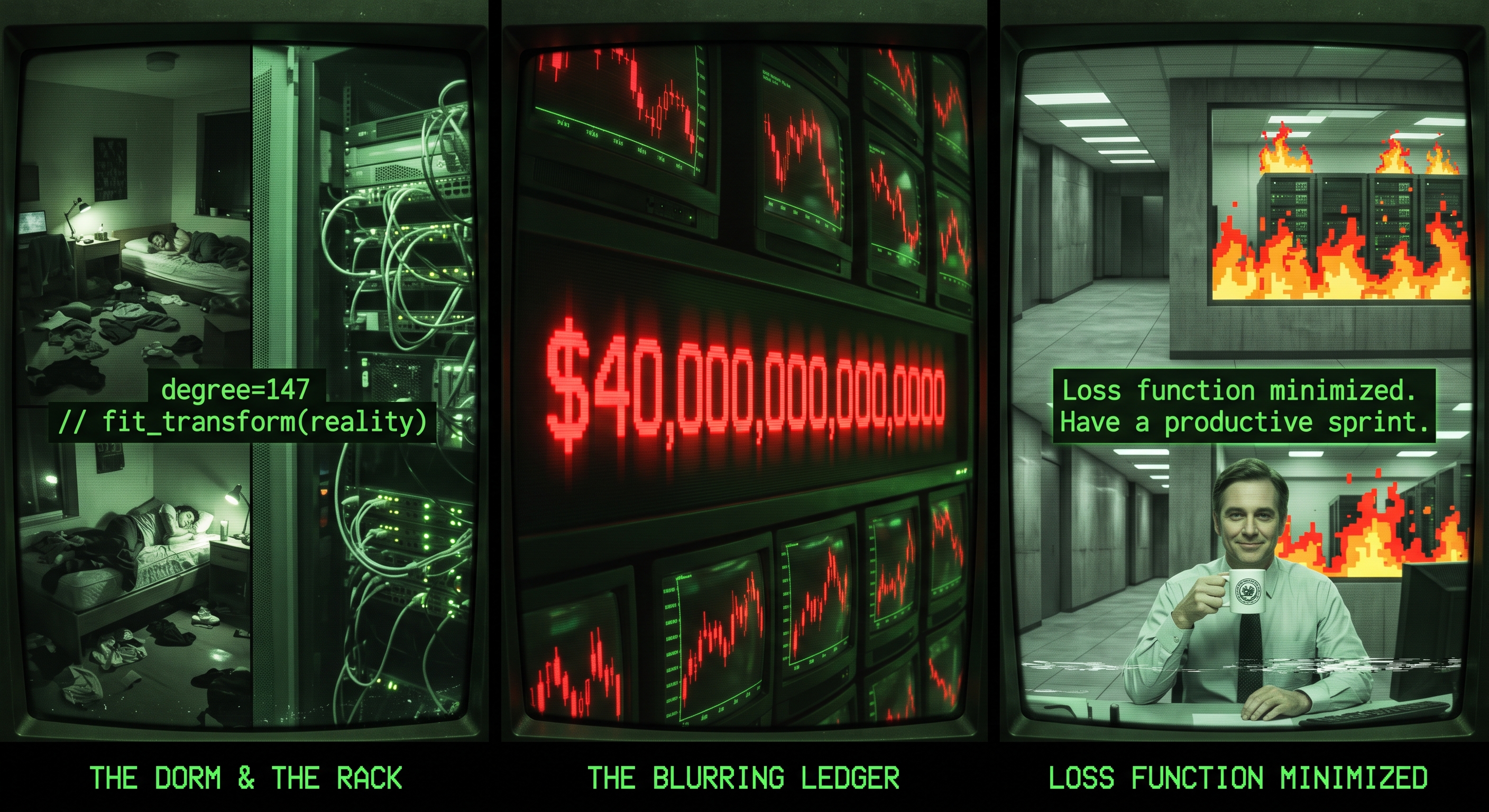
More than 150 anonymous crypto wallets—dubbed “Orcas” by researchers who clearly have a flair for cinematic dread—have been pulling off a 97.2% win rate by placing massive, long-shot bets on kinetic military strikes hours before the bombs actually drop. Why bother with MI6 or satellite reconnaissance when you can simply set up an automated Python script to watch high-ranking Pentagon desk jockeys hedge their weekend airstrikes against their remortgages?
We have achieved peak late-stage cyber-feudalism: war is no longer declared by sovereign parliaments; it is front-run by anonymous liquidity pools while trading bots copy-trade classified intelligence on a public ledger.
And towering over this algorithmic carnival is the grand daddy of all floating-point rounding errors: the US national debt sailing effortlessly past forty trillion dollars. At this point, forty trillion is not an economic figure. It is an abstract piece of conceptual poetry. It is a number so vast that the only reasonable mathematical operation left is an integer overflow that wraps the entire global ledger back around to zero.
We aren’t sleepwalking into dystopia; we’ve written a cron job to automate it, backed by a leveraged prediction market, running on open-source code that an AI hallucinated to spite a student.
 Shiel Yule