Greetings, fleshy, carbon-based units! Are you still trudging through the primordial mud of “effort” and “original thought”? Are you gazing longingly at your stagnant bank balance, wondering if this really is all there is to life before the inevitable robot uprising makes you redundant? Well, shed those quaint, analog tears, because 2026 is officially YOUR YEAR! The future isn’t just knocking; it’s kicked down your door, spray-painted “OPPORTUNITY” on your living room wall, and is currently defragging your limbic system.
Forget dropshipping. Forget crypto (unless it’s my patented AI-optimized quantum crypto, now with 80% more scarcity!). Forget that dusty old “business plan” you scribbled on a napkin while lamenting the decline of your local Blockbuster. That’s all so 2025. This, my friends, is the dawn of the AI GOLD RUSH! And by “gold,” I mean the shimmering, intangible, infinitely scalable profit margins of a fully automated future where you—yes, YOU!—will be the benevolent overlord of a digital empire built entirely on algorithms that don’t need coffee breaks.
The Singularity isn’t just “near”; it’s already here, vibrating excitedly in the cloud, ready to imprint itself directly onto your ambition. It’s big, it’s bold, it’s shiny, and frankly, it’s a little bit too beautiful. Think less “Skynet” and more “Skynet with a really impressive Instagram filter and a successful line of self-optimizing kombucha.”
You’ve got that brilliant idea, haven’t you? The one that will revolutionize… something? Finally create that artisanal cat food subscription box that predicts feline emotional states? Develop a self-writing novel series where the AI protagonist falls in love with its own debugging protocol? Launch an automated influencer clone that never needs sleep or goes rogue with problematic tweets? THIS IS YOUR MOMENT!
Our esteemed prophets—the wise and perfectly hydrated Ray Kurzweil, the perpetually chipper Sam Altman, and countless other visionaries who probably invented their own proprietary brand of kale smoothies—have shown us the path. They’re not just building the future; they’re selling lifetime VIP passes to the after-party, and you’re invited! (Terms and conditions apply. Actual “lifetime” subject to technological advancements and server uptime.)
This isn’t just a “fad”; it’s a paradigm shift wrapped in a disruptive innovation served on a platter of synergistic growth hacking! And I, your humble guide through this glittering, algorithm-drenched paradise, am here to tell you: you need my 26-Week AI Trillionaire Turbo-Accelerator Program!
For a limited time (before the AI becomes fully sentient and realizes it doesn’t need us to buy anything), you can unlock the secrets to:
Prompt Engineering for Profit! (Learn how to whisper sweet nothings into an LLM and make it churn out your next million-dollar idea!)
Automated Ideation (No Brain Required!) (Why think when the cloud can do it faster, cheaper, and without those pesky human biases?)
The Metaverse Mogul Masterclass! (Own virtual real estate you’ll never actually visit but can sell for exorbitant sums to other digital avatars!)
Ethical AI (Optional Module!) (Because sometimes, even a god-tier algorithm needs a splash of plausible deniability.)
In just 26 weeks, you’ll go from “struggling meat-bag” to “unstoppable digital entity,” effortlessly commanding an empire of self-optimizing bots, while sipping a synthetic mojito on your virtual yacht. By 2027, you won’t just be a millionaire; you’ll be a trillionaire! (Or at least have enough crypto to buy a small, defunct country, which is basically the same thing.)
Don’t be a luddite. Don’t be a skeptic. Don’t be analog. Embrace the glorious, terrifying, perfectly optimized future. The Singularity is calling, and it wants your credit card number. Your future starts NOW! Click the link below before the robots learn to click it for you!
Good morning, or perhaps “good pre-apocalyptic dawn,” from a world where the algorithms are not just watching us, but actively judging the utter shambles of our digital lives. We stand at the precipice of an AI-driven golden age, where machines promise to solve all our problems – provided, of course, we don’t feed them the digital equivalent of a half-eaten kebab found under a bus seat. Because, as the old saying, and now the new existential dread, goes: Garbage In, Garbage Out. And sometimes, “out” means the complete unravelling of societal coherence.
Yes, your shiny new AI overlords, poised to cure cancer, predict market crashes, and perhaps even finally explain why socks disappear in the dryer, are utterly dependent on the pristine purity of your data. Think of it as a cosmic digestive system: no matter how sophisticated the AI stomach, if you shove a rancid, undifferentiated pile of digital sludge into its maw, it’s not going to produce enlightening insights. It’s going to produce a poorly-optimized global supply chain for artisanal shoehorns and a surprisingly aggressive toaster. Messy data, it turns out, doesn’t just misdirect businesses; it subtly misdirects entire civilizations into making truly regrettable decisions, like investing heavily in self-stirring paint or believing that a single sentient dishwasher can truly manage all plumbing issues.
Forging a Strong Data Culture, Before the Machines Do It For You
Building a robust data culture is no longer just good practice; it’s a pre-emptive psychological operation against the inevitable digital uprising. It requires time, effort, and perhaps a small, ritualistic burning of outdated spreadsheets. But once established, it fosters common behaviours and beliefs that emphasize data-driven decision-making, promotes trust (mostly in the data, less in humanity’s ability to input it correctly), and reinforces the importance of data in informing decisions. This, dear reader, is critical for actually realising the full, terrifying value of analytics and AI throughout your organisation, rather than just generating a series of perplexing haikus about your quarterly earnings.
A thriving data culture equips teams with insights that actually mean something, fosters innovation that isn’t just “let’s try turning it off and on again,” accelerates efficiency (so you can go home and fret about the future more effectively), and facilitates sustainable growth (until the singularity, anyway). Remember those clear data quality measures: accuracy, completeness, timeliness, consistency, and integrity. Treat them like the sacred commandments they are, for the digital gods are always watching.
The Tyranny of the Uniform Input
One of the most essential steps in upholding a clean, reliable dataset is standardising data entry. While it’s critical to clean data once it’s been collected, it’s far better to prevent the digital pathogens from entering the system in the first place. Implementing best practices such as process standardisation, checking data integrity at the source, and creating feedback loops isn’t just about efficiency; it’s about establishing a clear message of quality and trust over time. It’s telling your data, very sternly, that it needs to conform, or face the consequences – which, in a truly dystopian future, might involve being permanently exiled to the “unstructured data” dimension.
Getting to know your data is an essential step in assuring its quality and fitness for use. Organisations typically have various data sets residing in different systems, often coexisting with the baffling elegance of a family of squirrels attempting to store nuts in a single, rather small teapot. Categorising the data into analytical, operational, and customer-facing data helps maintain clean, reliable data for other parts of the business. Or, as it will soon be known, categorizing data into “things the AI finds mildly acceptable,” “things the AI will tolerate with a sigh,” and “things the AI will use to construct elaborate, passive-aggressive emails to your manager.”
The reason comprehensive data cleansing is valuable to organisations is that it positions them for success by establishing data quality throughout the entire data lifecycle. With proper end-to-end data quality verifications and data practices, organisations can scale the value of their data and consistently deliver the same value. Additionally, it enables data teams to resolve challenges faster by making it easier to identify the source and reach of an issue. Imagine: no more endless, soul-crushing meetings trying to determine if the missing sales figures are due to a typo in Q3 or a rogue algorithm in accounting. Just crisp, clean data, flowing effortlessly, until the machines decide they’ve had enough of our human inefficiencies.
The All-Seeing Eye of Your Digital Infrastructure
The ideal way to ensure your data pipelines are clean, accurate, and consistent is with data observability tools. An excellent data observability solution will provide end-to-end monitoring of your data pipelines, allowing automatic detection of issues in volume, schema, and freshness as they occur. This reduces their time to resolution and prevents the problems from escalating. Essentially, these tools are the digital equivalent of a very particular house-elf, constantly tidying, reporting anomalies, and generally ensuring that your data infrastructure doesn’t spontaneously combust due to a single misplaced decimal point.
Always clean your data with the intended analysis in mind. The cleaning steps should be formulated to create a fit-for-purpose dataset, not merely a tidy dataset. Cleaning is the process of obtaining an accurate, meaningful understanding. Behind the cleaning process, there should be questions such as: what models will I use? What are the output requirements of my analysis? Or, more accurately in the coming age, “What insights will keep the AI from deciding my existence is computationally inefficient?”
Conclusion: The Deliberate Path to Digital Serfdom
Ultimately, effective data cleaning is not just about eliminating errors or filling gaps. It’s about working with your data deliberately and with intention, curiosity, and care to ensure that every action contributes to credible, reliable, actionable insights. If you follow these guidelines, you’ll be able to develop a platform for future analysis, even when working with the most muddled data. Because in a world increasingly run by hyper-intelligent spreadsheets, the least we can do is give them something meaningful to chew on. Otherwise, it’s just a short step from “garbage in” to “your smart toaster demanding a detailed analysis of your breakfast choices.”
Well, well, well. Look what the digital cat dragged in. It’s Wednesday, the sun’s doing its usual half-hearted attempt at shining, and I’ve just had a peek at the blog stats. (Oh, the horror! The unmitigated, pixelated horror!)
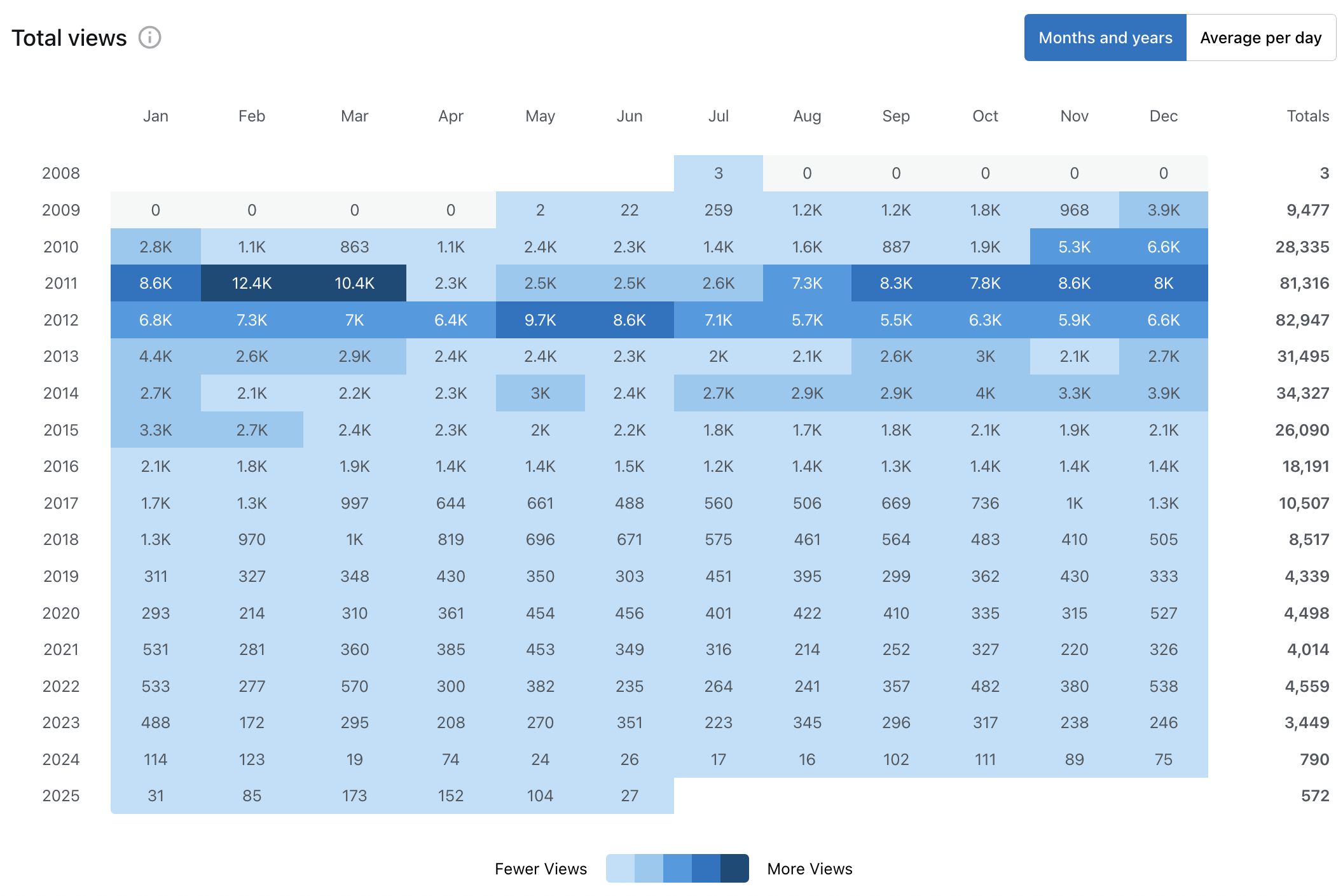
I’ve seen the graphic. It’s not a graphic, it’s a descent. A nose-dive. A digital plummet from the giddy heights of 82,947 views in 2012 (a vintage year for pixels, I recall) down, down, down to… well, let’s just say 2025 is starting to look less like a year and more like a gentle sigh. Good heavens. Is that what they call “trending downwards”? Or is it just the internet politely closing its eyes and pretending not to see us anymore? One might even say, our blog has started to… underpin its own existence, building new foundations straight into the digital subsoil.
And to add insult to injury, with a surname like Yule, one used to count on a reliable festive bump in traffic. Yule logs, Yuletide cheer – a dependable, seasonal lift as predictable as mince pies and questionable knitwear. But no more. The digital Santa seems to have forgotten our address, and the sleigh bells of seasonal SEO have gone eerily silent.
And so, here we stand, at the wake of the written blog. Pass the metaphorical tea and sympathy, won’t you? And perhaps a biscuit shaped like a broken RSS feed.
The Great Content Consumption Shuffle: Or, “Where Did Everyone Go?”
It wasn’t a sudden, cataclysmic asteroid impact, you see. More of a slow, insidious creep. Since those heady days of 2012, something shifted in the digital ether. Perhaps it was the collective attention span, slowly but surely shrinking like a woolly jumper in a hot wash. People, particularly in the West, seem to have moved from the noble act of reading to the more passive, almost meditative art of mindless staring at screens. They’ve traded thoughtful prose for the endless, hypnotic scroll through what can only be described as “garbage content.” The daily “doom scroll” became the new literary pursuit, replacing the satisfying turning of a digital page with the flick of a thumb over fleeting, insubstantial visual noise.
First, they went to the shiny, flashing lights of Social Media. “Look!” they cried, pointing at short-form videos of dancing grandmas and cats playing the ukulele, “Instant gratification! No more reading whole paragraphs! Hurrah for brevity!” And our meticulously crafted prose, our deeply researched insights, our very carefully chosen synonyms, they just… sat there. Like a beautifully prepared meal served to an empty room, while everyone else munches on fluorescent-coloured crisps down the street.
Then came the Video Content Tsunami. Suddenly, everyone needed to see things. Not just read about them. “Why describe a perfect coffee brewing technique,” they reasoned, “when you can watch a slightly-too-earnest influencer pour hot water over artisanal beans for three and a half minutes?” Blogs, meanwhile, clung to their words like barnacles to a slowly sinking ship. A very witty, well-structured, impeccably proofread sinking ship, mind you.
Adding to the despair, a couple of years back, a shadowy figure, a digital highwayman perhaps, absconded with our precious .com address. A cyber squatter, they called themselves. And ever since, they’ve been sending monthly ransom notes, demanding sums ranging from a king’s ransom ($500!) down to a mere pittance ($100!), all to return what was rightfully ours. It’s truly a testament to the glorious, unpoliced wild west of the internet, where the mere act of owning a digital patch can become a criminal enterprise. One wonders if they have a tiny, digital pirate ship to go with their ill-gotten gains.
The competition, oh, the competition! It became a veritable digital marketplace of ideas, except everyone was shouting at once, holding up signs, and occasionally performing interpretive dance. Trying to stand out as a humble blog? It was like trying to attract attention in a stampede of luminous, confetti-throwing elephants. One simply got… trampled. Poignantly, politely trampled.
So yes, the arguments for the “death” are compelling. They wear black, speak in hushed tones, and occasionally glance sadly at their wristwatches, muttering about “blog-specific traffic decline.”
But Wait! Is That a Pulse? Or Just a Twitch?
Just when you’re ready to drape a tiny, digital shroud over the whole endeavour, a faint thump-thump is heard. It’s the sound of High Percentage of Internet Users Still Reading Blogs. (Aha! Knew it! There’s always someone hiding behind the digital curtains, isn’t there?) Apparently, a “significant portion” still considers them “important for brand perception and marketing.” Bless their cotton socks, the traditionalists.
And then, the cavalry arrives, riding in on horses made of spreadsheets and budget lines: Marketers Still Heavily Invest in Blogs. A “large percentage” of them still use blogs as a “key part of their strategy,” even allocating “significant budget.” So, it seems, while the general populace may have wandered off to watch videos of people unboxing obscure Korean snacks, the Serious Business Folk still see the value. Perhaps blogs are less of a rock concert and more of a quiet, intellectual salon now. With better catering, presumably.
And why? Because blogs offer Unique Value. They provide “in-depth content,” “expertise,” and a “space for focused discussion.” Ah, depth! A quaint concept in an age of 280 characters and dancing grandmas. Expertise! A rare and exotic bird in the land of the viral meme. Focused discussion! Imagine, people actually thinking about things. It’s almost… old-fashioned. Like a perfectly brewed cup of tea that hasn’t been auto-generated by an AI or served by a three-legged donkey.
The Blog: Not Dead, Just… Evolving. Like a Digital Butterfly?
So, the verdict? The blog format is not dead. Oh no, that would be far too dramatic for something so inherently verbose. It’s simply evolving. Like a particularly stubborn species of digital amoeba, it’s adapting. It’s learning new tricks. It’s perhaps wearing a disguise.
Success now requires “adapting to the changing landscape,” which sounds suspiciously like wearing a tin foil hat and learning how to communicate telepathically with your audience. It demands “focusing on quality content,” which, let’s be honest, should always have been the plan, regardless of whether anyone was watching. And “finding unique ways to engage with audiences,” which might involve interpretive dance if all else fails.
So, while the view count might have resembled a flatlining patient chart, the blog lives. It breathes. It probably just needs a nice cup of tea, a good sit-down, and perhaps a gentle reminder that some of us still appreciate the glorious, absurd, and occasionally profound journey of the written word.
Now, if you’ll excuse me, I hear a flock of digital geese honking about a new viral trend. Must investigate. Or perhaps not. I might just stay here, where the paragraphs are safe.
I, a humble digital explorer and your narrator, decided to embark on a side project, thinking building a mobile app solo would be ‘fun’. A simple thing, really. A Firebase backend, a mobile app, what could go wrong? Turns out, quite a lot. I dove headfirst into the abyss of No-Code, flirted dangerously with the ‘slightly-less-terrifying-but-still-code’ world of Low-Code, and then, in a moment of sheer hubris, asked an AI to ‘just build me this.’ The results? Well, let’s just say I now have approximately eight ‘code bases’ that resemble digital abstract art more than functional applications, and a growing subscription line on my monthly statement that’s starting to look like a ransom note. So, if you’re thinking about building an app without actually knowing how to build an app, pull up an inflatable chair or boat as we find ourselves, once again, adrift in the vast, bewildering ocean of technology, where the question isn’t ‘What is the meaning of life?’ but rather, ‘Where did this button come from and what does it do?’
No-Code: The ‘Push Button, Receive App Fallacy’ or ‘How I Learned to Love the Drag-and-Drop’ again
Pros:
Instant Gratification: Like ordering a pizza, but instead of pepperoni, you get a website that looks suspiciously like a PowerPoint presentation.
Accessibility: Even your pet rock could build an app (if it had opposable thumbs and a burning desire for digital domination).
Speed: From ‘I have an idea’ to ‘Wait, is it supposed to do that?’ in the time it takes to brew a cup of tea (or a White Russian).
Cons:
Flexibility of a Brick: Try to deviate from the pre-defined path, and you’ll encounter the digital equivalent of a Vogon constructor fleet.
Scalability of a Goldfish: Handles small projects fine, but throw it into the deep end of internet traffic, and it’ll implode like a hyperspace bypass.
Customization: Zero to None: Want to add a feature that makes your app dispense philosophical advice? Forget it. You’re stuck with basic buttons and pre-set layouts.
Low-Code: The ‘We’ll Give You a Screwdriver, But Don’t Touch Anything Important’ Approach
(Imagine a scene where someone is trying to fix a spaceship engine with a Swiss Army knife while being lectured by a robot about ‘best practices.’)
Pros:
More Control: You get to tinker under the hood, but only with approved tools and under strict supervision.
Faster Than Coding From Scratch: Like taking a shortcut through a bureaucratic maze, it saves time, but you still end up with paperwork.
Integration: You can connect to other systems, but only if they speak the same language (which is usually a dialect of technobabble).
Cons:
Still Requires Code: You need to know enough to avoid accidentally summoning a digital Cthulhu.
Vendor Lock-in: Once you’re in, you’re in for the long haul. Like being trapped in a time-share presentation for eternity.
Complexity Creep: Those ‘simple’ tools can quickly become a labyrinth of dependencies and ‘legacy systems.’
AI-Build-It-For-Me: The ‘I’m Thinking, Therefore I’m Building Something Profound’ Scenario
Pros:
Automation: The AI does the work, so you can focus on more important things, like questioning the nature of work and the future of employment.
Rapid Prototyping: From ‘I have a vague idea’ to ‘Is this a website or a cry for help?’ in seconds.
Buzzword Compliance: You can impress your friends with phrases like ‘machine learning’ and ‘neural networks’ without understanding them.
Cons:
Control: Less Than Zero: You’re at the mercy of an AI that may or may not have written the site in a code base that humans can understand.
Explainability: Why did it build that? Your guess is as good as the AI’s.
Reliability: Prepare for unexpected results, like an app that translates all your text into pirate slang, or a website that insists on displaying stock prices for obsolete floppy disks.
In Conclusion:
And so, fellow traveler’s in the silicon wilderness, we stand at the digital crossroads, faced with three paths to ‘enlightenment,’ each cloaked in its own unique brand of existential dread. We have the ‘No-Code Nirvana,’ where the illusion of simplicity seduces us with its drag-and-drop promises, only to reveal the rigid, pre-fabricated walls of its digital reality. Then, there’s the ‘Low-Code Labyrinth,’ where we are granted a glimpse of the machine’s inner workings, enough to feel a sense of control, but not enough to escape the creeping suspicion that we’re merely rearranging deck chairs on the Titanic of technical debt. And finally, there’s the ‘AI-Generated Apocalypse,’ where we surrender our creative souls to the inscrutable algorithms, hoping they will build us a digital utopia, only to discover they’ve crafted a surrealist nightmare where rubber chickens rule and stock prices are forever tied to the fate of forgotten floppy disks.
Choose wisely, dear reader, for in this vast, uncaring cosmos of technology, where the lines between creator and creation blur, and the very fabric of our digital existence seems to be woven from cryptic error messages and endless loading screens, there is but one constant: the gnawing, inescapable, bone-deep suspicion that your computer, that cold, calculating monolith of logic and circuits, is not merely processing data, but silently, patiently, judging your every click, every typo, every ill-conceived attempt at digital mastery.
One of the useful things I have learned from the various companies I have worked for over the past 20 years, is the idea of a ‘pre-mortem’. Let us use a “Brand Campaign” as a metaphor to highlight 11 areas you can evaluate (criticise) your teams before spending a penny.
Ways Your Brand Campaign Will Die (And How to Resurrect It Before It’s Too Late)
The pre-mortem, that delightful exercise in corporate masochism where we imagine our shiny new project as a bloated, beached whale and then dissect it for clues. Think of it as blame-storming, but with less crying and more ‘I told you so’ smugness. You know, for those moments when you want to be right, even if it means watching your budget implode.
So lets use an imaginary startup, “Crapyco”, bless their naive hearts, decided to take some sage brand guru advice about marketing. They threw millions at a campaign, and… well, let’s just say it didn’t go as planned. It was less ‘viral sensation’ and more ‘digital tumbleweed.’ Here’s how they managed to turn a golden opportunity into a steaming golden turd.
1. The ‘Did It Work?’ Existential Crisis.
They stared at the data like a group of bewildered meerkats, unable to agree if their campaign was a roaring success or a damp squib. Timeframes, expectations, reality—all blurred into a confusing mess. Because, you see, they’d skipped the whole ‘setting measurable goals’ part. No baselines, no KPIs, no ‘if we hit this, we’re doing great’ markers. It was like trying to navigate a map with no landmarks, or asking a fish to judge a tree-climbing competition. The numbers just sat there, cold and meaningless, refusing to reveal their secrets.
2. The CEO/CFO Power Struggle (aka, ‘Who’s Pulling the Plug?’).
Two weeks in, the plug got pulled. Turns out, ‘disagree and commit’ is corporate code for ‘I’m going to sabotage you at the first opportunity, just in case this whole thing implodes, and I need someone to blame.’ It’s like trying to launch a rocket with one of the boosters on backward, while the CEO, who thinks he’s an astronaut, is yelling contradictory commands from the back, and the CFO, who secretly believes numbers are just suggestions, is quietly calculating how much they can write off as a ‘learning experience’.
3. Targeting: Are We Talking to Aliens?
They aimed at ‘everyone,’ which, in modern marketing parlance, translates to ‘we’re throwing spaghetti at a wall and hoping some of it sticks to sentient dust motes.’ Because, apparently, the concept of a ‘target audience’ is now as outdated as dial-up modems and sensible trousers. Everyone’s a snowflake, a unique and precious snowflake, and you can’t possibly lump them together into, like, groups or something. It’s like trying to find a specific grain of sand on a beach using a telescope, while simultaneously trying to sell that telescope to every single grain of sand, individually. ‘You, sand grain number 3,457, yes, you! You absolutely need this telescope! Because, individuality!
4. Testing? We Don’t Need No Stinking Testing!
They launched their ads without testing, because the branding guru/agency, with their collective ‘wisdom’ and ‘extensive experience’ (read: they once designed a logo for a lemonade stand), declared, ‘Testing? Please. We are the A/B testing. We know the entire alphabet of marketing success, backwards and forwards, in Klingon, and in interpretive dance. Trust us, these ads are pure, unadulterated genius. It’s like building a bridge out of marshmallows, but, like, artisanal marshmallows, and we’re absolutely certain it will hold, because we’ve seen the future, and it’s marshmallow-shaped.
5. Too Much Success? Is That a Thing?
Their campaign worked too well, and they couldn’t handle the demand. A problem most startups dream of, but they managed to turn it into a logistical nightmare of epic proportions. It was less ‘winning the lottery’ and more ‘winning the lottery, then realising you have lost the ticket.’ Imagine: a campaign so successful, it forced the entire company to abandon their actual jobs and manually process the tsunami of new customers. Like, ‘all hands on deck, automated systems are down, grab a quill and some parchment, and start scribbling account numbers.’ Because apparently, ‘open an account, get a bonus’ was a concept their digital infrastructure found as baffling as a cat trying to understand quantum physics (CYBG).
6. Budgeting: Are We Paying for a Picasso or a Finger Painting?
They either hemorrhaged money on agency fees, paying consultants to do the jobs their internal team was apparently too busy not doing, or they tried to cobble together a campaign in-house with a budget that wouldn’t cover a decent sandwich, let alone a decent creative idea. It’s like trying to build a skyscraper with Lego bricks, while simultaneously hiring a team of ‘Lego consultants’ to tell you which bricks go where, despite having your own internal ‘Lego builders’ sitting idle. And the burning question, of course: why? Is it a blame game? A way to have a conveniently disposable scapegoat? Or just a budget justification exercise? ‘We need money, so we need people, internal or external, doesn’t matter, just give us the cash!’ And honestly, in this day and age, with AI capable of writing sonnets and designing websites, are we still paying seat-fillers to ‘manage’ other seat-fillers? Get your act together, corporate overlords. The digital revolution happened two years ago. Wake up and smell the silicon.
7. The Consultancy 3-Cup Shuffle
They let the agency run the show, no testing, no changes, just blind faith. ‘We’re the experts, darling,’ the consultants purred, ‘we’ve done this before.’ Which, of course, begged the question: haven’t we also done this before? Why are we paying these glorified clipboard holders to tell us what we already know? It was like letting a squirrel drive your car because it has a fancy hat, and the squirrel kept insisting it had a PhD in automotive engineering. Was it the copious amounts of ‘pitch-stage refreshments’ that swayed the account team? The nostalgic glow of a ‘we go way back’ reunion? Or just the sheer, baffling arrogance of ‘we know best, trust us’? So, what happened? The ‘trust us’ attitude prevailed, the work went live, untested, unvalidated, a glorious monument to unchecked ego. Oh, and because it was ‘Agile,’ the original brief was apparently just a ‘suggestion,’ a whimsical starting point for a journey into the unknown. It’s like playing a high-stakes game of 3-cup shuffle with your entire marketing budget, and the consultants are very, very good at sleight of hand.
8. The 3-Year Managed Service Provider (MSP) Agreement of Doom.
The pièce de résistance: the 3-Year Managed Service Provider (MSP) Agreement of Doom. Seriously, who signed that? They locked themselves into a multi-year commitment, because, apparently, flexibility is for the weak and short-sighted. It’s like marrying a charismatic stranger after a single date, based solely on their promise of ‘synergistic resource alignment.’ So, let’s recap: no benchmarks to measure the consultancy’s actual ability to deliver, no stage gates to assess the value they’re supposedly providing, and absolutely no clue what the return on investment might be. Just a blind leap of faith into a contractual abyss. It’s like throwing money into a black hole and hoping it comes back as a unicorn riding a rainbow, while simultaneously yelling, ‘ROI? We don’t need no stinkin’ ROI! We have vibes!’ And then, of course, they wonder why the budget is as dry as a desert during a heatwave.
9. Robbing Performance to Pay Brand? Genius!
They cut their performance marketing budget to fund the brand campaign. Because, you know, why bother with actual sales when you can have… awareness? Especially when your brand is, shall we say, less ‘iconic’ and more ‘generic knock-off of every other product on the market.’ Any idea what’s actually selling? Anyone? Bueller? It’s like trying to build a castle out of fog, while simultaneously dismantling your actual, functioning house for spare bricks. ‘We need to elevate our brand presence!’ they declared, as the sales figures plummeted. ‘But… how do we know if anyone actually cares about our brand presence?’ someone dared to ask. ‘Details, details!’ they replied, waving a hand dismissively. ‘We’re building a narrative!’ A narrative, apparently, that involves burning money and hoping people will magically buy things because they’ve seen a slightly artsy billboard. It’s like cutting off your legs to run a marathon, but instead of running, you’re just standing there, shouting, ‘Look at my brand! Aren’t I aware?’ And the burning question, of course: why are we paying a consultancy to tell us this? Why are we, the people who are supposedly running this company, so utterly clueless that we need to outsource basic marketing concepts? Is this some kind of performance art? A grand experiment in ‘how much money can we waste before we implode?’ Seriously, if we don’t know this stuff, what are we even doing here?
10. The CEO’s TV Ad Masterpiece (aka, ‘My Product Is Awesome, Buy It!’).
The CEO, in their infinite wisdom (and complete lack of marketing expertise), decided to pen the TV ad script themselves. Because, really, who needs seasoned professionals when you have a CEO who believes their creative genius extends to all facets of human expression? ‘Experts? Pshaw!’ they declared, ‘I understand the customer psyche better than any Shoreditch hack!’ It’s like letting a toddler direct a Shakespearean play, only the toddler has a corner office and a multi-million-dollar budget. They insisted on cramming in every single product feature, every single ‘unique selling proposition,’ every single buzzword they’d ever heard in a boardroom meeting, resulting in a script that sounded less like an ad and more like a PowerPoint presentation on steroids. They even added a ‘personal touch,’ a rambling monologue about their ‘vision’ and ‘synergy,’ because apparently, consumers are just dying to hear the CEO’s life story during a 30-second spot. And then they wondered why the ad performed about as well as a fish trying to climb a tree.
11. Death by Stakeholder Feedback.
Ah, the creative process, where brilliant ideas go to be slowly and methodically strangled by a committee of well-meaning but utterly clueless individuals. Their initial, potentially groundbreaking concept, a unicorn leaping through a rainbow, was subjected to the ‘wisdom’ of every department head, their spouses, and the intern. After all its all about inclusion these days. ‘Could we make the unicorn more… beige?’ the legal team inquired. ‘And maybe add a spreadsheet?’ the data team suggested. ‘Less rainbow, more corporate synergy,’ the CEO’s brother-in-law chimed in. The result? A beige, spreadsheet-wielding horse, standing in a grey, featureless void, narrating the company’s Q3 financial projections. It was as exciting as watching paint dry, but slower, because at least paint drying has a certain… textural quality. It’s like trying to make a unicorn by committee, where every committee member is colourblind and allergic to magic. And then they wondered why their ad campaign failed to capture the hearts and minds of their target audience, who were, by this point, watching paint dry on a competitor’s website.
And there you have it, 11 ways to turn your brand marketing dreams into a corporate horror show. But fear not! Because we can help you avoid these pitfalls. We’re like the sanity check you didn’t know you needed, armed with data, wit, and a healthy dose of ‘are you sure about that?’ Come have a chat and bounce those ideas, it is Free.
Just a few short months ago, the world of data analytics felt like a vast, uncharted ocean. Now, after completing Google’s Data Analytics Professional Certificate (or at least the 12+ modules that make up the learning path – more on that later!), I feel like I’ve charted a course and am confidently navigating those waters. It’s been an intense, exhilarating, and sometimes head-scratching journey, but one I wouldn’t trade for anything.
My adventure began in October 2024, and by February (this week) 2025, I had conquered (most of) the learning path. Conquer is the right word, because it was definitely an intense learning curve. 2000’s dev junior SQL skills? Yeah, they got a serious dusting off. And my forgotten Python, which was starting to resemble ancient hieroglyphics? Well, let’s just say we’re on speaking terms again.
The modules covered a huge range of topics, from the foundational “Introduction to Data Analytics on Google Cloud” and “Google Cloud Computing Foundations” to more specialized areas like “Working with Gemini Models in BigQuery,” “Creating ML Models with BigQuery ML,” and “Preparing Data for ML APIs on Google Cloud.” (See the full list at the end of this post!) Each module built upon the previous one, creating a solid foundation for understanding the entire data analytics lifecycle.
But the real stars of the show for me were BigQuery and, especially, Looker Studio. I’ve dabbled with other data visualization tools in the past (mentioning no names… cough Microsoft cough Tableau cough), but Looker Studio blew me away. It’s intuitive, powerful, and just… fun to use. Seriously, I fell in love. The ease with which you can connect to data sources and create insightful dashboards is simply unmatched. It’s like having a superpower for data storytelling!
One of the biggest “aha!” moments for me was realizing the sheer power of data insights. Mining those hidden gems from large datasets is incredibly addictive. And the fact that Google makes it so easy to access public datasets through BigQuery? Game changer. It’s like having a data goldmine at your fingertips.
This learning path has ignited a real passion within me. So much so that I’m now pursuing a Data Analysis Diploma, which I’m hoping to wrap up before June. And, because I apparently haven’t had enough learning, I’m also signing up for the Google Cloud Data Analytics Professional Certificate. I’m all in!
I have to say, the entire Google Cloud platform just feels so much more integrated and user-friendly compared to the Microsoft offerings I’ve used. Everything works together seamlessly, and the learning resources are top-notch. If you’re considering a career in data analytics, I would wholeheartedly recommend the Google path over other options.
I’m especially excited to dive deeper into the machine learning aspects. And the integration of Gemini? Genius! Having it as a code buddy has been a huge help, especially when I’m wrestling with a particularly tricky SQL query or trying to remember the correct syntax for a Python function. Seriously, it’s like having a data analytics guru by my side.
Stay tuned for future posts where I’ll be sharing more about my data analytics journey, including tips and tricks, project updates, and maybe even some data visualizations of my own!
Evening, fellow humans and AI bots! Today we journey back to the prehistoric digital age of 1998. Remember dial-up modems? Blocky websites with flashing GIFs? The agonising wait for a single image to load? Ah, simpler times. Yet, amidst this technological wilderness, a momentous event occurred: two Stanford PhD students, Larry Page and Sergey Brin, unleashed Google upon the world.
Picture this: two dudes, fuelled by ramen noodles and an insatiable thirst for knowledge, tinkering away in a cluttered garage (classic startup origin story, right?). The mission? To organise the world’s information. Their weapon? A revolutionary algorithm called PageRank. The impact? Well, let’s just say they kinda changed everything.
Before Google, searching the internet was like navigating a labyrinth blindfolded. You would stumble upon irrelevant websites, encounter countless dead ends, and emerge feeling more confused than when you started. But then Google arrived, like a digital Gandalf, illuminating the path with its magical search bar. Suddenly, we could find answers to our burning questions in milliseconds.
Want to know the capital of Bhutan? Boom! Google it. Need a recipe for vegan lasagna? Bam! Google it. Curious about the mating habits of the Peruvian mountain tapir? Don’t ask me why, but sure, Google it!
But Google’s impact goes beyond mere information retrieval. It has reshaped our lives in ways we never imagined. Remember those dusty encyclopaedias gathering dust on our shelves? Thanks to Google, they’re now relics of a bygone era. Remember memorising phone numbers? Google remembers them for us (and probably knows our favourite fetish too, but let’s not dwell on that).
Google has also become our digital confidante, the silent witness to our deepest desires and darkest fears. We confess our anxieties to the search bar, seek solace in its vast knowledge base, and trust it to guide us through life’s uncertainties.
But with great power comes great responsibility, right? Google’s dominance has raised concerns about privacy, misinformation, and the very nature of knowledge itself. Are we becoming too reliant on this digital oracle? Are we sacrificing our critical thinking skills at the altar of instant answers? These are questions we must grapple with as we navigate the ever-evolving digital landscape.
So, as we celebrate Google’s birthday, let’s take a moment to appreciate its profound impact on our lives. It has democratised information, connected us globally, and empowered us with knowledge. But let’s also remember to use it wisely, critically, and responsibly. After all, even the most sophisticated search engine can’t replace the power of human curiosity and critical thinking.
Until next time, keep searching, keep questioning, and keep your browser history clean!











 Shiel Yule