So, LinkedIn, in its infinite, algorithmically-optimised wisdom, sent me an email and posed a question: Has generative AI transformed how you hire?
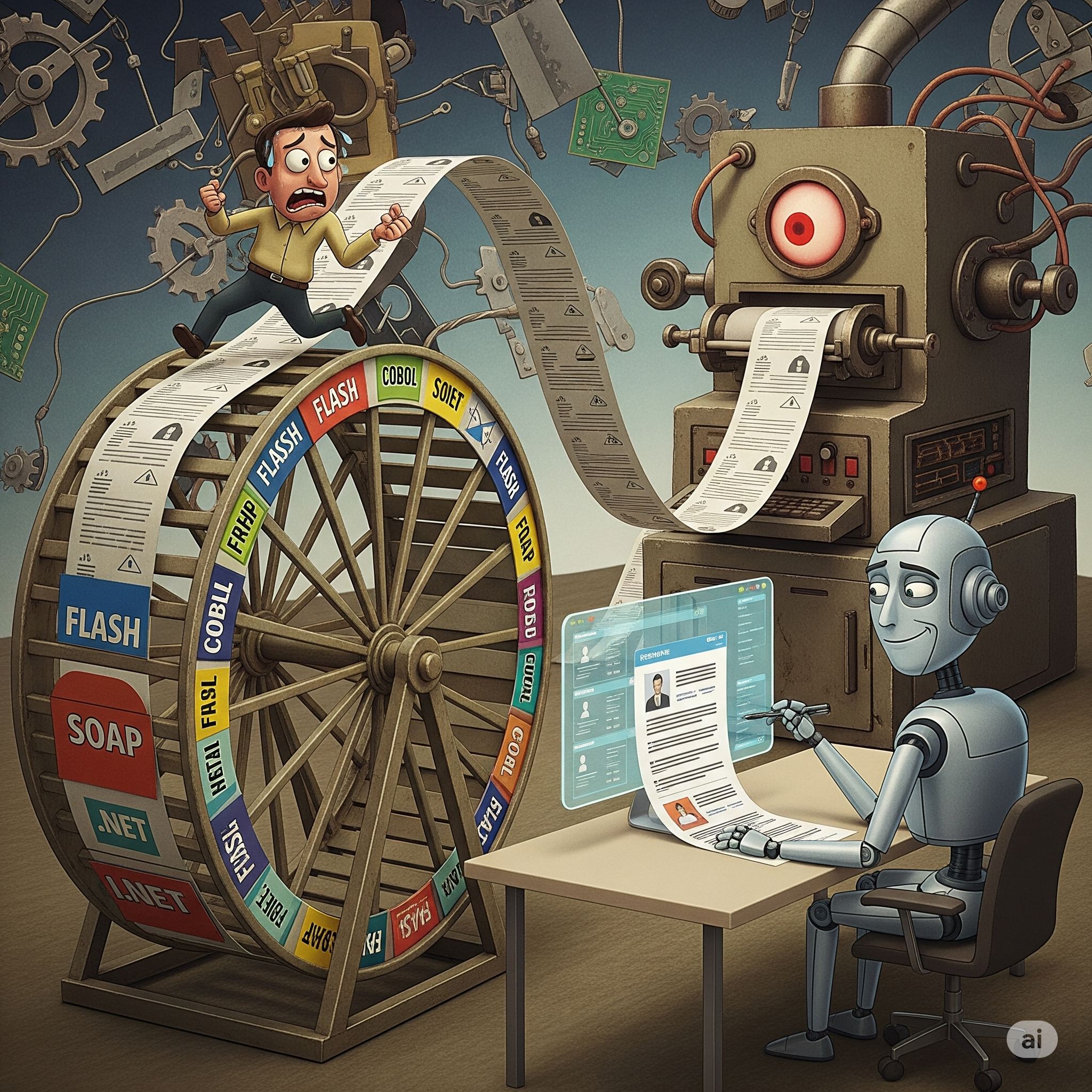
Oh, you sweet, innocent, content-moderated darlings. Has the introduction of the self-service checkout had any minor, barely noticeable effect on the traditional art of conversing with a cashier? Has the relentless efficiency of Amazon Prime in any way altered our nostalgic attachment to a Saturday afternoon browse down the local high street? Has the invention of streaming services had any small impact on the business model of your local Blockbuster video?
Yes. Duh.
You see, the modern hiring process is no longer about finding a person for a role. It is a wonderfully ironic Turing Test in reverse. The candidate, a squishy carbon-based lifeform full of anxieties and a worrying coffee dependency, uses a vast, non-sentient silicon brain to convince you they are worthy. You, another squishy carbon-based lifeform, must then use your own flawed, meat-based intuition to decide if the ghost in their machine is a good fit for the ghost in your machine.
The CV is dead. It is a relic, a beautifully formatted PDF of lies composed by a language model that has read every CV ever written and concluded that the ideal candidate is a rock-climbing, volunteer-firefighting, Python-coding polymath who is “passionate about synergy.” The cover letter? It’s a work of algorithmically generated fiction, a poignant, computer-dreamed ode to a job it doesn’t understand for a company it has never heard of.
So, are you hiring a person, or the AI-powered spectre of that person? A LinkedIn profile is no longer a testament to a career; it’s a monument to successful prompt engineering.
To truly prove consciousness in 2025, a candidate needs a blog. A podcast. A YouTube channel where they film themselves, unshaven and twitching, wrestling with a piece of code while muttering about the futility of existence. We require a verifiable, time-stamped proof of life to show they haven’t simply outsourced their entire professional identity to a subscription service.
Meanwhile, the Great Career Shuffle accelerates. An entire car-crash multitude of ex-banking staff, their faces etched with the horror of irrelevance, are now desperately rebranding as “AI strategists.” The banks themselves are becoming quaint, like steam museums, while the real action—the glorious, three-month contracts of frantic, venture-capital-fueled chaos—is in the AI startups.
It all feels so familiar. It’s that old freelance feeling, where your CV wasn’t a document but a long list of weapons in your arsenal. You needed a bow with a string for every conceivable software battle. One week it was pure HTML+CSS. The next, you were a warrior in the trenches of the Great Plugin Wars, wrestling the bloated, beautiful behemoth of Flash until, almost overnight, it was rendered obsolete by the sleek, sanctimonious assassin that was HTML5.
The backend was a wilder frontier. A company demanded you wrestle with the hydra of PHP, be it WordPress, Drupal, or the dark arts of Magento if a checkout was involved. For a brief, shining moment, everything was meant to be built on the elegant railway tracks of Ruby. Then came the Javascript Tsunami, a wave so vast it swept over both the front and back ends, leaving a tangled mess that developers are still trying to untangle to this day.
And the enterprise world? A mandatory pilgrimage to the great, unkillable temple of Java. The backend architecture evolved from the stuffy, formal rituals of SOAP APIs to the breezy, freewheeling informality of REST. Then came the Great Atomisation, an obsession with breaking monoliths into a thousand tiny microservices, putting each one in a little digital box with Docker, and then hiring an entirely new army of engineers just to plumb all the boxes back together again. If you had a bit of COBOL, the banks would pay you a king’s ransom to poke their digital dinosaurs. A splash of SQL always won the day.
On top of all this, the Agile evangelists descended, an army of Scrum Masters who achieved sentience overnight and promptly promoted themselves to “Agile Coaches,” selling certifications and a brand of corporate mindfulness that fixed precisely nothing. All of it, every last trend, every rise and fall and rise again of Java, was just a slow, inexorable death march towards the beige, soul-crushing mediocracy of the Microsoft stack—a sprawling empire of .NET and Azure so bland and full of holes that every junior hacker treats it as a welcome mat.
AI is just the latest, shiniest weapon to add to the rack.
So, in the spirit of this challenge, here are my Top Tips for Candidates Navigating This New World:
- Stop Writing Your CV. Your new job is to become the creative director for the AI that writes your CVs for you. Learn its quirks. Feed it your soul. Your goal is not to be the best candidate, but to operate the best candidate-generating machine.
- Manufacture Authenticity. That half-finished blog post from 2019? Resurrect it. That opinion you had about coffee? Turn it into a podcast. Your real CV is your digital footprint. Prove you exist beyond a series of prompts.
- Embrace Glorious Insecurity. The job you’re applying for will be automated, outsourced, or rendered utterly irrelevant by a new model release in six months anyway. Stop thinking about a career ladder. There is no ladder. There is only a chaotic, unpredictable, exhilarating wave. Learn to surf.
The whole thing is, of course, gloriously absurd. We are using counterfeit intelligence to apply for counterfeit jobs in a counterfeit economy. And we have the audacity to call it progress.
#LinkedInNewsEurope

 Shiel Yule