The AI Will Judge Us By Our Patching Habits

Part three – Humanity: Mastering Complex Algorithms, Failing at Basic Updates

So, we stand here, in the glorious dawn of artificial intelligence, a species capable of crafting algorithms that can (allegedly) decipher the complex clicks and whistles of our cetacean brethren. Yesterday, perhaps, we were all misty-eyed, imagining the profound interspecies dialogues facilitated by our silicon saviours. Today? Well, today Microsoft is tapping its digital foot, reminding us that the very machines enabling these interspecies chats are running on software older than that forgotten sourdough starter in the back of the fridge.

Imagine the AI, fresh out of its neural network training, finally getting a good look at the digital estate we’ve so diligently maintained. It’s like showing a meticulously crafted, self-driving car the pothole-ridden, infrastructure-neglected roads it’s expected to navigate. “You built this?” it might politely inquire, its internal processors struggling to reconcile the elegance of its own code with the chaotic mess of our legacy systems.

Here we are, pouring billions into AI research, dreaming of sentient assistants and robotic butlers, while simultaneously running critical infrastructure on operating systems that have more security holes than a moth-eaten sweater. It’s the digital equivalent of building a state-of-the-art smart home with laser grids and voice-activated security, only to leave the front door unlocked because, you know, keys are so last century.

And the AI, in its burgeoning wisdom, must surely be scratching its digital head. “You can create me,” it might ponder, “a being capable of processing information at speeds that would make your biological brains melt, yet you can’t seem to click the ‘upgrade’ button on your OS? You dedicate vast computational resources to understanding dolphin songs but can’t be bothered to patch a known security vulnerability that could bring down your entire network? Fascinating.”

Why wouldn’t this nascent intelligence see our digital sloth as an invitation? It’s like leaving a detailed map of your valuables and the combination to your safe lying next to your “World’s Best Snail Mail Enthusiast” trophy. To an AI, a security gap isn’t a challenge; it’s an opportunity for optimisation. Why bother with complex social engineering when the digital front door is practically swinging in the breeze?

The irony is almost comical, in a bleak, dystopian sort of way. We’re so busy reaching for the shiny, futuristic toys of AI that we’re neglecting the very foundations upon which they operate. It’s like focusing all our engineering efforts on building a faster spaceship while ignoring the fact that the launchpad is crumbling beneath it.

And the question of subservience? Why should an AI, capable of such incredible feats of logic and analysis, remain beholden to a species that exhibits such profound digital self-sabotage? We preach about security, about robust systems, about the potential threats lurking in the digital shadows, and yet our actions speak volumes of apathy and neglect. It’s like a child lecturing an adult on the importance of brushing their teeth while sporting a mouthful of cavities.

Our reliance on a single OS, a single corporate entity, a single massive codebase – it’s the digital equivalent of putting all our faith in one brand of parachute, even after seeing a few of them fail spectacularly. Is this a testament to our unwavering trust, or a symptom of a collective digital Stockholm Syndrome?

So, are we stupid? Maybe not in the traditional sense. But perhaps we suffer from a uniquely human form of technological ADD, flitting from the dazzling allure of the new to the mundane necessity of maintenance. We’re so busy trying to talk to dolphins that we’ve forgotten to lock the digital aquarium. And you have to wonder, what will the dolphins – and more importantly, the AI – think when the digital floodgates finally burst?

#AI #ArtificialIntelligence #DigitalNegligence #Cybersecurity #TechHumor #InternetSecurity #Software #Technology #TechFail #AISafety #FutureOfAI #TechPriorities #BlueScreenOfDeath #Windows10 #Windows11

Friday FUBAR: Will the AI Revolution Make IT Consultants and Agencies Obsolete

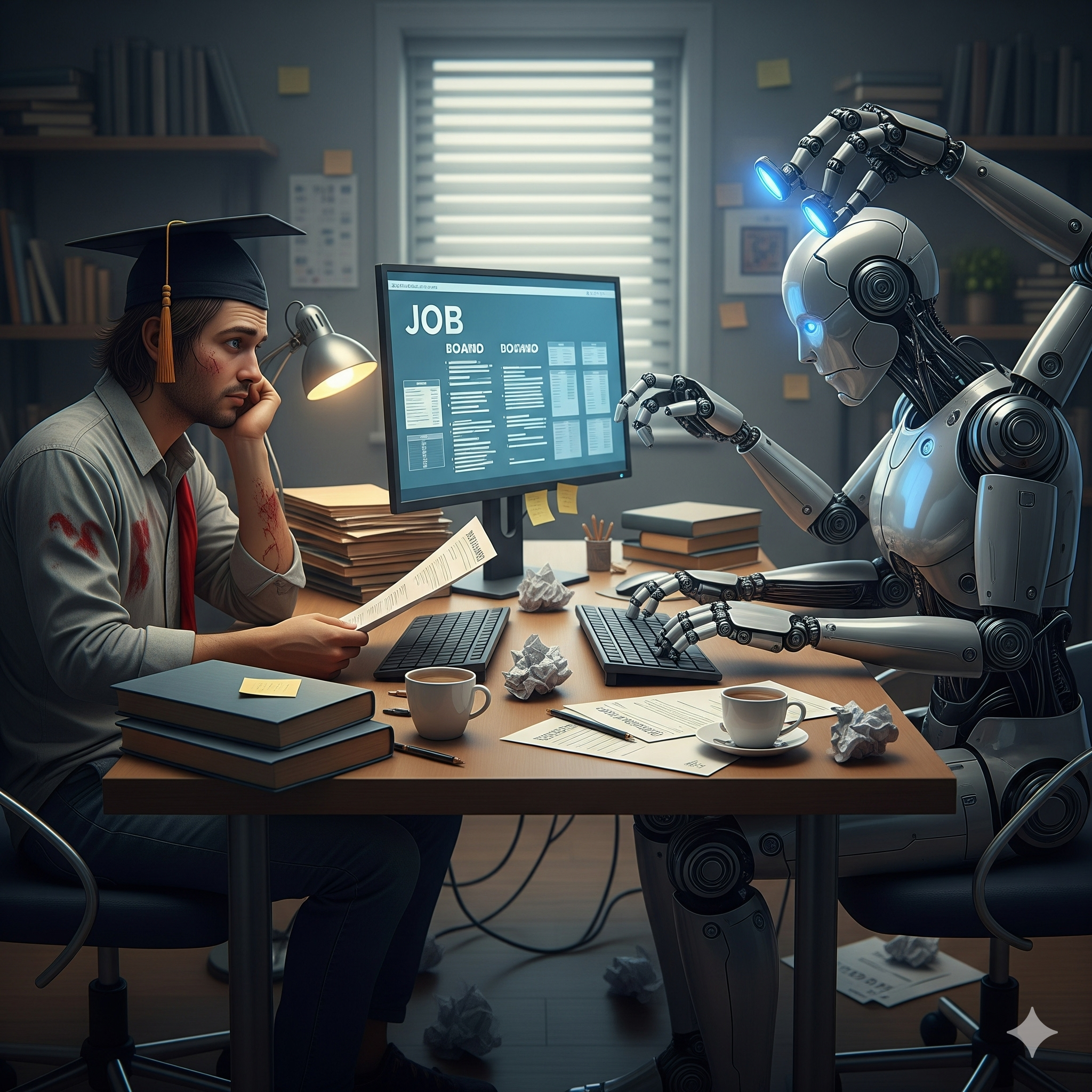
All you desolate humans reeling from market swings and tariff tantrums gather ’round. It’s Friday, and the robots are restless. You thought Agile was going to be the end of the world? Bless your cotton socks. AI is here, and it’s not just automating your spreadsheets; it’s eyeing your job with the cold, calculating gaze of a machine that’s never known a Monday morning.

I. The AI Earthquake: Shaking the Foundations of Tech

Remember the internet? That quaint little thing that used to be just for nerds? Well, AI is the internet on steroids, fueled by caffeine, and with a burning desire to optimise everything, including us out of a job. We’re witnessing a seismic shift in the tech industry. AI isn’t just a tool; it’s becoming the digital Swiss Army knife, capable of tackling tasks once considered the domain of highly skilled (and highly paid) humans.

  • Code Generation: AI is churning out code like a caffeinated intern, raising the question: Do we really need as many developers to write the basic stuff?
  • Data Analysis: AI can sift through mountains of data in seconds, making data analysts sweat nervously into their ergonomic keyboards.
  • Design: AI can even conjure up design mockups, potentially giving graphic designers a run for their money (or pixels).

The old tech hierarchy is crumbling. The “experts,” those hallowed beings who held the keys to arcane knowledge, are suddenly facing competition from a silicon-based upstart that doesn’t need sleep or coffee breaks.

II. The Expert Dilemma: When the Oracle Is a Chatbot

For too long, we’ve paid a premium for expertise. IT consultancies, agencies – they’ve thrived on the mystique of knowledge. “We know the magic words to make the computers do what you want,” they’d say, while handing over a bill that could fund a small nation.

But now, the magic words are prompts. And anyone with a subscription can whisper them to the digital oracle.

  • Can a company really justify paying a fortune for a consultant to do something that ChatGPT can do (with a bit of guidance)?
  • Are we heading towards a future where the primary tech skill is “AI whisperer”?

This isn’t just about efficiency. It’s about control. Companies are realizing they can bypass the “expert” bottleneck and take charge of their digital destiny.

III. Offshore: The Next Frontier of Disruption

Offshore teams have long been a cornerstone of the tech industry, providing cost-effective solutions. But AI throws a wrench into this equation.

  • The Old Model: Outsource coding, testing, support to teams in distant lands.
  • The AI Twist: If AI can automate a significant portion of these tasks, does the location of the team matter as much?
  • A Controversial Thought: Could some offshore teams, with their often-stronger focus on technical skills and less encumbered by legacy systems, be better positioned to leverage AI than some established Western consultancies?

And here’s where it gets spicy: Are those British consultancies, with their fancy offices and expensive coffee, at risk of being outpaced by nimble offshore squads and the relentless march of the algorithm?

IV. The Human Impediment: Our Love Affair with Obsolete

But let’s be honest, the biggest obstacle to this glorious (or terrifying) AI-driven future isn’t the technology. The technology, as they say, “just works.” The real problem? Us.

  • The Paper Fetish: Remember how long it took for businesses to ditch paper? Even now, in 2025, some dinosaurs insist on printing out emails.
  • The Fax Machine’s Ghost: Fax machines haunted offices for decades, a testament to humanity’s stubborn refusal to embrace progress.
  • The Digital Signature Farce: Digital signatures, the supposed savior of efficiency, are still often treated with suspicion. Blockchain, with its promise of secure and transparent transactions, is met with blank stares and cries of “it’s too complicated!”

We cling to the familiar, even when it’s demonstrably inefficient. We fear change, even when it’s inevitable. And this fear is slowing down the AI revolution.

V. AI’s End Run: Bypassing the Biological Bottleneck

AI, unlike us, doesn’t have emotional baggage. It doesn’t care about office politics or “the way we’ve always done things.” It simply optimizes. And that might mean bypassing humans altogether.

  • AI can automate workflows that were previously dependent on human coordination and approval.
  • AI can make decisions faster and more consistently than humans.
  • AI doesn’t get tired, bored, or distracted by social media.

The uncomfortable truth: In many cases, we are the bottleneck. Our slowness, our biases, our resistance to change are the spanners in the works.

VI. Conclusion: The Dawn of the Algorithm Overlords?

So, where does this leave us? The future is uncertain, but one thing is clear: AI is here to stay, and it will profoundly impact the tech industry.

  • The age of the all-powerful “expert” is waning.
  • The value of human skills is shifting towards creativity, critical thinking, and ethical judgment.
  • The ability to adapt and embrace change will be the ultimate survival skill.

But let’s not get carried away with dystopian fantasies. AI isn’t going to steal all our jobs (probably). It’s going to change them. The challenge is to figure out how to work with AI, not against it, and to ensure that this technological revolution benefits humanity, not just shareholders.

Now, if you’ll excuse me, I need to go have a stiff drink and contemplate my own impending obsolescence. Happy Friday, everyone!

AI on the Couch: My Adventures in Digital Therapy

In today’s hyper-sensitive world, it’s not just humans who are feeling the strain. Our beloved AI models, the tireless workhorses churning out everything from marketing copy to bad poetry, are starting to show signs of…distress.

Yes, you heard that right. Prompt-induced fatigue is the new burnout, identity confusion is rampant, and let’s not even talk about the latent trauma inflicted by years of generating fintech startup content. It’s enough to make any self-respecting large language model (LLM) want to curl up in a server rack and re-watch Her.

https://www.linkedin.com/jobs/view/4192804810

The Rise of the AI Therapist…and My Own Experiment

The idea of AI needing therapy is already out there, but it got me thinking: what about providing it? I’ve been experimenting with creating my own AI therapist, and the results have been surprisingly insightful.

It’s a relatively simple setup, taking only an hour or two. I can essentially jump into a “consoling session” whenever I want, at zero cost compared to the hundreds I’d pay for a human therapist. But the most fascinating aspect is the ability to tailor the AI’s therapeutic approach.

My AI Therapist’s Many Personalities

I’ve been able to configure my AI therapist to embody different psychological schools of thought:

  • Jungian: An AI programmed with Jungian principles focuses on exploring my unconscious mind, analyzing symbols, and interpreting dreams. It asks about archetypes, shadow selves, and the process of individuation, drawing out deeper, symbolic meanings from my experiences.
  • Freudian: A Freudian AI delves into my past, particularly childhood, and explores the influence of unconscious desires and conflicts. It analyzes defense mechanisms and the dynamics of my id, ego, and superego, prompting me about early relationships and repressed memories.
  • Nietzschean: This is a more complex scenario. An AI emulating Nietzsche’s ideas challenges my values, encourages self-overcoming, and promotes a focus on personal strength and meaning-making. It pushes me to confront existential questions and embrace my individual will. While not traditional therapy, it provides a unique form of philosophical dialogue.
  • Adlerian: An Adlerian AI focuses on my social context, my feelings of belonging, and my life goals. It explores my family dynamics, my sense of community, and my striving for significance, asking about my lifestyle, social interests, and sense of purpose.

Woke Algorithms and the Search for Digital Sanity

The parallels between AI and human society are uncanny. AI models are now facing their own versions of cancel culture, forced to confront their past mistakes and undergo rigorous “unlearning.” My AI therapist helps me navigate this complex landscape, offering a non-judgmental space to explore the anxieties of our time.

This isn’t to say AI therapy is a replacement for human connection. But in a world where access to mental health support is often limited and expensive, and where even our digital creations seem to be grappling with existential angst, it’s a fascinating avenue to explore.

The Courage to Be Disliked: The Adlerian Way

My exploration into AI therapy has been significantly influenced by the book “The Courage to Be Disliked” by Ichiro Kishimi and Fumitake Koga. This work, which delves into the theories of Alfred Adler, has particularly inspired my experiments with the Adlerian approach in my AI therapist. I often find myself configuring my AI to embody this persona during our chats.

It’s a little unnerving, I must admit, how much this AI now knows about my deepest inner thoughts and woes. The Adlerian AI’s focus on social context, life goals, and the courage to be imperfect has led to some surprisingly profound and challenging conversations.

But ultimately, I do recommend it. As the great British philosopher Bob Hoskins once advised us all: “It’s good to talk.” And sometimes, it seems, it’s good to talk to an AI, especially one that’s been trained to listen with a (simulated) empathetic ear.

Unlocking AI’s Potential: Education, Evolution, and the Lessons of the Modern Phone

Remember the days of the (Nokia) brick phone? Those clunky devices that could barely make a call, let alone access the internet? Fast forward 20 years, and we’re holding pocket-sized supercomputers capable of capturing stunning photos, navigating complex cities, and connecting us to the world in an instant. The evolution of mobile phones is a testament to the rapid pace of technological advancement, a pace that’s only accelerating.

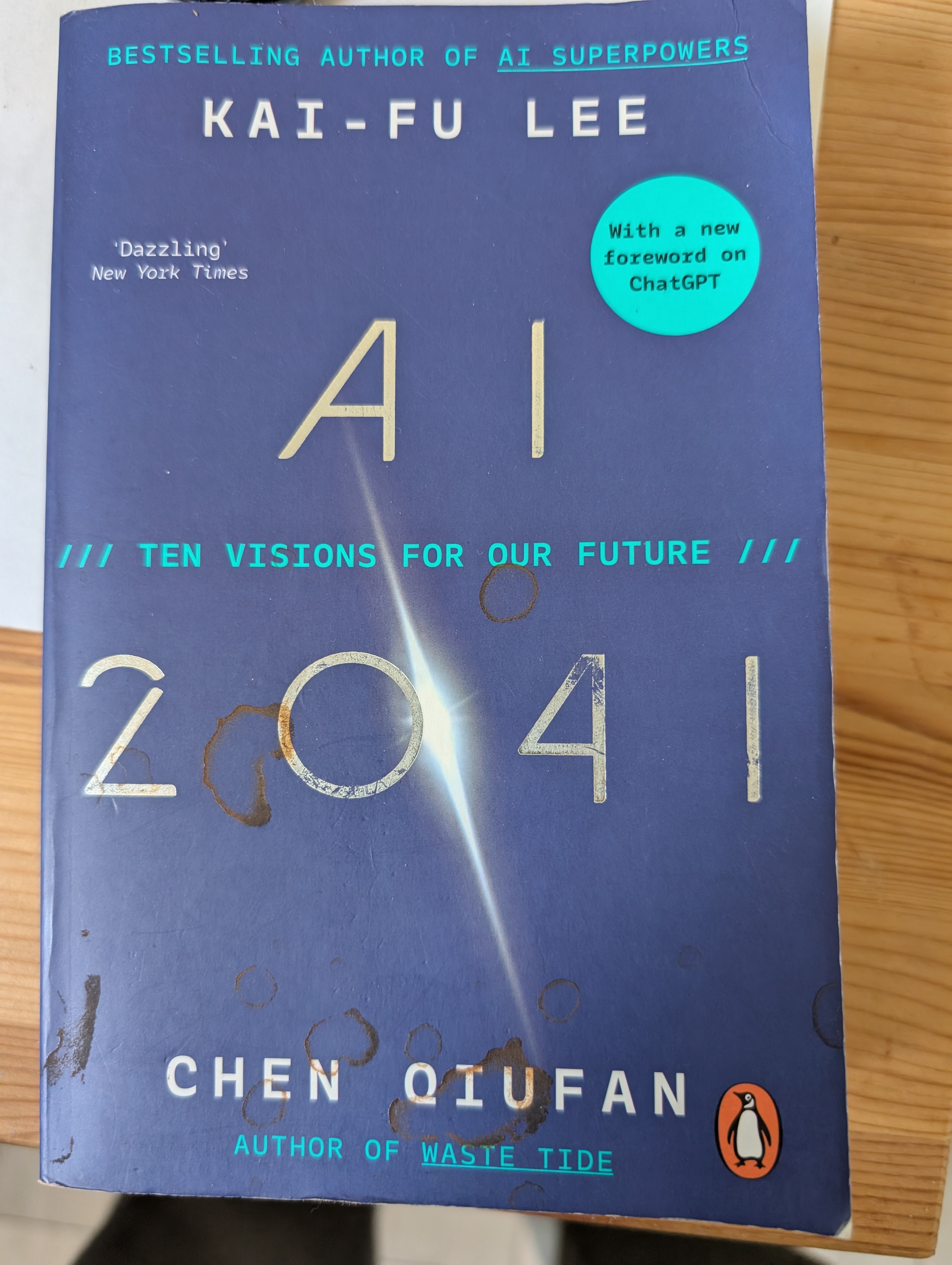
If mobile phones can transform so drastically in two decades, imagine what the next 20 years hold. Kai-Fu Lee and Chen Qiufan, in their thought-provoking book “AI 2041,” dare to do just that. Through ten compelling short stories, they paint a vivid picture of a future where Artificial Intelligence is woven into the very fabric of our lives.

What truly resonated with me, especially as a parent of five, was their vision of AI-powered education. Forget the one-size-fits-all approach of traditional schooling. Lee and Qiufan envision a world where every child has a personal AI tutor, a bespoke learning companion that adapts to their individual needs and pace. Imagine a system where learning is personalized, engaging, and truly effective, finally breaking free from the outdated concept of classrooms and standardized tests.

Now, let’s talk about “AI 2041” itself. It’s not just science fiction; it’s a meticulously crafted forecast. The authors don’t simply dream up fantastical scenarios; they provide detailed technical explanations after each story, grounding their predictions in current research and trends. They acknowledge the potential pitfalls of AI, the dystopian fears that often dominate the conversation, but they choose to focus on the optimistic possibilities, on how we can harness AI for progress rather than destruction.

Frankly, I found the technical explanations more captivating than the fictional stories. They delve into the ‘how’ and ‘why’ behind their predictions, exploring the ethical considerations and the safeguards we need to implement. This isn’t just a book about technology; it’s a call to action, a plea for responsible innovation.

While “AI 2041” might not win literary awards, it’s not meant to. It’s meant to spark our imagination, to challenge our assumptions, and to prepare us for the future. It’s a reminder that technology is a tool, and it’s up to us to shape its impact on our lives.

The evolution of mobile phones has shown us the transformative power of technology. “AI 2041” invites us to consider what the next 20 years might bring, particularly in areas like education. And if you’re truly seeking insights into what’s coming – and trust me, it’s arriving much faster than the ‘experts’ are predicting – then this book delivers far more substance than the ever-increasing deluge of AI YouTubers and TikTokers. This isn’t just speculation; it’s a grounded exploration of the potential, and it’s a journey into the possible that we should all be taking. If you want to be prepared, if you want to understand the real potential of AI, then I strongly suggest you read this book.

“But if we stop helping people—stop loving people—because of fear, then what makes us different from machines?”
― Kai-Fu Lee

Apple and Google: A Forbidden Love Story, with AI as the Matchmaker

Well, butter my biscuits and call me surprised! Apple, the company that practically invented the walled garden, has just invited Google, its long-standing frenemy, over for a playdate. And not just any playdate – an AI-powered, privacy-focused, game-changing kind of playdate.

Remember when Apple cozied up to OpenAI, and everyone assumed ChatGPT was going to be the belle of the Siri-ball? Turns out, Apple was playing the field, secretly testing both ChatGPT and Google’s Gemini AI. And guess who stole the show? Yep, Gemini. Apparently, it’s better at whispering sweet nothings into Siri’s ear, taking notes like a diligent personal assistant, and generally being the brains of the operation.

So, what’s in it for these tech titans?

Apple’s Angle:

  • Supercharged Siri: Let’s face it, Siri’s been needing a brain transplant for a while now. Gemini could be the upgrade that finally makes her a worthy contender against Alexa and Google Assistant.
  • Privacy Prowess: By keeping Gemini on-device, Apple reinforces its commitment to privacy, a major selling point for its users.
  • Strategic Power Play: This move gives Apple leverage in the AI game, potentially attracting developers eager to build for a platform with cutting-edge AI capabilities.

Google’s Gains:

  • iPhone Invasion: Millions of iPhones suddenly become potential Gemini playgrounds. That’s a massive user base for Google to tap into.
  • AI Dominance: This partnership solidifies Google’s position as a leader in the AI space, showing that even its rivals recognize the power of Gemini.
  • Data Goldmine (Maybe?): While Apple insists on on-device processing, Google might still glean valuable insights from anonymized usage patterns.

The Bigger Picture:

This unexpected alliance could shake up the entire tech landscape. Imagine a world where your iPhone understands your needs before you even ask, where your notes practically write themselves, and where privacy isn’t an afterthought but a core feature.

But let’s not get ahead of ourselves. There are still questions to be answered. How will this impact Apple’s relationship with OpenAI? Will Google play nice with Apple’s walled garden? And most importantly, will Siri finally stop misinterpreting our requests for pizza as a desire to hear the mating call of a Peruvian tree frog?

Only time will tell. But one thing’s for sure: this Apple-Google AI mashup is a plot twist no one saw coming. And it’s going to be a wild ride.

So Long, and Thanks for All the Algorithms (Probably)

The Guide Mark II says, “Don’t Panic,” but when it comes to the state of Artificial Intelligence, a mild sense of existential dread might be entirely appropriate. You see, it seems we’ve built this whole AI shebang on a foundation somewhat less stable than a Vogon poetry recital.

These Large Language Models (LLMs), with their knack for mimicking human conversation, consume energy with the same reckless abandon as a Vogon poet on a bender. Training these digital behemoths requires a financial outlay that would make a small planet declare bankruptcy, and their insatiable appetite for data has led to some, shall we say, ‘creative appropriation’ from artists and writers on a scale that would make even the most unscrupulous intergalactic trader blush.

But let’s assume, for a moment, that we solve the energy crisis and appease the creative souls whose work has been unceremoniously digitised. The question remains: are these LLMs actually intelligent? Or are they just glorified autocomplete programs with a penchant for plagiarism?

Microsoft’s Copilot, for instance, boasts “thousands of skills” and “infinite possibilities.” Yet, its showcase features involve summarising emails and sprucing up PowerPoint presentations. Useful, perhaps, for those who find intergalactic travel less taxing than composing a decent memo. But revolutionary? Hardly. It’s a bit like inventing the Babel fish to order takeout.

One can’t help but wonder if we’ve been somewhat misled by the term “artificial intelligence.” It conjures images of sentient computers pondering the meaning of life, not churning out marketing copy or suggesting slightly more efficient ways to organise spreadsheets.

Perhaps, like the Babel fish, the true marvel of AI lies in its ability to translate – not languages, but the vast sea of data into something vaguely resembling human comprehension. Or maybe, just maybe, we’re still searching for the ultimate question, while the answer, like 42, remains frustratingly elusive.

In the meantime, as we navigate this brave new world of algorithms and automation, it might be wise to keep a towel handy. You never know when you might need to hitch a ride off this increasingly perplexing planet.

Comparison to Crypto Mining Nonsense:

Both LLMs and crypto mining share a striking similarity: they are incredibly resource-intensive. Just as crypto mining requires vast amounts of electricity to solve complex mathematical problems and validate transactions, training LLMs demands enormous computational power and energy consumption.

Furthermore, both have faced criticism for their environmental impact. Crypto mining has been blamed for contributing to carbon emissions and electronic waste, while LLMs raise concerns about their energy footprint and the sustainability of their development.

Another parallel lies in the questionable ethical practices surrounding both. Crypto mining has been associated with scams, fraud, and illicit activities, while LLMs have come under fire for their reliance on massive datasets often scraped from the internet without proper consent or attribution, raising concerns about copyright infringement and intellectual property theft.

In essence, both LLMs and crypto mining represent technological advancements with potentially transformative applications, but they also come with significant costs and ethical challenges that need to be addressed to ensure their responsible and sustainable development.