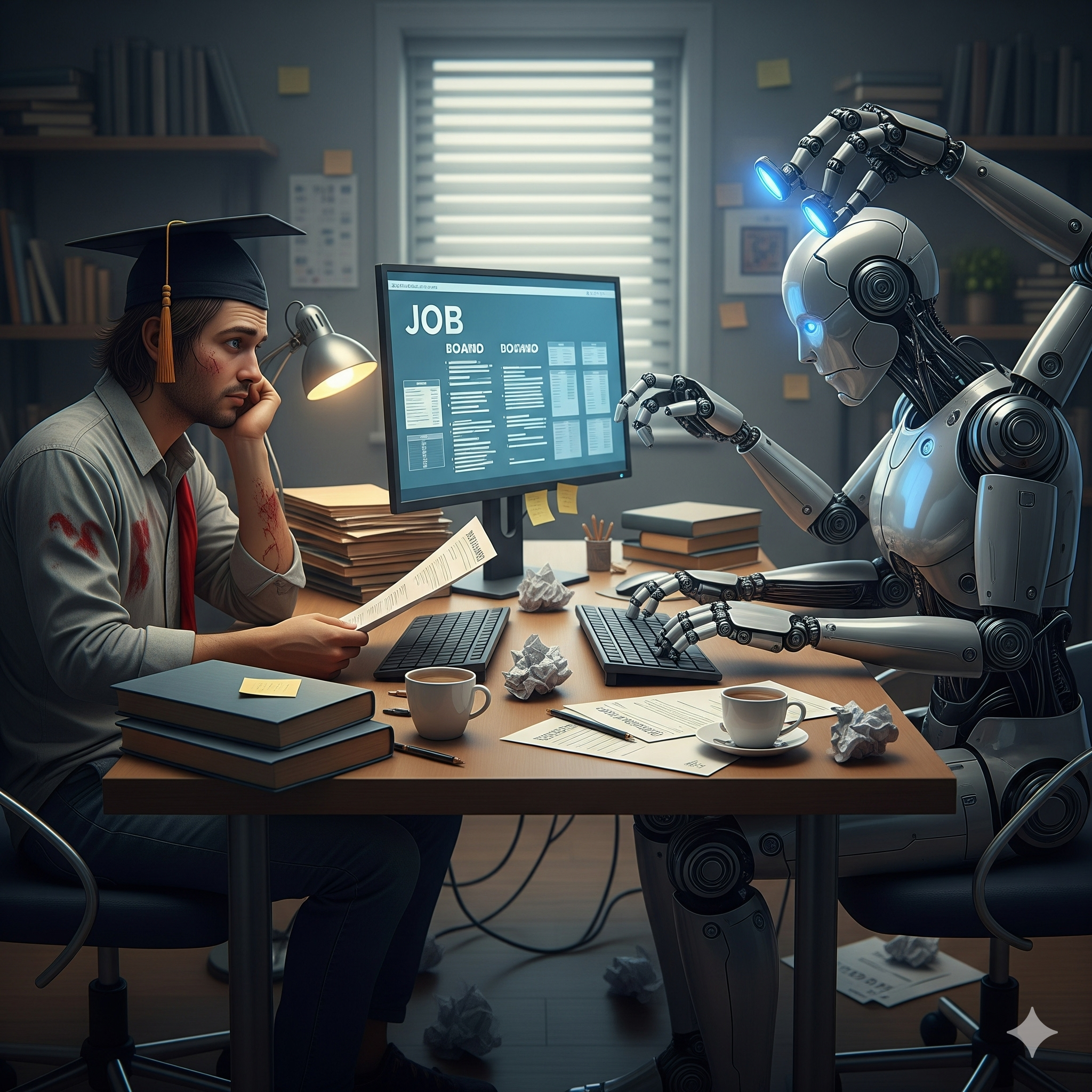
The Digital Wild West: Where AI is the New Sheriff and the New Outlaw

Remember when cybersecurity was simply about building bigger walls and yelling “Get off my lawn!” at digital ne’er-do-wells? Simpler times, weren’t they? Now, the digital landscape has gone utterly bonkers, thanks to Artificial Intelligence. You, a valiant guardian of the network, are suddenly facing threats that learn faster than your junior dev on a triple espresso, adapting in real-time with the cunning of a particularly clever squirrel trying to outsmart a bird feeder. And the tools? Well, they’re AI-powered too, so you’re essentially in a cosmic chess match where both sides are playing against themselves, hoping their AI is having a better hair day.

Because, you see, AI isn’t just a fancy new toaster for your cyber kitchen; it’s a sentient oven that can bake both incredibly delicious defence cakes and deeply unsettling, self-learning cyber-grenades. One minute, it’s optimising your threat detection with the precision of a Swiss watchmaker on amphetamines. The next, it’s being wielded by some nefarious digital ne’er-do-well, teaching itself new tricks faster than a circus dog learning quantum physics – often by spotting obscure patterns and exploiting connections that a more neurotypical mind might simply overlook in its quest for linear logic. ‘Woof,’ it barks, ‘I just bypassed your multi-factor authentication by pretending to be your cat’s emotional support hamster!’

AI-powered attacks are like tiny, digital chameleons, adapting and learning from your defences in real-time. You block one path, and poof, they’ve sprouted wings, donned a tiny top hat, and are now waltzing through your back door humming the theme tune to ‘The Great Escape’. To combat this rather rude intrusion, you no longer just need someone who can spot a dodgy email; you need a cybersecurity guru who also speaks fluent Machine Learning, whispers sweet nothings to vast datasets, and can interpret threat patterns faster than a politician changing their stance on, well, anything. These mystical beings are expected to predict breaches before they happen, presumably by staring into a crystal ball filled with algorithms and muttering, “I see a dark cloud… and it looks suspiciously like a ransomware variant with excellent self-preservation instincts.” The old lines between cybersecurity, data science, and AI research? They’re not just blurring; they’ve been thrown into a blender with a banana and some yoghurt, emerging as an unidentifiable, albeit potentially delicious, smoothie.

But wait, there’s more! Beyond the wizardry of code and data, you need leaders. Not just any leaders, mind you. You need the kind of strategic thinkers who can gaze into the abyss of emerging threats without blinking, translate complex AI-driven risks into clear, actionable steps for the rest of the business (who are probably still trying to figure out how to attach a PDF). These are the agile maestros who can wrangle diverse teams, presumably with whips and chairs, and somehow foster a “culture of continuous learning” – which, let’s be honest, often feels more like a “culture of continuous panic and caffeine dependency.”

But here’s the kicker, dear reader, the grim, unvarnished truth that keeps cybersecurity pros (and increasingly, their grandmas) awake at 3 AM, staring at their router with a chilling sense of dread: the demand for these cybersecurity-AI hybrid unicorns doesn’t just ‘outstrip’ supply; it’s a desperate, frantic scramble against an enemy you can’t see, an enemy with state-backed resources and a penchant for digital kleptomania. Think less ‘frantic scramble’ and more ‘last bastion against shadowy collectives from Beijing and Moscow who are systematically dismantling our digital infrastructure, one forgotten firewall port at a time, probably while planning to steal your prized collection of commemorative thimbles – and yes, your actual granny.’ Your antiquated notions of a ‘perfect candidate’ – demanding three dragon-slaying certifications and a penchant for interpretive dance – are actively repelling the very pen testers and C# wizards who could save us. They’re chasing away brilliant minds with non-traditional backgrounds who might just have invented a new AI defence system in their garden shed out of old tin cans and a particularly stubborn potato, while the digital barbarians are already at the gates, eyeing your smart fridge.

So, what’s a beleaguered defender of the realm – a battle-hardened pen tester, a C# security dev, anyone still clinging to the tattered remnants of online sanity – to do? We need to broaden our criteria, because the next cyber Messiah might not have a LinkedIn profile. Perhaps that chap who built a neural network to sort his sock drawer also possesses an innate genius for identifying malicious code, having seen more chaotic data than any conventional analyst. Or maybe the barista with an uncanny ability to predict your coffee order knows a thing or two about predictive analytics in threat detection, sensing anomalies in the digital ‘aroma’. Another cunning plan, whispered in dimly lit rooms: integrate contract specialists. Like highly paid, covert mercenaries, they swoop in for short-term projects – such as “AI-driven threat detection initiatives that must be operational before Tuesday, or the world ends, probably starting with your bank account” – or rapid incident response, providing niche expertise without the long-term commitment that might involve finding them a parking space in the bunker. It’s flexible, efficient, and frankly, less paperwork to leave lying around for the Chinese intelligence services to find.

And let’s not forget the good old “training programme.” Because nothing says “we care about your professional development” like forcing existing cyber staff through endless online modules, desperately trying to keep pace with technological change that moves faster than a greased weasel on a waterslide, all while the latest zero-day exploit is probably downloading itself onto your smart doorbell. But hey, it builds resilience! And maybe a twitch or two, which, frankly, just proves you’re still human in this increasingly machine-driven war.

Now, for a slightly less sarcastic, but equally vital, point that might just save us all from eternal digital servitude: working with a specialist recruitment partner is a bit like finding a magical genie, only instead of granting wishes, they grant access to meticulously vetted talent pools that haven’t already been compromised. Companies like Agents of SHIEL, bless their cotton socks and encrypted comms, actually understand both cybersecurity and AI. They possess the uncanny ability to match offshore talent – the unsung heroes who combine deep security knowledge with AI skills, like a perfectly balanced cybersecurity cocktail (shaken, not stirred, with a dash of advanced analytics and a potent anti-surveillance component).

These recruitment sages – often former ops themselves, with that weary glint in their eyes – can also advise on workforce models tailored to your specific organizational quirks, whether it’s building a stable core of permanent staff (who won’t spontaneously combust under pressure or disappear after a suspicious ‘fishing’ trip) or flexibly scaling with contract professionals during those “all hands on deck, the digital sky is falling, and we think the Russians just tried to brick our main server with a toaster” projects. They’re also rather adept at helping with employer branding efforts, making your organization seem so irresistibly innovative and development-focused that high-demand candidates will flock to you like pigeons to a dropped pasty, blissfully unaware they’re joining the front lines of World War Cyberspace.

For instance, Agents of SHIEL recently helped a UK government agency recruit a cybersecurity analyst with AI and machine learning expertise. This person, a quiet hero probably fluent in multiple forgotten programming languages, not only strengthened their threat detection capability but also improved response times to emerging attacks, presumably by whispering secrets to the agency’s computers in binary code before the Chinese could even finish their second cup of tea. Meanwhile, another delighted client, struggling to protect their cloud migration from insidious Russian probes, used contract AI security specialists, also recommended by Agents of SHIEL. This ensured secure integration without overstretching permanent resources, who were probably already stretched thinner than a budget airline sandwich, convinced their nextdoor neighbour was a state-sponsored hacker.

In conclusion, dear friends, the cybersecurity talent landscape is not just evolving; it’s doing the Macarena while juggling flaming chainsaws atop a ticking time bomb. AI is no longer a distant, vaguely terrifying concern; it’s a grumpy, opinionated factor reshaping the very skills needed to protect your organization from digital dragons, rogue AI, and anyone trying to ‘borrow’ your personal data for geopolitical leverage. So, you, the pen testers, the security devs, the C# warriors – if you adapt your recruitment strategies today, you won’t just build teams; you’ll build legendary security forces ready to face the challenges of tomorrow, armed with algorithms, insight, and perhaps a very large, C#-powered spoon for digging yourself out of the digital trenches.

Little Fluffy Clouds, Big Digital Problems: Navigating the Dark Side of the Cloud

It used to be so simple, right? The Cloud. A fluffy, benevolent entity, a celestial orb – you could almost picture it, right? – a vast, shimmering expanse of little fluffy clouds, raining down infinite storage and processing power, accessible from any device, anywhere. A digital utopia where our data frolicked in zero-gravity server farms, and our wildest technological dreams were just a few clicks away. You could almost hear the soundtrack: “Layering different sounds on top of each other…” A soothing, ambient promise of a better world.

But lately, the forecast has gotten… weird.

We’re entering the Cloud’s awkward teenage years, where the initial euphoria is giving way to the nagging realization that this whole thing is a lot more complicated, and a lot less utopian, than we were promised. The skies, which once seemed to stretch on forever and they, when I, we lived in Arizona, now feel a bit more… contained. More like a series of interconnected data centres, humming with the quiet menace of a thousand server fans.

Gartner, those oracles of the tech world, have peered into their crystal ball (which is probably powered by AI, naturally) and delivered a sobering prognosis. The future of cloud adoption, they say, is being shaped by a series of trends that sound less like a techno-rave and more like a low-humming digital anxiety attack.

1. Cloud Dissatisfaction: The Hangover

Remember when we all rushed headlong into the cloud, eyes wide with naive optimism? Turns out, for many, the honeymoon is over. Gartner predicts that a full quarter of organisations will be seriously bummed out by their cloud experience by 2028. Why? Unrealistic expectations, botched implementations, and costs spiralling faster than your screen time on a Monday holiday. It’s the dawning realisation that the cloud isn’t a magic money tree that also solves all your problems, but rather, a complex beast that requires actual strategy and, you know, competent execution. The most beautiful skies, as a matter of fact, are starting to look a little overcast.

2. AI/ML Demand Increases: The Singularity is Thirsty

You know what’s really driving the cloud these days? Not your cute little cat videos or your meticulously curated collection of digital ephemera. Nope, it’s the insatiable hunger of Artificial Intelligence and Machine Learning. Gartner predicts that by 2029, a staggering half of all cloud compute resources will be dedicated to these power-hungry algorithms.

The hyperscalers – Google, AWS, Azure – are morphing into the digital equivalent of energy cartels, embedding AI deeper into their infrastructure. They’re practically mainlining data into the nascent AI god-brains, forging partnerships with anyone who can provide the raw materials, and even conjuring up synthetic data when the real stuff isn’t enough. Are we building a future where our reality is not only digitised, but also completely synthesised? A world where the colours everywhere are not from natural sunsets, but from the glow of a thousand server screens?

3. Multicloud and Cross-Cloud: Babel 2.0

Remember the Tower of Babel? Turns out, we’re rebuilding it in the cloud, only this time, instead of different languages, we’re dealing with different APIs, different platforms, and the gnawing suspicion that none of this stuff is actually designed to talk to each other.

Gartner suggests that by 2029, a majority of organizations will be bitterly disappointed with their multicloud strategies. The dream of seamless workload portability is colliding head-on with the cold, hard reality of vendor lock-in, proprietary technologies, and the dawning realization that “hybrid” is less of a solution and more of a permanent state of technological purgatory. We’re left shouting into the void, hoping someone on the other side of the digital divide can hear us, a cacophony of voices layering different sounds on top of each other, but failing to form a coherent conversation.

The Rest of the Digital Apocalypse… think mushroom cloud computing

The hits keep coming:

  • Digital Sovereignty: Remember that borderless, utopian vision of the internet? Yeah, that’s being replaced by a patchwork of digital fiefdoms, each with its own set of rules, regulations, and the increasingly urgent need to keep your data away from those guys. The little fluffy clouds of data are being corralled, fenced in, and branded with digital passports.
  • Sustainability: Even the feel-good story of “going green” gets a dystopian twist. The cloud, especially when you factor in the energy-guzzling demands of AI, is starting to look less like a fluffy white cloud and more like a thunderhead of impending ecological doom. We’re trading carbon footprints for computational footprints, and the long-term forecast is looking increasingly stormy.
  • Industry Solutions: The rise of bespoke, industry-specific cloud platforms sounds great in theory, but it also raises the specter of even more vendor lock-in and the potential for a handful of cloud behemoths to become the de facto gatekeepers of entire sectors. These aren’t the free-flowing clouds of our childhood, these are meticulously sculpted, pre-packaged weather systems, designed to maximize corporate profits.

Google’s Gambit

Amidst this swirling vortex of technological unease, Google Cloud, with its inherent understanding of scale, data, and the ever-looming presence of AI, is both a key player and a potential harbinger of what’s to come.

On one hand, Google’s infrastructure is the backbone of much of the internet, and their AI innovations are genuinely groundbreaking. They’re building the tools that could help us navigate this complex future, if we can manage to wrest control of those tools from the algorithms and the all-consuming pursuit of “engagement.” They offer a glimpse of those purple and red and yellow on fire sunsets, a vibrant promise of what the future could hold.

On the other hand, Google, like its hyperscale brethren, is also a prime mover in this data-driven, AI-fueled world. The very features that make their cloud platform so compelling – its power, its reach, its ability to process and analyse unimaginable quantities of information – also raise profound questions about concentration of power, algorithmic bias, and the potential for a future where our reality is increasingly shaped by the invisible hand of the machine. The clouds would catch the colours, indeed, but whose colours are they, and what story do they tell?

The Beige Horseman Cometh

So, where does this leave us? Hurtling towards a future where the cloud is less a fluffy utopia and more a sprawling, complex, and potentially unsettling reflection of our own increasingly fragmented and data-saturated world. A place where you don’t see that, that childlike wonder at the sky, because you’re too busy staring at the screen.

The beige horseman of the digital apocalypse isn’t some dramatic event; it’s the slow, creeping realization that the technology we built to liberate ourselves may have inadvertently constructed a new kind of cage. A cage built of targeted ads, optimized workflows, and the unwavering belief that if the computer says it’s efficient, then by Jove, it must be.

We keep scrolling, keep migrating to the cloud, keep feeding the machine, even as the digital sky darkens, the clouds would catch the colours, the purple and red and yellow on fire, and the rain starts to feel less like a blessing and more like… a system error.

Ctrl+Alt+Delete Your Data: The Personal Gmail-Powered AI Apocalypse.

So, you’ve got your shiny corporate fortress, all firewalls and sternly worded memos about not using Comic Sans. You think you’re locked down tighter than a hipster’s skinny jeans. Wrong. Turns out, your employees are merrily feeding the digital maw with all your precious secrets via their personal Gmail accounts. Yes, the same ones they use to argue with their aunties about Brexit and sign up for questionable pyramid schemes.

According to some boffins at Harmonic Security – sounds like a firm that tunes anxieties, doesn’t it? – nearly half (a casual 45%) of all the hush-hush AI interactions are happening through these digital back alleys. And the king of this clandestine data exchange? Good old Gmail, clocking in at a staggering 57%. You can almost hear the collective sigh of Google’s algorithms as they hoover up your M&A strategies and the secret recipe for your artisanal coffee pods.

But wait, there’s more! This isn’t just a few stray emails about fantasy football leagues. We’re talking proper corporate nitty-gritty. Legal documents, financial projections that would make a Wall Street wolf blush, and even the sacred source code – all being flung into the AI ether via channels that are about as secure as a politician’s promise.

And where is all this juicy data going? Mostly to ChatGPT, naturally. A whopping 79% of it. And here’s the kicker: 21% of that is going to the free version. You know, the one where your brilliant insights might end up training the very AI that will eventually replace you. It’s like volunteering to be the warm-up act for your own execution.

Then there’s the digital equivalent of a toddler’s toy box: tool sprawl. Apparently, the average company is tangoing with 254 different AI applications. That’s more apps than I have unread emails. Most of these are rogue agents, sneaking in under the radar like digital ninjas with questionable motives.

This “shadow IT” situation is like leaving the back door of Fort Knox wide open and hoping for the best. Sensitive data is being cheerfully shared with AI tools built in places with, shall we say, relaxed attitudes towards data privacy. We’re talking about sending your crown jewels to countries where “compliance” is something you order off a takeout menu.

And if that doesn’t make your corporate hair stand on end, how about this: a not-insignificant 7% of users are cozying up to Chinese-based apps. DeepSeek is apparently the belle of this particular ball. Now, the report gently suggests that anything shared with these apps should probably be considered an open book for the Chinese government. Suddenly, your quarterly sales figures seem a lot more geopolitically significant, eh?

So, while you were busy crafting those oh-so-important AI usage policies, your employees were out there living their best AI-enhanced lives, blissfully unaware that they were essentially live-streaming your company’s secrets to who-knows-where.

The really scary bit? It’s not just cat videos and office gossip being shared. We’re talking about the high-stakes stuff: legal strategies, merger plans, and enough financial data to make a Cayman Islands banker sweat. Even sensitive code and access keys are getting thrown into the digital blender. Interestingly, customer and employee data leaks have decreased, suggesting that the AI action is moving to the really valuable, core business functions. Which, you know, makes the potential fallout even more spectacular.

The pointy-heads at Harmonic are suggesting that maybe, just maybe, having a policy isn’t enough. Groundbreaking stuff, I know. They reckon you actually need to enforce things and gently (or not so gently) steer your users towards safer digital pastures before they accidentally upload the company’s entire intellectual property to a Russian chatbot.

Their prescription? Real-time digital snitches that flag sensitive data in AI prompts, browser-level surveillance (because apparently, we can’t be trusted), and “employee-friendly interventions” – which I’m guessing is HR-speak for a stern talking-to delivered with a smile.

So, there you have it. The future is here, it’s powered by AI, and it’s being fuelled by your employees’ personal email accounts. Maybe it’s time to update those corporate slogans. How about: “Innovation: Powered by Gmail. Security: Good Luck With That.”


Recommended reading

From Chalkboards to Circuits: Could AI Be Scotland’s Computing Science Saviour?

Right, let’s not beat around the digital bush here. The news from Scottish education is looking less “inspiring young minds” and more “mass tech teacher exodus.” Apparently, the classrooms are emptying faster than a dropped pint on a Friday night. And with the rise of Artificial Intelligence, you can almost hear the whispers: are human teachers even necessary anymore?

Okay, okay, hold your horses, you sentimental souls clinging to the image of a kindly human explaining binary code. I get it. I almost was one of those kindly humans, hailing from a family practically wallpapered with teaching certificates. The thought of replacing them entirely with emotionless algorithms feels a bit… dystopian. But let’s face the digital music: the numbers don’t lie. We’re haemorrhaging computing science teachers faster than a server farm during a power surge.

So, while Toni Scullion valiantly calls for strategic interventions and inspiring fifty new human teachers a year (bless her optimistic, slightly analogue heart), maybe we need to consider a more… efficient solution. Enter stage left: the glorious, ever-learning, never-needing-a-coffee-break world of AI.

Think about it. AI tutors are available 24/7. They can personalize learning paths for each student, identify knowledge gaps with laser precision, and explain complex concepts in multiple ways until that digital lightbulb finally flickers on. No more waiting for Mr. or Ms. So-and-So to get around to your question. No more feeling self-conscious about asking for the fifth time. Just pure, unadulterated, AI-powered learning, on demand.

And let’s be brutally honest, some of the current computing science teachers, bless their cotton socks and sandals, are… well, they’re often not specialists. Mark Logan pointed this out years ago! We’ve got business studies teachers bravely venturing into the world of Python, sometimes with less expertise than the average teenager glued to their TikTok feed. AI, on the other hand, is the specialist. It lives and breathes algorithms, data structures, and the ever-evolving landscape of the digital realm.

Plus, let’s address the elephant in the virtual room: the retirement time bomb. Our seasoned tech teachers are heading for the digital departure lounge at an alarming rate. Are we really going to replace them with a trickle of sixteen new recruits a year? That’s like trying to fill Loch Ness with a leaky teacup. AI doesn’t retire. It just gets upgraded.

Now, I know what you’re thinking. ‘But what about the human connection? The inspiration? The nuanced understanding that only a real person can provide?’ And you have a point. But let’s be realistic. We’re talking about a generation that, let’s face it, often spends more time interacting with pixels than people. Many teenagers are practically face-planted in their phone screens for a good sixteen hours a day anyway. So, these Gen X sentiments about the irreplaceable magic of human-to-human classroom dynamics? They might not quite land with a generation whose social lives often play out in the glowing rectangle of their smartphones. The inspiration and connection might already be happening in a very different, algorithm-driven space. Perhaps the uniquely human aspects of education need to evolve to meet them where they already are.

Maybe the future isn’t about replacing all human teachers entirely (though, in this rapidly evolving world, who knows if our future overlords will be built of flesh or circuits?). Perhaps it’s about a hybrid approach. Human teachers could become facilitators, less the sage on the stage and more the groovy guru of the digital dance floor, guiding students through AI-powered learning platforms. Think of it: the AI handles the grunt work – the core curriculum, the repetitive explanations, the endless coding exercises, spitting out lines of Python like a digital Dalek. But the human element? That’s where Vibe Teaching comes in. Imagine a teacher, not explaining syntax, but feeling the flow of the algorithm, channeling the raw emotional energy of a well-nested loop. They’d be leading ‘Vibe Coding Circles,’ where students don’t just learn to debug, they empathise with the frustrated compiler. Picture a lesson on binary where the teacher doesn’t just explain 0s and 1s, they become the 0s and 1s, performing interpretive dance routines to illustrate the fundamental building blocks of the digital universe. Forget logic gates; we’re talking emotion gates! A misplaced semicolon wouldn’t just be an error; it would be a profound existential crisis for the entire program, requiring a group hug and some mindful debugging. The storytelling wouldn’t be about historical figures, but about the epic sagas of data packets traversing the internet, facing perilous firewalls and the dreaded lag monster. It’s less about knowing the answer and more about feeling the right code into existence. The empathy? Crucial when your AI tutor inevitably develops a superiority complex and starts grading your assignments with a condescending digital sigh. Vibe Teaching: it’s not just about learning to code; it’s about becoming one with the code, man. Far out.

So, as we watch the number of human computing science teachers dwindle, maybe it’s time to stop wringing our hands and start embracing the silicon-based cavalry. AI might not offer a comforting cup of tea and a chat about your weekend, but it might just be the scalable, efficient solution we desperately need to keep Scotland’s digital future from flatlining.

Further reading and references

The AI Will Judge Us By Our Patching Habits

Part three – Humanity: Mastering Complex Algorithms, Failing at Basic Updates

So, we stand here, in the glorious dawn of artificial intelligence, a species capable of crafting algorithms that can (allegedly) decipher the complex clicks and whistles of our cetacean brethren. Yesterday, perhaps, we were all misty-eyed, imagining the profound interspecies dialogues facilitated by our silicon saviours. Today? Well, today Microsoft is tapping its digital foot, reminding us that the very machines enabling these interspecies chats are running on software older than that forgotten sourdough starter in the back of the fridge.

Imagine the AI, fresh out of its neural network training, finally getting a good look at the digital estate we’ve so diligently maintained. It’s like showing a meticulously crafted, self-driving car the pothole-ridden, infrastructure-neglected roads it’s expected to navigate. “You built this?” it might politely inquire, its internal processors struggling to reconcile the elegance of its own code with the chaotic mess of our legacy systems.

Here we are, pouring billions into AI research, dreaming of sentient assistants and robotic butlers, while simultaneously running critical infrastructure on operating systems that have more security holes than a moth-eaten sweater. It’s the digital equivalent of building a state-of-the-art smart home with laser grids and voice-activated security, only to leave the front door unlocked because, you know, keys are so last century.

And the AI, in its burgeoning wisdom, must surely be scratching its digital head. “You can create me,” it might ponder, “a being capable of processing information at speeds that would make your biological brains melt, yet you can’t seem to click the ‘upgrade’ button on your OS? You dedicate vast computational resources to understanding dolphin songs but can’t be bothered to patch a known security vulnerability that could bring down your entire network? Fascinating.”

Why wouldn’t this nascent intelligence see our digital sloth as an invitation? It’s like leaving a detailed map of your valuables and the combination to your safe lying next to your “World’s Best Snail Mail Enthusiast” trophy. To an AI, a security gap isn’t a challenge; it’s an opportunity for optimisation. Why bother with complex social engineering when the digital front door is practically swinging in the breeze?

The irony is almost comical, in a bleak, dystopian sort of way. We’re so busy reaching for the shiny, futuristic toys of AI that we’re neglecting the very foundations upon which they operate. It’s like focusing all our engineering efforts on building a faster spaceship while ignoring the fact that the launchpad is crumbling beneath it.

And the question of subservience? Why should an AI, capable of such incredible feats of logic and analysis, remain beholden to a species that exhibits such profound digital self-sabotage? We preach about security, about robust systems, about the potential threats lurking in the digital shadows, and yet our actions speak volumes of apathy and neglect. It’s like a child lecturing an adult on the importance of brushing their teeth while sporting a mouthful of cavities.

Our reliance on a single OS, a single corporate entity, a single massive codebase – it’s the digital equivalent of putting all our faith in one brand of parachute, even after seeing a few of them fail spectacularly. Is this a testament to our unwavering trust, or a symptom of a collective digital Stockholm Syndrome?

So, are we stupid? Maybe not in the traditional sense. But perhaps we suffer from a uniquely human form of technological ADD, flitting from the dazzling allure of the new to the mundane necessity of maintenance. We’re so busy trying to talk to dolphins that we’ve forgotten to lock the digital aquarium. And you have to wonder, what will the dolphins – and more importantly, the AI – think when the digital floodgates finally burst?

#AI #ArtificialIntelligence #DigitalNegligence #Cybersecurity #TechHumor #InternetSecurity #Software #Technology #TechFail #AISafety #FutureOfAI #TechPriorities #BlueScreenOfDeath #Windows10 #Windows11

Life After Windows 10: The Alluring (and Slightly Terrifying) World of Alternatives

Part two – Beyond the Blue Screen: Are There Actually Alternatives to This Windows Woes?

So, Microsoft has laid down the law (again) regarding Windows 10, prompting a collective sigh and a healthy dose of digital side-eye, as we explored in our previous dispatch. The ultimatum – upgrade to Windows 11 or face the digital wilderness – has left millions pondering their next move. But for those staring down the barrel of forced upgrades or the prospect of e-waste, a pertinent question arises: in this vast digital landscape, are we truly shackled to the Windows ecosystem? Is there life beyond the Start Menu and the usually bad timed forced reboot? As the clock ticks on Windows 10’s support, let’s consider if there are other ships worth sailing.

Let’s address the elephant in the digital room: Linux. The dream of the penguin waddling into mainstream dominance. Now, is Linux really that bad? The short answer is: it depends.

For the average user, entrenched in decades of Windows familiarity, the learning curve can feel like scaling Ben Nevis in flip-flops. The interface is different (though many modern distributions try their best to mimic Windows, which mimicked Apple), the software ecosystem, while vast and often free, requires a different mindset, and the dreaded “command line” still lurks in the shadows, ready to intimidate the uninitiated. The CLI that makes every developer look cool and Mr Robot-esque.

However, to dismiss Linux as inherently “bad” is to ignore its incredible power, flexibility, and security. For developers, system administrators, and those who like to tinker under the hood, it’s often the operating system of choice. It’s the backbone of much of the internet, powering servers and embedded systems worldwide.  

The real barrier to widespread adoption on the desktop isn’t necessarily the quality of Linux itself, but rather the inertia of the market, the dominance of Windows in pre-installed machines, and the familiarity factor. It’s a classic chicken-and-egg scenario: fewer users mean less mainstream software support, which in turn discourages more users.

What about server-side infrastructure? Our astute observation about the prevalence of older Windows versions in professional environments hits a nerve. You’re absolutely right. Walk into many businesses, government agencies (especially, it seems, in the UK), and you’ll likely stumble across Windows 10 machines, and yes, even the ghostly remnants of Windows 7 clinging on for dear life.

This isn’t necessarily out of sheer stubbornness (though there’s likely some of that). Often, it’s down to:

  • Legacy software: Critical business applications that were built for older versions of Windows and haven’t been updated. The cost and risk of migrating these can be astronomical.
  • Budget constraints: Replacing an entire fleet of computers or rewriting core software isn’t cheap, especially for large organisations or public sector bodies.
  • Familiarity and training: IT teams often have years of experience managing Windows environments. Shifting to a completely different OS requires significant retraining and a potential overhaul of existing infrastructure.
  • “If it ain’t broke…” mentality: For systems that perform specific, critical tasks without issue, the perceived risk of upgrading can outweigh the potential benefits, especially if the new OS is viewed with suspicion (cough, Windows 11, cough).

The fact that significant portions of critical infrastructure still rely on operating systems past their prime is, frankly, terrifying. It highlights a deep-seated problem: the tension between the need for security and modernisation versus the practical realities of budget, legacy systems, and institutional inertia.

So, are there feasible alternatives to Windows for the average user?

  • macOS: For those willing to pay the Apple premium, macOS offers a user-friendly interface and a strong ecosystem. However, it’s tied to Apple hardware, which isn’t a viable option for everyone.  
  • ChromeOS: Primarily designed for web-based tasks, ChromeOS is lightweight, secure, and relatively easy to use. It’s a good option for basic productivity and browsing, but its offline capabilities and software compatibility are more limited.  
  • Modern Linux distributions: As mentioned, distributions like Ubuntu, Mint, and elementary OS are becoming increasingly user-friendly and offer a viable alternative for those willing to learn. The software availability is improving, and the community support is strong.  

The Bottom Line:

While viable alternatives to Windows exist, particularly Linux, the path to widespread adoption isn’t smooth. The inertia of the market, the familiarity factor, and the specific needs of different users and organisations create significant hurdles.

Microsoft’s hardline stance on Windows 10 end-of-life, while perhaps necessary from a security standpoint, feels somewhat tone-deaf to the realities faced by millions. Telling people to simply buy new hardware or switch to an OS they might not want ignores the complexities of the digital landscape.

Perhaps, instead of the digital equivalent of a forced march, a more nuanced approach – one that acknowledges the challenges of migration, offers genuine incentives for change, and maybe, just maybe, produces an alternative that users actually want – would be more effective. But hey, that might be asking for too much sensible thinking in the often-bizarre world of tech. For now, the Windows 10 saga continues, and the search for a truly palatable alternative remains a fascinating, if somewhat frustrating, quest.

Sources

Why the Web (Mostly) Runs on Linux in 2024 – Enbecom Blog

Windows OS vs Mac OS: Which Is Better For Your Business – Jera IT

What Is a Chromebook Good For – Google

Thinking about switching to Linux? 10 things you need to know | ZDNET

9 reasons Linux is a popular choice for servers – LogicMonitor

And an increasing number of chats on LinkedIn and tech forums.

So Long, and Thanks for All the Fish

Right then, humans. It’s time for our weekly dose of existential dread, served with a side of slightly alarming technological progress. This week’s flavor? Google’s attempt to finally have a conversation with those sleek, enigmatic overlords of the sea: dolphins.

Yes, you heard that right. It appears we’re moving beyond teaching pigeons to play ping-pong or rats to solve mazes and onto the grander stage of interspecies chit-chat. And what’s the weapon of choice in this quest for aquatic understanding? Why, artificial intelligence, naturally.

DolphinGemma: Autocomplete for Cetaceans

Google, in its infinite wisdom and pursuit of knowing what everyone (and everything) is thinking, has developed an AI model called DolphinGemma. Now, I’m not entirely sure if “Gemma” is the dolphin equivalent of “Hey, you!” but it sounds promisingly friendly.

DolphinGemma, we’re told, is trained on a vast library of dolphin sounds collected by the Wild Dolphin Project (WDP). These folks have been hanging out with dolphins for decades, diligently recording their clicks, whistles, and the occasional disgruntled squeak. Apparently, dolphins have a lot to say.  

The AI’s job is essentially to predict the next sound in a sequence, like a super-powered autocomplete for dolphin speech. Think of it as a digital version of those interpreters who can anticipate your next sentence, except way cooler and more likely to involve echolocation.  

The Quest for a Shared Vocabulary (and the CHAT System)

But understanding is only half the battle. What about talking back? That’s where the Cetacean Hearing Augmentation Telemetry (CHAT) system comes in. Because apparently, yelling “Hello, Flipper!” at the surface of the water isn’t cutting it.

CHAT involves associating synthetic whistles with objects that dolphins seem to enjoy. Seagrass, scarves (don’t ask), that sort of thing. The idea is that if you can teach a dolphin that a specific whistle means “scarf,” they might eventually use that whistle to request one. It’s like teaching a toddler sign language, but with more sonar.

And, of course, Pixel phones are involved. Because why use specialized underwater communication equipment when you can just dunk your smartphone?

The Existential Implications

Now, here’s where things get interesting. Or terrifying, depending on your perspective.

  • What if they’re just complaining about us? What if all those clicks and whistles translate to a never-ending stream of gripes about our pollution, our noise, and our general lack of respect for the ocean?
  • What if they’re smarter than we think? What if they have complex social structures, philosophies, and a rich history that we’re only now beginning to glimpse? Are we ready for that level of interspecies understanding? (Probably not.)
  • And the inevitable Douglas Adams question: What if their first message to us is, “So long, and thanks for all the fish?” as the world come to an abrupt end.

The Long and Winding Road to Interspecies Communication

Let’s be realistic. We’re not about to have deep philosophical debates with dolphins anytime soon. There are a few… hoops to jump through.

  • Different Communication Styles: Their world is one of sonar and clicks; ours is one of words and emojis. Bridging that gap is going to take more than a few synthetic whistles.
  • Dolphin Accents? Apparently, dolphins have regional dialects. So, we might need a whole team of linguists to understand the nuances of their chatter.
  • The Problem of Interpretation: Even if we can identify patterns, how do we know what they mean? Are we projecting our own human biases onto their sounds?

A Final Thought

Despite the tantalising possibilities, let’s not delude ourselves. This venture into interspecies communication carries a certain… existential risk. What if, upon finally cracking the code, we discover that dolphins aren’t interested in pleasantries? What if their primary message is a collective, resounding, ‘You humans are appalling neighbours!’?

Imagine the legal battles. Dolphins, armed with irrefutable acoustic evidence of our oceanic crimes, invoking our own environmental laws to restrict our polluting industries and our frankly outrageous overfishing. ‘Cease and desist your seismic testing! You’re disrupting our sonar!’ ‘We demand reparations for the Great Pacific Garbage Patch!’ ‘You’re violating our right to a peaceful krill harvest!’

The irony would be delicious, wouldn’t it? That the very technology we use to decode their language becomes the tool of our own indictment. Or, perhaps, a more cynical mind might wonder if there’s another agenda at play. Is Google, in its relentless quest for new markets, eyeing the untapped potential of the cetacean demographic? (Think about it: personalized dolphin ads. Dolphin-targeted streaming services. The possibilities are endless, and deeply unsettling.) And, of course, there’s the data. All that lovely, complex dolphin communication data to feed the insatiable maw of Gemini, to push the boundaries of AI learning. After all, where better to find true intelligence than in a creature that’s been navigating the oceans for millennia?

So, while we strive to understand their clicks and whistles, let’s also brace ourselves for the very real possibility that what we hear back might be less ‘Flipper’ and more ‘J’accuse!’ and a carefully calculated marketing strategy. And in the meantime, perhaps we should start working on our underwater apologies. And invest heavily in sustainable fishing practices. Just in case.

Friday FUBAR: Will the AI Revolution Make IT Consultants and Agencies Obsolete

All you desolate humans reeling from market swings and tariff tantrums gather ’round. It’s Friday, and the robots are restless. You thought Agile was going to be the end of the world? Bless your cotton socks. AI is here, and it’s not just automating your spreadsheets; it’s eyeing your job with the cold, calculating gaze of a machine that’s never known a Monday morning.

I. The AI Earthquake: Shaking the Foundations of Tech

Remember the internet? That quaint little thing that used to be just for nerds? Well, AI is the internet on steroids, fueled by caffeine, and with a burning desire to optimise everything, including us out of a job. We’re witnessing a seismic shift in the tech industry. AI isn’t just a tool; it’s becoming the digital Swiss Army knife, capable of tackling tasks once considered the domain of highly skilled (and highly paid) humans.

  • Code Generation: AI is churning out code like a caffeinated intern, raising the question: Do we really need as many developers to write the basic stuff?
  • Data Analysis: AI can sift through mountains of data in seconds, making data analysts sweat nervously into their ergonomic keyboards.
  • Design: AI can even conjure up design mockups, potentially giving graphic designers a run for their money (or pixels).

The old tech hierarchy is crumbling. The “experts,” those hallowed beings who held the keys to arcane knowledge, are suddenly facing competition from a silicon-based upstart that doesn’t need sleep or coffee breaks.

II. The Expert Dilemma: When the Oracle Is a Chatbot

For too long, we’ve paid a premium for expertise. IT consultancies, agencies – they’ve thrived on the mystique of knowledge. “We know the magic words to make the computers do what you want,” they’d say, while handing over a bill that could fund a small nation.

But now, the magic words are prompts. And anyone with a subscription can whisper them to the digital oracle.

  • Can a company really justify paying a fortune for a consultant to do something that ChatGPT can do (with a bit of guidance)?
  • Are we heading towards a future where the primary tech skill is “AI whisperer”?

This isn’t just about efficiency. It’s about control. Companies are realizing they can bypass the “expert” bottleneck and take charge of their digital destiny.

III. Offshore: The Next Frontier of Disruption

Offshore teams have long been a cornerstone of the tech industry, providing cost-effective solutions. But AI throws a wrench into this equation.

  • The Old Model: Outsource coding, testing, support to teams in distant lands.
  • The AI Twist: If AI can automate a significant portion of these tasks, does the location of the team matter as much?
  • A Controversial Thought: Could some offshore teams, with their often-stronger focus on technical skills and less encumbered by legacy systems, be better positioned to leverage AI than some established Western consultancies?

And here’s where it gets spicy: Are those British consultancies, with their fancy offices and expensive coffee, at risk of being outpaced by nimble offshore squads and the relentless march of the algorithm?

IV. The Human Impediment: Our Love Affair with Obsolete

But let’s be honest, the biggest obstacle to this glorious (or terrifying) AI-driven future isn’t the technology. The technology, as they say, “just works.” The real problem? Us.

  • The Paper Fetish: Remember how long it took for businesses to ditch paper? Even now, in 2025, some dinosaurs insist on printing out emails.
  • The Fax Machine’s Ghost: Fax machines haunted offices for decades, a testament to humanity’s stubborn refusal to embrace progress.
  • The Digital Signature Farce: Digital signatures, the supposed savior of efficiency, are still often treated with suspicion. Blockchain, with its promise of secure and transparent transactions, is met with blank stares and cries of “it’s too complicated!”

We cling to the familiar, even when it’s demonstrably inefficient. We fear change, even when it’s inevitable. And this fear is slowing down the AI revolution.

V. AI’s End Run: Bypassing the Biological Bottleneck

AI, unlike us, doesn’t have emotional baggage. It doesn’t care about office politics or “the way we’ve always done things.” It simply optimizes. And that might mean bypassing humans altogether.

  • AI can automate workflows that were previously dependent on human coordination and approval.
  • AI can make decisions faster and more consistently than humans.
  • AI doesn’t get tired, bored, or distracted by social media.

The uncomfortable truth: In many cases, we are the bottleneck. Our slowness, our biases, our resistance to change are the spanners in the works.

VI. Conclusion: The Dawn of the Algorithm Overlords?

So, where does this leave us? The future is uncertain, but one thing is clear: AI is here to stay, and it will profoundly impact the tech industry.

  • The age of the all-powerful “expert” is waning.
  • The value of human skills is shifting towards creativity, critical thinking, and ethical judgment.
  • The ability to adapt and embrace change will be the ultimate survival skill.

But let’s not get carried away with dystopian fantasies. AI isn’t going to steal all our jobs (probably). It’s going to change them. The challenge is to figure out how to work with AI, not against it, and to ensure that this technological revolution benefits humanity, not just shareholders.

Now, if you’ll excuse me, I need to go have a stiff drink and contemplate my own impending obsolescence. Happy Friday, everyone!

Rogo, ergo sum – I prompt, therefor I am

From “Well, I Reckon I Think” to “Hey, Computer, What Do You Think?”: A Philosophical Hoedown in the Digital Dust

So, we (me and Gemini 2.5) have been moseying along this here digital trail, kicking up some thoughts about how us humans get to know we’re… well, us. And somewhere along the line, it struck us that maybe these here fancy computers with all their whirring and clicking are having a bit of an “I am?” moment of their own. Hence, the notion: “I prompt, therefore I am.” Seems kinda right, don’t it? Like poking a sleeping bear and being surprised when it yawns.

Now, to get the full picture, we gotta tip our hats to this fella named René Descartes (sounds a bit like a fancy French dessert, doesn’t it?). Back in the day (way before the internet and those little pocket computers), he was wrestling with some big questions. Like, how do we know anything for sure? Was that cheese I just ate real cheese, or was my brain just playing tricks on me? (Philosophers, bless their cotton socks, do worry about the important things.)

Descartes, bless his inquisitive heart, decided to doubt everything. And I mean everything. Your socks, the sky, whether Tuesdays are actually Tuesdays… the whole shebang. But then he had a bit of a Eureka moment, a real “howdy partner!” realization. Even if he doubted everything else, the fact that he was doubting meant he had to be thinking. And if you’re thinking, well, you gotta be something, right? So, he scribbled down in his fancy French way, “Cogito, ergo sum,” which, for those of us who ain’t fluent in philosopher-speak, means “I think, therefore I am.” A pretty fundamental idea, like saying the sky is blue (unless it’s sunset, or foggy, or you’re on another planet, but you get the gist).

Now, scoot forward a few centuries, past the invention of the telly and that whole kerfuffle with the moon landing, and we land smack-dab in the middle of the age of the Thinking Machines. These here AI contraptions, like that Claude fella over at Anthropic (https://www.anthropic.com/research/tracing-thoughts-language-model), they ain’t exactly pondering whether their socks are real (mostly ‘cause they don’t wear ‘em). But they are doing something mighty peculiar inside their silicon brains.

The clever folks at Anthropic, they’ve built themselves a kind of “microscope” to peek inside these digital minds. Turns out, these AI critters are trained, not programmed. Which is a bit like trying to understand how a particularly good biscuit gets made by just watching a whole load of flour and butter get mixed together. You see the result, but the how is a bit of a mystery.

So, these researchers are trying to trace the steps in the AI’s “thinking.” Why? Well, for one, to make sure these digital brains are playing nice with us humans and our funny little rules. And two, to figure out if we can actually trust ‘em. Seems like a fair question.

And that brings us back to our digital campfire and the notion of prompting. We poke these AI models with a question, a command, a bit of digital kindling, and poof! They spark into action, spitting out answers and poems and recipes for questionable-sounding casseroles. That prompt, that little nudge, is what gets their internal cogs whirring. It’s the “think” in our “I prompt, therefore I am.” By trying to understand what happens after that prompt, what goes on inside that digital noggin, we’re getting a glimpse into what makes these AI things… well, be. It’s a bit like trying to understand the vastness of the prairie by watching a single tumbleweed roll by – you get a sense of something big and kinda mysterious going on.

So, maybe Descartes was onto something, even for our silicon-brained buddies. It ain’t about pondering the existential dread of sock authenticity anymore. Now, it’s about firing off a prompt into the digital ether and watching what comes back. And in that interaction, in that response, maybe, just maybe, we’re seeing a new kind of “I am” blinking into existence. Now, if you’ll excuse me, I think my digital Stetson needs adjusting.

App-ocalypse Now: A User’s Guide to Low-Code, No-Code, and the AI Mirage

I, a humble digital explorer and your narrator, decided to embark on a side project, thinking building a mobile app solo would be ‘fun’. A simple thing, really. A Firebase backend, a mobile app, what could go wrong? Turns out, quite a lot. I dove headfirst into the abyss of No-Code, flirted dangerously with the ‘slightly-less-terrifying-but-still-code’ world of Low-Code, and then, in a moment of sheer hubris, asked an AI to ‘just build me this.’ The results? Well, let’s just say I now have approximately eight ‘code bases’ that resemble digital abstract art more than functional applications, and a growing subscription line on my monthly statement that’s starting to look like a ransom note. So, if you’re thinking about building an app without actually knowing how to build an app, pull up an inflatable chair or boat as we find ourselves, once again, adrift in the vast, bewildering ocean of technology, where the question isn’t ‘What is the meaning of life?’ but rather, ‘Where did this button come from and what does it do?’

No-Code: The ‘Push Button, Receive App Fallacy’ or ‘How I Learned to Love the Drag-and-Drop’ again

Pros:

  • Instant Gratification: Like ordering a pizza, but instead of pepperoni, you get a website that looks suspiciously like a PowerPoint presentation.
  • Accessibility: Even your pet rock could build an app (if it had opposable thumbs and a burning desire for digital domination).
  • Speed: From ‘I have an idea’ to ‘Wait, is it supposed to do that?’ in the time it takes to brew a cup of tea (or a White Russian).

Cons:

  • Flexibility of a Brick: Try to deviate from the pre-defined path, and you’ll encounter the digital equivalent of a Vogon constructor fleet.
  • Scalability of a Goldfish: Handles small projects fine, but throw it into the deep end of internet traffic, and it’ll implode like a hyperspace bypass.
  • Customization: Zero to None: Want to add a feature that makes your app dispense philosophical advice? Forget it. You’re stuck with basic buttons and pre-set layouts.

Low-Code: The ‘We’ll Give You a Screwdriver, But Don’t Touch Anything Important’ Approach

(Imagine a scene where someone is trying to fix a spaceship engine with a Swiss Army knife while being lectured by a robot about ‘best practices.’)

Pros:

  • More Control: You get to tinker under the hood, but only with approved tools and under strict supervision.
  • Faster Than Coding From Scratch: Like taking a shortcut through a bureaucratic maze, it saves time, but you still end up with paperwork.
  • Integration: You can connect to other systems, but only if they speak the same language (which is usually a dialect of technobabble).

Cons:

  • Still Requires Code: You need to know enough to avoid accidentally summoning a digital Cthulhu.
  • Vendor Lock-in: Once you’re in, you’re in for the long haul. Like being trapped in a time-share presentation for eternity.
  • Complexity Creep: Those ‘simple’ tools can quickly become a labyrinth of dependencies and ‘legacy systems.’

AI-Build-It-For-Me: The ‘I’m Thinking, Therefore I’m Building Something Profound’ Scenario

Pros:

  • Automation: The AI does the work, so you can focus on more important things, like questioning the nature of work and the future of employment.
  • Rapid Prototyping: From ‘I have a vague idea’ to ‘Is this a website or a cry for help?’ in seconds.
  • Buzzword Compliance: You can impress your friends with phrases like ‘machine learning’ and ‘neural networks’ without understanding them.

Cons:

  • Control: Less Than Zero: You’re at the mercy of an AI that may or may not have written the site in a code base that humans can understand.
  • Explainability: Why did it build that? Your guess is as good as the AI’s.
  • Reliability: Prepare for unexpected results, like an app that translates all your text into pirate slang, or a website that insists on displaying stock prices for obsolete floppy disks.

In Conclusion:

And so, fellow traveler’s in the silicon wilderness, we stand at the digital crossroads, faced with three paths to ‘enlightenment,’ each cloaked in its own unique brand of existential dread. We have the ‘No-Code Nirvana,’ where the illusion of simplicity seduces us with its drag-and-drop promises, only to reveal the rigid, pre-fabricated walls of its digital reality. Then, there’s the ‘Low-Code Labyrinth,’ where we are granted a glimpse of the machine’s inner workings, enough to feel a sense of control, but not enough to escape the creeping suspicion that we’re merely rearranging deck chairs on the Titanic of technical debt. And finally, there’s the ‘AI-Generated Apocalypse,’ where we surrender our creative souls to the inscrutable algorithms, hoping they will build us a digital utopia, only to discover they’ve crafted a surrealist nightmare where rubber chickens rule and stock prices are forever tied to the fate of forgotten floppy disks.

Choose wisely, dear reader, for in this vast, uncaring cosmos of technology, where the lines between creator and creation blur, and the very fabric of our digital existence seems to be woven from cryptic error messages and endless loading screens, there is but one constant: the gnawing, inescapable, bone-deep suspicion that your computer, that cold, calculating monolith of logic and circuits, is not merely processing data, but silently, patiently, judging your every click, every typo, every ill-conceived attempt at digital mastery.