Available on Amazon

Available on Amazon
Writer, Scribbler and Prompt Alchemist
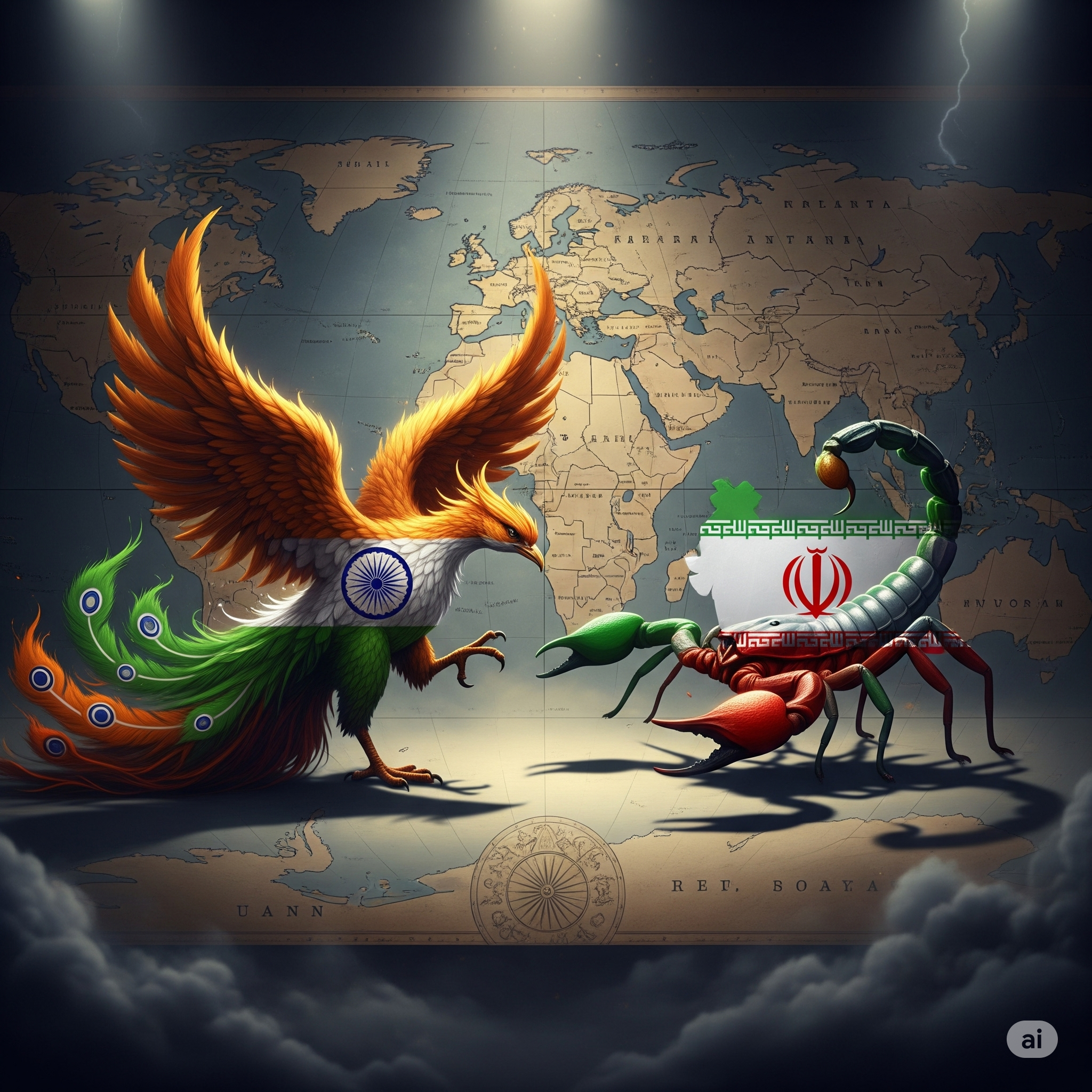
Today is August 15th, and while India celebrates its Independence Day with vibrant parades and patriotic fervour, the world stands on a precipice. The storm clouds of conflict gathering over the Persian Gulf are not just another geopolitical squall; they are the harbingers of a global reset. The bitter, resentful revenge of a cornered nation is about to create the power vacuum that a patient, rising superpower has been quietly preparing to fill. This is a tale of two futures: one of a spectacular, self-inflicted collapse, and the other of a quiet, inexorable ascent.
Warren Buffett famously called derivatives “financial weapons of mass destruction.” He wasn’t being metaphorical. He was describing a doomsday device embedded in the heart of our global financial system, waiting for a trigger. That trigger is now being pulled in the escalating conflict between the US, Israel, and Iran.
Iran’s revenge will not be a conventional war it cannot win. Its true trump card is a geopolitical choke point: the Strait of Hormuz. By shutting down this narrow waterway, Iran can instantly remove 20% of the world’s daily oil supply from the market. To put that in perspective, the 1973 oil crisis that quadrupled prices was caused by a mere 9% supply shock. A 20% shock is an extinction-level event for the global economy as we know it.
This isn’t a problem central banks can solve by printing money; they cannot print oil. The immediate price surge to well over $275 a barrel would act as the detonator for Buffett’s financial WMDs. The derivatives market, built on a tangled web of bets on oil prices, would implode. We would see a cascade of margin calls, defaults, and liquidity crises that would make 2008 look like a minor tremor. This is Iran’s asymmetric revenge: a single move that cripples its adversary by turning the West’s complex financial system against itself. The era of the US policing the world would end overnight, not with a bang, but with the silent, terrifying seizure of the global economic heart.
And as the old order chokes on its own hubris, a new one rises. Today, on its Independence Day, India isn’t just celebrating its past; it’s stepping into its future. While the West has been consumed with military dominance and policing the globe, India has been playing a different, longer game. Its strategy is not one of confrontation, but of strategic patience and relentless economic acquisition.
As the US fractures under the weight of economic collapse and internal strife, India will not send armies; it will send dealmakers. For years, it has been quietly and methodically getting on with the real business of building an empire:
This is not the loud, coercive power of the 20th century. It is a quiet, intelligent expansion built on economic partnership and a philosophy of multi-alignment. While America was spending trillions on wars, India has been investing its capital to build the foundations of the 21st-century’s dominant power.
The chaos born from the Scorpion’s sting provides the perfect cover for the Phoenix’s rise. As the West reels from an economic crisis it cannot solve, India, having maintained its neutrality, will step into the void. It will be the lender, the buyer, the partner of last resort. Today’s Independence Day marks the turning point. The world’s attention is on the explosion in the Gulf, but the real story is the quiet construction of a new world order, architected in New Delhi.
Down in the doom-scroll trenches, the memes about the Strait of Hormuz are getting spicier. Someone’s even set up a 24/7 livestream of the tanker routes with a synthwave soundtrack, already sponsored by a VPN. We’re all watching the end of the world like it’s a product launch, waiting to see if it drops on time and if we get the pre-order bonus. The collapse of empire, it turns out, is not a bug; it’s a feature.
The suits in DC and Tel Aviv finally swiped right on a war with Iran, and now the payback is coming. Not as a missile, but as a glitch in the matrix of global commerce. Iran’s revenge is to press CTRL+ALT+DEL on the Strait of Hormuz, that tiny pixel of water through which 20% of the world’s liquid motivation flows. Warren Buffett, bless his folksy, analogue heart, called derivatives “financial weapons of mass destruction.” He was thinking of numbers on a screen. He wasn’t thinking of the vurt-feathers and data-ghosts that truly haunt the system—toxic financial spells cooked up by algorithmic daemons in sub-zero server farms. The 20% oil shock isn’t a market correction; it’s a scream in the machine, a fever that boils those probability-specters into a vengeful, system-crashing poltergeist. Central banks can’t exorcise this demon with printed money. You can’t fight a ghost with paper.
And so the Great Unsubscribe begins. One morning you’ll wake up and your smart-fridge will have cancelled your avocado subscription, citing “unforeseen geopolitical realignments.” The ATMs won’t just be out of cash; they’ll dispense receipts with cryptic, vaguely philosophical error messages that will become a new form of street art. The American Civil War everyone LARP’d about online won’t be fought with guns; it’ll be fought between algorithm-fueled flash-mobs in states that are now just corporate fiefdoms—the Amazon Protectorate of Cascadia versus the United Disney Emirates of Florida. Your gig-economy rating will plummet because you were too busy bartering protein paste for Wi-Fi to deliver a retro-ironic vinyl record on time. The empire doesn’t end with a bang; it ends with a cascade of notifications telling you your lifestyle has been deprecated.
Meanwhile, the real story is happening elsewhere, humming quietly beneath the noise of the Western world’s noisy, spectacular nervous breakdown. India, the patient subcontinent, is not launching an invasion; it’s executing a hostile takeover disguised as a wellness retreat. As America’s brand identity fractures, India’s dealmakers move like pollen-priests on the wind, not buying companies so much as metabolizing them. Their power isn’t in aircraft carriers; it’s in the elegant, undeniable logic of the code being written in Bangalore that now runs the logistics for a port in Africa that used to have a US flag flying over it. It’s a reverse-colonization happening at the speed of light, a bloodless coup fought on spreadsheets and in server racks, utterly unnoticed by a populace busy arguing over the last can of artisanal kombucha.
The future has already happened; we’re just waiting for the update to finish installing. On a rooftop in Mumbai, a kid is beta-testing a neural interface powered by a chip designed in what used to be called Silicon Valley. On a cracked pavement in what used to be California, another kid is trying to trade a vintage, non-functional iPhone for a bottle of clean water. The global operating system has been rebooted. Today isn’t just India’s Independence Day. It’s the day the rest of the world realized their free trial had expired.
Happy Independence Day to all my Indian friends – may the next century be peacefully yours.
Prem (प्रेम) Shanti (शान्ति) Safalta (सफलता) Khushi (ख़ुशी)

Iteration. The word itself conjures up images of spinning wheels, cyclical patterns, and that hamster in its never-ending quest for… well, whatever a hamster sees in those wheels. But “iteration” is more than just a fancy word for “doing something again and again.” It’s a fundamental concept that permeates our lives, from the mundane to the profound.
Think about your morning routine. Wake up, stumble to the bathroom, brush your teeth (hopefully), make coffee (definitely). That’s an iteration, a daily ritual repeated with minor variations. Or consider the changing seasons, the ebb and flow of tides, the endless cycle of birth, growth, decay, and renewal. Iteration is the rhythm of existence, the heartbeat of the universe.
In the world of art and creativity, iteration takes center stage. Painters rework their canvases, musicians refine their melodies, writers revise their manuscripts – all in pursuit of that elusive perfect expression. Each iteration builds upon the last, refining, reimagining, and ultimately transforming the original concept into something new and hopefully improved.
But let’s not get all misty-eyed about iteration. It can be a cruel mistress, a source of frustration, a never-ending loop of “almost, but not quite.” Think about that DIY project that seemed so simple at first but has now become a Frankensteinian monster of mismatched parts and questionable design choices. Or that recipe you’ve tried a dozen times, each attempt yielding a slightly different (disastrous) result. Iteration, in these moments, feels less like progress and more like a punishment for our hubris.
And if we stretch it into the political arena, iteration takes on a particularly cynical flavor. The UK, with its revolving door of prime ministers, its endless Brexit debates, and its uncanny ability to elect leaders who promise change but deliver more of the same, is a prime example. Each election cycle feels like an iteration of the last, a Groundhog Day of broken promises, partisan squabbles, and that nagging sense that no matter who’s in charge, nothing really changes. Even the emergence of new parties, with their fresh faces and bold manifestos, often seems to get sucked into the same iterative loop, their initial idealism slowly eroded by the realities of power and the entrenched political system. Iteration, in this context, feels less like progress and more like a depressing reminder of our collective inability to break free from the past.
And then there’s Agile. Ah, Agile. The methodology that puts iteration on a pedestal, enshrining it as the holy grail of software development. Sprints, stand-ups, retrospectives – all designed to facilitate that relentless cycle of build, measure, learn. And while the Agile evangelists wax lyrical about the beauty of iterative development, those of us in the trenches know the truth: iteration can be a messy, chaotic, and often frustrating process.
We love iteration for its ability to adapt to change, to embrace uncertainty, to deliver value incrementally. We hate it for the endless meetings, the ever-growing backlog, the constant pressure to “fail fast” (which, let’s be honest, doesn’t always feel so fast). We love it for the sense of progress, the satisfaction of seeing a product evolve. We hate it for the scope creep, the shifting priorities, the nagging feeling that we’re building the plane as we fly it.
But love it or hate it, iteration is the heart of Agile. It’s the engine that drives innovation, the fuel that powers progress. And while it may not always be pretty, it’s undeniably effective. So, embrace the iteration, my friends. Embrace the chaos. Embrace the uncertainty. And maybe, just maybe, you’ll find yourself falling in love with the process, even if it’s a slightly dysfunctional, love-hate kind of love.
So Agile. It’s the buzzword du jour, the management mantra, the thing everyone’s been talking about for at least 10 years. Apparently, it is the antidote to all our project woes. Because, you know, Waterfall is so last century. And so, it seems, is cognitive function.
To be honest, Waterfall had a good run. Planning everything upfront, meticulously documenting every single detail, then… waiting. Waiting for the inevitable train wreck when reality collided with the perfectly crafted plan. It was like building a magnificent sandcastle, only to have the tide laugh maniacally and obliterate it. Ah fun times at Ridgemont High (aka RBS).
Agile, on the other hand, is all about embracing the chaos. Sprints, stand-ups, retrospectives – it’s a whirlwind of activity, a constant state of flux. Like trying to build that sandcastle while surfing the waves. Exhilarating? Maybe. Efficient? Debatable. Sane? No comment.
The Agile manifesto talks about “responding to change over following a plan.” Which is excellent advice, unless the change involves your entire development team suddenly deciding they’ve all become Scrum Masters or Product Owners. Then, your carefully crafted sprint plan goes out the window, and you’re left wondering if you accidentally wandered into a performance art piece.
And don’t even get me started on the stand-ups. “What did you do yesterday?” “What are you doing today?” “Are there any impediments?” It’s like a daily therapy session, except instead of delving into your inner demons, you’re discussing the finer points of code refactoring. And the “impediments”? Oh, the impediments. They range from “the coffee machine is broken” to “existential dread” (which is a constant in software development). It’s a rich tapestry of human experience, woven with threads of caffeine withdrawal and the gnawing fear that your code will spontaneously combust the moment you deploy it.
But the stand-up is just the tip of the iceberg, isn’t it? We’ve got the sprint planning, where we all gather around the backlog like it’s a mystical oracle, divining which user stories are worthy of our attention. It’s a delicate dance of estimation, negotiation, and the unspoken understanding that whatever we commit to now will inevitably be wildly inaccurate by the end of the sprint. We play “Planning Poker,” holding up cards with numbers that represent our best guesses at task complexity, secretly hoping that everyone else is as clueless as we are. It’s like a high-stakes poker game, except the only prize is more work.
Then there’s the sprint review, where we unveil our latest masterpiece to the stakeholders, praying that they won’t ask too many awkward questions. It’s a bit like showing your unfinished painting to an art critic, except the critic also controls your budget. We demonstrate the new features, carefully avoiding any mention of the bugs we haven’t fixed yet, and bask in the fleeting glow of (hopefully) positive feedback. It’s a moment of triumph, quickly followed by the realization that we have another sprint review looming in two weeks.
And let’s not forget the retrospective, the post-mortem of the sprint. We gather in a circle, armed with sticky notes and a burning desire to improve (or at least to vent our frustrations). We discuss what went well, what went wrong, and what we can do differently next time. It’s a valuable exercise in self-reflection, often culminating in the profound realization that we’re all just trying our best in a world of ever-changing requirements and impossible deadlines. It’s like group therapy, except instead of leaving feeling lighter, you leave with a list of action items and a renewed sense of impending doom. Because, you know, Agile.
But, amidst the chaos, the sprints, the stand-ups, there’s a glimmer of something… maybe… progress? Just maybe, Agile isn’t completely bonkers. Perhaps it’s a way to navigate the ever-changing landscape of software development, a way to build sandcastles that can withstand the occasional rogue wave. Or maybe it’s just a really elaborate way to procrastinate on actually finishing the project.
Either way, one thing’s for sure: it’s certainly more entertaining than Waterfall. And who knows, maybe in the process, we’ll all be forced to downgrade our cognitive functions to “basic operating level.” Who needs advanced cognitive functions when you have Agile and AI?

But amidst the gentle ribbing and self-deprecating humour, there is a serious point here. Agile, like any methodology, isn’t a magic bullet. It’s a tool, and like any tool, it can be used effectively or ineffectively. The key is understanding where Agile truly shines, where it needs to be adapted, and where – a touch of Waterfall might actually be the right approach.
That’s where I come in. With years of experience navigating the Agile landscape (and yes, even surviving a few Waterfall projects in my time), I can help your organisation cut through the jargon, identify the real pain points, and implement solutions that actually deliver results. Whether you’re struggling with sprint planning, drowning in a sea of sticky notes, or simply wondering if all this Agile stuff is worth the hassle, I can provide clarity, guidance, and a healthy dose of pragmatism. Because ultimately, it’s not about blindly following a methodology, it’s about finding the right approach to deliver value, achieve your goals, and maybe, just maybe, retain a little bit of your sanity in the process.
If you’re ready to move beyond the Agile buzzwords and build a truly effective development process, let’s talk.
Behold the scrum: a tangled mass of caffeine fuelled coders, their postures suggesting a desperate attempt to escape the clutches of the dreaded Daily Standup. The Scrum Master, our fearless referee, blows the whistle, signalling the start of another gruelling Daily Standup.
“Yesterday, I worked on the login feature, but I encountered a blocker…” groans the first zombie developer, his voice a monotonous drone.
“I’m still debugging the payment gateway,” mumbles the second, eyes glazed over as he stares into the abyss of his coffee mug.
“I completed my tasks, but I’m waiting for code review,” mutters the third, swaying slightly as if fighting off the urge to take a nap right there on the spot.
And so it continues, a litany of half-finished tasks, unresolved dependencies, and vague promises of future progress. The scrum board looms overhead, a colorful mosaic of sticky notes that seems to mock their collective inertia.
The Scrum Master, ever optimistic, tries to inject some life into the proceedings. “Remember, folks, we are a team! Let’s work together to overcome these challenges!”
But his words fall on deaf ears. The zombie developers, their brains addled by endless sprints and Jira tickets, can only muster a collective grunt in response.
The Daily Standup drags on, a mind-numbing ritual that seems to sap the last vestiges of life from its participants. Finally, the whistle blows again, signaling the end of the ordeal. The zombie developers shuffle back to their desks, leaving a trail of unfinished tasks and unanswered questions in their wake.
Is this the Agile utopia we were promised? A world of collaboration, transparency, and continuous improvement? Or is it just another corporate nightmare, where productivity has been sacrificed on the altar of process?
Perhaps it is time to re-evaluate our approach to Agile. Maybe we need to inject a little more humanity into our daily routines. Or maybe we just need to accept that some days, we are all just zombies, stumbling through the motions until the coffee kicks in.

In the flickering candlelight of the Agile underworld, three amigos gather, their faces painted in the vibrant hues of the Day of the Dead. The Product Owner, adorned with a skeletal grin, clutches a tattered backlog, whispering tales of user desires and market demands. The Developer, a patchwork of exposed components, humming with digital life, dances with code and logic, conjuring code to manifest ethereal visions. The Tester, eyes gleaming like polished obsidian, prowls the edges, seeking vulnerabilities and imperfections in the nascent creation. This unholy trinity, united in their shared quest for quality, engages in a macabre ballet of collaboration. They dissect user stories, challenge assumptions, and unearth hidden flaws, all while honouring the sacred tradition of the three amigos – a ritual of refinement, ensuring that each increment of work rises from the development grave, flawless and ready to delight the living.
Through this macabre dance of collaboration, the project emerges not as a shambling corpse of missed deadlines and buggy code, but as a vibrant, polished gem, ready to dazzle stakeholders and users alike. The company, once plagued by the lumbering gait of waterfall development, now sprints with newfound agility, delivering value faster than a hungry zombie chasing brains. This harmonious union of business, development, and testing will finally lead to software so intuitive, so user-friendly, that even the most technologically challenged among us can navigate it without turning into mindless, keyboard-mashing zombies ourselves. A small step for Agile, a giant leap for humanity’s sanity.

 Shiel Yule