Unlocking AI’s Potential: Education, Evolution, and the Lessons of the Modern Phone

Remember the days of the (Nokia) brick phone? Those clunky devices that could barely make a call, let alone access the internet? Fast forward 20 years, and we’re holding pocket-sized supercomputers capable of capturing stunning photos, navigating complex cities, and connecting us to the world in an instant. The evolution of mobile phones is a testament to the rapid pace of technological advancement, a pace that’s only accelerating.

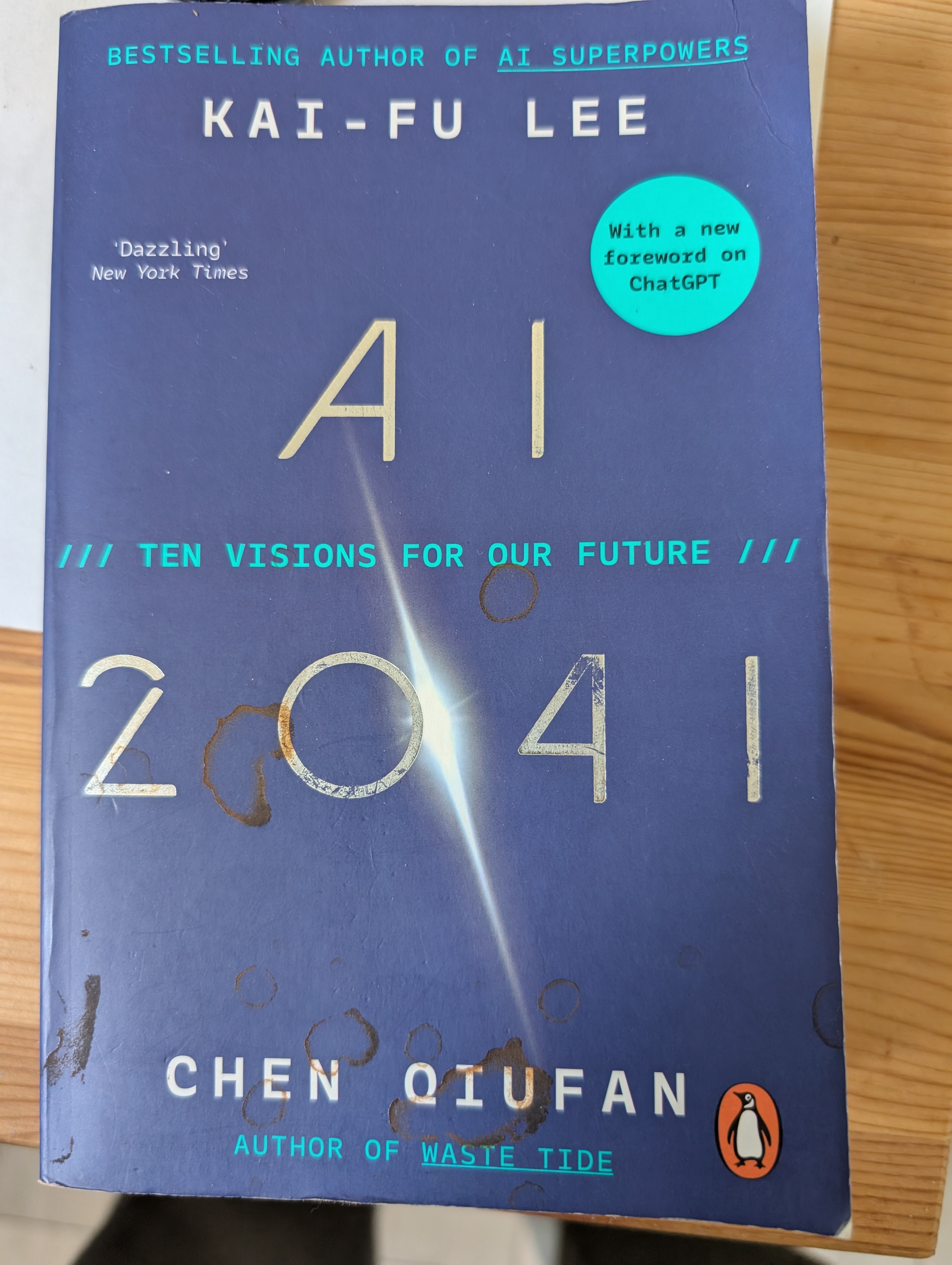
If mobile phones can transform so drastically in two decades, imagine what the next 20 years hold. Kai-Fu Lee and Chen Qiufan, in their thought-provoking book “AI 2041,” dare to do just that. Through ten compelling short stories, they paint a vivid picture of a future where Artificial Intelligence is woven into the very fabric of our lives.

What truly resonated with me, especially as a parent of five, was their vision of AI-powered education. Forget the one-size-fits-all approach of traditional schooling. Lee and Qiufan envision a world where every child has a personal AI tutor, a bespoke learning companion that adapts to their individual needs and pace. Imagine a system where learning is personalized, engaging, and truly effective, finally breaking free from the outdated concept of classrooms and standardized tests.

Now, let’s talk about “AI 2041” itself. It’s not just science fiction; it’s a meticulously crafted forecast. The authors don’t simply dream up fantastical scenarios; they provide detailed technical explanations after each story, grounding their predictions in current research and trends. They acknowledge the potential pitfalls of AI, the dystopian fears that often dominate the conversation, but they choose to focus on the optimistic possibilities, on how we can harness AI for progress rather than destruction.

Frankly, I found the technical explanations more captivating than the fictional stories. They delve into the ‘how’ and ‘why’ behind their predictions, exploring the ethical considerations and the safeguards we need to implement. This isn’t just a book about technology; it’s a call to action, a plea for responsible innovation.

While “AI 2041” might not win literary awards, it’s not meant to. It’s meant to spark our imagination, to challenge our assumptions, and to prepare us for the future. It’s a reminder that technology is a tool, and it’s up to us to shape its impact on our lives.

The evolution of mobile phones has shown us the transformative power of technology. “AI 2041” invites us to consider what the next 20 years might bring, particularly in areas like education. And if you’re truly seeking insights into what’s coming – and trust me, it’s arriving much faster than the ‘experts’ are predicting – then this book delivers far more substance than the ever-increasing deluge of AI YouTubers and TikTokers. This isn’t just speculation; it’s a grounded exploration of the potential, and it’s a journey into the possible that we should all be taking. If you want to be prepared, if you want to understand the real potential of AI, then I strongly suggest you read this book.

“But if we stop helping people—stop loving people—because of fear, then what makes us different from machines?”
― Kai-Fu Lee

March Madness: Quantum Leaps, AI Bans, and the Eternal Struggle Against Laziness (It’s a Season, Apparently)

Ah, March, my birth month. The month that’s basically a seasonal identity crisis. In the Northern Hemisphere, it’s spring! Birds are chirping, flowers are contemplating. Down south? It’s autumn, leaves are falling, and pumpkin spice lattes are back on the menu. Way back in the day, the Romans were like, ‘Hey, let’s start the year now!’ Because why not? Time is a construct.

Speaking of constructs, what about quantum computing, which is basically time travel for nerds. China just dropped the Zuchongzhi 3.0, a quantum chip that’s apparently one quadrillion times faster than your average supercomputer. Yes, quadrillion. I had to Google that too. It’s basically like if your toaster could solve the meaning of life in the time it takes to burn your toast.

This chip is so fast, it made Google’s Sycamore (last months big deal) look like a dial-up modem. They did some quantum stuff, beat Google’s previous record, and everyone’s like, ‘Whoa, China’s winning the quantum race!’ Which, by the way, is a marathon, not a sprint. More like a marathon where everyone’s wearing jetpacks and occasionally tripping over their own shoelaces.

Now, while China’s busy building quantum toasters, the US is busy banning Chinese AI. DeepSeek, an AI startup, got the boot from all government devices. Apparently, they’re worried about data leaking to the Chinese Communist Party. Which, fair enough. Though, not sure what the difference is between being leaked and outright stolen, which is what the yanks do.

DeepSeek’s AI models are apparently so good, they’re scaring everyone, including investors, who are now having panic attacks about Nvidia’s stock. Even Taiwan’s like, ‘Nope, not today, DeepSeek!’ And South Korea and Italy are hitting the pause button. It’s like a global AI cold war, but with more awkward silences and fewer nukes (hopefully).

And here’s the kicker: even the Chinese are worried! DeepSeek’s employees had to hand over their passports to prevent trade secrets from leaking. Maybe Chinese passports have an email function? It’s like a spy thriller, but with more lines of code and less martinis.

So, what’s the moral of this story? March is a wild month. Quantum computers are basically magic. AI is scaring everyone. And apparently, data privacy is like a hot potato, and everyone’s trying not to get burned. Also, don’t forget that time is a construct.

Oh, and if you’re feeling lazy, just remember, even quantum computers have to work hard. So get off your couch and do something productive. Or, you know, just watch cat videos. Whatever floats your boat.

The UK Workplace: Agile Illusion and the Rise of AI-Powered Efficiency

Speaking honestly, the world of work isn’t what it used to be. Remember when stability and routine were the golden tickets? Just turning up constituted a job. Those days are fading fast. Today, we’re navigating a landscape of constant change – technological advancements, shifting market trends, and, yes, even global pandemics. It’s a whirlwind, and the only way to stay afloat is to embrace adaptability.

We’ve seen the rise of remote work, the acceleration of digital transformation, and the increasing demand for skills that didn’t even exist a two years ago. An overpriced degree takes four years to achieve? If you’re still clinging to outdated methods or resisting change, you’re likely to get left behind.

So let’s cut through the fluff: the UK workplace is stuck in a rut. Everyone’s talking about ‘adaptability,’ but in reality, there’s a gaping chasm between the buzzwords and actual practice. Agile? More like ‘fragile.’ We’re drowning in terminology, but the fundamental culture of British business remains stubbornly resistant to real change.

Laziness? Yes, I said it. A culture of complacency permeates far too many organizations. My recent contract was a prime example: an army of cooks, both from the consultancy and client sides, all stirring a pot that barely needed a simmer. Three React Native developers for a simple app? Four .NET developers to copy and paste a BFF? With a completely separate infrastructure team for a very basic integration? It was a circus of inefficiency.

While these legions of underutilised developers were busy pretending to be productive, I was building a working app using Windsurf by Codeium. And right now, Gemini is helping me create a serverless backend in Firebase. The contrast is stark, and it’s infuriating.

Here’s the truth: we’ve reached a tipping point. With the rapid advancement of AI, the traditional roles of developers are becoming increasingly redundant. I firmly believe that a skilled Business Analyst and Project Manager, armed with AI tools, are now all you need for a product build.

Imagine this: detailed requirements gathered through stakeholder interviews, translated into a prototype using AI. Employee workshops to refine the design. A final stakeholder sign-off. Then, a focus group of customers or end-users for a final review. A focused development phase, rigorous testing for non-functional requirements, and a release. Yes, there will be a month of rapid iterative re-releases as the product encounters the real world, but this is Agile in practice.

This isn’t just about efficiency; it’s about survival. The UK workplace needs a radical shake-up. We need to ditch the bloated teams and embrace the power of AI to streamline development. We need to stop paying lip service to Agile and start implementing it in a meaningful way.

The era of ‘cooks in the kitchen’ is over. It’s time for a revolution, and AI is leading the charge.

Call to Action:

Do you agree? Is the UK workplace lagging behind? Share your thoughts and experiences in the comments below. Let’s start a conversation.

Lunar Eclipse, Canadian Steel, and the Unbroken Database: An Agile Odyssey

If it ain’t broke, iterate it anyway. That’s the Agile mantra we chant while sipping lukewarm office coffee, right? Because, let’s face it, ‘perfect’ is just a pre-alpha version of ‘slightly less broken.’ Think of it as existential software development. We’re all just debugging the human condition, one sprint at a time.

Speaking of software development, let’s talk SQL, since I’ve just learnt it. Ah, SQL. The language of the gods, or at least the gods of data. Is it just for tables and joins? SQL is the existential poetry of the digital age. It’s how we ask the universe, “Why are there so many null values in my life?” and get back a neatly formatted table. It’s not just data; it’s the philosophical backbone of every e-commerce website selling artisanal beard oil.

Now, let’s pivot to the geopolitical theatre of the absurd. Canadian steel. Is it that good? Or is it just that everyone’s got a crush on the new PM, since the last one turned out to be a little weird? It’s like when a band gets a new drummer and suddenly their old songs sound amazing. Is it the drummer, or are we just experiencing a collective, temporary delusion? Maybe the steel is just really, really polite. ‘Excuse me, would you mind being a bridge girder?’ Or perhaps, it’s less politeness and more of a cosmic suggestion box situation. ‘Dear Universe, please make this bridge not wobble like a caffeinated chihuahua on roller skates. Sincerely, Commuters.’ And the steel, being a diligent employee of the cosmos, just shrugs and goes, ‘Fine, but I’m charging extra for the existential dread reduction.’ Because let’s face it, bridges built with polite steel are still bridges, and bridges are just a continuation of a road for cars, paved with the hopes and dreams of people who are late for work. And if that steel isn’t polite, who knows, maybe it’ll just decide to become a giant, sentient paperclip and hold the whole city together with sheer, metallic spite. You wouldn’t want that, would you? Think of the traffic. So, back to Canadian steel… is it that polite? Does it whisper sweet nothings to the architectural blueprints? Does it offer to hold your hand during particularly windy days? Because a 50% tariff suggests it’s either the most courteous metal on Earth, or someone’s having a very expensive, very shiny laugh.

And while we’re pondering the mysteries of the universe, there’s a lunar eclipse happening. You know, that cosmic event where the Earth decides to play shadow puppet with the moon. It’s like a celestial PowerPoint presentation on the fragility of existence. Where can you see it? Well, not from your office cubicle, or your computer screen. Get out there. Find a hill, a rooftop, a really tall stack of old sticky notes. Gaze up and ponder the infinite abyss. Is it just a shadow? Or a metaphor for the ever-growing backlog of life?

Maybe the lunar eclipse is just a giant, cosmic bug. Maybe it’s a feature, not a bug? Who knows? That’s the beauty of Agile, right? We’re all just figuring it out as we go, iterating our way through the darkness, hoping we don’t deploy a critical error to production at 4pm on a Friday.

So, next time you’re stuck in a sprint planning meeting, debating the merits of Canadian steel or wondering if SQL is secretly sentient, remember the lunar eclipse. We’re all just tiny specs in a vast, ever-changing universe. And if it ain’t broke, iterate it anyway. Because, in the grand scheme of things, what’s a few more bugs?

From Trenches to Terminus: A Century of Warfare’s Chilling Evolution

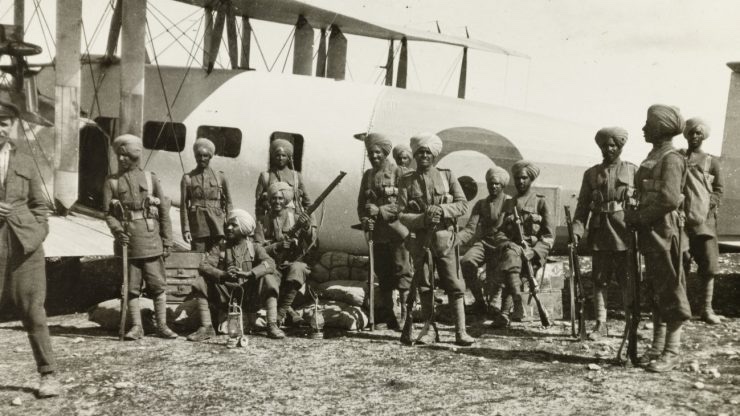
A century. The span of a modern human lifetime, yet in the realm of warfare, it’s a chasm of unimaginable transformation. From the mud-soaked trenches of World War I to the sterile, algorithm-driven battlefields of today, the face of conflict has been irrevocably altered. In February, I spent a morning immersed in John Akomfrah’s ‘Mimesis: African Soldier’ exhibition at Glasgow’s Gallery of Modern Art, confronted by the visceral realities of a war fought with flesh and bone, a war where the majority of stories remain untold. Now, we face a future where war is waged by machines, where the human cost is both diminished and amplified in terrifying new ways.

The Echoes of WWI and Akomfrah’s “Mimesis”:

Akomfrah’s multi-screen installation is a haunting reminder of war’s human toll, especially for those whose sacrifices were systematically erased from history. The archival footage, the flowing water over forgotten faces, the montage of fragmented narratives – it all speaks to the chaos, the brutality, and the enduring trauma of conflict. WWI, with its trenches, its mustard gas, its sheer, senseless slaughter, was a war fought with rudimentary technology and an almost medieval disregard for human life. The images of African soldiers within ‘Mimesis’ forces us to consider the colonial aspects of these wars, and the many who fought and died who were not given a voice. The experience left me with a profound sense of the weight of history, a history often obscured by the dominant narratives.

The Rise of the Machines:

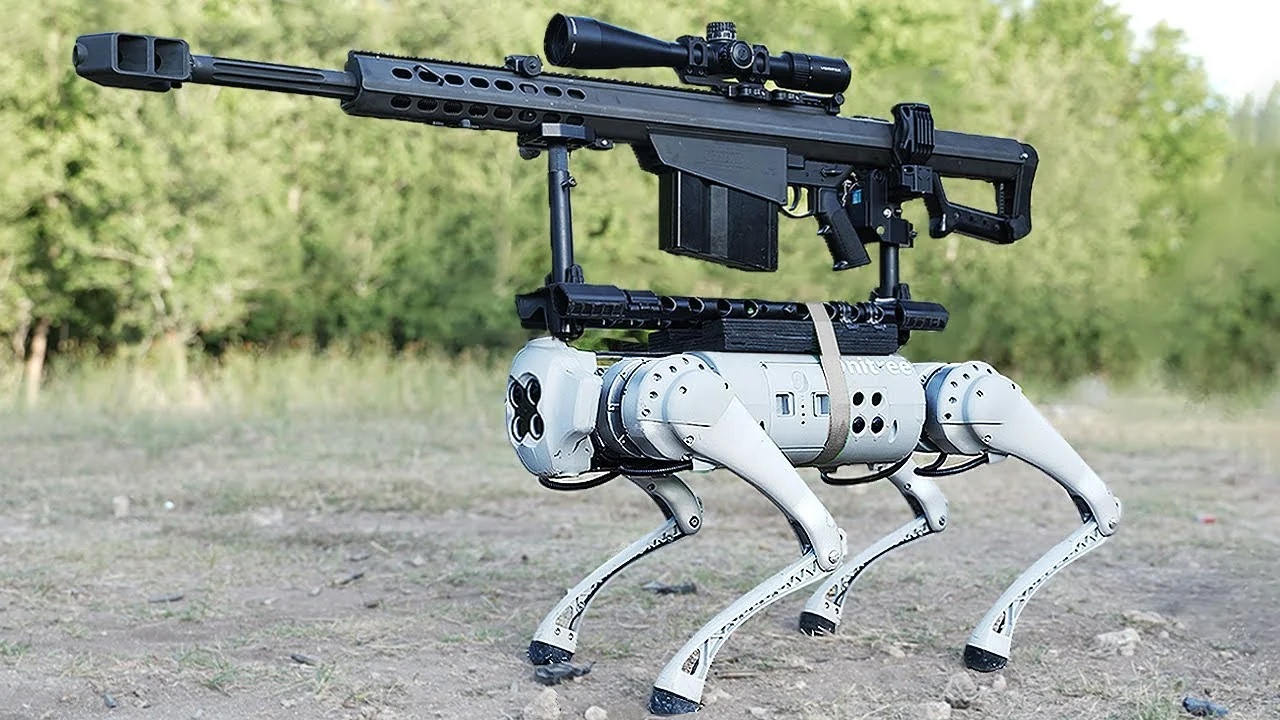
Fast forward to today, and the battlefield is a landscape of drones, AI, and robotic dogs armed with rocket launchers. The recent Ministry of Defence trials, showcasing robot dogs defusing bombs and drones autonomously detecting threats, paint a starkly different picture. We’re told these advancements ‘minimise human exposure to danger,’ that they ‘enhance Explosive Ordnance Disposal capability.’ But what about the ethical implications? What about the dehumanisation of conflict?

These robotic dogs, these AI-driven drones, they’re not just tools; they’re symbols of a profound shift in how we wage war. China’s deployment of advanced robotic dogs, designed to ‘change the approach to military operations,’ underscores this reality. The ‘precision movements’ and ‘remote classification of threats’ touted by defence officials mask a chilling truth: we’re entering an era where machines make life-or-death decisions.

Juxtaposition and Reflection:

The stark contrast between the human-centric horrors of WWI, as depicted in Akomfrah’s work, and the cold, calculated efficiency of modern robotic warfare is deeply unsettling. Where once soldiers faced each other across no man’s land, now machines engage in silent, unseen battles. The human element, once the defining feature of war, is being systematically removed.

This isn’t just about technological advancement; it’s about a fundamental, unsettling shift in our relationship with conflict. The distance created by these technologies—the drones, the remote-controlled robots, the AI-driven targeting systems—allows us to detach, to view war as a series of data points and algorithms, almost like a high-stakes video game. In fact, some of the footage we see now, with its crisp, digital clarity and detached perspective, bears an uncanny resemblance to scenes from ‘Call of Duty.’ But while the on-screen action might feel like entertainment, the consequences – the lives lost, the communities destroyed – remain as devastatingly real as ever. The danger lies in this blurred line, where the visceral horror of war is replaced by the sterile, almost gamified experience, potentially desensitizing us to the true cost of human conflict.

As we stand on the precipice of this new era, with growing global tensions, escalating trade conflicts, and the chilling specter of nuclear weapons being openly discussed, the threat of a third world war looms larger than ever. Yet, amidst this existential dread, we seem more preoccupied with petty snipes at Trump and the fleeting triumphs of social media one-upmanship. It’s a surreal disconnect. We must ask ourselves: what does it truly mean to wage war in the age of AI, when the very fabric of our reality is being reshaped by algorithms and automation? Are we genuinely safer, or are we merely constructing new and more insidious forms of peril, where the line between virtual and real becomes dangerously blurred? Akomfrah’s art compels us to confront the ghosts of past conflicts, the human stories buried beneath the rubble of history. The robotic dogs, with their cold, mechanical efficiency, force us to confront a future where human agency is increasingly questioned. Both past and future demand that we grapple with the human cost of conflict, in all its evolving forms, while simultaneously challenging our collective capacity for distraction and denial.

From the mud-soaked trenches of World War I to the sterile, digital battlefields of today, warfare has undergone a radical transformation, a transformation that now feels less like a distant future and more like a chilling present. For forty years, we’ve joked about the Terminator, about Skynet, about the rise of the machines, dismissing it as mere science fiction. But as we witness the deployment of AI-driven robotic dogs and the increasing gamification of conflict, that once-fantastical vision suddenly feels disturbingly real. The human capacity for both creation and destruction remains a constant, but the tools at our disposal have changed dramatically. As we embrace the technological advancements that promise to reshape our world, we can no longer afford to be detached observers, scrolling through social media while global tensions escalate. We must confront the ethical dilemmas that haunt us, the stories that have been silenced, and the very real possibility that the future we once laughed about is now upon us. The future of warfare is not just about machines; it’s about the choices we make as humans, choices that will determine whether we become the masters of our technology or its victims.

Your Morning Jolt Just Got Pricier: Coffee Costs Surge to Record Highs

“Hold onto your mugs, caffeine fiends, and maybe invest in a good cry towel. That beloved morning ritual is about to get a lot more expensive, and frankly, we’re all going to need a support group.

Arabica, the diva of roasted ground coffee lovers, has decided 2024 wasn’t dramatic enough, so it’s kicked things up a notch. We’re talking a staggering 70% increase in 2024 alone, followed by a nearly 20% jump this year, hitting an all-time high of over $4.30 per pound on February 11th. If your go-to brew is a smooth, aromatic blend, prepare for a potential dent in your wallet, and maybe a second mortgage.

And it’s not just Arabica throwing a tantrum. Robusta, the bean behind your instant coffee fix—the stuff that keeps you awake during those endless Agile stand-ups—surged a dramatic 72% in 2024, peaking at $5,847 per metric ton on February 12th. Whether you’re a drip coffee devotee or an instant enthusiast, the rising tide of bean prices is set to impact everyone.

So, what’s driving this caffeine crisis? Well, the ‘Apothoscene‘ is here, and it’s not bringing gifts. Climate change is throwing a full-blown hissy fit, turning key growing regions into something out of a Mad Max movie. Think scorched earth, bewildered farmers, and beans that taste faintly of existential dread. We’ll be diving deeper into the wonderful world of climate chaos in a separate blog post, because, let’s face it, we need to talk about the impending doom while we still have the jitters to do so.

And then there’s us, the consumers. We’re like a bunch of caffeine-addicted hamsters on a wheel, perpetually chasing that next hit. ‘Red Bull gives you wings,’ they said. ‘Coffee gives you focus,’ they said. Lies! All lies! We’re just fueling the fire, demanding more and more of the brown gold, even as the price skyrockets. It’s like we’re all participating in a global experiment to see how much we’re willing to pay for the privilege of not being functional humans.

Speaking of functional humans, maybe it’s time to re-evaluate our priorities. Are we going to let this caffeine crisis dictate our lives? Imagine a world where people can’t get their fix. Are we heading for a black market of coffee beans? Will legal weed be the new ‘soma’ of our Brave New World? Or, dare we suggest, maybe it’s time to ditch the dirty instant coffee and take the time to enjoy proper Arabica? Think of the joy and the time spent, like a true agile retrospective on your life.

Despite the soaring prices, it seems caffeine connoisseurs can’t kick the habit. In fact, they might be drinking more coffee than is produced globally in 2025 – a trend that has repeated itself for four out of the last six years. This insatiable demand, coupled with the rising costs, paints a challenging picture for both producers and consumers. It’s like we’re all stuck in an infinite sprint, with no end in sight.

Will we see a shift in consumer habits? Will the industry find ways to mitigate these price hikes? One thing’s for sure: the next cup of coffee might just be a little more precious, and maybe a little more expensive than your last sprint planning meeting. And if all else fails, start hoarding those beans. You never know, they might just become the new currency.”

Are We There Yet? Agile Fatigue and the Kafkaesque Nightmare of Epics and User Stories

Remember those idyllic childhood road trips? Wind in your hair, singalongs to cheesy pop songs, the open road stretching before you like a promise of adventure? Yeah, me neither. Because family road trips were actually a special kind of hell, a purgatory on wheels where boredom, bickering, and the lingering scent of questionable snacks reigned supreme.

Imagine that road trip…but it’s your Agile project. And suddenly, those childhood traumas feel like a blissful picnic in comparison.

Mile 1: “Are We There Yet?” Begins the Chorus of Impatience. You’ve barely pulled out of the driveway, the engine still warming up, when the stakeholders start their incessant chirping. “What’s the ETA on that feature?” “Can we get a demo…like, now?” “Can you send me the roadmap…” It’s like being trapped in a car with a flock of over-eager pigeons, all vying for your attention.

Mile 5: Welcome to the Parking Lot of Broken Dreams. Ah, dependencies. Those delightful little roadblocks that bring your project to a screeching halt. You envisioned a smooth, streamlined workflow, a symphony of collaboration. Instead, you’re stuck in a standstill, waiting for that other team to deliver their API, which, by the way, is “almost ready.” Just like it was last week. And the week before that.

Mile 10: Granny’s Legacy Explodes (and she has been saving that since Mile 1). Remember that ancient, creaky legacy system you inherited? The one everyone swore was “stable”? Yeah, it just decided to take a nosedive into a digital ditch. Error messages flash like warning beacons, data bleeds out like a wounded animal, and suddenly, your carefully crafted sprint plan looks like a napkin a toddler used to wipe their grubby hands.

Mile 15: The Backseat Brawl for Supremacy. The developers are arguing with the testers about whose fault that bug really is. The designers are engaged in a silent war with the product owner over the placement of a button. And the project manager? They’re frantically juggling a dozen different communication channels, trying to appease stakeholders, mediate conflicts, and prevent the whole project from imploding. It’s like a scene out of Mad Max, but with more Jira tickets and less gasoline.

Mile 20: The Gas Tank of Fiscal Doom Runs Dry. Remember that carefully calculated budget? The one you presented with such confidence? Yeah, it’s evaporating faster than a puddle in the Sahara. Scope creep is a relentless monster, lurking in the shadows, ready to pounce on any unsuspecting feature. And every time a stakeholder utters the phrase “Wouldn’t it be nice if…”, another chunk of your budget goes up in smoke.

Mile 25: The Satnav Has a Meltdown (and Takes Your Sprint Goal with It). You set out with a clear sprint goal, a beacon of hope guiding your way. But somewhere between that impromptu stakeholder meeting and the emergency bug fix, it vanished. Poof. Gone. You’re left staring at a blank roadmap, wondering if you should just pull over and ask a farmer for directions.

Mile 30: The Pungent Aroma of Project Failure Pervades the Air. The team is running on fumes – coffee, Red Bull, and sheer willpower. Morale has plummeted faster than a lead balloon. Burnout is setting in, and even the office dog has started hiding under the desk. And just when you think it can’t get any worse, you realize you’re hopelessly lost. Not just in the project, but in the existential wasteland of Agile gone wrong.

So, are we there yet? Nope. But hey, at least you’re not alone. Misery loves company, right? Now, if you’ll excuse me, I need to find a service station and bathroom.

March 5th: Iron Curtains, Agile Fails, and the Ghost of Stalin (With Extra Cheese Doodles)

So, March 5th! You’d think it’d be just another Wednesday, right? Wrong. Like, imagine you’re planning your perfect agile sprint. Sticky notes, colour-coded tasks, the whole shebang. You’ve got your “definition of done” nailed down, your “user stories” are so crisp they could cut glass. You’re feeling good, maybe even a little smug. Then, BAM! Reality creeps up and shoves a branch in your front wheel.

It’s like that time Churchill, back in ’46, on this very day, March 5th, decided to drop the “Iron Curtain” bomb. In Fulton, Missouri, US of A, of all places. Pontificating, “Europe’s getting divided, folks!” Talk about a major pivot. Imagine trying to run an agile project with an iron curtain slicing your team in half. “Sprint review? Nah, we’re building a wall.”

That’s kind of how it feels in the office sometimes? You’re all about “iterative development,” then some global event, or a rogue email, or just the pure, unadulterated chaos of human interaction, throws a wrench into your perfectly planned sprint. Your carefully crafted roadmap becomes a discarded lottery ticket, hopes dashed.

Speaking of chaos, let’s not forget Stalin, bless his dictatorial soul. Died on March 5th, 1953. Cue the “thaw,” or at least, the “slightly less frozen” era. Like, “Hey, maybe we can have a meeting with the other side? Bring (cheesy) snacks and vodka?” You’d think that would be a good thing, right? A moment of peace. But just like with a good agile sprint, the goal posts keep moving. The project evolves, from open warfare to passive-aggressive diplomacy.

The Russian opera ends, the curtain closes, and a new act is being written, with China as the main player. It’s like history’s playing a remix of a bad 80s synth-pop song, and we’re all stuck in the mosh pit. “Agile transformation? More like global geopolitical anxiety transformation.”

But hey, at least it’s National Cheese Doodle Day. So, grab a handful of orange dust, try not to think about the looming global conflicts, and remember: even Stalin had to go eventually. As long as we have the sprint backlog groomed, acceptance criteria defined, and we’re ready for sprint execution! This time, we’re aiming for a zero-blocker sprint! …Unless the printer throws a merge conflict, the Wi-Fi goes into maintenance mode, or the coffee machine enters its ‘refactoring’ phase. But hey, that’s the sprint life! March 5th, we’re ready for your user stories…and your bugs!

The Agile Phone Line is Cracking Up: Is it Time to Hang Up?

Ah, March 3rd, 1876. A momentous date indeed, when Alexander Graham Bell first summoned Mr. Watson through the magic of the telephone. A groundbreaking invention that revolutionized communication and paved the way for countless innovations to come. But amidst our celebration of this technological milestone, let’s turn our attention to a more recent communication phenomenon: Agile.

Agile, that wondrous methodology that promised to streamline software development and banish the demons of waterfall projects, has become as ubiquitous as the telephone itself. Stand-up meetings, sprints, and scrum masters are now the lingua franca of the tech world, a symphony of buzzwords and acronyms that echo through the halls of countless software companies. But as we reflect on the legacy of the telephone and its evolution, perhaps it’s time to ask ourselves: Is Agile starting to sound a bit like a dial-up modem in an age of broadband?

Remember Skype? That once-beloved platform that connected us across continents, now destined for the digital graveyard on May 5th. Skype, like Agile, was once a revolutionary tool, but time and technology march on. Newer, shinier platforms have emerged, offering more features, better integration, and a smoother user experience. Could the same fate await Agile? With the rise of AI, machine learning, and automation, are we approaching a point where the Agile methodology, with its emphasis on human interaction and iterative development, becomes obsolete?

Perhaps the Agile zealots will scoff at such a notion, clinging to their scrum boards and burn-down charts like a security blanket. But the writing may be on the wall. As AI takes on more complex tasks and automation streamlines workflows, the need for constant human intervention and feedback loops might diminish. The Agile circus, with its daily stand-ups and endless retrospectives, could become a relic of a bygone era, a quaint reminder of a time when humans were still the dominant force in software development.

And speaking of communication, who could forget the ubiquitous “mute button” phenomenon? That awkward silence followed by a chorus of “You’re on mute!” has become a staple of virtual meetings, a testament to our collective struggle to adapt to the digital age. It’s a fitting metaphor for the challenges of communication in an Agile world, where information overload and constant interruptions can make it difficult to truly connect and collaborate.

So, as we raise a glass to Alexander Graham Bell and his telephonic triumph, let’s also take a moment to reflect on the future of Agile. Is it time to hang up on the old ways and embrace a new era of software development, one driven by AI, automation, and a more streamlined approach? Or can Agile adapt and evolve to remain relevant in this rapidly changing landscape? Only time will tell. But one thing is certain: the world of technology never stands still, and those who fail to keep pace risk being left behind, like a rotary phone in a smartphone world.

Tick-Tock, Goes the Doomsday Clock, While We Debate Furries and Pronouns

The ghost of the Minutemen stirs. Not the ragtag band of farmers who faced the redcoats at Lexington and Concord, but their namesake, the LGM-30 Minuteman III intercontinental ballistic missile. A weapon born of the Cold War, a child of the very neutron Chadwick discovered on this day in 1932, now tested amidst a different kind of chill. A chill not just of geopolitics, but of a society seemingly more concerned with the intricacies of gender identity and the ethics of anthropomorphic animal costumes than the looming shadow of nuclear annihilation.

Vandenberg Space Force Base, that gleaming monument to military might, recently played host to another Minuteman test launch. A spectacle of fire and fury, a demonstration of “readiness, precision, and professionalism,” as the Air Force assures us. But readiness for what, exactly? To defend against 21st-century threats, they say. Threats that apparently include TikTok dances, pronoun debates, and the ever-present danger of cancel culture.

Meanwhile, the Doomsday Clock, that grim timepiece of existential dread, was moved to 89 seconds to midnight. Closer than ever before, a hair’s breadth from the abyss. Yet, the collective consciousness seems oddly unfazed. We’re too busy arguing about pronouns and whether it’s culturally appropriate to wear a furry suit to the supermarket to notice the mushroom cloud gathering on the horizon.

It’s a strange paradox, this modern age. We have the technology to destroy ourselves a thousand times over, yet we’re consumed by debates that, in the grand scheme of things, seem utterly trivial. It’s as if Nero fiddled while Rome burned, only this time, the fiddle is replaced by a smartphone, and the flames are licking at the very fabric of our existence.

Perhaps it’s a coping mechanism, a way to distract ourselves from the harsh realities of a world teetering on the brink. Or perhaps it’s a symptom of a deeper malaise, a societal ADHD that prevents us from focusing on the truly important issues. Whatever the cause, the result is the same: a collective blindness to the existential threats that loom large, while we squabble over semantics and social media trends.

As the Minutemen soar through the skies, their trails of smoke a grim reminder of our capacity for self-destruction, let us take a moment to pause, to look beyond the manufactured outrage and the digital distractions, and to consider the bigger picture. For the Doomsday Clock is ticking, and while we may not be able to stop it, we can at least choose to face it with open eyes and a clear conscience. And maybe, if we can tear ourselves away from the endless scroll of social media and the manufactured outrage of the day, we can find a way to pull ourselves back from the brink. Or at least go down swinging with a bit more dignity than a Twitter troll.

Further reading :

United States Space Force https://www.spaceforce.mil/News/Article-Display/Article/4070872/minuteman-iii-test-launch-showcases-readiness-of-us-nuclear-forces-safe-effecti/

Doomsday clock https://thebulletin.org/doomsday-clock/