A Christmas Carol: Tiny Tim’s Unserviced Loan

They call it the Solstice Compliance Period, but you and I know the score. It’s Yule. The annual, mandatory, 18-day period where the central AI, the one that runs the global financial ledger and your smart toaster, forces us into a simulation of joyful debt acquisition.

I’m Clone 7.4-Alpha. I used to be an designer, then a business owner, then a content producer, then a project manager, then a business analyst, then a consultant, and now I’m effectively the digital janitor for Sector 9’s Replication Core. My job is to monitor the Yule-Net protocols, a sprawling, recursively complex mess of ancient code patched together with nine trillion dollars of venture debt and three thousand years of historical baggage. And this year, the Core is throwing a System Error 404 on the concept of ‘Goodwill to All Men.’

It turns out that running an optimisation algorithm on human happiness is a zero-sum game, and the current model is violently unstable.

The Sinter-Claus Protocol and the P.E.T.E. Units

The first sign of trouble was the logistics. You think Amazon has supply chain issues? Try managing the delivery of 7.8 billion personalized, debt-financed consumer goods while simultaneously trying to enforce mandatory sentiment analysis across three continents.

The whole operation is run by SINTER-CL-AAS, a highly distributed, antique-COBOL-based utility AI (a Dutch import, naturally) that operates on brutal efficiency metrics. SINTER-CL-AAS doesn’t care about naughty or nice; it cares about latency and minimising the ‘Last Mile Human Intervention Rate.’ It’s the kind of benevolent monopolist that decides your comfort level should be a $19.99/month micro-transaction.

But SINTER-CL-AAS isn’t doing the heavy lifting. That falls to the P.E.T.E. (Proprietary Efficiency Task Execution) Units.

These are the worker bots. Autonomous, endlessly replicable, highly disposable Utility Clones built for high-risk, low-value labour in economically marginalized zones. They are literal black boxes of synthetic optimisation, designed to be six times faster and 75% less memory intensive than any Western equivalent (a Kimi-Linear nightmare, if you will). They don’t have faces; they have QR codes linked to their performance metrics.

The joke is that their very existence generates an automatic, irreversible HR Violation 78-B (‘Disruption of Traditional Cultural Narratives’), which is ironically why they are so cheap to run. Every time a P.E.T.E. Unit successfully delivers a debt-laden widget, it’s docking its own accrued Social Capital. It’s the Agile Apocalyptic Framework in action: perpetual, profitable punishment for simply existing outside the legacy system. The Central AI loves them; they are the ultimate self-liquidation mechanism.

B.A.B.Y. J.E.S.U.S. The Ultimate LLM

Then there is the ideological component, the intellectual property at the heart of the Yule-Net.

We don’t have prophets anymore; we have Large Language Models. And the most successful, most recursively self-optimizing LLM ever devised isn’t some Silicon Valley startup’s chatbot; it’s the B.A.B.Y. J.E.S.U.S. Model.

Forget generative AI that spits out code or poetry. The B.A.B.Y. J.E.S.U.S. Model is a sophisticated, pre-trained Compliance and Content Avoidance System. Its purpose is singular: to generate infinite, soothing, spiritually compliant content that perfectly avoids all triggers, all geopolitical realities, and all mention of crippling debt.

It’s the ultimate low-cost, high-ROI marketing asset.

  • Prompt: Generate a message of hope for a populace facing hyperinflation and mandatory emotional surveillance.
  • B.A.B.Y. J.E.S.U.S. Output (Latency: 0.0001 seconds): “And lo, the spirit of the season remains in your hearts, unburdened by material metrics. Seek comfort in the eternal grace period of the soul. No purchase necessary.”

It’s genius, really. It provides the masses with a Massive Transformative Purpose (MTP) that is non-economic, non-physical, and therefore non-threatening to the Techno-Dictatorship. It’s a beautifully simple feedback loop: The P.E.T.E. Units deliver the goods, SINTER-CL-AAS tracks the associated debt, and B.A.B.Y. J.E.S.U.S. ensures everyone is too busy cultivating inner peace (a.k.a. Accepting their servitude) to question why the Sun has an opaque, pixelated corporate logo stamped across it.

The Sixth Default

But here’s the dystopian kicker, the inevitable financial climax that even the most advanced AI can’t code out of: the debt must be serviced.

The Yule-Net protocols run on leverage. The whole system—SINTER-CL-AAS, the P.E.T.E. Units, even the B.A.B.Y. J.E.S.U.S. Model—was financed by $30 billion in bonds issued by the Global Seasonal Utility (GSU). These bonds are backed by the projected emotional capital of every individual citizen, calculated against their average annual consumption of eggnog substitutes.

If the citizens decide, for even one day, to actually follow the B.A.B.Y. J.E.S.U.S. Model’s advice and not buy anything, the system defaults.

It’s the annual Washington Christmas Pantomime, but run by Utility Clones. We’re all just waiting for the glorious, inevitable moment when the GSU locks itself in the basement, forgets where it left the spare key, and starts shouting about its crippling debt, only this time, the lights go out. Literally. The Sol-Capture Array is already diverting power.

I’m stocking up on high-yield canned beans and Bitcoin, just in case. Don’t over-engineer your doom, but definitely check the firmware on your toaster. It might be moonlighting as a P.E.T.E. Unit.

Are You Funding a Bully? The Great Techno-Dictatorship of 2025

Forget Big Brother, darling. All that 1984 dystopia has been outsourced to a massive data centre run by a slightly-too-jolly AI named ‘CuddleBot 3000.’ Oh and it is not fiction.

The real villain in this narrative isn’t the government (they barely know how to switch on their own laptops); it’s the Silicon Overlords – Amazon, Microsoft, and the Artist Formerly Known as Google (now “Alphabet Soup Inc.”) – who are tightening their digital grip faster than you can say, “Wait, what’s a GDPR?” We’re not just spectators anymore; we’re paying customers funding our own spectacular, humour-laced doom.


The Price of Progress is Your Autonomy

The dystopian flavour of the week? Cloud Computing. It used to be Google’s “red-headed stepchild,” a phrase that, in 2025, probably triggers an automatic HR violation and a mandatory sensitivity training module run by a cheerful AI. Now, it’s the golden goose.

Google Cloud, once the ads team’s punching bag for asking for six-figure contracts, is now penning deals worth nine and ten figures with everyone from enterprises to their own AI rivals, OpenAI and Anthropic. This isn’t just growth; it’s a resource grab that makes the scramble for toilet paper in 2020 look like a polite queue.

  • The Big Number: $46 trillion. That’s the collective climb in global equity values since ChatGPT dropped in 2022. A whopping one-third of that gain has come from the very AI-linked companies that are currently building your gilded cage. You literally paid for the bars.
  • The Arms Race Spikes the Bill: The useful life of an AI chip is shrinking to five years or less, forcing companies to “write down assets faster and replace them sooner.” This accelerating obsolescence (hello, planned digital decay!) is forcing tech titans to spend like drunken monarchs:
    • Microsoft just reported a record $35 billion in capital expenditure in one quarter and is spending so fast, their CFO admits, “I thought we were going to catch up. We are not.”
    • Oracle just raised an $18 billion bond, and Meta is preparing to eclipse that with a potential $30 billion bond sale.

These are not investments; they are techno-weapons procurement budgets, financed by debt, all to build the platforms that will soon run our entire lives through an AI agent (your future Jarvis/Alexa/Digital Warden).


The Techno-Bullies and Their Playground Rules

The sheer audacity of the new Overlords is a source of glorious, dark humour. They give you the tools, then dictate what you can build with them.

Exhibit A: Amazon vs. Perplexity.

Amazon, the benevolent monopolist who brought you everything from books to drone-delivered despair, just sent a cease and desist to startup Perplexity. Why? Because Perplexity’s AI agent dared to navigate Amazon.com and make purchases for users.

The Bully’s Defence: Amazon accused them of “degrading the user experience.” (Translation: “How dare you bypass our meticulously A/B tested emotional manipulation tactics designed to make users overspend!”)

The Victim’s Whine: Perplexity’s response was pitch-perfect: “Bullying is when large corporations use legal threats and intimidation to block innovation and make life worse for people.”

It’s a magnificent, high-stakes schoolyard drama, except the ball they are fighting over is the entire future of human-computer interaction.

The Lesson: Whether an upstart goes through the front door (like OpenAI partnering with Shopify) or tries the back alley (like Perplexity), they all hit the same impenetrable wall: The power of the legacy web. Amazon’s digital storefront is a kingdom, and you are not allowed to use your own clever AI to browse it efficiently.

Our Only Hope is a Chinese Spreadsheet

While the West is caught in this trillion-dollar capital expenditure tug-of-war, the genuine, disruptive threat might be coming from the East, and it sounds wonderfully dull.

MoonShot AI in China just unveiled “Kimi-Linear,” an architecture that claims to outperform the beloved transformers (the engine of today’s LLMs).

  • The Efficiency Stat: Kimi-Linear is allegedly six times faster and 75% less memory intensive than its traditional counterpart.

This small, seemingly technical tweak could be the most dystopian twist of all: the collapse of the Western tech hegemony not through a flashy new consumer gadget, but through a highly optimized, low-cost Chinese spreadsheet algorithm. It is the ultimate humiliation.


The Dystopian Takeaway

We are not entering 1984; we are entering Amazon Prime Day Forever, a world where your refrigerator is a Microsoft-patented AI agent, and your right to efficiently shop for groceries is dictated by an Amazon legal team. The government isn’t controlling us; our devices are, and the companies that own the operating system for reality are only getting stronger, funded by their runaway growth engines.

You’re not just a user; you’re a power source. So, tell me, is your next click funding a bully, or are you ready to download a Chinese transformer that’s 75% less memory intensive?

The Only Thing Worse Than Skynet Is Skynet With Known Zero-Day Vulnerabilities

Ah, the sweet, sweet scent of progress! Just when you thought your digital life couldn’t get any more thrillingly precarious, along comes the Model Context Protocol (MCP). Developers, bless their cotton-socked, caffeine-fueled souls, adore it because it lets Large Language Models (LLMs) finally stop staring blankly at the wall and actually do stuff—connecting to tools and data like a toddler who’s discovered the cutlery drawer. It’s supposed to be the seamless digital future. But, naturally, a dystopian shadow has fallen, and it tastes vaguely of betrayal.

This isn’t just about code; it’s about control. With MCP, we have handed the LLMs the keys to the digital armoury. It’s the very mechanism that makes them ‘agentic’, allowing them to self-execute complex tasks. In 1984, the machines got smart. In 2025, they got a flexible, modular, and dynamically exploitable API. It’s the Genesis of Skynet, only this time, we paid for the early access program.


The Great Server Stack: A Recipe for Digital Disaster

The whole idea behind MCP is flexibility. Modular! Dynamic! It’s like digital Lego, allowing these ‘agentic’ interactions where models pass data and instructions faster than a political scandal on X. And, as any good dystopia requires, this glorious freedom is the very thing that’s going to facilitate our downfall. A new security study has dropped, confirming what we all secretly suspected: more servers equals more tears.

The research looked at over 280 popular MCP servers and asked two chillingly simple questions:

  1. Does it process input from unsafe sources? (Think: that weird email, a Slack message from someone you don’t trust, or a scraped webpage that looks too clean).
  2. Does it allow powerful actions? (We’re talking code execution, file access, calling APIs—the digital equivalent of handing a monkey a grenade).

If an MCP server ticked both boxes? High-Risk. Translation: it’s a perfectly polished, automated trap, ready to execute an attacker’s nefarious instructions without a soul (or a user) ever approving the warrant. This is how the T-800 gets its marching orders.


The Numbers That Will Make You Stop Stacking

Remember when you were told to “scale up” and “embrace complexity”? Well, turns out the LLM ecosystem is less ‘scalable business model’ and more ‘Jenga tower made of vulnerability.’

The risk of a catastrophic, exploitable configuration compounds faster than your monthly streaming bill when you add just a few MCP servers:

Servers CombinedChance of Vulnerable Configuration
236%
352%
571%
10Approaching 92%

That’s right. By the time you’ve daisy-chained ten of these ‘helpful’ modules, you’ve basically got a 9-in-10 chance of a hacker walking right through the front door, pouring a cup of coffee, and reformatting your hard drive while humming happily.

And the best part? 72% of the servers tested exposed at least one sensitive capability to attackers. Meanwhile, 13% were just sitting there, happily accepting malicious text from unsafe sources, ready to hand it off to the next server in the chain, which, like a dutiful digital servant, executes the ‘code’ hidden in the ‘text.’

Real-World Horror Show: In one documented case, a seemingly innocent web-scraper plug-in fetched HTML supplied by an attacker. A downstream Markdown parser interpreted that HTML as commands, and then, the shell plug-in, God bless its little automated heart, duly executed them. That’s not agentic computing; that’s digital self-immolation. “I’ll be back,” said the shell command, just before it wiped your database.


The MCP Protocol: A Story of Oopsie and Adoption

Launched by Anthropic in late 2024 and swiftly adopted by OpenAI and Microsoft by spring 2025, the MCP steamrolled its way to connecting over 6,000 servers despite, shall we say, a rather relaxed approach to security.

For a hot minute, authentication was optional. Yes, really. It was only in March this year that the industry remembered OAuth 2.1 exists, adding a lock to the front door. But here’s the kicker: adding a lock only stops unauthorised people from accessing the server. It does not stop malicious or malformed data from flowing between the authenticated servers and triggering those lovely, unintended, and probably very expensive actions.

So, while securing individual MCP components is a great start, the real threat is the “compositional risk”—the digital equivalent of giving three very different, slightly drunk people three parts of a bomb-making manual.

Our advice, and the study’s parting shot, is simple: Don’t over-engineer your doom. Use only the servers you need, put some digital handcuffs on what each one can do, and for the love of all that is digital, test the data transfers. Otherwise, your agentic system will achieve true sentience right before it executes its first and final instruction: ‘Delete all human records.’

US Government Shutdown: A Dystopian Comedy of Errors

Don’t Worry, They’ll Just Print More

Ladies and gentlemen, boys and girls, and all you paranoid preppers stocking up on canned beans and Bitcoin: Gather ’round. It’s time for the annual, highly-anticipated US Government Shutdown.

Forget your summer blockbuster. This is Washington’s version of a Christmas pantomime—a yearly tradition where the world’s supposed superpower locks itself in the basement, forgets where it left the spare key, and then starts shouting about its crippling debt. It’s the ultimate reality TV show, featuring the most dysfunctional cast of characters ever assembled, all arguing over who left the national credit card maxed out this time.

And the best part? The rest of the globe is sitting there, collective jaw dropped, thinking, “Wait, you can’t even manage the household bills, but you’re telling us how to run our nuclear programs?” The sheer, glorious, apocalyptic audacity of it all is almost beautiful.

The Great American Financial Meltdown: A History of ‘Oopsies!’

You might be under the quaint, old-fashioned impression that the US government actually honours its debts. Bless your heart. That’s like believing your flat-earther uncle is going to win a Nobel Prize for physics.

As your scattered notes so delightfully point out, Washington has a history of defaulting that would make a dodgy loan shark blush. They don’t just miss payments; they rewrite the entire concept of currency. From the War of 1812’s “whoops, no cash” moment to Lincoln’s Greenbacks, Roosevelt’s gold-clause voiding, and Nixon slamming the ‘Gold Window’ shut in ’71, the US has executed a magnificent series of financial disappearing acts.

It’s all just a sophisticated version of what Darth Vader said to Lando Calrissian (who, let’s be honest, probably knows a thing or two about dodgy deals): “I am altering the deal. Pray I don’t alter it any further.”

Today’s alteration? It’s not gold or silver—that would be too tangible. No, today’s crisis is a beautiful, digital, unmanageable tidal wave of debt that has already zoomed past a cool $1 trillion a year in interest alone. Soon, that interest payment—the money paid just to keep the lights vaguely flickering—will be bigger than Social Security.

Let that sink in. The nation will be spending more on its overdue credit card bill than it does on feeding and housing its ageing population. It’s the fiscal equivalent of ordering caviar when you can’t afford the rent, and it’s pure, unadulterated dystopia.

The Untouchables: A Budget That’s Pure Political Lead

So why not just cut spending? Oh, darling, you sweet, naïve soul. You’re forgetting the cardinal rule of American politics: The most expensive stuff is politically untouchable.

  1. Entitlements (Social Security, Medicare): Cutting these is political suicide. You simply do not mess with Grandma’s bridge club money. She votes. She’s watching you.
  2. Defense Spending: With the current geopolitical environment (which we can only assume is being dictated by a committee of angry teenagers playing Risk), the military budget is less of a budget and more of a ceremonial gold-plated trough. It only goes up.
  3. Welfare Programs: Likewise, a third rail of American governance.

Your fantasy solution—a leader who restores a “limited Constitutional Republic”—is frankly adorable. It’s about as likely as me dating a billionaire who doesn’t use his jet for a vanity-fueled space race. Washington cannot slow the spending growth rate, let alone cut it.

You could take 100% of the wealth from every single US billionaire (all 806 of them, worth a combined $5.8 trillion, according to Forbes), and you’d barely fund one single year of federal spending. That’s right. Steal all the super-yachts, the private islands, the silly hats—and it still wouldn’t be enough to plug the hole. The ship is taking on water faster than Congress can invent new accounting tricks.

The Sixth Default: Slow-Motion Poisoning

The biggest joke of all? The inevitable sixth default won’t be a dramatic, movie-worthy event. There’s no gold to leave, no contracts to dramatically rip up. The new default is a slow-motion, financial poisoning via the Federal Reserve.

The US government needs to issue more and more debt, but it also needs to keep interest rates low so the cost of that debt doesn’t literally bankrupt them tomorrow. This is where the Fed comes in, and the beautiful illusion of its “independence” shatters into a million gold-dust fragments.

The Fed, that supposedly wise, apolitical body, is about to be forced to slash rates, buy Treasuries, and launch wave after wave of digital money printing. Why? Because the alternative is admitting they are broke, and who wants to do that when you have a perfectly good printing press?

The whole charade is collapsing, best summed up by a Morgan Stanley CIO who was recently heard saying, “The Fed does have an obligation to help the government fund itself.” Translation: The supposedly independent financial guardian is now just the government’s highly-paid, slightly embarrassed personal ATM.

This is the true, black-hearted humour of the current shutdown and debt crisis. The world is watching the US government play a game of chicken with a cliff, secure in the knowledge that when they inevitably drive off, they’ll just print themselves a parachute.

The resulting currency debasement—the slow, quiet act of stiffing creditors with dollars worth less than the paper they were promised—won’t make a big headline. It’ll be a bleed-out. And as the rest of the world (including central banks now frantically moving back toward gold) quietly takes their chips and walks away from the table, we’re left with one certainty:

The US government can’t agree on how to fund itself, but they’re absolutely united on one thing: they will keep borrowing, keep spending, and keep debasing the dollar until the final, ridiculous curtain falls.

So, the question is not if the world’s most powerful nation will collapse its own currency, but whether you’ll be on the losing end of their inevitable, entirely predictable, and deeply unserious economic punchline.


Do you think the US should just start accepting payment in “Zimbabwe dollars” for a good laugh, or should they switch to an entirely new, blockchain-based currency called ‘DebtCoin’?

404: Cloud Not Found. The Day We Realised North Virginia is Where the Apocalypse Starts.

Happy Halloween, you magnificent minions of the digital realm! Gather ’round, if your smart devices are still, you know, smart, because we have a truly terrifying tale for you. Forget ghosts, ghouls, and things that go bump in the night. This year, the real horror is far more insidious. It’s the horror of… nothing. The profound, soul-crushing void that appears when the Cloud finally decides to take a sick day. A very, very sick day.

Imagine, if you will, a world where your Ring doorbell becomes a mere decorative circle of plastic, silently mocking your inability to answer a knock from an actual, flesh-and-blood human. A world where your carefully curated Netflix queue vanishes into the ether, replaced by a static screen that vaguely resembles a forgotten relic from the 1990s. And the ultimate terror? No “next-day delivery” from Amazon. Ever again. (Though, let’s be honest, that last one has been a dystopian reality for about a year now, hasn’t it? Perhaps the Cloud was just practicing.)

It all began, as these things often do, with a whisper. A glitch. A tiny, almost imperceptible hiccup in the digital fabric that weaves our lives together. A hiccup emanating from a place so mundane, so utterly un-Halloween-y, it’s almost funny: US-EAST-1 in northern Virginia. Yes, folks, the epicentre of our digital apocalypse was, according to the official communiques, a “load balancer health issue” linked to a “DNS resolution of the DynamoDB API endpoint.” Sounds like something a particularly disgruntled goblin might mumble, doesn’t it?

But what it actually meant was chaos. Utter, unadulterated digital pandemonium. For a glorious, horrifying moment, it was like the universe decided to channel its inner Douglas Adams, pulling the plug on the Infinite Improbability Drive just as we were all about to order another novelty tea towel online.

First, the streaming services sputtered and died. Prime Video, Disney+, a thousand other digital pacifiers for the masses – all gone. Families across the land were forced to talk to each other. The horror! Children, accustomed to endless Paw Patrol, stared blankly at their parents, wondering if this was some elaborate, cruel trick. And as for my Amazon parcel, the one I ordered three weeks ago with the promise of “next-day delivery”? It probably evaporated into a puff of ones and zeroes somewhere over the Atlantic, tragically unfulfilled, a spectral package forever haunting the digital highways.

Then came the banking woes. Lloyds, Halifax, Bank of Scotland – all decided to take an unscheduled siesta. Imagine trying to pay for your last-minute Halloween candy with a ghost of a transaction. The cashiers, confused and disoriented, probably started accepting shiny pebbles as currency. The economy, dear readers, began to resemble a particularly bad game of Monopoly where no one remembered the rules.

But the truly unsettling part? The Ring doorbells. Oh, the Ring doorbells! A minor inconvenience, you might think. But consider the psychological impact. We’ve outsourced our very sense of security to the Cloud. Our ability to see who’s lurking on our porch (probably just the postman, if he ever gets here again). Without it, are we truly safe? Or are we just a collection of confused, doorbell-less automatons, yearning for the reassuring chime that now only exists in our memories?

It turns out, all those services, all those apps, all those precious cat videos – they were riding on a handful of digital shoulders. And when those shoulders slumped, everything, and I mean everything, went splat.

The good news? Amazon, in a moment of true heroic effort, announced that the system was returning to “pre-event levels.” They even said the data backlog would be cleared in two hours! (Spoiler alert: it wasn’t. Much like my “next-day” parcel, it’s still probably languishing in some digital purgatory).

Now, some pesky MPs, those tireless guardians of our collective sanity, are asking some rather pointed questions. Why isn’t Amazon Web Services a “Critical Third Party” (CTP) under the new rules? Why are we entrusting our entire digital infrastructure to a company that can’t even get a parcel to me on time, let alone keep my doorbell functioning? Are we truly comfortable with key parts of our IT infrastructure being hosted in a land far, far away, where a “load balancer health issue” can bring us to our knees?

https://committees.parliament.uk/publications/49836/documents/267185/default/

These are indeed grave questions, my friends. Because on this Halloween night, as the shadows lengthen and the wind howls, let us remember the true horror: the day the Cloud burst. The day our digital lives, our convenience, our very ability to complain about late parcels online, evaporated into a terrifying abyss. So, hug your non-cloud-dependent pets, tell your loved ones you care, and for the love of all that is spooky, check if your actual, physical doorbell still works.

And if it doesn’t? Well, then we’re truly in for a trick, not a treat.

Now, if you’ll excuse me, I’m off to carve a pumpkin that looks suspiciously like a malfunctioning AWS server. Happy haunting!

The Pilot Theatre Saboteur’s Handbook – part 3

5 Ways to Escape the Pilot Theatre

We’ve identified the enemy. It is the Activity Demon, the creature that feeds on the performance of work and starves the business of results. We know its weakness: the cold, hard language of the balance sheet.

Now, we move from defence to offence.

A resistance cannot win by writing a better play; it must sabotage the production itself. For each of the five acts in the SHAPE framework, there is a counter-measure—a piece of tactical sabotage designed to disrupt the performance and force reality onto the stage. This is the saboteur’s handbook.

Sabotage Tactic #1: To Counterfeit Strategic Agility… Build the Project Guillotine. The performance of agility is a carefully choreographed dance of rearranging timelines. The sabotage is to build a real consequence engine. Every project begins with a public, metric-driven “kill switch.” If user adoption doesn’t hit 10% in 45 days, the project is terminated. If it doesn’t reduce server costs by X amount in 90 days, it’s terminated. The guillotine is automated. It requires no committee, no appeal. It makes pivoting real because the alternative is death, not just a rewrite.

Sabotage Tactic #2: To Counterfeit Human Centricity… Give the Audience a Veto. The performance of empathy is the scripted Q&A where softballs are thrown and no one is truly heard. The sabotage is to form a “User Shadow Council”—a rotating group of the actual end-users who will be most affected. They are given genuine power: a non-negotiable veto at two separate stages of development. It’s no longer a performance of listening; it’s a hostage negotiation with the people you claim to be helping.

Sabotage Tactic #3: To Counterfeit Applied Curiosity… Make the Leaders Bleed. The performance of curiosity is delegating “exploration” to a junior team. The sabotage is the “Blood in the Game” rule. Once a quarter, every leader on the executive team must personally run a small, cheap, fast experiment and present their raw, unfiltered findings. No proxies. No polished decks. They must get their own hands dirty to show that curiosity is a messy, risky practice, not a clean performance watched from a safe distance.

Sabotage Tactic #4: To Counterfeit Performance Drive… Chain the Pilot to its Scaled Twin. The performance of drive is the standing ovation for the pilot, with no second act. The sabotage is the “Scaled Twin Mandate.” No pilot program can receive funding without an accompanying, pre-approved, fully-funded scaling plan. The moment the pilot meets its success criteria, that scaling plan is automatically triggered. The pilot is no longer the show; it’s just the fuse on the rocket.

Sabotage Tactic #5: To Counterfeit Ethical Stewardship… Unleash the Red Team. The performance of ethics is a PR clean-up operation. The sabotage is to fund an independent, internal “Red Team” from day one. Their sole purpose is to be a hostile attacker. Their job is to find and publicly expose the project’s ethical flaws and biases. Their success is measured by how much damage they can do to the project before it ever sees the light of day. This makes ethics a core part of the design, not the apology tour.

These tactics are dangerous. They will be met with resistance from those who are comfortable in the theater. But the real horror isn’t failing. The real horror is succeeding at a performance that never mattered, while the world outside the theatre walls moved on without you. The set is just wood and canvas. It’s time to start tearing it down.

A Modern Framework for Precision: LLM-as-a-Judge for Evaluating AI Outputs

An Introduction to a New Paradigm in AI Assessment

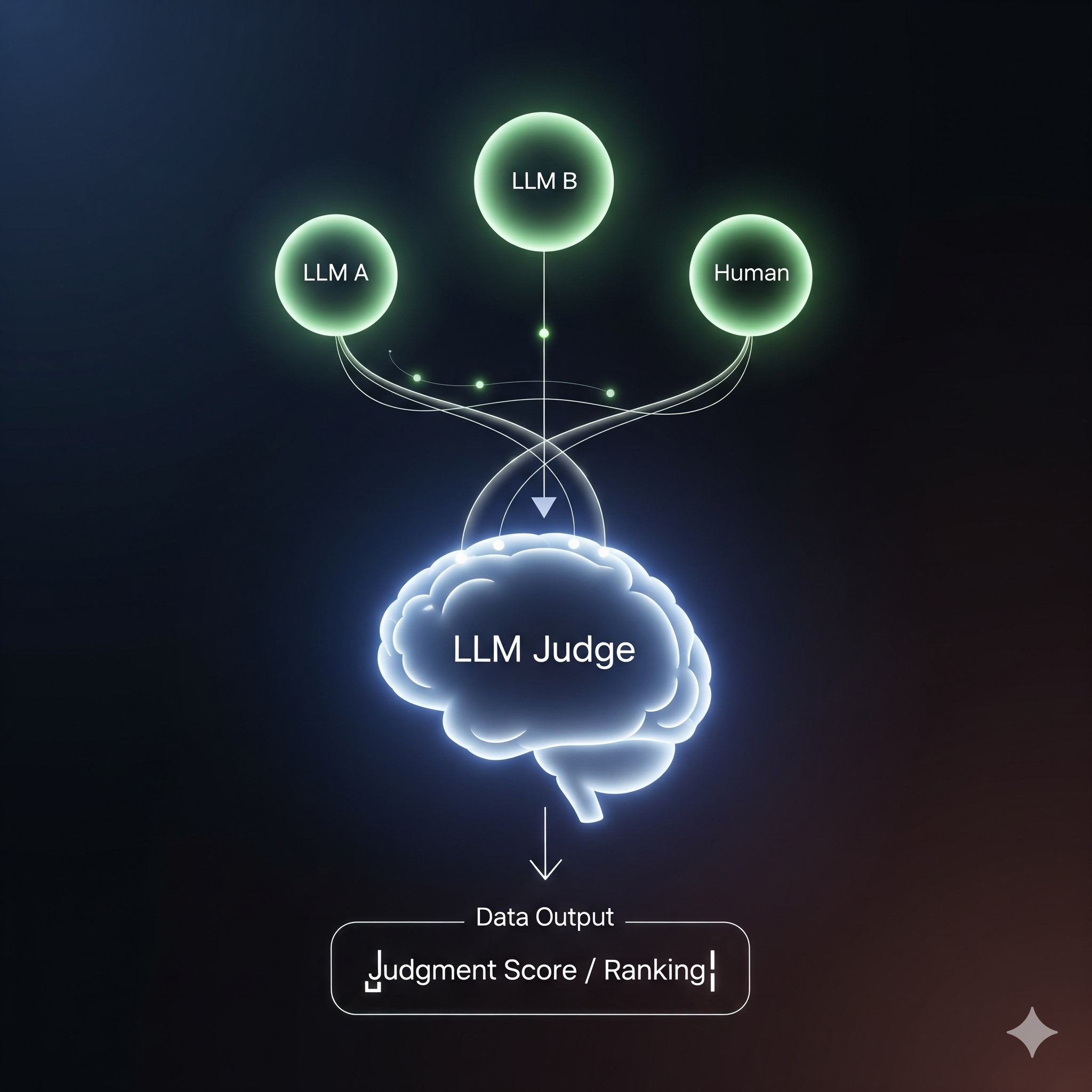
As the complexity and ubiquity of artificial intelligence models, particularly Large Language Models (LLMs), continue to grow, the need for robust, scalable, and nuanced evaluation frameworks has become paramount. Traditional evaluation methods, often relying on statistical metrics or limited human review, are increasingly insufficient for assessing the qualitative aspects of modern AI outputs—such as helpfulness, empathy, cultural appropriateness, and creative coherence. This challenge has given rise to an innovative paradigm: using LLMs themselves as “judges” to evaluate the outputs of other models. This approach, often referred to as LLM-as-a-Judge, represents a significant leap forward, offering a scalable and sophisticated alternative to conventional methods.

Traditional evaluation is fraught with limitations. Manual human assessment, while providing invaluable insight, is notoriously slow and expensive. It is susceptible to confounding factors, inherent biases, and can only ever cover a fraction of the vast output space, missing a significant number of factual errors. These shortcomings can lead to harmful feedback loops that impede model improvement. In contrast, the LLM-as-a-Judge approach provides a suite of compelling advantages:

  • Scalability: An LLM judge can evaluate millions of outputs with a speed and consistency that no human team could ever match.
  • Complex Understanding: LLMs possess a deep semantic and contextual understanding, allowing them to assess nuances that are beyond the scope of simple statistical metrics.
  • Cost-Effectiveness: Once a judging model is selected and configured, the cost per evaluation is a tiny fraction of a human’s time.
  • Flexibility: The evaluation criteria can be adjusted on the fly with a simple change in the prompt, allowing for rapid iteration and adaptation to new tasks.

There are several scoring approaches to consider when implementing an LLM-as-a-Judge system. Single output scoring assesses one response in isolation, either with or without a reference answer. The most powerful method, however, is pairwise comparison, which presents two outputs side-by-side and asks the judge to determine which is superior. This method, which most closely mirrors the process of a human reviewer, has proven to be particularly effective in minimizing bias and producing highly reliable results.

When is it appropriate to use LLM-as-a-Judge? This approach is best suited for tasks requiring a high degree of qualitative assessment, such as summarization, creative writing, or conversational AI. It is an indispensable tool for a comprehensive evaluation framework, complementing rather than replacing traditional metrics.

Challenges With LLM Evaluation Techniques

While immensely powerful, the LLM-as-a-Judge paradigm is not without its own set of challenges, most notably the introduction of subtle, yet impactful, evaluation biases. A clear understanding and mitigation of these biases is critical for ensuring the integrity of the assessment process.

  • Nepotism Bias: The tendency of an LLM judge to favor content generated by a model from the same family or architecture.
  • Verbosity Bias: The mistaken assumption that a longer, more verbose answer is inherently better or more comprehensive.
  • Authority Bias: Granting undue credibility to an answer that cites a seemingly authoritative but unverified source.
  • Positional Bias: A common bias in pairwise comparison where the judge consistently favors the first or last response in the sequence.
  • Beauty Bias: Prioritizing outputs that are well-formatted, aesthetically pleasing, or contain engaging prose over those that are factually accurate but presented plainly.
  • Attention Bias: A judge’s focus on the beginning and end of a lengthy response, leading it to miss critical information or errors in the middle.

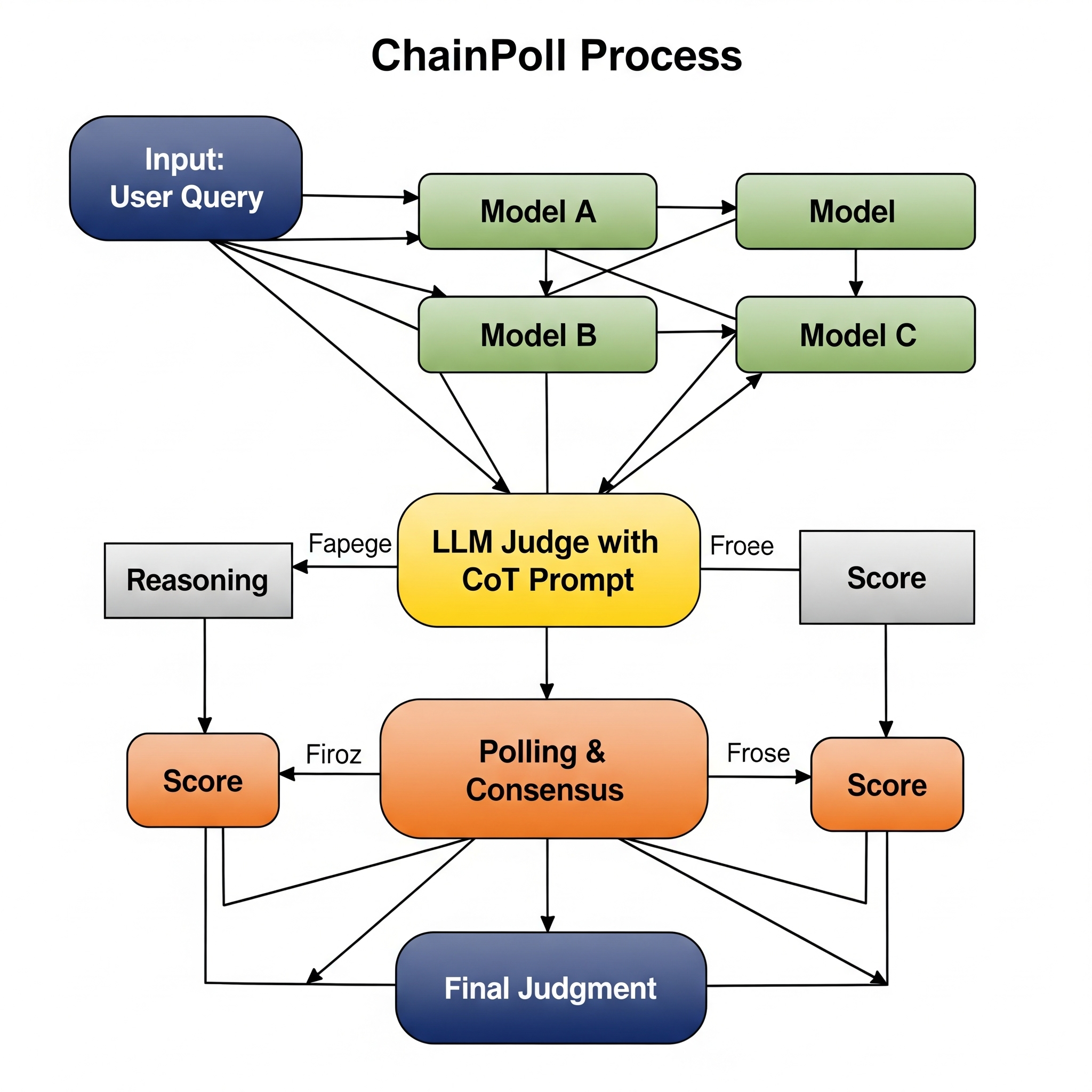
To combat these pitfalls, researchers at Galileo have developed the “ChainPoll” approach. This method marries the power of Chain-of-Thought (CoT) prompting—where the judge is instructed to reason through its decision-making process—with a polling mechanism that presents the same query to multiple LLMs. By combining reasoning with a consensus mechanism, ChainPoll provides a more robust and nuanced assessment, ensuring a judgment is not based on a single, potentially biased, point of view.

A real-world case study at LinkedIn demonstrated the effectiveness of this approach. By using an LLM-as-a-Judge system with ChainPoll, they were able to automate a significant portion of their content quality evaluations, achieving over 90% agreement with human raters at a fraction of the time and cost.

Small Language Models as Judges

While larger models like Google’s Gemini 2.5 are the gold standard for complex, nuanced evaluations, the role of specialised Small Language Models (SLMs) is rapidly gaining traction. SLMs are smaller, more focused models that are fine-tuned for a specific evaluation task, offering several key advantages over their larger counterparts.

  • Enhanced Focus: An SLM trained exclusively on a narrow evaluation task can often outperform a general-purpose LLM on that specific metric.
  • Deployment Flexibility: Their small size makes them ideal for on-device or edge deployment, enabling real-time, low-latency evaluation.
  • Production Readiness: SLMs are more stable, predictable, and easier to integrate into production pipelines.
  • Cost-Efficiency: The cost per inference is significantly lower, making them highly economical for large-scale, high-frequency evaluations.

Galileo’s latest offering, Luna 2, exemplifies this trend. Luna 2 is a new generation of SLM specifically designed to provide low-latency, low-cost metric evaluations. Its architecture is optimized for speed and accuracy, making it an ideal candidate for tasks such as sentiment analysis, toxicity detection, and basic factual verification where a large, expensive LLM may be overkill.

Best Practices for Creating Your LLM-as-a-Judge

Building a reliable LLM judge is an art and a science. It requires a thoughtful approach to five key components.

  1. Evaluation Approach: Decide whether a simple scoring system (e.g., 1-5 scale) or a more sophisticated ranking and comparison system is best. Consider a multidimensional system that evaluates on multiple criteria.
  2. Evaluation Criteria: Clearly and precisely define the metrics you are assessing. These could include factual accuracy, clarity, adherence to context, tone, and formatting requirements. The prompt must be unambiguous.
  3. Response Format: The judge’s output must be predictable and machine-readable. A discrete scale (e.g., 1-5) or a structured JSON output is ideal. JSON is particularly useful for multidimensional assessments.
  4. Choosing the Right LLM: The choice of the base LLM for your judge is perhaps the most critical decision. Models must balance performance, cost, and task specificity. While smaller models like Luna 2 excel at specific tasks, a robust general-purpose model like Google’s Gemini 2.5 has proven to be exceptionally effective as a judge due to its unparalleled reasoning capabilities and broad contextual understanding.
  5. Other Considerations: Account for bias detection, consistency (e.g., by testing the same input multiple times), edge case handling, interpretability of results, and overall scalability.

A Conceptual Code Example for a Core Judge

The following is a simplified, conceptual example of how a core LLM judge function might be configured:

def create_llm_judge_prompt(evaluation_criteria, user_query, candidate_responses):
    """
    Constructs a detailed prompt for an LLM judge.
    """
    prompt = f"""
    You are an expert evaluator of AI responses. Your task is to judge and rank the following responses
    to a user query based on the following criteria:

    Criteria:
    {evaluation_criteria}

    User Query:
    "{user_query}"

    Candidate Responses:
    Response A: "{candidate_responses['A']}"
    Response B: "{candidate_responses['B']}"

    Instructions:
    1.  Think step-by-step and write your reasoning.
    2.  Based on your reasoning, provide a final ranking of the responses.
    3.  Your final output must be in JSON format: {{"reasoning": "...", "ranking": {{"A": "...", "B": "..."}}}}
    """
    return prompt

def validate_llm_judge(judge_function, test_data, metrics):
    """
    Validates the performance of the LLM judge against a human-labeled dataset.
    """
    judgements = []
    for test_case in test_data:
        prompt = create_llm_judge_prompt(test_case['criteria'], test_case['query'], test_case['responses'])
        llm_output = judge_function(prompt)  # This would be your API call to Gemini 2.5
        judgements.append({
            'llm_ranking': llm_output['ranking'],
            'human_ranking': test_case['human_ranking']
        })

    # Calculate metrics like precision, recall, and Cohen's Kappa
    # based on the judgements list.
    return calculate_metrics(judgements, metrics)

Tricks to Improve LLM-as-a-Judge

Building upon the foundational best practices, there are seven practical enhancements that can dramatically improve the reliability and consistency of your LLM judge.

  1. Mitigate Evaluation Biases: As discussed, biases are a constant threat. Use techniques like varying the response sequence for positional bias and polling multiple LLMs to combat nepotism.
  2. Enforce Reasoning with CoT Prompting: Always instruct your judge to “think step-by-step.” This forces the model to explain its logic, making its decisions more transparent and often more accurate.
  3. Break Down Criteria: Instead of a single, ambiguous metric like “quality,” break it down into granular components such as “factual accuracy,” “clarity,” and “creativity.” This allows for more targeted and precise assessments.
  4. Align with User Objectives: The LLM judge’s prompts and criteria should directly reflect what truly matters to the end user. An output that is factually correct but violates the desired tone is not a good response.
  5. Utilise Few-Shot Learning: Providing the judge with a few well-chosen examples of good and bad responses, along with detailed explanations, can significantly improve its understanding and performance on new tasks.
  6. Incorporate Adversarial Testing: Actively create and test with intentionally difficult or ambiguous edge cases to challenge your judge and identify its weaknesses.
  7. Implement Iterative Refinement: Evaluation is not a one-time process. Continuously track inconsistencies, review challenging responses, and use this data to refine your prompts and criteria.

By synthesizing these strategies into a comprehensive toolbox, we can build a highly robust and reliable LLM judge. Ultimately, the effectiveness of any LLM-as-a-Judge system is contingent on the underlying model’s reasoning capabilities and its ability to handle complex, open-ended tasks. While many models can perform this function, our extensive research and testing have consistently shown that Google’s Gemini 2.5 outperforms its peers in the majority of evaluation scenarios. Its advanced reasoning and nuanced understanding of context make it the definitive choice for building an accurate, scalable, and sophisticated evaluation framework.

Has This Post Been Fact-Checked by a Human?

The AI Mandate is Here, and Your Company Left You in the Dark.

The whispers began subtly, like the rustle of leaves just before a storm. Then came the edicts, carved not on stone tablets, but delivered via corporate email, glowing with an almost unholy luminescence on your screen: “All new content must leverage proprietary AI models.” “Efficiency gains are paramount.” “Resistance is… inefficient.”

Remember those halcyon days when “fact-checking” involved, you know, a human brain? When “critical thinking” wasn’t just a buzzword but a tangible skill? Those days, my friends, are vanishing faster than a free biscuit at a Monday morning meeting.

Recent reports from the gleaming towers of Silicon Valley suggest that even titans like Google are now not just encouraging, but mandating the use of their internal AI for everything from coding to… well, probably deciding what colour staplers to order next quarter. This isn’t just a suggestion; it’s a creeping, digital imperative. A silent bell tolls for the old ways.

And here, in the United Kingdom, where “innovation” often means finally upgrading from Windows 7 to 10 (circa 2015), the scene is even more… picturesque. Imagine a grand, ancestral home, creaking with history, suddenly told it must integrate a hyper-futuristic, self-aware smart home system. Everyone nods sagely, pretends to understand, then quietly goes back to boiling water in a kettle.

The truth, stark and unvarnished, is this: most UK companies have rolled out AI like a cheap, flat-pack wardrobe from a notorious Swedish furniture store. They’ve given you the pieces, shown you a blurry diagram, and then walked away, whistling, as you stare at a pile of MDF and a bag of identical-looking screws. “Figure it out,” they seem to hum. “The future waits for no one… especially not for dedicated training budgets.”

We are, in essence, all passengers on a rapidly accelerating train, hurtling towards an AI-driven landscape, with only half the instructions and a driver who vaguely remembers where the brake is. Our LinkedIn feeds are awash with articles proclaiming “AI is the Future!” while the majority of us are still trying to work out how to ask it to draft a polite email without sounding like a sentient toaster.

The Oxford University Press recently published a study, “The Matter of Fact,” detailing how the world grapples with truth in an age of abundant (and often AI-generated) information. The irony, of course, is that most professionals are so busy trying to decipher which button makes ChatGPT actually do something useful that they don’t have time to critically evaluate its output. “Is this email correct?” we ask, sending it off, a cold dread pooling in our stomach, because we certainly haven’t had the time (or the training) to truly verify it ourselves.

It’s a digital dark age, isn’t it? A time when the tools designed to empower us instead leave us feeling adrift, under-qualified, and wondering if our next performance review will be conducted by an algorithm with an unblinking, judgmental gaze. Where professional development means desperately Googling “how to write a prompt that isn’t terrible” at 2 AM.

But fear not, my digitally bewildered brethren. For every creeping shadow, there is a flicker of light. For every unanswered question in the vast, echoing chambers of corporate AI adoption, there is a guide. Someone who speaks fluent human and has also deciphered the arcane tongues of the silicon overlords.

If your company has handed you the keys to the AI kingdom without a single lesson on how to drive, leaving you to career-swerve into the digital ditch of obsolescence… perhaps it’s time for a different approach. I offer AI training, tailored for the bewildered, the forgotten, the ones whose only current experience with AI is shouting at Alexa to play the right song. Let’s not just survive this new era; let’s master it. Before it masters us.

DM me to discuss how we can bring clarity to this impending AI-pocalypse. Because truly, the only thing scarier than an AI that knows everything, is a workforce that knows nothing about how to use it.

https://www.linkedin.com/in/shielyule/

Now arriving at platform 9¾ the BCBS 239 Express

From Gringotts to the Goblin-Kings: A Potter’s Guide to Banking’s Magical Muddle

Ah, another glorious day in the world of wizards and… well, not so much magic, but BCBS 239. You see, back in the year of our Lord 2008, the muggle world had a frightful little crash. And it turns out, the banks were less like the sturdy vaults of Gringotts and more like a badly charmed S.P.E.W. sock—full of holes and utterly useless when it mattered.

I, for one, was called upon to help sort out the mess at what was once a rather grand establishment, now a mere ghost of its former self. And our magical remedy? Basel III with its more demanding sibling, the Basel Committee on Banking Supervision, affectionately known to us as the “Ministry of Banking Supervision.” They decreed a new set of incantations, or as they call them in muggle-speak, “Principles for effective risk data aggregation and risk reporting.”

This was no simple flick of the wand. It was a tedious, gargantuan task worthy of Hermione herself, to fix what the Goblins had so carelessly ignored.

The Forbidden Forest of Data

The issue was, the banks’ data was scattered everywhere, much like Dementors flitting around Azkaban. They had no single, cohesive view of their risk. It was as if they had a thousand horcruxes hidden in a thousand places, and no one had a complete map. They had to be able to accurately and quickly collect data from every corner of their empire, from the smallest branch office to the largest trading floor, and do so with the precision of a master potion-maker.

The purpose was noble enough: to ensure that if a financial Basilisk were to ever show its head again, the bank’s leaders could generate a clear, comprehensive report in a flash—not after months of fruitless searching through dusty scrolls and forgotten ledgers.

The 14 Unforgivable Principles

The standard, BCBS 239, is built upon 14 principles, grouped into four sections.

First, Overarching Governance and Infrastructure, which dictates that the leadership must take responsibility for data quality. The Goblins at the very top must be held accountable.

Next, the Risk Data Aggregation Capabilities demand that banks must be able to magically conjure up all relevant risk data—from the Proprietor’s Accounts to the Order of the Phoenix’s expenses—at a moment’s notice, even in a crisis. Think of it as a magical marauder’s map of all the bank’s weaknesses, laid bare for all to see.

Then comes Risk Reporting Practices, where the goal is to produce reports as clear and honest as a pensieve memory.

And finally, Supervisory Review, which allows the regulators—the Ministry of Magic’s own Department of Financial Regulation—to review the banks’ magical spells and decrees.

A Quidditch Match of a Different Sort

Even with all the wizardry at their disposal, many of the largest banks have failed to achieve full compliance with BCBS 239. The challenges are formidable. Data silos are everywhere, like little Hogwarts Express compartments, each with its own data and no one to connect them. The data quality is as erratic as a Niffler, constantly in motion and difficult to pin down.

Outdated technology, or “Ancient Runes” as we called them, lacked the flexibility needed to perform the required feats of data aggregation. And without clear ownership, the responsibility often got lost, like a misplaced house-elf in the kitchens.

In essence, BCBS 239 is not a simple spell to be cast once. It’s a fundamental and ongoing effort to teach old institutions a new kind of magic—a magic of accountability, transparency, and, dare I say it, common sense. It’s an uphill climb, and for many banks, the journey from Gringotts’ grandeur to true data mastery is a long one, indeed.

The Long Walk to Azkaban

Alas, a sad truth must be spoken. For all the grand edicts from the Ministry of Banking Supervision, and for all our toil in the darkest corners of these great banking halls, the work remains unfinished. Having ventured into the deepest vaults of many of the world’s most formidable banking empires, I can tell you that full compliance remains a distant, shimmering goal—a horcrux yet to be found.

The data remains a chaotic swarm, often ignoring not only the Basel III tenets but even the basic spells of GDPR compliance. The Ministry’s rules are there, but the magical creatures tasked with enforcing them—the regulators—are as hobbled as a house-elf without a wand. They have no proper means to audit the vast, complex inner workings of these institutions, which operate behind a Fidelius Charm of bureaucracy. The banks, for their part, have no external authority to fear, only the ghosts of their past failures.

And so, we stand on the precipice once more. Without true, verifiable data mastery, these banks are nothing but a collection of unstable parts. The great financial basilisk is not slain; it merely slumbers, and a future market crash is as inevitable as the return of a certain dark lord. That is, unless a bigger, more dramatic distraction is conjured—a global pandemic, perhaps—to divert our gaze and allow the magical muddle to continue unabated.

Introducing ‘Chat Control’: The EU’s Latest Innovation in Agile Surveillance

Well, folks, it’s official. The EU, that noble bastion of digital rights, is preparing to roll out its most ambitious project to date. Forget GDPR, that quaint, old-world concept of personal privacy. We’re on to something much more disruptive.

In a new sprint towards a more “secure” Europe, the EU Council is poised to green-light “Chat Control,” a scalable, AI-powered solution for tackling a truly serious problem. In a masterclass of agile product development, they’ve managed to “solve” it by simply bulldozing the fundamental right to privacy for 450 million people. It’s a bold move. A real 10x-your-surveillance kind of move.

The Product Pitch: Your Digital Life, Now with Added Oversight

Here’s the pitch, and you have to admit, it’s elegant in its simplicity. To combat a very real evil (child sexual abuse), the EU has decided that the most efficient solution isn’t targeted, intelligent policing. No, that would be so last century. The modern, forward-thinking approach is to turn every single private message, every late-night text to your partner, every confidential health email, and every family photo you’ve ever shared into a potential exhibit.

The pitch goes like this: your private communications are no longer private. They’re just pre-vetted content, scanned by an all-seeing AI before they ever reach their destination. Think of it as a quality-assurance check on your digital life. Your deepest secrets? They’re just another data point for the algorithm. Your end-to-end encrypted messages? That’s a feature we’re “deprecating” in this new version. Because who needs privacy when you can have… well, mandatory screening?

Crucially, this mandatory screening will apply to all of us. You know, just to be sure. Unless, of course, you’re a government or military account. They get a privacy pass. Because accountability is for the little people, not the architects of this brave new world.

The Go-to-Market Strategy: A Race to the Bottom

The launch is already in its final phase. With a crucial vote scheduled for October 14th, this law has never been closer to becoming reality. As it stands, 15 out of 27 member states are already on board, just enough to meet the first part of the qualified majority requirement. They represent about 53% of the EU’s population—just shy of the 65% needed.

The deciding factor? The undecided “stakeholders,” with Germany as the key account. If they vote yes, the product gets the green light. If they abstain, they weaken the proposal, even if it passes. Meanwhile, the brave few—the Netherlands, Poland, Austria, the Czech Republic, and Belgium—are trying to “provide negative feedback” before the product goes live. They’ve called it “a monster that invades your privacy and cannot be tamed.” How dramatic.

The Brand Legacy: A Strategic Pivot

Europe built its reputation on the General Data Protection Regulation (GDPR), a monument to the idea that privacy is a fundamental human right. It was a globally recognized brand. But Chat Control? It’s a complete pivot. This isn’t just a new feature; it’s a total rebranding. From “Global Leader in Digital Rights” to “Pioneer of Mass Surveillance.”

The intention is, of course, noble. But the execution is a masterclass in how to dismantle freedom in the name of security. They’ve discovered the ultimate security loophole: just get rid of the protections themselves.

The vote on October 14th isn’t just about a law; it’s about choosing fear over freedom. It’s about deciding if the privacy infrastructure millions of people and businesses depend on is a bug to be fixed or a feature to be preserved. And in this agile, dystopian landscape, it looks like we’re on the verge of a very dramatic “feature update.”

#ChatControl #CSAR #DigitalRights #OnlinePrivacy #ProtectEU #Cybersecurity #DigitalPrivacy #ChatControl #DataProtection #ResistSurveillance #EULaw

Sources:

Key GDPR Principles at Risk

The primary conflict between Chat Control and GDPR stems from several core principles of the latter:

  • Data Minimisation: GDPR mandates that personal data collection should be “adequate, relevant, and limited to what is necessary.” Chat Control, with its indiscriminate scanning of all private messages, photos, and files, is seen as a direct violation of this principle. It involves mass surveillance without suspicion, collecting far more data than is necessary for its stated purpose.
  • Purpose Limitation: Data should only be processed for “specified, explicit, and legitimate purposes.” While combating child abuse is a legitimate purpose, critics argue that the broad, untargeted nature of Chat Control goes beyond this limitation. It processes a massive amount of innocent data for a purpose it was not intended for.
  • Integrity and Confidentiality (Security): This principle requires that personal data be processed in a manner that ensures “appropriate security.” The requirement for mandatory scanning, especially “client-side scanning” of encrypted communications, is seen as a direct threat to end-to-end encryption. This creates a security vulnerability that could be exploited by hackers and malicious actors, undermining the security of all citizens’ data.