Available on Amazon

Available on Amazon
Writer, Scribbler and Prompt Alchemist

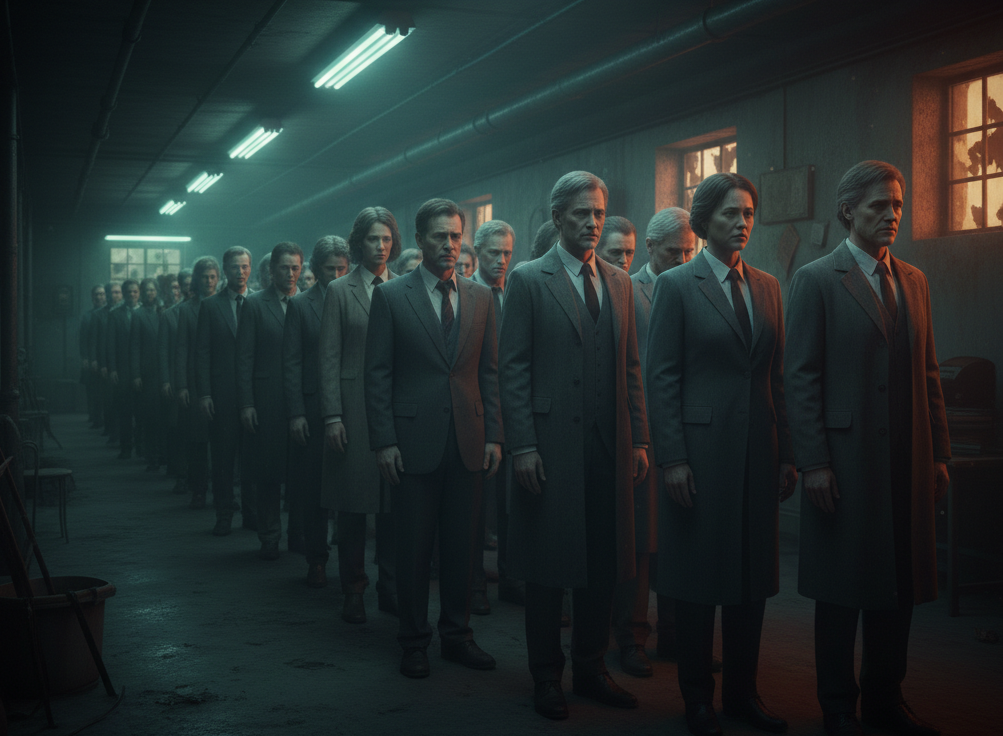
The thing about Edinburgh in August is that the city’s ghosts have to queue. They’re suddenly outnumbered, you see, jostling for space between a silent mime from Kyoto, a twenty-person acapella group from Yale wearing sponsored lanyards, and a man juggling flaming pineapples. The whole place becomes a glorious, pop-up psychic bruise. I was mainlining this year’s particular vintage of glorious chaos when I stumbled past the Preston Street Primary School. It’s a perfectly normal school playground. Brightly painted walls, a climbing frame, the faint, lingering scent of disinfectant and existential dread. Except this particular patch of publicly-funded joy is built on a historical feedback loop of profound unpleasantness. It’s a place that gives you a profound system error in the soul; a patch of reality where the source code of the past has started bleeding through the brightly coloured, EU-regulated safety surfacing of the present. It’s the kind of psychic stain that makes you think, not of a hamster exploding, but of the day the children’s laughter started to sound digitally corrupted, looping with the faint, static-laced echo of a hangman’s final prayer. It’s the chilling feeling that if you looked too closely at the kids’ innocent crayon drawings of their families, you’d notice they had instinctively, unconsciously, drawn one of the stick figures hanging from a tree.
So naturally, in my Fringe-addled brain, I pictured the school’s inevitable entry into the festival programme. It’s the hit no one saw coming: “Our Playground of Perpetual Shame: A Musical!”, brought to you by the kids of P4. The opening number is a banger, all about the 1586 construction of the gibbet, with a perky chorus about building the walls high “so the doggos can’t steal the bodies!” It’s got that dark, primary-colour simplicity that really resonates with the critics. The centrepiece is a complex, heavily choreographed piece depicting the forty-three members of Clan Macgregor being hanged for their murderous beef with the Colquhouns. Mr. Dumbeldor from P.E. has them doing it with skipping ropes. It’s avant-garde, it’s visceral, it’s a logistical nightmare for the school trip permission slips.
The second act, of course, delves into the ethnic cleansing of the Romani people under James VI. It’s a tough subject, but the kids handle it with a chillingly naive sincerity. They re-enact the 1624 arrest of their “captain,” John Faa, and the great rescue attempt. Little Gavin Trotter, played by the smallest kid in P1, is “cunningly conveyed away” from a prison of gym mats while the audience (mostly horrified parents) is encouraged to create a distracting “shouting and crying.” It’s the most authentic immersive theatre experience on the circuit. They even have a whole number for General Montrose, whose torso was buried right under what is now the sandbox. His niece, played by a girl with a glittery pink art box, comes to retrieve his heart. It’s a tender, if anatomically questionable, moment.
Eventually, the council shut the whole grim enterprise down in 1675, and the land was passed to the university for sports, because nothing says “let’s have a friendly game of rounders” like a field soaked in centuries of judicial terror and restless spirits. Now, kids play there. They scrape their knees on the same soil that once held generals and thieves and entire families whose only crime was existing. And you watch them, in their little hi-vis jackets, and you have to wonder. Maybe this Fringe show isn’t an act. Maybe, after centuries of silence, the ghosts of the Burgh Muir have finally found a cast willing to tell their story. And judging by the queues, they’re heading for a five-star review.

I have just finished immersing myself in the bleak and fascinating world of C.J. Sansom’s “Winter in Madrid,” and I’m still processing the experience. Overall, I found it a compelling read that successfully transported me to a fractured Spain in 1940, under the shadow of Franco’s regime and the looming threat of Nazi Germany.
Sansom excels at creating richly drawn characters, and Harry Brett, the reluctant British spy, is no exception. His internal struggles as a Dunkirk veteran thrust into the murky world of espionage felt incredibly real. Similarly, Barbara Clare’s determined search for her lost love, and even the morally ambiguous Sandy Forsyth, were all complex and engaging individuals who evolved convincingly throughout the narrative. I particularly enjoyed how their paths intertwined in unexpected ways, creating a captivating tapestry of personal stories against the backdrop of a nation still reeling from civil war. The way Sansom allowed these characters to develop and reveal their true natures was definitely a highlight for me.
The story itself was intricate and kept me turning the pages, eager to see how the various threads would connect. The evolution of the plot, with its layers of secrets, betrayals, and hidden agendas, was compelling. I appreciated how the initial premise of Harry’s mission gradually expanded to encompass broader political intrigue and personal stakes.
One of the most impactful aspects of “Winter in Madrid” for me was the historical setting. While I had a general understanding of the Spanish Civil War, Sansom brought the realities of life in post-war Madrid to vivid life. The descriptions of the ruined city, the hunger, the political repression, and the pervasive sense of fear were incredibly powerful and immersive. This book genuinely sparked a desire in me to learn more about this period in history and the complexities of the Franco regime. I’ve already found myself delving into further reading on the Spanish Civil War, which is a testament to Sansom’s ability to weave historical detail seamlessly into his fiction.
However, I must admit that at times the book felt a little long, and the intricate plot occasionally veered into convolution. There were moments where I felt the pacing could have been tighter, and some of the subplots, while interesting, perhaps added to the length without significantly enhancing the central narrative.
My biggest reservation, though, lies with the ending. While I won’t spoil it for anyone who hasn’t read it, I felt it concluded rather abruptly and with a sense of contrivance. It was as if the author had reached a certain page count and decided it was time to wrap things up, leaving me with the feeling that the story could have explored further, particularly regarding the long-term consequences for the characters. It felt a little rushed, and I personally would have welcomed a more extended and perhaps less neatly tied-up conclusion.

Despite these minor criticisms, “Winter in Madrid” remains a compelling and thought-provoking read. The strength of its characters, the gripping evolution of the story, and the fascinating historical backdrop make it a book I would recommend, especially to those interested in historical fiction and spy thrillers. Just be prepared for a journey that is both immersive and, at times, a little winding, with an ending that might leave you wanting just a little bit more.
While the spectre of right-wing fascist regimes controlling and punishing their own populations remains a historical warning, the current global trajectory, though fraught with challenges, shows significant forces pushing in the opposite direction. The interconnectedness fostered by technology allows for greater transparency and facilitates the mobilization of civil society against oppression. International norms and institutions, despite their imperfections, continue to exert pressure on states to uphold human rights and democratic principles. While instances of authoritarianism persist and democratic backsliding is a concern in some regions, the widespread desire for freedom, self-determination, and accountable governance, coupled with the increasing ability of citizens to organize and demand these rights, suggests a global movement that, while facing headwinds, is ultimately charting a course away from the dark chapters of history where such regimes held sway. The ongoing struggles for democracy and human rights around the world, while highlighting the work that remains, also underscore the resilience of the human spirit in resisting tyranny.
Have you read “Winter in Madrid”? What were your thoughts? Let me know in the comments below!

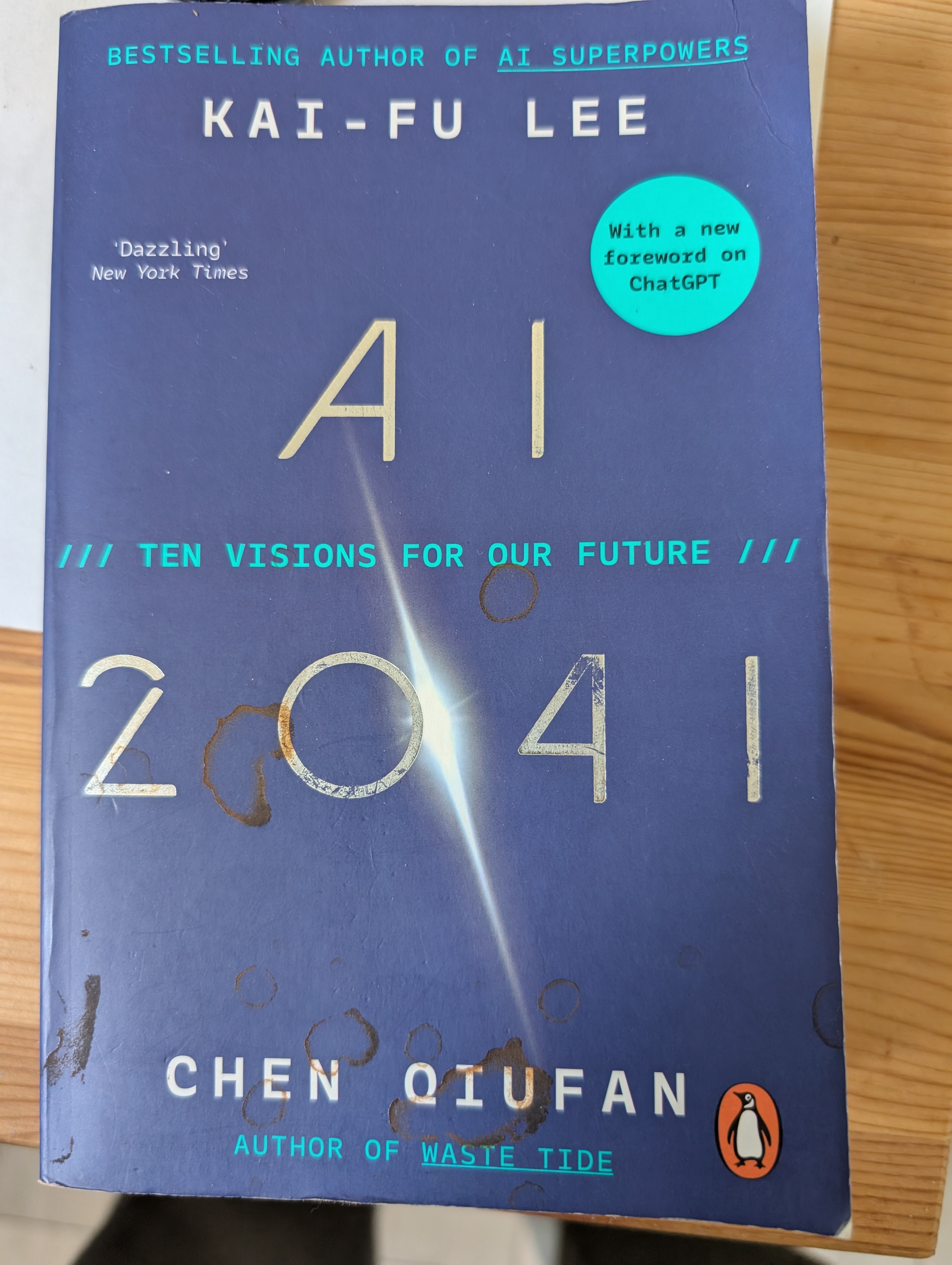
Remember the days of the (Nokia) brick phone? Those clunky devices that could barely make a call, let alone access the internet? Fast forward 20 years, and we’re holding pocket-sized supercomputers capable of capturing stunning photos, navigating complex cities, and connecting us to the world in an instant. The evolution of mobile phones is a testament to the rapid pace of technological advancement, a pace that’s only accelerating.
If mobile phones can transform so drastically in two decades, imagine what the next 20 years hold. Kai-Fu Lee and Chen Qiufan, in their thought-provoking book “AI 2041,” dare to do just that. Through ten compelling short stories, they paint a vivid picture of a future where Artificial Intelligence is woven into the very fabric of our lives.
What truly resonated with me, especially as a parent of five, was their vision of AI-powered education. Forget the one-size-fits-all approach of traditional schooling. Lee and Qiufan envision a world where every child has a personal AI tutor, a bespoke learning companion that adapts to their individual needs and pace. Imagine a system where learning is personalized, engaging, and truly effective, finally breaking free from the outdated concept of classrooms and standardized tests.
Now, let’s talk about “AI 2041” itself. It’s not just science fiction; it’s a meticulously crafted forecast. The authors don’t simply dream up fantastical scenarios; they provide detailed technical explanations after each story, grounding their predictions in current research and trends. They acknowledge the potential pitfalls of AI, the dystopian fears that often dominate the conversation, but they choose to focus on the optimistic possibilities, on how we can harness AI for progress rather than destruction.
Frankly, I found the technical explanations more captivating than the fictional stories. They delve into the ‘how’ and ‘why’ behind their predictions, exploring the ethical considerations and the safeguards we need to implement. This isn’t just a book about technology; it’s a call to action, a plea for responsible innovation.
While “AI 2041” might not win literary awards, it’s not meant to. It’s meant to spark our imagination, to challenge our assumptions, and to prepare us for the future. It’s a reminder that technology is a tool, and it’s up to us to shape its impact on our lives.
The evolution of mobile phones has shown us the transformative power of technology. “AI 2041” invites us to consider what the next 20 years might bring, particularly in areas like education. And if you’re truly seeking insights into what’s coming – and trust me, it’s arriving much faster than the ‘experts’ are predicting – then this book delivers far more substance than the ever-increasing deluge of AI YouTubers and TikTokers. This isn’t just speculation; it’s a grounded exploration of the potential, and it’s a journey into the possible that we should all be taking. If you want to be prepared, if you want to understand the real potential of AI, then I strongly suggest you read this book.
“But if we stop helping people—stop loving people—because of fear, then what makes us different from machines?”
― Kai-Fu Lee

Simon Stålenhag’s “The Electric State” is a captivating blend of sci-fi and Americana, painting a picture of a near-future where retro technology coexists with futuristic marvels. The book, with its melancholic tone and focus on the human condition amidst technological advancements, offers a poignant reflection on the past, present, and a potential future.
The recent film adaptation, while retaining the essence of Stålenhag’s distinctive aesthetic, takes a decidedly lighter turn. Gone are some of the book’s more somber undercurrents, replaced by a more upbeat and action-packed narrative. With Millie Bobby Brown Bongiovi, Christopher Michael Pratt (contractually obligated to be charming), Stanley Tucci (because every good sci-fi needs a Tucci), and Giancarlo Giuseppe Alessandro Esposito (who can make even a toaster sound menacing). It was like Stålenhag’s world got a Hollywood makeover, and suddenly, it was less “end of the world” and more “road trip with your cool, slightly malfunctioning robot pal.” This shift in tone, while perhaps diverging from the book’s original intent, allows the film to embrace a more accessible and entertaining style, making it a thrilling adventure for audiences of all ages.
A Visual Feast:
One of the most striking aspects of both the book and the film is their visual splendor. Stålenhag’s iconic artwork, with its blend of vintage Americana and futuristic technology seamlessly integrated into breathtaking landscapes, is brought to life on screen with stunning visuals. The film masterfully captures the essence of Stålenhag’s unique vision, transporting viewers to a world where rusty pickup trucks share the road with towering robots and retro-futuristic gadgets.
A Lighter Touch:
While the film retains the core elements of the book – the road trip, the mysterious android, and the search for meaning – it opts for a more lighthearted and action-oriented approach. The book delves deeper into themes of loneliness, isolation, and the anxieties of a changing world, while the film leans more heavily on humor, adventure, and a touch of the fantastical.
A Visual Spectacle:
Ultimately, “The Electric State” film is a visually stunning and entertaining adaptation that successfully captures the spirit of Simon Stålenhag’s work. While it may not perfectly mirror the book’s more introspective tone, it provides a thrilling cinematic experience. I loved it. It was a visual feast, less “what if the internet ate my soul?” and more “what if my robot best friend and I saved the world while listening to awesome tunes?” It’s a different vibe to the book, for sure, but it’s a fun one. It’s like finding a vintage video game console in your attic and discovering it’s still got a few levels left to play. And honestly, who doesn’t love a good retro-futuristic joyride with a stellar cast and a killer soundtrack? It’s the kind of thing that makes you want to dust off your old Walkman and hit the open road, even if that road is just to the nearest coffee shop.


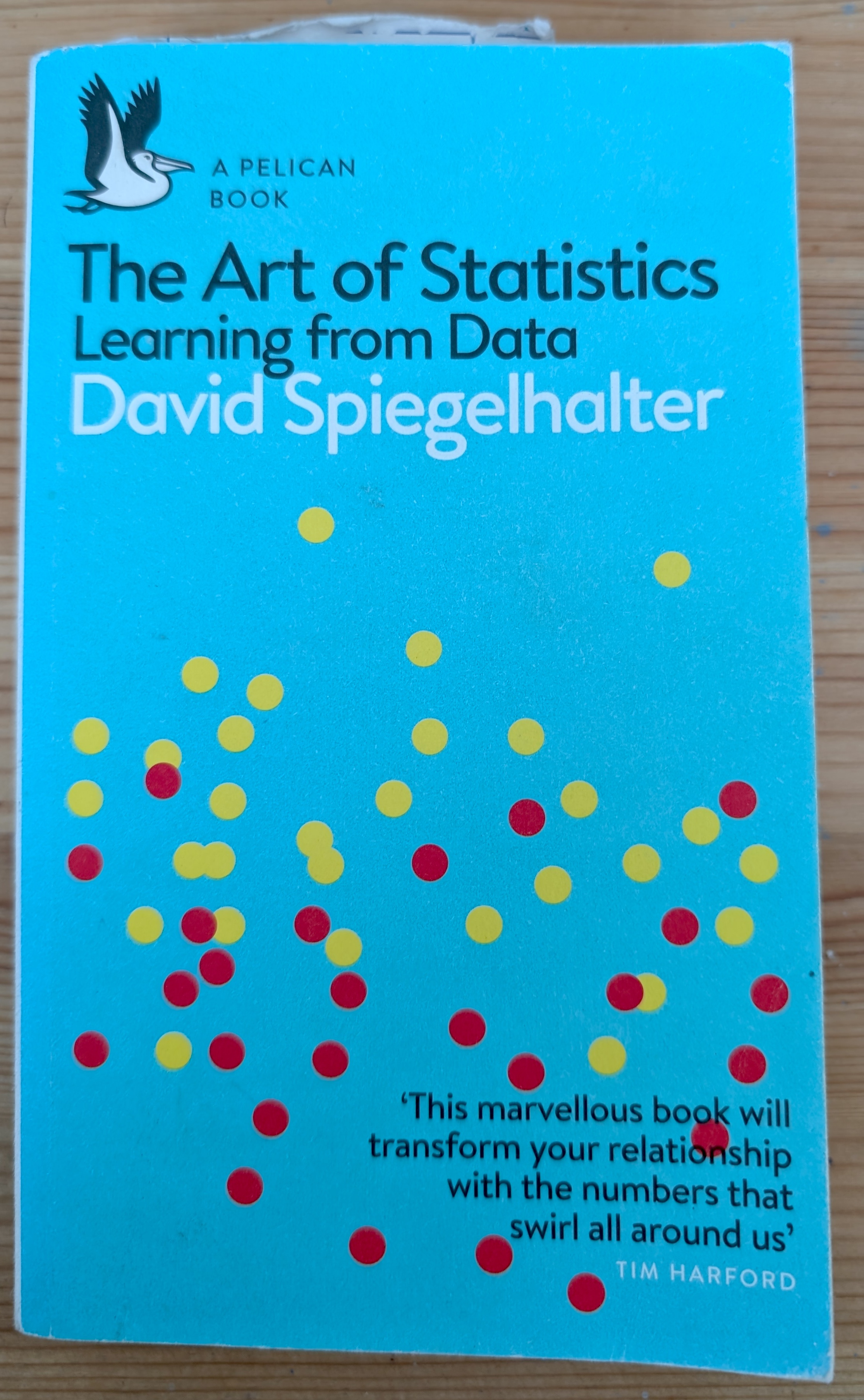
Gather ’round because I have a tale to tell. A tale of statistical daring-do, of intellectual battles fought and won (eventually), and of a book that nearly broke me but ultimately sparked a lifelong love affair with data.
The hero of our story? “The Art of Statistics” by David Spiegelhalter. The villain? My own statistically insignificant attention span.
Our story begins in 2019, a simpler time when “pandemic” was just a scary word in a board game and sourdough starter wasn’t a mandatory kitchen accessory. I bright-eyed and bushy-tailed, decided to tackle this tome, convinced I would emerge a statistical savant, capable of predicting the lottery numbers and the exact moment my toast would burn.
Turns out, statistics is a bit more complicated than the pie charts I used to colour in at school. Who knew? So began my years-long wrestling match with this book. I’d read a chapter, feel my brain cells staging a mass exodus, and promptly retreat to the soothing embrace of a comic, minecraft or Fortnite. Rinse and repeat.
But like a stubborn stain on my favorite shirt, I just couldn’t get rid of this book. So, I persevered. I re-read chapters. I Googled terms that sounded like they belonged in a Harry Potter spellbook (“heteroscedasticity,” anyone?). I even resorted to drawing diagrams on my windows with dry-erase markers (much to the confusion of my neighbours).
And slowly, miraculously, something started to click. David Spiegelhalter, bless his statistically significant heart, has a way of making even the most mind-bending concepts understandable. He’s like the data whisperer, the statistical Yoda, the… okay, I’ll stop with the analogies. But seriously, his writing is engaging, witty, and surprisingly relatable. Plus, the examples he uses are fascinating – from the probability of winning the lottery (spoiler alert: don’t quit your day job) to the statistical quirks of birth dates and death rates.
This book, my friends, was a journey. A statistical odyssey, if you will. It challenged me, frustrated me, and ultimately, inspired me. It sparked a curiosity about data that led me to the Google Data Analytics course I’m currently immersed in (more on that in another blog post, because this one is already longer than the average attention span, statistically speaking).
So, what’s the moral of the story? Well, first, never underestimate the power of a good book. Second, statistics can be fascinating. And third, if I can conquer “The Art of Statistics,” then by the transitive property of awesomeness, I can probably conquer this data analytics course too.
P.S. Pelican Books, you guys are the real MVPs. Bringing back all those school textbook memories (the good ones, mostly). And for publishing this gem of a book? You deserve a statistically significant high-five.

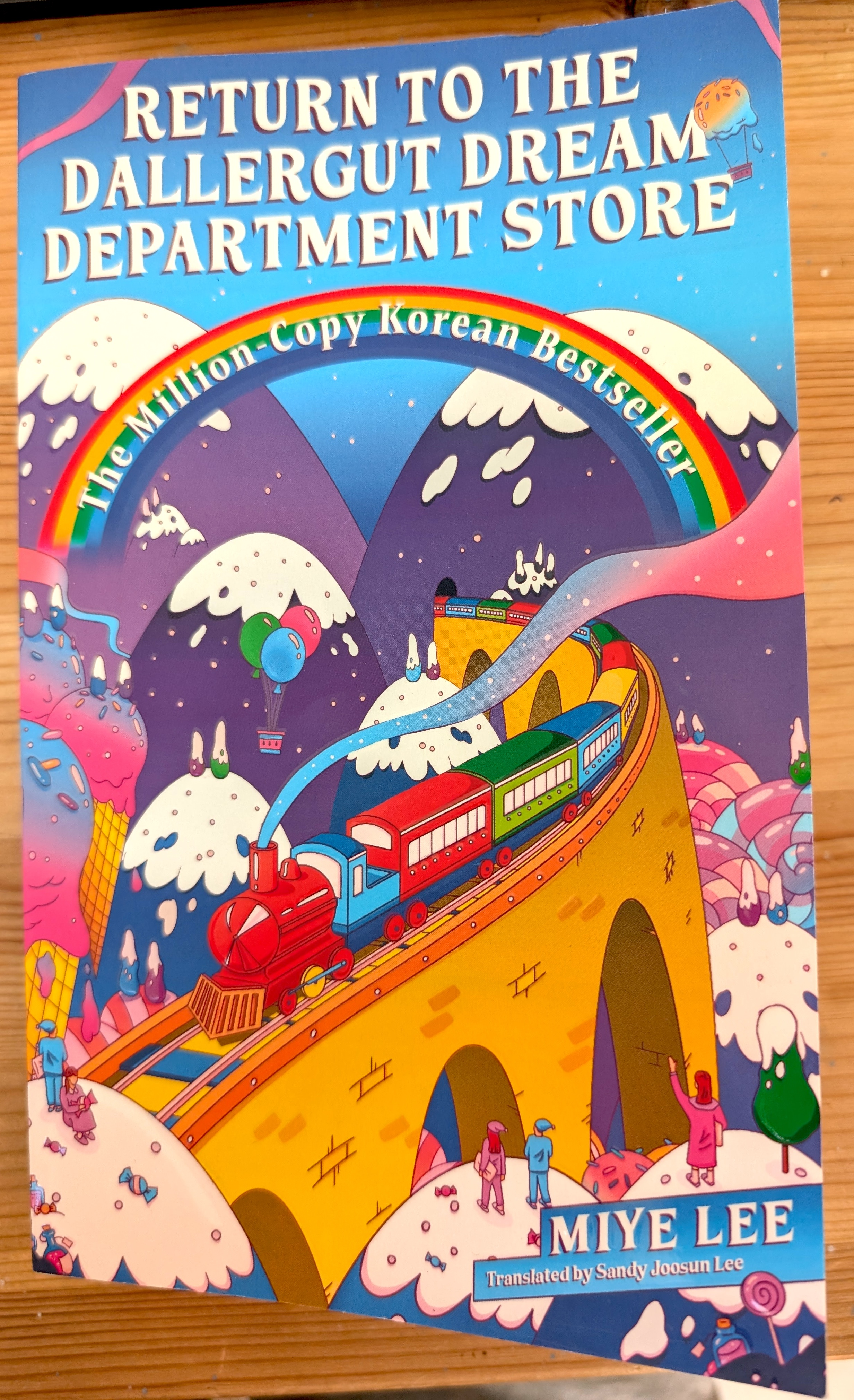
Okay, confession time. I have a problem. A delightful problem, but a problem nonetheless. It’s called the Dallergut Dream Department Store. Specifically, two Dallergut Dream Department Store-shaped problems.
Remember over Christmas when I raved about this whimsical Korean novel? The one where you can buy dreams? Yeah, that one. Well, I finished it, and I was bereft. Like, my brain was wandering around the real world, bumping into things and muttering, “But… where are the dream catalogues?”
Luckily, my literary fairy godmother (aka the internet) whispered sweet nothings about a sequel. A sequel! Turns out, my dream-buying days were far from over. And let me tell you, “Welcome to the Dream Department Store” was even better than the original. It was like going back to your favorite cafe and discovering they now serve your favorite cake with extra sprinkles.
Seriously, these books are pure magic. Miye Lee has this incredible way of weaving stories that just pull you in. I devoured both books (okay, maybe not quite in one sitting, but the temptation was REAL). The writing style is so refreshing. It’s different from what I’m used to in Western literature, but in the best possible way. It’s…gentle? Magical? Like being wrapped in a warm blanket made of storytelling.
Now, I have to give a shout-out to Sandy Joosun Lee, the translator. I’m convinced a huge part of the books’ charm is down to her skill. And I totally agree with her comment in the second book – I’ve been dreaming like crazy since I started reading these at bedtime! My subconscious is clearly a loyal customer of the Dallergut Dream Department Store. I’m pretty sure I bought a flying unicorn and a lifetime supply of chocolate in my last dream. (Sadly, neither were delivered. Dream Department Store customer service, if you’re reading this, I’d like to file a complaint.)
So, if you’re looking for a book that will transport you to another world, make you believe in the impossible, and maybe even inspire some seriously epic dreams, then I cannot recommend the Dallergut Dream Department Store books enough. Go. Read. Them. Your brain (and your dream life) will thank you. Just don’t blame me if you start trying to pay for your morning coffee with dream coupons. I warned you.
My Bank Account is Safe, But My Dream Wallet is Officially Empty (Thanks, Dallergut!)

The Guide Mark II says, “Don’t Panic,” but when it comes to the state of Artificial Intelligence, a mild sense of existential dread might be entirely appropriate. You see, it seems we’ve built this whole AI shebang on a foundation somewhat less stable than a Vogon poetry recital.
These Large Language Models (LLMs), with their knack for mimicking human conversation, consume energy with the same reckless abandon as a Vogon poet on a bender. Training these digital behemoths requires a financial outlay that would make a small planet declare bankruptcy, and their insatiable appetite for data has led to some, shall we say, ‘creative appropriation’ from artists and writers on a scale that would make even the most unscrupulous intergalactic trader blush.
But let’s assume, for a moment, that we solve the energy crisis and appease the creative souls whose work has been unceremoniously digitised. The question remains: are these LLMs actually intelligent? Or are they just glorified autocomplete programs with a penchant for plagiarism?
Microsoft’s Copilot, for instance, boasts “thousands of skills” and “infinite possibilities.” Yet, its showcase features involve summarising emails and sprucing up PowerPoint presentations. Useful, perhaps, for those who find intergalactic travel less taxing than composing a decent memo. But revolutionary? Hardly. It’s a bit like inventing the Babel fish to order takeout.
One can’t help but wonder if we’ve been somewhat misled by the term “artificial intelligence.” It conjures images of sentient computers pondering the meaning of life, not churning out marketing copy or suggesting slightly more efficient ways to organise spreadsheets.
Perhaps, like the Babel fish, the true marvel of AI lies in its ability to translate – not languages, but the vast sea of data into something vaguely resembling human comprehension. Or maybe, just maybe, we’re still searching for the ultimate question, while the answer, like 42, remains frustratingly elusive.
In the meantime, as we navigate this brave new world of algorithms and automation, it might be wise to keep a towel handy. You never know when you might need to hitch a ride off this increasingly perplexing planet.

Comparison to Crypto Mining Nonsense:
Both LLMs and crypto mining share a striking similarity: they are incredibly resource-intensive. Just as crypto mining requires vast amounts of electricity to solve complex mathematical problems and validate transactions, training LLMs demands enormous computational power and energy consumption.
Furthermore, both have faced criticism for their environmental impact. Crypto mining has been blamed for contributing to carbon emissions and electronic waste, while LLMs raise concerns about their energy footprint and the sustainability of their development.
Another parallel lies in the questionable ethical practices surrounding both. Crypto mining has been associated with scams, fraud, and illicit activities, while LLMs have come under fire for their reliance on massive datasets often scraped from the internet without proper consent or attribution, raising concerns about copyright infringement and intellectual property theft.
In essence, both LLMs and crypto mining represent technological advancements with potentially transformative applications, but they also come with significant costs and ethical challenges that need to be addressed to ensure their responsible and sustainable development.
In January, nestled in the quietude of the post-holiday season, I found myself immersed in a book that was as unsettling as it was captivating. It was a Christmas gift from my daughter, a copy of Octavia Butler’s Parable of the Sower. Little did I know that this dystopian novel, penned in 1993, would resonate with an eerie familiarity in the year 2024.

Butler paints a grim picture of America in the 2020s, ravaged by climate change, economic collapse, and social disintegration. Walled communities offer a semblance of safety from the chaos that reigns outside, but even these fragile havens are not immune to the encroaching darkness.
At the heart of the story is Lauren Olamina, a young woman with hyperempathy, a condition that allows her to feel the pain of others as her own. This heightened sensitivity becomes both a burden and a source of strength as she navigates a world teetering on the brink of collapse.
When her community is brutally attacked, Lauren is forced to flee, embarking on a perilous journey north. Along the way, she gathers a ragtag group of survivors, each grappling with their own demons and seeking a glimmer of hope in a world gone mad.
What struck me most about Parable of the Sower was its prescience. Written over three decades ago, it eerily foreshadows many of the challenges we face today – the widening gap between rich and poor, the rise of extremism, the devastating impact of climate change. It’s a stark reminder that the seeds of dystopia are often sown in the present.
But amidst the darkness, there is also a flicker of hope. Lauren’s journey is not just one of survival; it’s a quest for meaning and purpose in a world that seems to have lost its way. She develops a new philosophy, Earthseed, which emphasises the power of change and the interconnectedness of all things.
Parable of the Sower is not an easy read. It’s a harrowing story that forces us to confront the uncomfortable realities of our time. But it’s also a deeply thought-provoking and ultimately hopeful book that reminds us of the resilience of the human spirit and the possibility of creating a better future, even in the face of overwhelming odds.
Have you read Parable of the Sower or any other works by Octavia Butler? What are your thoughts on the book’s relevance to our current times? Share your reflections in the comments below.