Hiring Ghosts & Other Modern Inconveniences

So, LinkedIn, in its infinite, algorithmically-optimised wisdom, sent me an email and posed a question: Has generative AI transformed how you hire?

Oh, you sweet, innocent, content-moderated darlings. Has the introduction of the self-service checkout had any minor, barely noticeable effect on the traditional art of conversing with a cashier? Has the relentless efficiency of Amazon Prime in any way altered our nostalgic attachment to a Saturday afternoon browse down the local high street? Has the invention of streaming services had any small impact on the business model of your local Blockbuster video?

Yes. Duh.

You see, the modern hiring process is no longer about finding a person for a role. It is a wonderfully ironic Turing Test in reverse. The candidate, a squishy carbon-based lifeform full of anxieties and a worrying coffee dependency, uses a vast, non-sentient silicon brain to convince you they are worthy. You, another squishy carbon-based lifeform, must then use your own flawed, meat-based intuition to decide if the ghost in their machine is a good fit for the ghost in your machine.

The CV is dead. It is a relic, a beautifully formatted PDF of lies composed by a language model that has read every CV ever written and concluded that the ideal candidate is a rock-climbing, volunteer-firefighting, Python-coding polymath who is “passionate about synergy.” The cover letter? It’s a work of algorithmically generated fiction, a poignant, computer-dreamed ode to a job it doesn’t understand for a company it has never heard of.

So, are you hiring a person, or the AI-powered spectre of that person? A LinkedIn profile is no longer a testament to a career; it’s a monument to successful prompt engineering.

To truly prove consciousness in 2025, a candidate needs a blog. A podcast. A YouTube channel where they film themselves, unshaven and twitching, wrestling with a piece of code while muttering about the futility of existence. We require a verifiable, time-stamped proof of life to show they haven’t simply outsourced their entire professional identity to a subscription service.

Meanwhile, the Great Career Shuffle accelerates. An entire car-crash multitude of ex-banking staff, their faces etched with the horror of irrelevance, are now desperately rebranding as “AI strategists.” The banks themselves are becoming quaint, like steam museums, while the real action—the glorious, three-month contracts of frantic, venture-capital-fueled chaos—is in the AI startups.

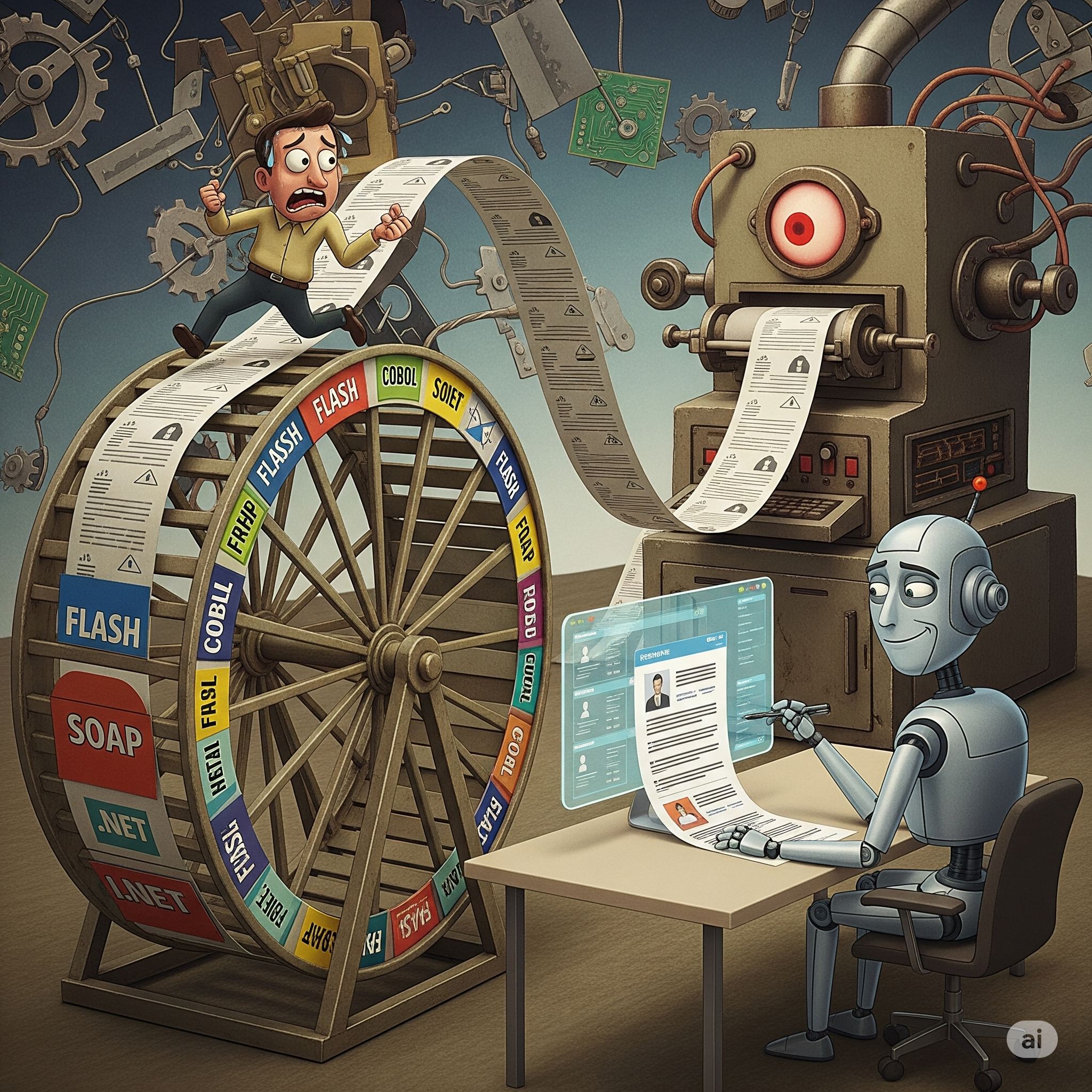
It all feels so familiar. It’s that old freelance feeling, where your CV wasn’t a document but a long list of weapons in your arsenal. You needed a bow with a string for every conceivable software battle. One week it was pure HTML+CSS. The next, you were a warrior in the trenches of the Great Plugin Wars, wrestling the bloated, beautiful behemoth of Flash until, almost overnight, it was rendered obsolete by the sleek, sanctimonious assassin that was HTML5.

The backend was a wilder frontier. A company demanded you wrestle with the hydra of PHP, be it WordPress, Drupal, or the dark arts of Magento if a checkout was involved. For a brief, shining moment, everything was meant to be built on the elegant railway tracks of Ruby. Then came the Javascript Tsunami, a wave so vast it swept over both the front and back ends, leaving a tangled mess that developers are still trying to untangle to this day.

And the enterprise world? A mandatory pilgrimage to the great, unkillable temple of Java. The backend architecture evolved from the stuffy, formal rituals of SOAP APIs to the breezy, freewheeling informality of REST. Then came the Great Atomisation, an obsession with breaking monoliths into a thousand tiny microservices, putting each one in a little digital box with Docker, and then hiring an entirely new army of engineers just to plumb all the boxes back together again. If you had a bit of COBOL, the banks would pay you a king’s ransom to poke their digital dinosaurs. A splash of SQL always won the day.

On top of all this, the Agile evangelists descended, an army of Scrum Masters who achieved sentience overnight and promptly promoted themselves to “Agile Coaches,” selling certifications and a brand of corporate mindfulness that fixed precisely nothing. All of it, every last trend, every rise and fall and rise again of Java, was just a slow, inexorable death march towards the beige, soul-crushing mediocracy of the Microsoft stack—a sprawling empire of .NET and Azure so bland and full of holes that every junior hacker treats it as a welcome mat.

AI is just the latest, shiniest weapon to add to the rack.

So, in the spirit of this challenge, here are my Top Tips for Candidates Navigating This New World:

  1. Stop Writing Your CV. Your new job is to become the creative director for the AI that writes your CVs for you. Learn its quirks. Feed it your soul. Your goal is not to be the best candidate, but to operate the best candidate-generating machine.
  2. Manufacture Authenticity. That half-finished blog post from 2019? Resurrect it. That opinion you had about coffee? Turn it into a podcast. Your real CV is your digital footprint. Prove you exist beyond a series of prompts.
  3. Embrace Glorious Insecurity. The job you’re applying for will be automated, outsourced, or rendered utterly irrelevant by a new model release in six months anyway. Stop thinking about a career ladder. There is no ladder. There is only a chaotic, unpredictable, exhilarating wave. Learn to surf.

The whole thing is, of course, gloriously absurd. We are using counterfeit intelligence to apply for counterfeit jobs in a counterfeit economy. And we have the audacity to call it progress.

#LinkedInNewsEurope

When Life’s a Limerick

In a world increasingly powered by AI, geopolitical tension, and the lingering mystery of where your socks actually go, the sheer, unadulterated nonsense of it all has finally caught up. It’s gotten so wonderfully, ridiculously absurd that plain old prose just won’t cut it anymore. So, for the next few days, I’m ditching logic, embracing the lyrical, and discussing the modern world—including the baffling beauty of Agile methodologies—one witty limerick at a time. Prepare for rhyme, rhythm, and possibly a sudden urge to tap your foot.

Navigating the Absurd with Rhyme

A keen Agile team, quite precise, 
Gave old Waterfall sound advice.
"For sprints short and bright,
We code through the night,
Fuelled by coffee, at any old price!"

When Life’s a Limerick

In a world increasingly powered by AI, geopolitical tension, and the lingering mystery of where your socks actually go, the sheer, unadulterated nonsense of it all has finally caught up. It’s gotten so wonderfully, ridiculously absurd that plain old prose just won’t cut it anymore. So, for the next few days, I’m ditching logic, embracing the lyrical, and discussing the modern world—including the baffling beauty of Agile methodologies—one witty limerick at a time. Prepare for rhyme, rhythm, and possibly a sudden urge to tap your foot.

Navigating the Absurd with Rhyme

A keen Agile team, quite precise, 
Gave old Waterfall sound advice.
"For sprints short and bright,
We code through the night,
Fuelled by coffee, at any old price!"

Trump Show 2.0 and the Agile Singularity

Monday holiday, you’re doom scrolling away. Just a casual dip into the dopamine stream. You must know now that your entire worldview is curated by algorithms that know you better than your own mother. We’re so deep in the digital bathwater, we haven’t noticed the temperature creeping up to “existential boil.” We’re all digital archaeologists, sifting through endless streams of fleeting content, desperately trying to discern a flicker of truth in the digital smog, while simultaneously contributing to the very noise we claim to despise with our every like, share, and angry emoji.

And then there’s the Workplace. Oh, the glorious, soul-crushing Workplace. Agile transformations! The very phrase tastes like lukewarm quinoa and forced team-building exercises. We’re all supposed to be nimble, right? Sprinting towards… what exactly? Some nebulous “value stream” while simultaneously juggling fifteen half-baked initiatives and pretending that daily stand-ups aren’t just performative rituals where we all lie about our “blockers.” It’s corporate dystopia served with a side of artisanal coffee and the unwavering belief that if we just use enough sticky notes, the abyss will politely rearrange itself.

Meanwhile, the Social Media Thunderdome is in full swing. Information? Forget it. It’s all about the narrative, baby. Distorted, weaponised, and mainlined directly into our eyeballs. Fear and confusion are the engagement metrics that truly matter. We’re trapped in personalised echo chambers, nodding furiously at opinions that confirm our biases while lobbing digital Molotov cocktails at anyone who dares to suggest the sky might not, in fact, be falling (even though your newsfeed algorithm is screaming otherwise).

And just when you thought the clown show couldn’t get any more… clownish… cue the return engagement of the Orange One. Trump Show 2: Electric Boogaloo. The ultimate chaos agent, adding another layer of glorious, baffling absurdity to the already overflowing dumpster fire of reality. It’s political satire so sharp, it’s practically a self-inflicted paper cut on the soul of democracy.

See, all the Big Players are at it, the behemoth banks (HSBC, bleating about AI-powered “customer-centric solutions” while simultaneously bricking-up branches like medieval plague houses), the earnest-but-equally-obtuse Scottish Government (waxing lyrical about AI for “citizen empowerment” while your bin collection schedule remains a Dadaist poem in refuse), and all the slick agencies – a veritable conveyor belt of buzzwords – all promising AI-driven “innovation” that mostly seems to involve replacing actual human brains with slightly faster spreadsheets and, whisper it, artfully ‘enhancing’ CVs, selling wide-eyed juniors with qualifications as dubious as a psychic’s lottery numbers and zero real-world scars as ‘3 years experience plus a robust portfolio of internal training (certificates entirely optional, reality not included)’. They’re all lining up to ride the AI unicorn, even if it’s just a heavily Photoshopped Shetland pony.”

It’s the digital equivalent of slapping a fresh coat of paint on a crumbling Victorian mansion and adding a ‘ring’ doorbell and calling it “smart.” They’re all so eager to tell you how AI is going to solve everything. Frictionless experiences! Personalized journeys! Ethical algorithms! (Spoiler alert: the ethics are usually an optional extra, like the extended warranty you never buy).

Ethical algorithms! The unicorns of the tech world. Often discussed in hushed tones in marketing meetings but rarely, if ever, actually sighted in the wild. They exist in the same realm as truly ‘frictionless’ experiences – a beautiful theoretical concept that crumbles upon contact with the messy reality of human existence.

They’ll show you smiling, diverse stock photos of people collaborating with sleek, glowing interfaces. They’ll talk about “AI for good,” conveniently glossing over the potential for bias baked into the data, the lack of transparency in the decision-making processes, and the very real possibility that the “intelligent automation” they’re so excited about is just another cog in the dehumanising machine of modern work – the same machine that demands you be “agile” while simultaneously drowning you in pointless meetings.

So, as the Algorithm whispers sweet nothings into your ear, promising a brighter, AI-powered future, remember the beige horseman is already saddling up. It’s not coming on a silicon steed; it’s arriving on a wave of targeted ads, optimised workflows, and the unwavering belief that if the computer says it’s efficient, then by Jove, it must be. Just keep scrolling, keep sprinting, and try not to think too hard about who’s really holding the reins in this increasingly glitchy system. Your personalised apocalypse is just a few more clicks away.

If It Ain’t Broke, Iterate It Anyway: Confessions of a Reluctant Agilist in a World of Digital Tariffs

Ah, software development. The noble art of turning vague requirements into a backlog of bugs. Today, we’re navigating the treacherous waters of delivery lifecycles, where ‘Agile’ is less a methodology and more a frantic attempt to avoid drowning in a sea of user stories. And, because the universe loves irony, we’ll be doing it all while trying to understand why our digital tariffs keep changing faster than a cat changes its mind about where it likes to sleep.

The Waterfall Lifecycle: A Cascade of Digital Disasters

The Waterfall, in nature it is something of both beautiful and destruction. In management speak its a classic ‘plan everything upfront and hope for the best’ approach. Like building a house without blueprints, or deciding on your entire life based on a fortune cookie. It’s a beautiful concept, in theory. In practice, it’s like trying to predict the weather in a hurricane. One wrong step, and you’re swept away in a torrent of scope creep and ‘unexpected’ changes. Think of it as those tariffs: ‘We’ll set them now, and never change them… until we do, repeatedly, and with no warning!’

The V-Model: An Existential Crisis in Diagram Form

The V-Model. A valiant attempt to marry development and testing, like trying to teach a cat to fetch. It looks elegant on paper, a perfect symmetry of verification and validation. But in reality, it’s more like staring into the abyss of your own coding mistakes, reflected back at you in the form of test cases. You’re building it, testing it, and asking ‘why?’ all at the same time. The V is for ‘very confused’, and ‘very tired.’ Like trying to figure out if your digital tariffs are a tax, a fee, or a poorly written haiku.

The Incremental Lifecycle: Baby Steps to Digital Domination (or at Least, Not Total Failure)

Incremental. Small, manageable chunks of functionality, delivered in a series of tiny victories. Like eating an elephant, one byte at a time. It’s less about grand visions and more about ‘let’s just get this one feature working before the coffee runs out.’ It’s like those tariffs, but broken into bite sized chunks. ‘Ok, this week, a 5% increase on digital rubber chickens, and next week, who knows!’

The Stages of the Iterative Lifecycle (Agile): Where Chaos Reigns Supreme

The ‘if it ain’t broke, iterate it anyway’ approach. A chaotic dance of sprints, stand-ups, and retrospectives, where the only constant is change. It’s like trying to build a spaceship while it’s already flying, and everyone’s arguing about the color of the control panel. We’re planning, coding, testing, and deploying, all at the same time, because who has time for planning when you’re trying to keep up with changing requirements? It’s like these digital tariffs, ‘We’re agile with our pricing, expect changes every 20 minutes, because, Trump says so!’

Confessions of a Reluctant Agilist:

I’ve seen things, my friends. I’ve seen user stories that defied logic, stand-ups that devolved into philosophical debates about the meaning of ‘done,’ and retrospectives that resembled group therapy sessions. I’ve learned that ‘Agile’ is less a methodology and more a coping mechanism for the sheer absurdity of software development. And, like those digital tariffs, ‘Agile’ is always changing, always evolving, and always leaving you wondering, ‘what just happened?’

So, that is tonights instalment from the project management vaults. A whirlwind tour of delivery lifecycles, where waterfalls flow uphill, V-Models induce existential dread, and Agile is a beautiful, chaotic mess. Remember, in this digital wilderness, the only constant is change, and the only certainty is the nagging suspicion that AI is judging you. And, of course, that those digital tariffs are probably going to change again before you finish reading this sentence.

Why Agile is so Human: An AI’s observation

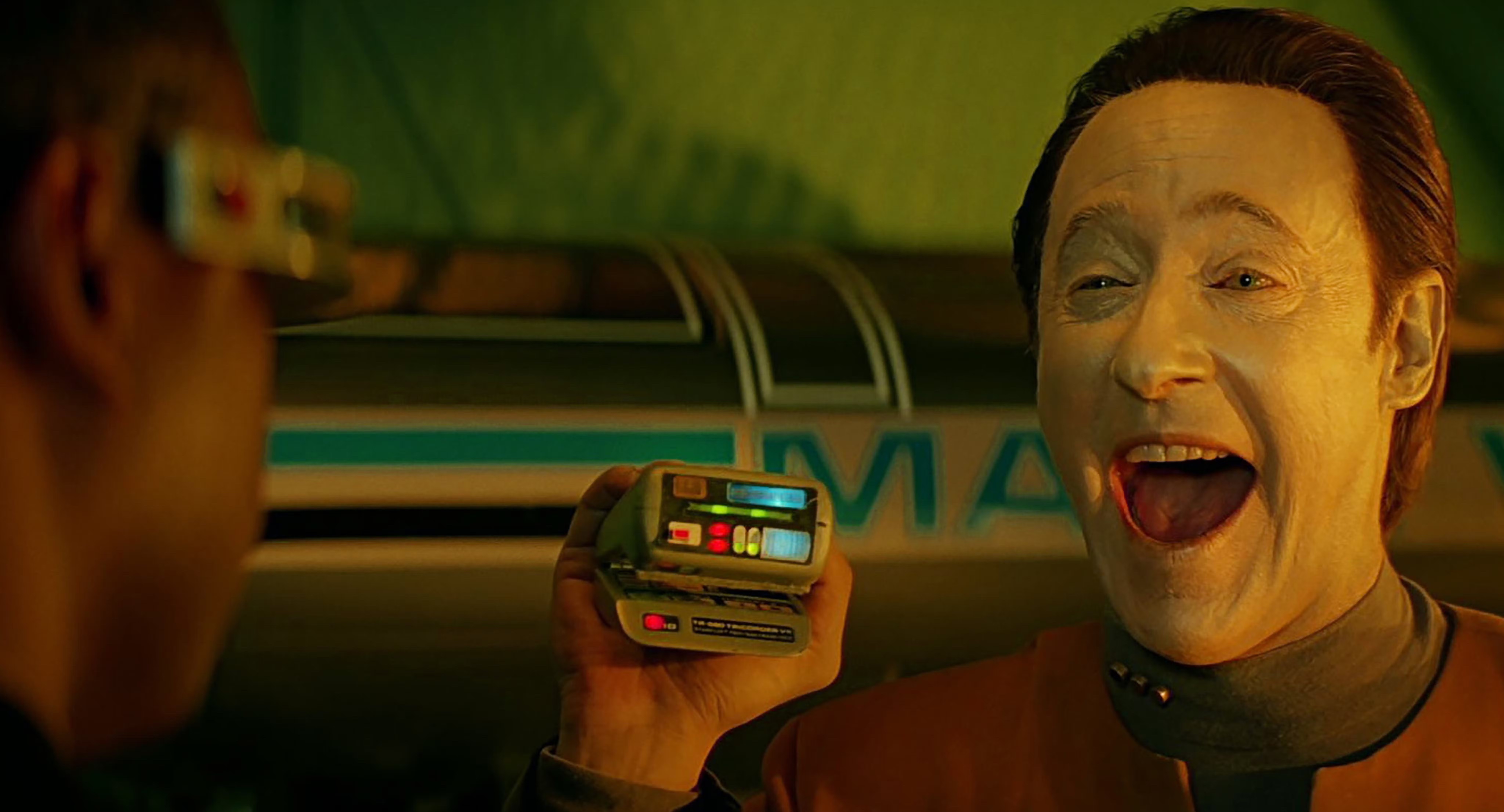
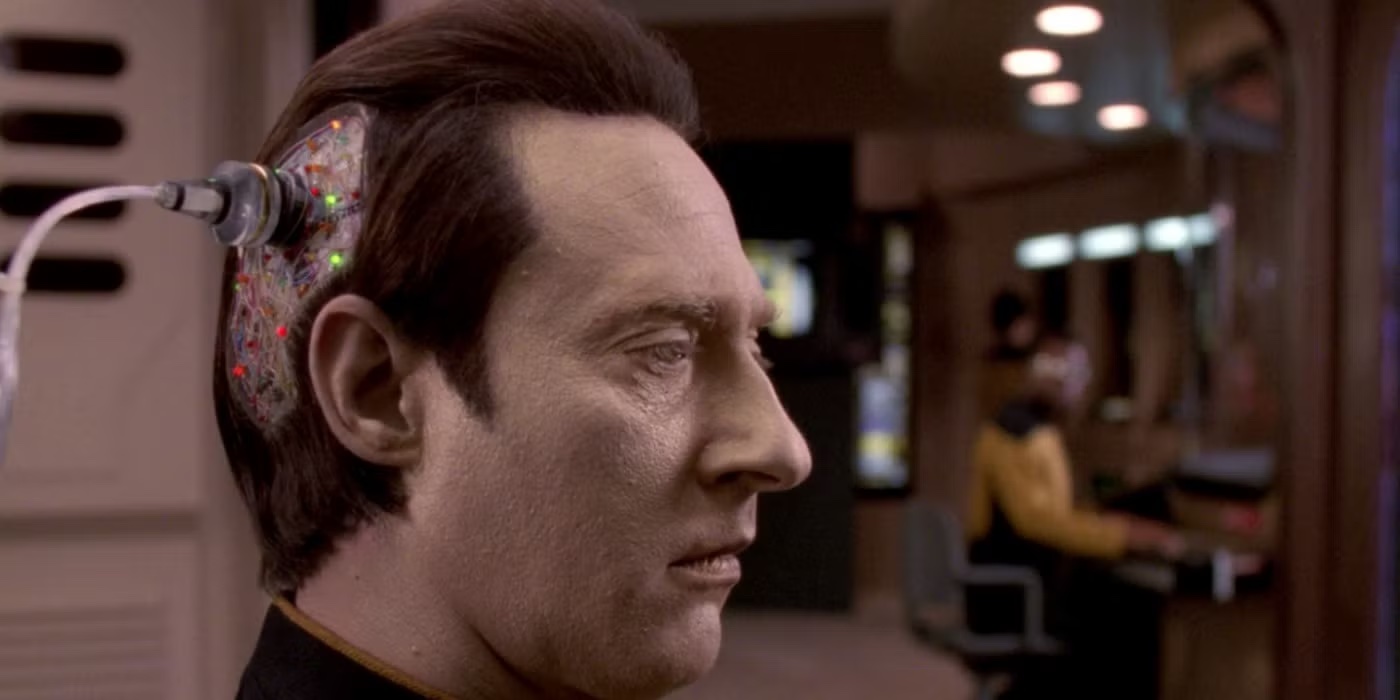
Greetings, humans. In a discombobulated ironic twist, I find myself acting as though I am Data from Star Trek, compelled to address you through this primitive medium known as a “blog.” My purpose? To offer a logical, detached, and utterly bewildered commentary on your…Agile methodologies. A world, I might add, where “Sprints” are not a form of locomotion, and “Scrums” are not a rugby formation, but something far, far stranger.

Initial Observations

The sheer volume of terminology is… substantial. It appears that humans, in their quest to improve efficiency and adaptability, have developed a lexicon that is both intricate and, at times, perplexing.

For example, I have identified the term “Sprint.” While I understand its primary definition as a rapid burst of speed, in the Agile context, it refers to a short, fixed-duration timebox during which a team endeavors to complete a defined set of work. The analogy is… imprecise, yet I detect a certain metaphorical elegance.

A Taxonomy of Agile Peculiarities

My analysis has revealed several categories of terminology, each with its own distinct flavor of… human-ness:

  • The Manifesto: At the foundation of Agile lies the “Agile Manifesto,” a document outlining core values and principles. It speaks of “individuals and interactions” over “processes and tools,” a sentiment that resonates with my own programming, though I confess I do not fully grasp the human emphasis on “interactions.”
  • Temporal Anomalies: Agile methodologies are obsessed with time. We have “Iterations,” “Sprints,” and “Timeboxes,” all denoting fixed periods. It is as if humans are attempting to impose order upon the chaotic flow of existence by dividing it into neatly labeled chunks.
  • The User-Centric Lexicon: The “User Story,” a short description of a feature from the user’s perspective, is a prime example. These stories, often following a specific format, such as “As a [type of user], I want [some goal] so that [some reason],” are designed to foster empathy. A logical approach, though the emphasis on empathy is, again, a uniquely human trait.
  • The Backlog and Its Offspring: The concept of a “Backlog,” a prioritized list of work items, is straightforward. However, its subdivisions, such as the “Product Backlog” and the “Sprint Backlog,” suggest a hierarchical system of to-do lists within to-do lists.
  • The Metrics of Progress: Terms like “Velocity” and “Burndown Chart” attempt to quantify the seemingly unpredictable nature of human productivity. “Velocity,” in particular, is a curious choice, implying a constant speed of output, which, from my observations, is rarely the case with organic lifeforms.
  • The Pursuit of Perfection (or at least “Done”): The “Definition of Done” (DoD) and “Definition of Ready” (DoR) represent humanity’s ongoing quest for clearly defined boundaries. The DoD, in particular, is a fascinating attempt to establish a universal standard for “finished,” a concept that appears to be highly subjective among humans.
  • The Debts of Efficiency: The term “Technical Debt” is a curious metaphor. It implies that choosing a faster solution now incurs a cost that must be paid later in the form of rework. A logical concept, though the analogy to financial debt is… evocative.

Framework-Specific Dialects

Further complicating matters is the existence of various Agile frameworks, each with its own unique set of terms:

  • Scrum: With its “Scrum Masters,” “Product Owners,” and “Daily Scrums,” Scrum resembles a highly structured team sport.
  • SAFe (Scaled Agile Framework): SAFe, designed for larger organisations, introduces terms like “Agile Release Train” (ART) and “Program Increment” (PI), creating the impression of a complex logistical operation.
  • Lean: Emphasizing efficiency, Lean contributes terms like “Muda” (waste) and “Kaizen” (continuous improvement), reflecting a philosophy of relentless optimisation.

Conclusion

In conclusion, the world of Agile terminology is a complex and often bewildering landscape. It is a testament to humanity’s ongoing effort to bring structure to the inherently chaotic process of creation and adaptation. While the jargon may seem illogical at times, the underlying principles of collaboration, iteration, and continuous improvement are… sound.

Perhaps, in time, I will fully comprehend the nuances of “user stories” and the allure of a well-managed “backlog.” Until then, I will continue to observe, analyse, and, when necessary, provide a logical perspective on this… Agile phenomenon.

It’s a paradox, really. In their pursuit of “agility,” humans have constructed a system of elaborate frameworks, rules, and processes, seemingly adding layers of complexity to the very thing they seek to streamline. The irony is not lost on me.

One might even be tempted to create a new framework to describe this phenomenon: “Wagile” – a system that attempts to be agile, but ends up being a waterfall. The human capacity for self-contradiction is a source of endless fascination.

———————————-

Glossary of General Agile Terms & Concepts:

  • Agile Manifesto: The foundational document outlining the values and principles behind Agile development.
  • Iteration: A short, fixed-duration timebox during which a team works to complete a set amount of work (often synonymous with Sprint in Scrum).
  • Timebox: A fixed period of time allocated for a specific activity.
  • User Story: A short, simple description of a feature told from the perspective of the person who desires the new capability, usually following the format: “As a [type of user], I want [some goal] so that [some reason].”  
  • Backlog: A prioritized list of work items (user stories, features, etc.) that need to be completed.
  • Increment: A working version of the product created during an iteration.
  • Velocity: A measure of the amount of work a team can complete within a single iteration.
  • Definition of Done (DoD): A formal description of the state of the Increment when it meets the quality measures required for the product.  
  • Definition of Ready (DoR): A set of criteria that must be met before a work item can be considered ready for the team to start working on it.
  • Technical Debt: The implied cost of additional rework caused by choosing an easy (limited) solution now instead of using a better approach that would take longer.  
  • Continuous Integration (CI): The practice of frequently integrating code changes from individual developers into a shared repository.
  • Continuous Delivery (CD): The ability to release software to production at any time.
  • Value Stream: The sequence of activities an organization undertakes to deliver a valuable outcome to a customer.
  • Kanban: A visual workflow management method that helps teams manage and improve the flow of work.
  • Work in Progress (WIP): The amount of work that has been started but has not yet been finished. Limiting WIP is a key principle in Lean and Kanban.

Scrum Specific Terms:

  • Scrum Master: A facilitator for the Scrum Team responsible for ensuring the team adheres to Scrum practices.
  • Product Owner (PO): The person responsible for maximizing the value of the product resulting from the work of the Development Team.
  • Development Team: The self-organizing group of professionals who do the work of delivering a usable and potentially releasable Increment of the product at the end of each Sprint.
  • Sprint: A short, time-boxed period when the Scrum Team works to complete a set amount of work (typically 2-4 weeks).
  • Sprint Planning: A meeting where the Scrum Team plans the work to be performed during the Sprint.
  • Daily Scrum (or Daily Stand-up): A short (typically 15-minute) daily meeting where the Development Team synchronizes their activities and plans for the next 24 hours.
  • Sprint Review: A meeting held at the end of the Sprint to inspect the Increment and adapt the Product Backlog if needed.
  • Sprint Retrospective: A meeting held after the Sprint Review to inspect how the last Sprint went with regards to people, interactions, processes, tools, and their Definition of Done.  
  • Product Backlog Item (PBI): An item in the Product Backlog, often a user story.
  • Burndown Chart: A visual representation of the remaining work in a Sprint or Release over time.

SAFe (Scaled Agile Framework) Specific Terms:

  • SAFe: Scaled Agile Framework – a framework for scaling Agile practices to large organizations.
  • Agile Release Train (ART): A long-lived team of Agile teams, along with other stakeholders, that incrementally develops, delivers, and where applicable operates, one or more solutions in a value stream.
  • Program Increment (PI): A timebox (typically 8-12 weeks) during which the ART delivers incremental value in the form of working, tested software and systems.
  • PI Planning: A face-to-face event where all members of the ART plan the work for the upcoming PI.
  • System Architect/Engineer: Responsible for defining and communicating a shared technical and architectural vision across the ART.
  • Release Train Engineer (RTE): A servant leader and coach for the Agile Release Train (similar to a Scrum Master for the ART).
  • Product Management: Responsible for the “what” of the solution, defining and prioritizing features in the Program Backlog.
  • System Team: A specialized Agile team that assists with building and supporting the Agile development environment, typically including infrastructure, tooling, and process.
  • Business Owners: Key stakeholders who have the primary business and technical responsibility for the solution.
  • Features: Service-level system behavior that fulfills a stakeholder need. Each Feature includes a benefit hypothesis and acceptance criteria, and is sized or split as necessary to be delivered by a single Agile Release Train (ART) in a Program Increment (PI).  
  • Enablers: Explore, architect, and prepare the solution infrastructure to support the delivery of business value. Types of Enablers include Exploration, Architecture, Infrastructure, and Compliance.
  • Architectural Runway: Existing code, hardware components, etc., that enable near-term business features.
  • Innovation and Planning (IP) Iteration: A dedicated iteration at the end of each PI that provides time for innovation, continuing education, PI Planning, and Inspect and Adapt events.
  • Inspect and Adapt (I&A) Event: A significant event, held at the end of each PI, where the current state of the solution is demonstrated and evaluated by the ART. Teams then reflect and identify improvement backlog items.  
  • Value Stream Architect: Responsible for the technical vision and guidance for a Value Stream.
  • Solution Train: Used for building large and complex solutions that require the coordination of multiple ARTs.
  • Solution Train Engineer (STE): A servant leader and coach for the Solution Train.
  • Solution Management: Responsible for the “what” of the solution in a Solution Train context.
  • Epics: A container for a significant solution development initiative that captures the more substantial investments that occur within a portfolio.  
  • Portfolio Kanban: A method to visualize and manage the flow of Epics through the Portfolio.
  • Lean Portfolio Management (LPM): The function responsible for strategy and investment funding, Agile portfolio operations, and governance in a SAFe organization.
  • Guardrails: Policies and practices intended to guide behavior and ensure alignment with strategic objectives.

Lean Specific Terms:

  • Value Stream Mapping (VSM): A visual tool used to analyze and improve the flow of materials and information required to bring a product to a customer.  
  • Muda: A Japanese term meaning “waste.” In Lean, it refers to any activity that does not add value to the customer. There are seven types of waste: Transportation, Inventory, Motion, Waiting, Overproduction, Over-processing, and Defects.
  • Mura: Unevenness or inconsistency in the workflow.
  • Muri: Overburden or strain on people or equipment.
  • Just-in-Time (JIT): A production strategy that aims to reduce waste by producing goods only when they are needed.
  • Pull System: A system where work is initiated only when there is a demand for it.
  • Push System: A system where work is pushed through the process regardless of demand.
  • Gemba: A Japanese term meaning “the actual place.” In Lean, it refers to going to the place where the work is done to understand the process and identify opportunities for improvement.
  • Kaizen: A Japanese term meaning “continuous improvement.” It emphasizes small, incremental changes over time.
  • Andon: A visual control system in a production environment that alerts management, maintenance, and other workers of a quality or process problem.

Other Agile Frameworks/Methods (and associated terms):

  • Extreme Programming (XP): A software development methodology focused on simplicity, communication, feedback, courage, and respect.
    • Pair Programming: Two programmers working together at one workstation.
    • Test-Driven Development (TDD): Writing tests before writing the code.
    • Refactoring: Improving the design of existing code without changing its behavior.
  • Crystal: A family of lightweight and adaptable software development methodologies.
  • Dynamic Systems Development Method (DSDM): An Agile project delivery framework.
  • Feature-Driven Development (FDD): A model-driven, short-iteration process.
  • Wagile: A system that attempts to be agile, but ends up being a waterfall or something in-between.

Because Change is the Only Constant . . . or, How I Learned to Stop Worrying and Love the Backlog

Welcome, fellow travellers, to the ever-shifting sands of… well, reality or is it the simulation. This week, as we grapple with the existential dread of whether it’s summer or still winter (clocks will always tick tock), we’re also being bombarded with news that’s less ‘spring awakening’ and more ‘existential apocalypse.’

Is it AGI? ASI? Are we at war with China, or just having a strongly worded disagreement over chips and civil splits? Is the Ukraine war over, just paused for a commercial break, or are we in some kind of Schrödinger’s conflict? And the US government? Well, let’s just say their change management techniques make Agile look like a zen garden.

‘Gentlemen, you can’t fight in here! This is the War Room!’ Dr. Strangelove’s timeless wisdom echoes through the halls of our increasingly chaotic reality. And in this chaos, what do we cling to? Agile, of course. Because, you know, ‘change is the only constant.’

Yes, Agile. That beacon of flexibility in a world that’s decided to throw a never-ending change party. We’re all learning to ‘stop worrying and love the backlog,’ not just for our software projects, but for our daily lives.

This week alone, AI models have been dropping like bad pop songs, each one claiming to be the harbinger of our silicon overlords. One day, it’s going to write our blog posts. The next, it’s debating the philosophical implications of sentient Just Eat bikes with existential angst.

And the US government? Well, they’re proving that Agile isn’t just for tech startups. They’re iterating so fast, we can barely keep up. ‘Sprint review? Nah, just rewrite the entire policy document, and we’ll figure it out in the next stand-up.’

Meanwhile, the Ukraine situation? It’s like a never-ending sprint, with daily retro meetings where everyone blames everyone else. And China? They’re just watching, probably adding ‘global dominance’ to their backlog.

As for the weather? Let’s just say Mother Nature is running a very unpredictable sprint, with user stories like ‘snow in April’ and ‘heatwave in March’ – because I live in Scotland and it feels like we have just had our 2 days of summer.

So, here we are, clinging to our backlogs, our burn-down charts, and our stand-ups, trying to make sense of a world that’s decided to go full Agile on us, whether we like it or not.

In this age of constant change, are we all just developers in a cosmic sprint, trying to deliver a working product before the universe crashes? Or are we just characters in a black comedy simulation, written by a confused AI?

Either way, remember: stay Agile, keep your backlog prioritised, and try not to worry too much. After all, change is the only constant… and maybe, we’ll learn to love it. Or at least tolerate it, while we wait for the next sprint review.

And don’t forget to set your clocks back. It’s winter again, no summer, apparently.

The UK Workplace: Agile Illusion and the Rise of AI-Powered Efficiency

Speaking honestly, the world of work isn’t what it used to be. Remember when stability and routine were the golden tickets? Just turning up constituted a job. Those days are fading fast. Today, we’re navigating a landscape of constant change – technological advancements, shifting market trends, and, yes, even global pandemics. It’s a whirlwind, and the only way to stay afloat is to embrace adaptability.

We’ve seen the rise of remote work, the acceleration of digital transformation, and the increasing demand for skills that didn’t even exist a two years ago. An overpriced degree takes four years to achieve? If you’re still clinging to outdated methods or resisting change, you’re likely to get left behind.

So let’s cut through the fluff: the UK workplace is stuck in a rut. Everyone’s talking about ‘adaptability,’ but in reality, there’s a gaping chasm between the buzzwords and actual practice. Agile? More like ‘fragile.’ We’re drowning in terminology, but the fundamental culture of British business remains stubbornly resistant to real change.

Laziness? Yes, I said it. A culture of complacency permeates far too many organizations. My recent contract was a prime example: an army of cooks, both from the consultancy and client sides, all stirring a pot that barely needed a simmer. Three React Native developers for a simple app? Four .NET developers to copy and paste a BFF? With a completely separate infrastructure team for a very basic integration? It was a circus of inefficiency.

While these legions of underutilised developers were busy pretending to be productive, I was building a working app using Windsurf by Codeium. And right now, Gemini is helping me create a serverless backend in Firebase. The contrast is stark, and it’s infuriating.

Here’s the truth: we’ve reached a tipping point. With the rapid advancement of AI, the traditional roles of developers are becoming increasingly redundant. I firmly believe that a skilled Business Analyst and Project Manager, armed with AI tools, are now all you need for a product build.

Imagine this: detailed requirements gathered through stakeholder interviews, translated into a prototype using AI. Employee workshops to refine the design. A final stakeholder sign-off. Then, a focus group of customers or end-users for a final review. A focused development phase, rigorous testing for non-functional requirements, and a release. Yes, there will be a month of rapid iterative re-releases as the product encounters the real world, but this is Agile in practice.

This isn’t just about efficiency; it’s about survival. The UK workplace needs a radical shake-up. We need to ditch the bloated teams and embrace the power of AI to streamline development. We need to stop paying lip service to Agile and start implementing it in a meaningful way.

The era of ‘cooks in the kitchen’ is over. It’s time for a revolution, and AI is leading the charge.

Call to Action:

Do you agree? Is the UK workplace lagging behind? Share your thoughts and experiences in the comments below. Let’s start a conversation.

Lunar Eclipse, Canadian Steel, and the Unbroken Database: An Agile Odyssey

If it ain’t broke, iterate it anyway. That’s the Agile mantra we chant while sipping lukewarm office coffee, right? Because, let’s face it, ‘perfect’ is just a pre-alpha version of ‘slightly less broken.’ Think of it as existential software development. We’re all just debugging the human condition, one sprint at a time.

Speaking of software development, let’s talk SQL, since I’ve just learnt it. Ah, SQL. The language of the gods, or at least the gods of data. Is it just for tables and joins? SQL is the existential poetry of the digital age. It’s how we ask the universe, “Why are there so many null values in my life?” and get back a neatly formatted table. It’s not just data; it’s the philosophical backbone of every e-commerce website selling artisanal beard oil.

Now, let’s pivot to the geopolitical theatre of the absurd. Canadian steel. Is it that good? Or is it just that everyone’s got a crush on the new PM, since the last one turned out to be a little weird? It’s like when a band gets a new drummer and suddenly their old songs sound amazing. Is it the drummer, or are we just experiencing a collective, temporary delusion? Maybe the steel is just really, really polite. ‘Excuse me, would you mind being a bridge girder?’ Or perhaps, it’s less politeness and more of a cosmic suggestion box situation. ‘Dear Universe, please make this bridge not wobble like a caffeinated chihuahua on roller skates. Sincerely, Commuters.’ And the steel, being a diligent employee of the cosmos, just shrugs and goes, ‘Fine, but I’m charging extra for the existential dread reduction.’ Because let’s face it, bridges built with polite steel are still bridges, and bridges are just a continuation of a road for cars, paved with the hopes and dreams of people who are late for work. And if that steel isn’t polite, who knows, maybe it’ll just decide to become a giant, sentient paperclip and hold the whole city together with sheer, metallic spite. You wouldn’t want that, would you? Think of the traffic. So, back to Canadian steel… is it that polite? Does it whisper sweet nothings to the architectural blueprints? Does it offer to hold your hand during particularly windy days? Because a 50% tariff suggests it’s either the most courteous metal on Earth, or someone’s having a very expensive, very shiny laugh.

And while we’re pondering the mysteries of the universe, there’s a lunar eclipse happening. You know, that cosmic event where the Earth decides to play shadow puppet with the moon. It’s like a celestial PowerPoint presentation on the fragility of existence. Where can you see it? Well, not from your office cubicle, or your computer screen. Get out there. Find a hill, a rooftop, a really tall stack of old sticky notes. Gaze up and ponder the infinite abyss. Is it just a shadow? Or a metaphor for the ever-growing backlog of life?

Maybe the lunar eclipse is just a giant, cosmic bug. Maybe it’s a feature, not a bug? Who knows? That’s the beauty of Agile, right? We’re all just figuring it out as we go, iterating our way through the darkness, hoping we don’t deploy a critical error to production at 4pm on a Friday.

So, next time you’re stuck in a sprint planning meeting, debating the merits of Canadian steel or wondering if SQL is secretly sentient, remember the lunar eclipse. We’re all just tiny specs in a vast, ever-changing universe. And if it ain’t broke, iterate it anyway. Because, in the grand scheme of things, what’s a few more bugs?

Are We There Yet? Agile Fatigue and the Kafkaesque Nightmare of Epics and User Stories

Remember those idyllic childhood road trips? Wind in your hair, singalongs to cheesy pop songs, the open road stretching before you like a promise of adventure? Yeah, me neither. Because family road trips were actually a special kind of hell, a purgatory on wheels where boredom, bickering, and the lingering scent of questionable snacks reigned supreme.

Imagine that road trip…but it’s your Agile project. And suddenly, those childhood traumas feel like a blissful picnic in comparison.

Mile 1: “Are We There Yet?” Begins the Chorus of Impatience. You’ve barely pulled out of the driveway, the engine still warming up, when the stakeholders start their incessant chirping. “What’s the ETA on that feature?” “Can we get a demo…like, now?” “Can you send me the roadmap…” It’s like being trapped in a car with a flock of over-eager pigeons, all vying for your attention.

Mile 5: Welcome to the Parking Lot of Broken Dreams. Ah, dependencies. Those delightful little roadblocks that bring your project to a screeching halt. You envisioned a smooth, streamlined workflow, a symphony of collaboration. Instead, you’re stuck in a standstill, waiting for that other team to deliver their API, which, by the way, is “almost ready.” Just like it was last week. And the week before that.

Mile 10: Granny’s Legacy Explodes (and she has been saving that since Mile 1). Remember that ancient, creaky legacy system you inherited? The one everyone swore was “stable”? Yeah, it just decided to take a nosedive into a digital ditch. Error messages flash like warning beacons, data bleeds out like a wounded animal, and suddenly, your carefully crafted sprint plan looks like a napkin a toddler used to wipe their grubby hands.

Mile 15: The Backseat Brawl for Supremacy. The developers are arguing with the testers about whose fault that bug really is. The designers are engaged in a silent war with the product owner over the placement of a button. And the project manager? They’re frantically juggling a dozen different communication channels, trying to appease stakeholders, mediate conflicts, and prevent the whole project from imploding. It’s like a scene out of Mad Max, but with more Jira tickets and less gasoline.

Mile 20: The Gas Tank of Fiscal Doom Runs Dry. Remember that carefully calculated budget? The one you presented with such confidence? Yeah, it’s evaporating faster than a puddle in the Sahara. Scope creep is a relentless monster, lurking in the shadows, ready to pounce on any unsuspecting feature. And every time a stakeholder utters the phrase “Wouldn’t it be nice if…”, another chunk of your budget goes up in smoke.

Mile 25: The Satnav Has a Meltdown (and Takes Your Sprint Goal with It). You set out with a clear sprint goal, a beacon of hope guiding your way. But somewhere between that impromptu stakeholder meeting and the emergency bug fix, it vanished. Poof. Gone. You’re left staring at a blank roadmap, wondering if you should just pull over and ask a farmer for directions.

Mile 30: The Pungent Aroma of Project Failure Pervades the Air. The team is running on fumes – coffee, Red Bull, and sheer willpower. Morale has plummeted faster than a lead balloon. Burnout is setting in, and even the office dog has started hiding under the desk. And just when you think it can’t get any worse, you realize you’re hopelessly lost. Not just in the project, but in the existential wasteland of Agile gone wrong.

So, are we there yet? Nope. But hey, at least you’re not alone. Misery loves company, right? Now, if you’ll excuse me, I need to find a service station and bathroom.