The Great Blog Extinction Event

Well, well, well. Look what the digital cat dragged in. It’s Wednesday, the sun’s doing its usual half-hearted attempt at shining, and I’ve just had a peek at the blog stats. (Oh, the horror! The unmitigated, pixelated horror!)

I’ve seen the graphic. It’s not a graphic, it’s a descent. A nose-dive. A digital plummet from the giddy heights of 82,947 views in 2012 (a vintage year for pixels, I recall) down, down, down to… well, let’s just say 2025 is starting to look less like a year and more like a gentle sigh. Good heavens. Is that what they call “trending downwards”? Or is it just the internet politely closing its eyes and pretending not to see us anymore? One might even say, our blog has started to… underpin its own existence, building new foundations straight into the digital subsoil.
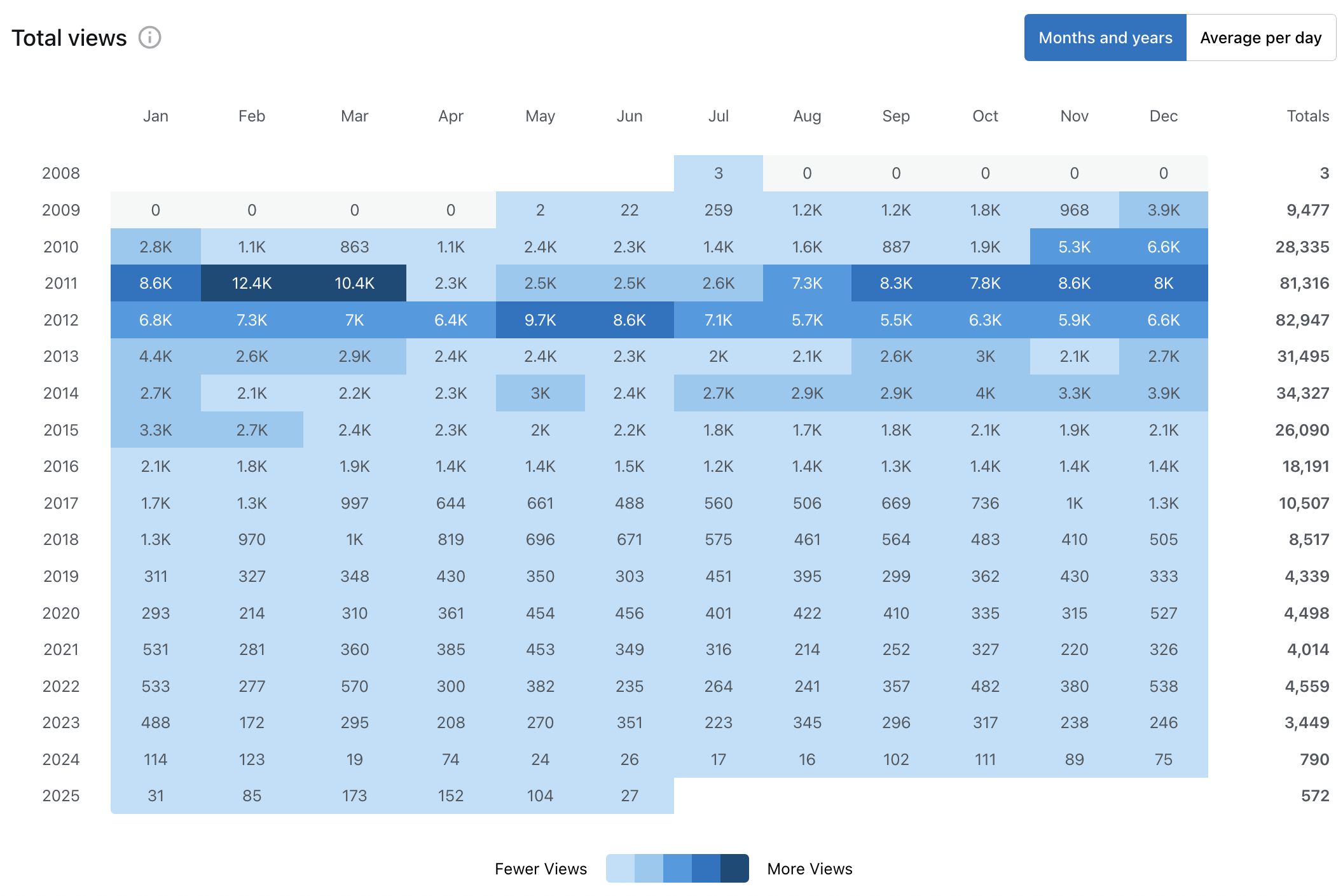
And to add insult to injury, with a surname like Yule, one used to count on a reliable festive bump in traffic. Yule logs, Yuletide cheer – a dependable, seasonal lift as predictable as mince pies and questionable knitwear. But no more. The digital Santa seems to have forgotten our address, and the sleigh bells of seasonal SEO have gone eerily silent.

And so, here we stand, at the wake of the written blog. Pass the metaphorical tea and sympathy, won’t you? And perhaps a biscuit shaped like a broken RSS feed.

The Great Content Consumption Shuffle: Or, “Where Did Everyone Go?”

It wasn’t a sudden, cataclysmic asteroid impact, you see. More of a slow, insidious creep. Since those heady days of 2012, something shifted in the digital ether. Perhaps it was the collective attention span, slowly but surely shrinking like a woolly jumper in a hot wash. People, particularly in the West, seem to have moved from the noble act of reading to the more passive, almost meditative art of mindless staring at screens. They’ve traded thoughtful prose for the endless, hypnotic scroll through what can only be described as “garbage content.” The daily “doom scroll” became the new literary pursuit, replacing the satisfying turning of a digital page with the flick of a thumb over fleeting, insubstantial visual noise.

First, they went to the shiny, flashing lights of Social Media. “Look!” they cried, pointing at short-form videos of dancing grandmas and cats playing the ukulele, “Instant gratification! No more reading whole paragraphs! Hurrah for brevity!” And our meticulously crafted prose, our deeply researched insights, our very carefully chosen synonyms, they just… sat there. Like a beautifully prepared meal served to an empty room, while everyone else munches on fluorescent-coloured crisps down the street.

Then came the Video Content Tsunami. Suddenly, everyone needed to see things. Not just read about them. “Why describe a perfect coffee brewing technique,” they reasoned, “when you can watch a slightly-too-earnest influencer pour hot water over artisanal beans for three and a half minutes?” Blogs, meanwhile, clung to their words like barnacles to a slowly sinking ship. A very witty, well-structured, impeccably proofread sinking ship, mind you.

Adding to the despair, a couple of years back, a shadowy figure, a digital highwayman perhaps, absconded with our precious .com address. A cyber squatter, they called themselves. And ever since, they’ve been sending monthly ransom notes, demanding sums ranging from a king’s ransom ($500!) down to a mere pittance ($100!), all to return what was rightfully ours. It’s truly a testament to the glorious, unpoliced wild west of the internet, where the mere act of owning a digital patch can become a criminal enterprise. One wonders if they have a tiny, digital pirate ship to go with their ill-gotten gains.

The competition, oh, the competition! It became a veritable digital marketplace of ideas, except everyone was shouting at once, holding up signs, and occasionally performing interpretive dance. Trying to stand out as a humble blog? It was like trying to attract attention in a stampede of luminous, confetti-throwing elephants. One simply got… trampled. Poignantly, politely trampled.

So yes, the arguments for the “death” are compelling. They wear black, speak in hushed tones, and occasionally glance sadly at their wristwatches, muttering about “blog-specific traffic decline.”

But Wait! Is That a Pulse? Or Just a Twitch?

Just when you’re ready to drape a tiny, digital shroud over the whole endeavour, a faint thump-thump is heard. It’s the sound of High Percentage of Internet Users Still Reading Blogs. (Aha! Knew it! There’s always someone hiding behind the digital curtains, isn’t there?) Apparently, a “significant portion” still considers them “important for brand perception and marketing.” Bless their cotton socks, the traditionalists.

And then, the cavalry arrives, riding in on horses made of spreadsheets and budget lines: Marketers Still Heavily Invest in Blogs. A “large percentage” of them still use blogs as a “key part of their strategy,” even allocating “significant budget.” So, it seems, while the general populace may have wandered off to watch videos of people unboxing obscure Korean snacks, the Serious Business Folk still see the value. Perhaps blogs are less of a rock concert and more of a quiet, intellectual salon now. With better catering, presumably.

And why? Because blogs offer Unique Value. They provide “in-depth content,” “expertise,” and a “space for focused discussion.” Ah, depth! A quaint concept in an age of 280 characters and dancing grandmas. Expertise! A rare and exotic bird in the land of the viral meme. Focused discussion! Imagine, people actually thinking about things. It’s almost… old-fashioned. Like a perfectly brewed cup of tea that hasn’t been auto-generated by an AI or served by a three-legged donkey.

The Blog: Not Dead, Just… Evolving. Like a Digital Butterfly?

So, the verdict? The blog format is not dead. Oh no, that would be far too dramatic for something so inherently verbose. It’s simply evolving. Like a particularly stubborn species of digital amoeba, it’s adapting. It’s learning new tricks. It’s perhaps wearing a disguise.

Success now requires “adapting to the changing landscape,” which sounds suspiciously like wearing a tin foil hat and learning how to communicate telepathically with your audience. It demands “focusing on quality content,” which, let’s be honest, should always have been the plan, regardless of whether anyone was watching. And “finding unique ways to engage with audiences,” which might involve interpretive dance if all else fails.

So, while the view count might have resembled a flatlining patient chart, the blog lives. It breathes. It probably just needs a nice cup of tea, a good sit-down, and perhaps a gentle reminder that some of us still appreciate the glorious, absurd, and occasionally profound journey of the written word.

Now, if you’ll excuse me, I hear a flock of digital geese honking about a new viral trend. Must investigate. Or perhaps not. I might just stay here, where the paragraphs are safe.

Ctrl+Alt+Delete Your Data: The Personal Gmail-Powered AI Apocalypse.

So, you’ve got your shiny corporate fortress, all firewalls and sternly worded memos about not using Comic Sans. You think you’re locked down tighter than a hipster’s skinny jeans. Wrong. Turns out, your employees are merrily feeding the digital maw with all your precious secrets via their personal Gmail accounts. Yes, the same ones they use to argue with their aunties about Brexit and sign up for questionable pyramid schemes.

According to some boffins at Harmonic Security – sounds like a firm that tunes anxieties, doesn’t it? – nearly half (a casual 45%) of all the hush-hush AI interactions are happening through these digital back alleys. And the king of this clandestine data exchange? Good old Gmail, clocking in at a staggering 57%. You can almost hear the collective sigh of Google’s algorithms as they hoover up your M&A strategies and the secret recipe for your artisanal coffee pods.

But wait, there’s more! This isn’t just a few stray emails about fantasy football leagues. We’re talking proper corporate nitty-gritty. Legal documents, financial projections that would make a Wall Street wolf blush, and even the sacred source code – all being flung into the AI ether via channels that are about as secure as a politician’s promise.

And where is all this juicy data going? Mostly to ChatGPT, naturally. A whopping 79% of it. And here’s the kicker: 21% of that is going to the free version. You know, the one where your brilliant insights might end up training the very AI that will eventually replace you. It’s like volunteering to be the warm-up act for your own execution.

Then there’s the digital equivalent of a toddler’s toy box: tool sprawl. Apparently, the average company is tangoing with 254 different AI applications. That’s more apps than I have unread emails. Most of these are rogue agents, sneaking in under the radar like digital ninjas with questionable motives.

This “shadow IT” situation is like leaving the back door of Fort Knox wide open and hoping for the best. Sensitive data is being cheerfully shared with AI tools built in places with, shall we say, relaxed attitudes towards data privacy. We’re talking about sending your crown jewels to countries where “compliance” is something you order off a takeout menu.

And if that doesn’t make your corporate hair stand on end, how about this: a not-insignificant 7% of users are cozying up to Chinese-based apps. DeepSeek is apparently the belle of this particular ball. Now, the report gently suggests that anything shared with these apps should probably be considered an open book for the Chinese government. Suddenly, your quarterly sales figures seem a lot more geopolitically significant, eh?

So, while you were busy crafting those oh-so-important AI usage policies, your employees were out there living their best AI-enhanced lives, blissfully unaware that they were essentially live-streaming your company’s secrets to who-knows-where.

The really scary bit? It’s not just cat videos and office gossip being shared. We’re talking about the high-stakes stuff: legal strategies, merger plans, and enough financial data to make a Cayman Islands banker sweat. Even sensitive code and access keys are getting thrown into the digital blender. Interestingly, customer and employee data leaks have decreased, suggesting that the AI action is moving to the really valuable, core business functions. Which, you know, makes the potential fallout even more spectacular.

The pointy-heads at Harmonic are suggesting that maybe, just maybe, having a policy isn’t enough. Groundbreaking stuff, I know. They reckon you actually need to enforce things and gently (or not so gently) steer your users towards safer digital pastures before they accidentally upload the company’s entire intellectual property to a Russian chatbot.

Their prescription? Real-time digital snitches that flag sensitive data in AI prompts, browser-level surveillance (because apparently, we can’t be trusted), and “employee-friendly interventions” – which I’m guessing is HR-speak for a stern talking-to delivered with a smile.

So, there you have it. The future is here, it’s powered by AI, and it’s being fuelled by your employees’ personal email accounts. Maybe it’s time to update those corporate slogans. How about: “Innovation: Powered by Gmail. Security: Good Luck With That.”


Recommended reading

Conduct a pre-mortem so you know who to blame before the Golden turd is laid

One of the useful things I have learned from the various companies I have worked for over the past 20 years, is the idea of a ‘pre-mortem’. Let us use a “Brand Campaign” as a metaphor to highlight 11 areas you can evaluate (criticise) your teams before spending a penny.

Ways Your Brand Campaign Will Die (And How to Resurrect It Before It’s Too Late)

The pre-mortem, that delightful exercise in corporate masochism where we imagine our shiny new project as a bloated, beached whale and then dissect it for clues. Think of it as blame-storming, but with less crying and more ‘I told you so’ smugness. You know, for those moments when you want to be right, even if it means watching your budget implode.

So lets use an imaginary startup, “Crapyco”, bless their naive hearts, decided to take some sage brand guru advice about marketing. They threw millions at a campaign, and… well, let’s just say it didn’t go as planned. It was less ‘viral sensation’ and more ‘digital tumbleweed.’ Here’s how they managed to turn a golden opportunity into a steaming golden turd.

1. The ‘Did It Work?’ Existential Crisis.

They stared at the data like a group of bewildered meerkats, unable to agree if their campaign was a roaring success or a damp squib. Timeframes, expectations, reality—all blurred into a confusing mess. Because, you see, they’d skipped the whole ‘setting measurable goals’ part. No baselines, no KPIs, no ‘if we hit this, we’re doing great’ markers. It was like trying to navigate a map with no landmarks, or asking a fish to judge a tree-climbing competition. The numbers just sat there, cold and meaningless, refusing to reveal their secrets.

2. The CEO/CFO Power Struggle (aka, ‘Who’s Pulling the Plug?’).

Two weeks in, the plug got pulled. Turns out, ‘disagree and commit’ is corporate code for ‘I’m going to sabotage you at the first opportunity, just in case this whole thing implodes, and I need someone to blame.’ It’s like trying to launch a rocket with one of the boosters on backward, while the CEO, who thinks he’s an astronaut, is yelling contradictory commands from the back, and the CFO, who secretly believes numbers are just suggestions, is quietly calculating how much they can write off as a ‘learning experience’.

3. Targeting: Are We Talking to Aliens?

They aimed at ‘everyone,’ which, in modern marketing parlance, translates to ‘we’re throwing spaghetti at a wall and hoping some of it sticks to sentient dust motes.’ Because, apparently, the concept of a ‘target audience’ is now as outdated as dial-up modems and sensible trousers. Everyone’s a snowflake, a unique and precious snowflake, and you can’t possibly lump them together into, like, groups or something. It’s like trying to find a specific grain of sand on a beach using a telescope, while simultaneously trying to sell that telescope to every single grain of sand, individually. ‘You, sand grain number 3,457, yes, you! You absolutely need this telescope! Because, individuality!

4. Testing? We Don’t Need No Stinking Testing!

They launched their ads without testing, because the branding guru/agency, with their collective ‘wisdom’ and ‘extensive experience’ (read: they once designed a logo for a lemonade stand), declared, ‘Testing? Please. We are the A/B testing. We know the entire alphabet of marketing success, backwards and forwards, in Klingon, and in interpretive dance. Trust us, these ads are pure, unadulterated genius. It’s like building a bridge out of marshmallows, but, like, artisanal marshmallows, and we’re absolutely certain it will hold, because we’ve seen the future, and it’s marshmallow-shaped.

5. Too Much Success? Is That a Thing?

Their campaign worked too well, and they couldn’t handle the demand. A problem most startups dream of, but they managed to turn it into a logistical nightmare of epic proportions. It was less ‘winning the lottery’ and more ‘winning the lottery, then realising you have lost the ticket.’ Imagine: a campaign so successful, it forced the entire company to abandon their actual jobs and manually process the tsunami of new customers. Like, ‘all hands on deck, automated systems are down, grab a quill and some parchment, and start scribbling account numbers.’ Because apparently, ‘open an account, get a bonus’ was a concept their digital infrastructure found as baffling as a cat trying to understand quantum physics (CYBG).

6. Budgeting: Are We Paying for a Picasso or a Finger Painting?

They either hemorrhaged money on agency fees, paying consultants to do the jobs their internal team was apparently too busy not doing, or they tried to cobble together a campaign in-house with a budget that wouldn’t cover a decent sandwich, let alone a decent creative idea. It’s like trying to build a skyscraper with Lego bricks, while simultaneously hiring a team of ‘Lego consultants’ to tell you which bricks go where, despite having your own internal ‘Lego builders’ sitting idle. And the burning question, of course: why? Is it a blame game? A way to have a conveniently disposable scapegoat? Or just a budget justification exercise? ‘We need money, so we need people, internal or external, doesn’t matter, just give us the cash!’ And honestly, in this day and age, with AI capable of writing sonnets and designing websites, are we still paying seat-fillers to ‘manage’ other seat-fillers? Get your act together, corporate overlords. The digital revolution happened two years ago. Wake up and smell the silicon.

7. The Consultancy 3-Cup Shuffle

They let the agency run the show, no testing, no changes, just blind faith. ‘We’re the experts, darling,’ the consultants purred, ‘we’ve done this before.’ Which, of course, begged the question: haven’t we also done this before? Why are we paying these glorified clipboard holders to tell us what we already know? It was like letting a squirrel drive your car because it has a fancy hat, and the squirrel kept insisting it had a PhD in automotive engineering. Was it the copious amounts of ‘pitch-stage refreshments’ that swayed the account team? The nostalgic glow of a ‘we go way back’ reunion? Or just the sheer, baffling arrogance of ‘we know best, trust us’? So, what happened? The ‘trust us’ attitude prevailed, the work went live, untested, unvalidated, a glorious monument to unchecked ego. Oh, and because it was ‘Agile,’ the original brief was apparently just a ‘suggestion,’ a whimsical starting point for a journey into the unknown. It’s like playing a high-stakes game of 3-cup shuffle with your entire marketing budget, and the consultants are very, very good at sleight of hand.

8. The 3-Year Managed Service Provider (MSP) Agreement of Doom.

The pièce de résistance: the 3-Year Managed Service Provider (MSP) Agreement of Doom. Seriously, who signed that? They locked themselves into a multi-year commitment, because, apparently, flexibility is for the weak and short-sighted. It’s like marrying a charismatic stranger after a single date, based solely on their promise of ‘synergistic resource alignment.’ So, let’s recap: no benchmarks to measure the consultancy’s actual ability to deliver, no stage gates to assess the value they’re supposedly providing, and absolutely no clue what the return on investment might be. Just a blind leap of faith into a contractual abyss. It’s like throwing money into a black hole and hoping it comes back as a unicorn riding a rainbow, while simultaneously yelling, ‘ROI? We don’t need no stinkin’ ROI! We have vibes!’ And then, of course, they wonder why the budget is as dry as a desert during a heatwave.

9. Robbing Performance to Pay Brand? Genius!

They cut their performance marketing budget to fund the brand campaign. Because, you know, why bother with actual sales when you can have… awareness? Especially when your brand is, shall we say, less ‘iconic’ and more ‘generic knock-off of every other product on the market.’ Any idea what’s actually selling? Anyone? Bueller? It’s like trying to build a castle out of fog, while simultaneously dismantling your actual, functioning house for spare bricks. ‘We need to elevate our brand presence!’ they declared, as the sales figures plummeted. ‘But… how do we know if anyone actually cares about our brand presence?’ someone dared to ask. ‘Details, details!’ they replied, waving a hand dismissively. ‘We’re building a narrative!’ A narrative, apparently, that involves burning money and hoping people will magically buy things because they’ve seen a slightly artsy billboard. It’s like cutting off your legs to run a marathon, but instead of running, you’re just standing there, shouting, ‘Look at my brand! Aren’t I aware?’ And the burning question, of course: why are we paying a consultancy to tell us this? Why are we, the people who are supposedly running this company, so utterly clueless that we need to outsource basic marketing concepts? Is this some kind of performance art? A grand experiment in ‘how much money can we waste before we implode?’ Seriously, if we don’t know this stuff, what are we even doing here?

10. The CEO’s TV Ad Masterpiece (aka, ‘My Product Is Awesome, Buy It!’).

The CEO, in their infinite wisdom (and complete lack of marketing expertise), decided to pen the TV ad script themselves. Because, really, who needs seasoned professionals when you have a CEO who believes their creative genius extends to all facets of human expression? ‘Experts? Pshaw!’ they declared, ‘I understand the customer psyche better than any Shoreditch hack!’ It’s like letting a toddler direct a Shakespearean play, only the toddler has a corner office and a multi-million-dollar budget. They insisted on cramming in every single product feature, every single ‘unique selling proposition,’ every single buzzword they’d ever heard in a boardroom meeting, resulting in a script that sounded less like an ad and more like a PowerPoint presentation on steroids. They even added a ‘personal touch,’ a rambling monologue about their ‘vision’ and ‘synergy,’ because apparently, consumers are just dying to hear the CEO’s life story during a 30-second spot. And then they wondered why the ad performed about as well as a fish trying to climb a tree.

11. Death by Stakeholder Feedback.

Ah, the creative process, where brilliant ideas go to be slowly and methodically strangled by a committee of well-meaning but utterly clueless individuals. Their initial, potentially groundbreaking concept, a unicorn leaping through a rainbow, was subjected to the ‘wisdom’ of every department head, their spouses, and the intern. After all its all about inclusion these days. ‘Could we make the unicorn more… beige?’ the legal team inquired. ‘And maybe add a spreadsheet?’ the data team suggested. ‘Less rainbow, more corporate synergy,’ the CEO’s brother-in-law chimed in. The result? A beige, spreadsheet-wielding horse, standing in a grey, featureless void, narrating the company’s Q3 financial projections. It was as exciting as watching paint dry, but slower, because at least paint drying has a certain… textural quality. It’s like trying to make a unicorn by committee, where every committee member is colourblind and allergic to magic. And then they wondered why their ad campaign failed to capture the hearts and minds of their target audience, who were, by this point, watching paint dry on a competitor’s website.

And there you have it, 11 ways to turn your brand marketing dreams into a corporate horror show. But fear not! Because we can help you avoid these pitfalls. We’re like the sanity check you didn’t know you needed, armed with data, wit, and a healthy dose of ‘are you sure about that?’ Come have a chat and bounce those ideas, it is Free.

On this day in 1998 Two Dudes in a Garage Accidentally Invented the Future – Happy Birthday Google

Evening, fellow humans and AI bots! Today we journey back to the prehistoric digital age of 1998. Remember dial-up modems? Blocky websites with flashing GIFs? The agonising wait for a single image to load? Ah, simpler times. Yet, amidst this technological wilderness, a momentous event occurred: two Stanford PhD students, Larry Page and Sergey Brin, unleashed Google upon the world.

Picture this: two dudes, fuelled by ramen noodles and an insatiable thirst for knowledge, tinkering away in a cluttered garage (classic startup origin story, right?). The mission? To organise the world’s information. Their weapon? A revolutionary algorithm called PageRank. The impact? Well, let’s just say they kinda changed everything.

Before Google, searching the internet was like navigating a labyrinth blindfolded. You would stumble upon irrelevant websites, encounter countless dead ends, and emerge feeling more confused than when you started. But then Google arrived, like a digital Gandalf, illuminating the path with its magical search bar. Suddenly, we could find answers to our burning questions in milliseconds.

Want to know the capital of Bhutan? Boom! Google it. Need a recipe for vegan lasagna? Bam! Google it. Curious about the mating habits of the Peruvian mountain tapir? Don’t ask me why, but sure, Google it!

But Google’s impact goes beyond mere information retrieval. It has reshaped our lives in ways we never imagined. Remember those dusty encyclopaedias gathering dust on our shelves? Thanks to Google, they’re now relics of a bygone era. Remember memorising phone numbers? Google remembers them for us (and probably knows our favourite fetish too, but let’s not dwell on that).

Google has also become our digital confidante, the silent witness to our deepest desires and darkest fears. We confess our anxieties to the search bar, seek solace in its vast knowledge base, and trust it to guide us through life’s uncertainties.

But with great power comes great responsibility, right? Google’s dominance has raised concerns about privacy, misinformation, and the very nature of knowledge itself. Are we becoming too reliant on this digital oracle? Are we sacrificing our critical thinking skills at the altar of instant answers? These are questions we must grapple with as we navigate the ever-evolving digital landscape.

So, as we celebrate Google’s birthday, let’s take a moment to appreciate its profound impact on our lives. It has democratised information, connected us globally, and empowered us with knowledge. But let’s also remember to use it wisely, critically, and responsibly. After all, even the most sophisticated search engine can’t replace the power of human curiosity and critical thinking.

Until next time, keep searching, keep questioning, and keep your browser history clean!