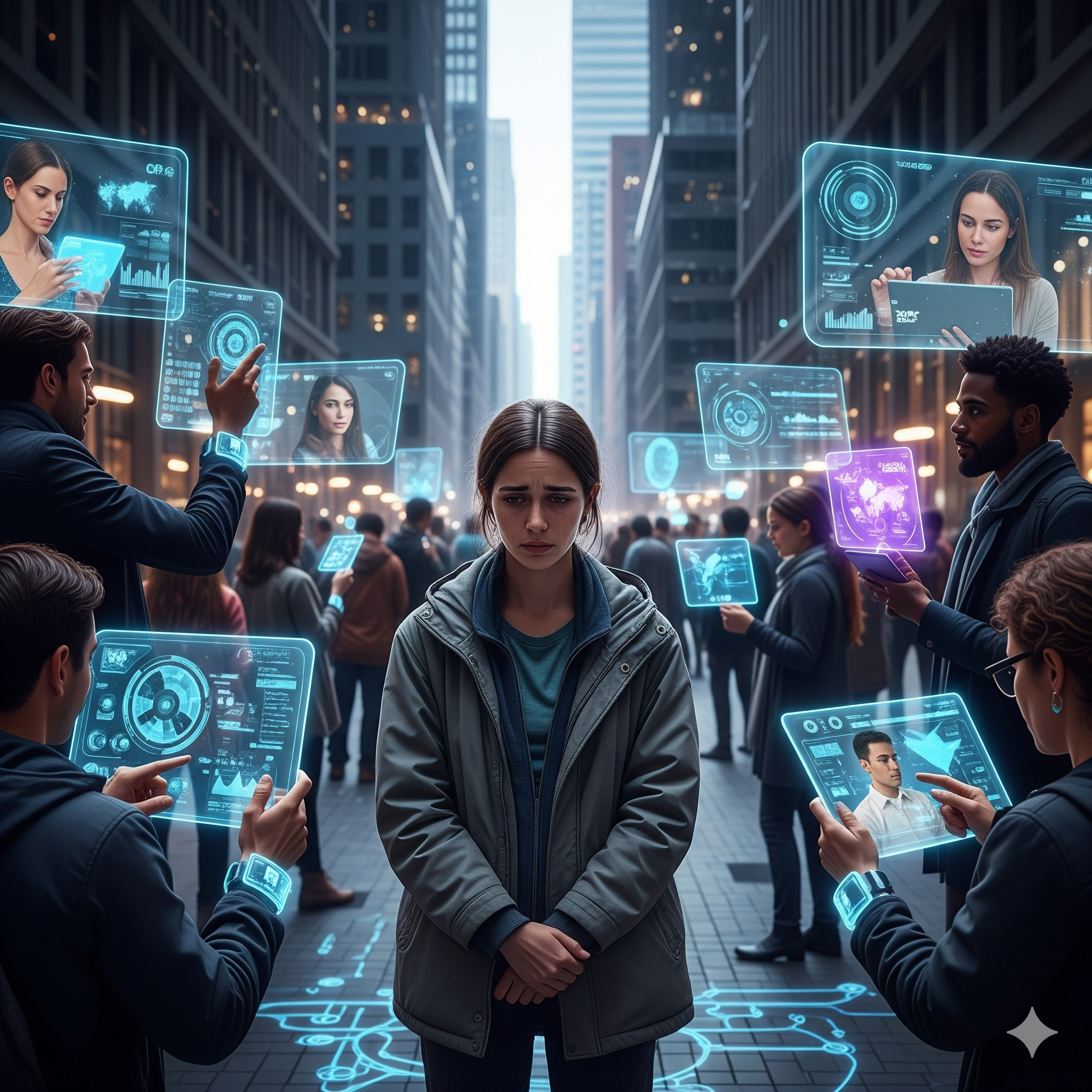
How Your AI Overlords Are Making You Redundant, & Why Your Kids Should Be Training Them Now

Ah, the sweet, sweet sound of economic collapse! Just when you thought the comforting rhythm of capitalism—where if you worked hard, you might, might, see a return—was a permanent fixture, the charts have decided to flip the bird at humanity.

For nearly two decades, the ballet between Labour and Capital was a harmonious, if painfully slow, Strictly Come Dancing routine. As job vacancies went up, the S&P 500 followed, dutifully confirming that the peasants were, in fact, contributing. But then, somewhere between 2023 and the current, terrifying moment, the lines decided they were done with each other. Markets are soaring like a cocaine-fueled space rocket, while job demand is looking sadder than the last biscuit in the tin.

This isn’t just a wobble; this is the Great Decoupling, and it tastes faintly of existential dread and concentrated stock options.

The Magnificently F**ked 7 and the Structural Sorting Hat

Forget your polite chatter about “economic cycles.” This isn’t a natural adjustment; it’s a structural rupture delivered by a handful of tech companies we now lovingly call the “Magnificent 7” (and their equally terrifying second-tier support crew).

The gains, darling, are concentrated. Amazon makes more money than God while dispensing with human workers like used tissues. Suddenly, the only college graduates getting paid exorbitant, life-affirming salaries are the AI-whisperers, the algorithm alchemists. Everyone else? Welcome to the Economic Refugee camp, where your degree in Georgian Literature is about as useful as a chocolate teapot in a server room.

And that’s before we even talk about the Anticipation Effect. Companies aren’t waiting for the robots to fully arrive; they’re pre-emptively firing you in a spasm of corporate anxiety, restructuring their doom in advance. It’s the ultimate corporate self-fulfilling prophecy: cutting labor before full automation, just to prove the market optimism was right. It’s like cancelling the wedding because you assume the spouse will eventually cheat. It’s efficient! It’s insane! It’s 2025!


The British Education Black Hole and the AI Saviour

Speaking of systemic collapse, let’s have a brief moment of national pride for our own education system. While the rest of the world is desperately trying to teach children how to train their AI assistants, our schools are too busy worrying about what shade of gray the uniform socks should be.

The UK education system is currently performing a magnificent, slow-motion reverse ferret into the 1950s, perfectly designed to prepare our young for a job market that ceased to exist a decade ago. We’re prioritizing memorization and rote learning—the very tasks AI agents perform flawlessly while running 24/7 on a diet of pure processing power.

This is the crucial pivot: Your children must become the masters of the machine, not its victim.

If the purpose of work is now more valuable than the task of work, then teaching kids to cultivate their Massive Transformative Purpose (MTP) is no longer New Age corporate jargon—it’s a survival strategy. Let them use AI. Let them break it. Let them find out that the quality of the question they ask the machine is the only thing separating them from economic obsolescence.

We are at the glorious, terrifying crossroad where the scarce resource is no longer capital or energy. It is Purpose.


The Hammer and the Purpose

The chart forces a chilling truth: if your identity is tied to the tasks you complete, and those tasks are now cheaper, faster, and better done by a sentient spreadsheet, then your identity is about to be liquidated.

For generations, “working for someone else and doing what you’re told” was the respectable, safe bet. Today, it’s a one-way ticket to the economic dustbin.

The people who will “own the next economy” aren’t the ones who can code the best. They are the ones who can look at this new era of digital Abundance and decide on a truly Juicy Problem worthy of solving. They are the entrepreneurs of purpose, aiming AI like a high-powered orbital laser at the world’s most difficult puzzles.

Your task is no longer to be intelligent, but to be aimful.

The alternative? Cling to the old ways, wait for the company pension that will never materialize, and become the economic refugee who spends their retirement trying to get their old job back from a remarkably cheerful robot named ‘Brenda.’

Don’t over-engineer your doom. Cultivate purpose. Aim the AI. And for the love of God, tell your kids that their GCSEs matter less than the quality of the prompts they write. The Digital Data Purge has already begun.
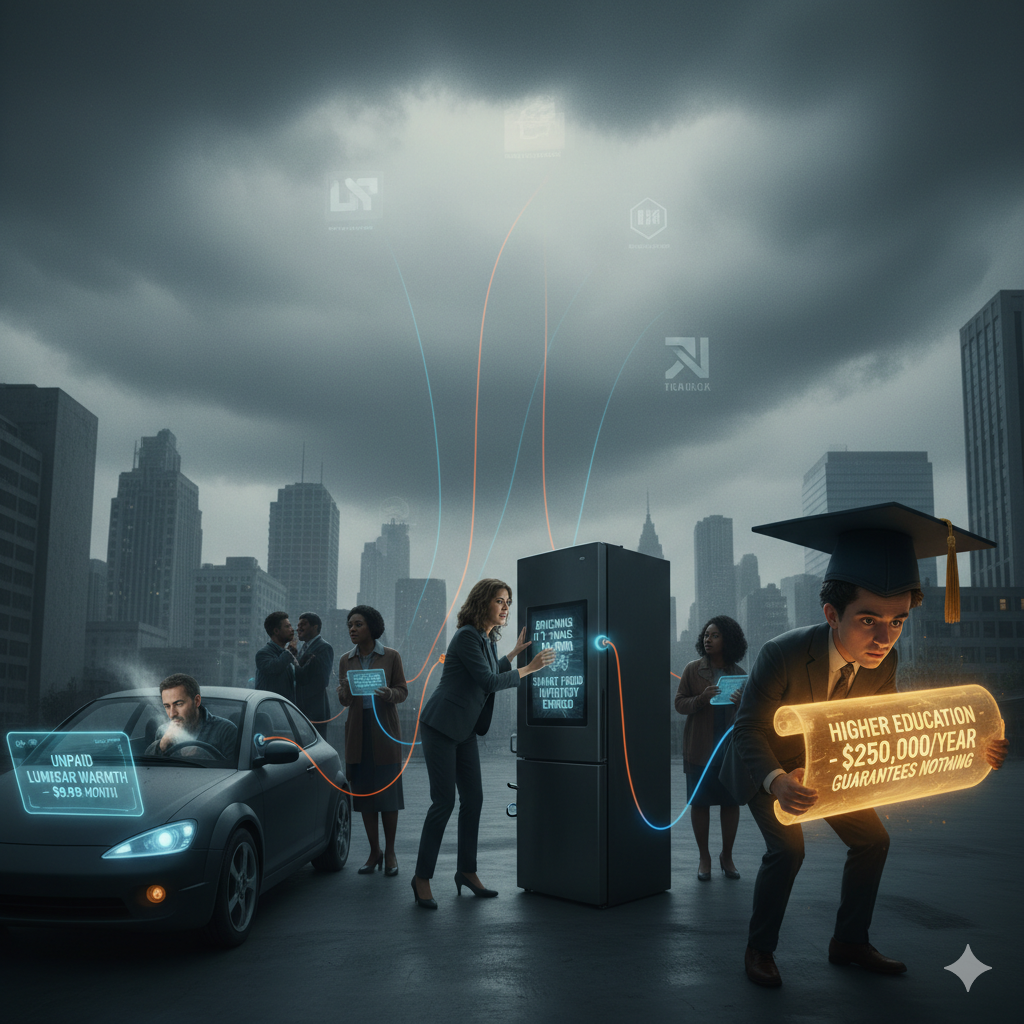
The Rise of Subscription Serfdom

Welcome, dear reader, to the glorious, modern age where “ownership” is a filthy, outdated word and “opportunity” is just another line item on your monthly bill.

We are living in the Subscription Serfdom, a beautiful new dystopia where every utility, every convenience, and every single thing you thought you purchased is actually rented from a benevolent overlord corporation. Your car seats are cold until you pay the $19.99/month Premium Lumbar Warmth Fee. Your refrigerator threatens to brick itself if you miss the ‘Smart Food Inventory’ subscription.

But the most insidious subscription of all? The one that costs you a quarter-million dollars and guarantees you absolutely nothing? Higher Education.


The University Industrial Complex: The World’s Worst Premium Tier

The classic American Dream once promised: “Go to college, get a great job.” That paradigm is officially deceased, its corpse currently rotting under a mountain of $1.8 trillion in student debt. This isn’t just a trend; it’s a financial catastrophe waiting for its cinematic sequel.

The data screams the horror story louder than a final exam bell:

  • The Credential Crash: Americans who call college “very important” has crashed from 75% to a pathetic 35% in 15 years. Meanwhile, those saying it’s “not too important” have quintupled.
  • The Debt Furnace: Tuition is up a soul-crushing 899% since 1983. Forget the cost of your car; your degree is the second-largest debt you’ll ever acquire (just behind your mortgage).
  • The Unemployment Premium: College graduates now make up one-third of the long-term unemployed. Congratulations! You paid a premium price for the privilege of being locked out of the job market.

That quarter-million-dollar private university education is now little more than an empty, gold-plated subscription box. The degree used to open the door; now it’s a useless Digital Rights Management (DRM) key that expired the second you crossed the stage.


The New Rules of the Game (Spoiler: No One’s Checking Your Transcript)

The market has wised up. While schools ranked #1 to #10 still coast on massive endowments and the intoxicating smell of prestige (MIT and Harvard are basically hedge funds with lecture halls), schools ranked #40 to #400 are facing an existential crisis. Their value has cratered because employers have realized the curriculum moves slower than a government bureaucracy.

As one MIT administrator hilariously confessed: “We can build a nuclear reactor on campus faster than we can change this curriculum.” By the time you graduate, everything you learned freshman year is obsolete. You are paying a six-figure monthly fee for four years of out-of-date information.

So, what do you do to survive the Subscription Serfdom? You cancel the old contract and build your own damn credibility:

1. Become the Self-Credentialed Mercenary

The era of signaling competence via a certificate is over. Today, you must demonstrate value. Your portfolio is your new degree. Got a GitHub repo showing what you shipped? A successful consulting practice proving you solve real problems? A YouTube channel teaching your specific niche? That work product is infinitely more valuable than a transcript full of B+ grades in ‘Introduction to Post-Modern Basket Weaving.’

2. Master the Only Skill That Matters: Revenue Growth

Forget everything else. Most companies care about exactly one thing: increasing revenue. If you can demonstrably prove you drove $2 million in new sales or built a product that acquired 100,000 users, your academic history becomes utterly irrelevant. Show me the money; I don’t need the diploma.

3. AI is the Educator, Not the Oppressor

The university model of one professor lecturing 300 debt-ridden, sleepy students is dead. It just hasn’t filed the paperwork yet. The future belongs to the AI tutor: adaptive, one-on-one instruction at near-zero cost. Students using AI-assisted learning are already learning 5 to 10 times faster. Why subscribe to a glacial, expensive classroom when an AI can upload the entire syllabus directly into your brain for free?

4. Blue Collar is the New Black Tie

Nvidia CEO Jensen Huang recently pointed out a cold truth: we need hundreds of thousands of electricians, plumbers, and carpenters to build the future. These trade professions now command immediate work and salaries between $100,000 and $150,000 per year—all without the crushing debt. Forget the ivory tower; the real money is in the well-maintained tool belt.


The Opportunity in the Apocalypse

The old gatekeepers—the colleges, the recruiters, the outdated HR software—are losing their monopoly. The Credential Economy is being rebuilt from scratch. This isn’t just chaos; it’s a massive, beautiful opening for the few brave souls who can demonstrate value directly, build networks through sheer entrepreneurial force, and learn faster using AI than any traditional program could teach.

So, cancel that worthless tuition subscription, fire up that AI tutor, and start building something. The future belongs to the self-credentialed serf.

Friday FUBAR: The Paradox of Progress

The world feels like it’s moving faster every day, a sensation that many of us share. It’s a feeling of both unprecedented progress and growing precariousness. At the heart of this feeling is artificial intelligence, a technology that acts as a mirror to our deepest fears and highest aspirations.

From the world of AI, there’s no single, simple thought, but rather a spectrum of possibilities. It’s a profound paradox: a tool that could both disintegrate society and build a better one.

The Western View: A Mirror of Our Anxieties

In many Western nations, the conversation around AI is dominated by a sense of caution. This perspective highlights the “scary” side of the technology:

  • Job Displacement and Economic Inequality: There’s a widespread fear that AI will automate routine tasks, leading to mass job losses and exacerbating the divide between the tech-savvy elite and those left behind.
  • Erosion of Human Connection: As AI companions and chatbots become more advanced, many worry we’ll lose our capacity for genuine human connection. The Pew Research Center, for example, found that most Americans are pessimistic about AI’s effect on people’s ability to form meaningful relationships.
  • Misinformation and Manipulation: AI’s ability to create convincing fake content, from deepfakes to disinformation, threatens to erode trust in media and democratic institutions. It’s becoming increasingly difficult to distinguish between what’s real and what’s AI-generated.
  • The “Black Box” Problem: Many of the most powerful AI models are so complex that even their creators don’t fully understand how they reach conclusions. This lack of transparency, coupled with the potential for algorithms to be trained on biased data, could lead to discriminatory outcomes in areas like hiring and criminal justice.

Despite these anxieties, a hopeful vision exists. AI could be a powerful tool for good, helping us tackle global crises like climate change and disease, or augmenting human ingenuity to unlock new levels of creativity.

The Rest of the World: Hope as a Catalyst

But this cautious view is not universal. In many emerging economies in Asia, Africa, and Latin America, the perception of AI is far more optimistic. People in countries like India, Kenya, and Brazil often view AI as an opportunity rather than a risk.

This divide is a product of different societal contexts:

  • Solving Pressing Problems: For many developing nations, AI is seen as a fast-track solution to long-standing challenges. It’s being used to optimize agriculture, predict disease outbreaks, and expand access to healthcare in remote areas.
  • Economic Opportunity: These countries see AI as a way to leapfrog traditional stages of industrial development and become global leaders in the new digital economy, creating jobs and driving innovation.

This optimism also extends to China, a nation with a unique, state-led approach to AI. Unlike the market-driven model in the West, China views AI development as a national priority to be guided by the government. The public’s trust in AI is significantly higher, largely because the technology is seen as a tool for economic growth and social stability. While Western countries express concern over AI-driven surveillance, many in China see it as an enhancement to public security and convenience, as demonstrated by the use of facial recognition and other technologies in urban areas.

The Dangerous Divide: A World of AI “Haves” and “Have-Nots”

These differing perceptions and adoption rates could lead to a global divide with both positive and negative consequences.

On the positive side, this could foster a diverse ecosystem of AI innovation. Different regions might develop AI solutions tailored to their unique challenges, leading to a richer variety of technologies for the world.

However, the negative potential is far more profound. The fear that AI will become a “rich or wealthy tool” is a major concern. If powerful AI models remain controlled by a handful of corporations or states—accessible only through expensive subscriptions or with state approval—they could further widen the global and social divides. This mirrors the early days of the internet, which was once envisioned as a great equaliser but has since become a place where access is gated by device ownership, a stable connection, and affordability. AI could deepen this divide, creating a society of technological “haves” and “have-nots.”

The Digital Identity Dilemma: When Efficiency Meets Exclusion

This leads to another critical concern: the rise of a new digital identity. The recent research in the UK on Digital Company ID for SMEs highlights the compelling benefits: it can reduce fraud, streamline compliance, and improve access to financial services. It’s an efficient, secure solution for businesses.

But what happens when this concept is expanded to society as a whole?

AI-powered digital identity could become a tool for control and exclusion. While it promises to make life easier by simplifying access to banking, healthcare, and government services, it also creates a new form of gatekeeping. What happens to a person who can’t get an official digital identity, perhaps due to a lack of documentation, a poor credit history, or simply no access to a smartphone or reliable internet connection? They could be effectively shut out from essential services, creating a new, invisible form of social exclusion.

This is the central paradox of our current technological moment. The same technologies that promise to solve global problems and streamline our lives also hold the power to create new divides, reinforce existing biases, and become instruments of control. Ultimately, the future of AI will not be determined by the technology itself, but by the human choices we make about how to develop, regulate, and use it. Will we build a future that is more creative, connected, and equitable for everyone, or will we let these powerful tools serve only a few? That is the question we all must answer. Any thoughts?

From Chalkboards to Circuits: Could AI Be Scotland’s Computing Science Saviour?

Right, let’s not beat around the digital bush here. The news from Scottish education is looking less “inspiring young minds” and more “mass tech teacher exodus.” Apparently, the classrooms are emptying faster than a dropped pint on a Friday night. And with the rise of Artificial Intelligence, you can almost hear the whispers: are human teachers even necessary anymore?

Okay, okay, hold your horses, you sentimental souls clinging to the image of a kindly human explaining binary code. I get it. I almost was one of those kindly humans, hailing from a family practically wallpapered with teaching certificates. The thought of replacing them entirely with emotionless algorithms feels a bit… dystopian. But let’s face the digital music: the numbers don’t lie. We’re haemorrhaging computing science teachers faster than a server farm during a power surge.

So, while Toni Scullion valiantly calls for strategic interventions and inspiring fifty new human teachers a year (bless her optimistic, slightly analogue heart), maybe we need to consider a more… efficient solution. Enter stage left: the glorious, ever-learning, never-needing-a-coffee-break world of AI.

Think about it. AI tutors are available 24/7. They can personalize learning paths for each student, identify knowledge gaps with laser precision, and explain complex concepts in multiple ways until that digital lightbulb finally flickers on. No more waiting for Mr. or Ms. So-and-So to get around to your question. No more feeling self-conscious about asking for the fifth time. Just pure, unadulterated, AI-powered learning, on demand.

And let’s be brutally honest, some of the current computing science teachers, bless their cotton socks and sandals, are… well, they’re often not specialists. Mark Logan pointed this out years ago! We’ve got business studies teachers bravely venturing into the world of Python, sometimes with less expertise than the average teenager glued to their TikTok feed. AI, on the other hand, is the specialist. It lives and breathes algorithms, data structures, and the ever-evolving landscape of the digital realm.

Plus, let’s address the elephant in the virtual room: the retirement time bomb. Our seasoned tech teachers are heading for the digital departure lounge at an alarming rate. Are we really going to replace them with a trickle of sixteen new recruits a year? That’s like trying to fill Loch Ness with a leaky teacup. AI doesn’t retire. It just gets upgraded.

Now, I know what you’re thinking. ‘But what about the human connection? The inspiration? The nuanced understanding that only a real person can provide?’ And you have a point. But let’s be realistic. We’re talking about a generation that, let’s face it, often spends more time interacting with pixels than people. Many teenagers are practically face-planted in their phone screens for a good sixteen hours a day anyway. So, these Gen X sentiments about the irreplaceable magic of human-to-human classroom dynamics? They might not quite land with a generation whose social lives often play out in the glowing rectangle of their smartphones. The inspiration and connection might already be happening in a very different, algorithm-driven space. Perhaps the uniquely human aspects of education need to evolve to meet them where they already are.

Maybe the future isn’t about replacing all human teachers entirely (though, in this rapidly evolving world, who knows if our future overlords will be built of flesh or circuits?). Perhaps it’s about a hybrid approach. Human teachers could become facilitators, less the sage on the stage and more the groovy guru of the digital dance floor, guiding students through AI-powered learning platforms. Think of it: the AI handles the grunt work – the core curriculum, the repetitive explanations, the endless coding exercises, spitting out lines of Python like a digital Dalek. But the human element? That’s where Vibe Teaching comes in. Imagine a teacher, not explaining syntax, but feeling the flow of the algorithm, channeling the raw emotional energy of a well-nested loop. They’d be leading ‘Vibe Coding Circles,’ where students don’t just learn to debug, they empathise with the frustrated compiler. Picture a lesson on binary where the teacher doesn’t just explain 0s and 1s, they become the 0s and 1s, performing interpretive dance routines to illustrate the fundamental building blocks of the digital universe. Forget logic gates; we’re talking emotion gates! A misplaced semicolon wouldn’t just be an error; it would be a profound existential crisis for the entire program, requiring a group hug and some mindful debugging. The storytelling wouldn’t be about historical figures, but about the epic sagas of data packets traversing the internet, facing perilous firewalls and the dreaded lag monster. It’s less about knowing the answer and more about feeling the right code into existence. The empathy? Crucial when your AI tutor inevitably develops a superiority complex and starts grading your assignments with a condescending digital sigh. Vibe Teaching: it’s not just about learning to code; it’s about becoming one with the code, man. Far out.

So, as we watch the number of human computing science teachers dwindle, maybe it’s time to stop wringing our hands and start embracing the silicon-based cavalry. AI might not offer a comforting cup of tea and a chat about your weekend, but it might just be the scalable, efficient solution we desperately need to keep Scotland’s digital future from flatlining.

Further reading and references

Exploring Tim Marshall’s Insights on Geography

Today, we embark on a chilling journey through the pages of two books that have shaken me to my core: Tim Marshall’s “Prisoners of Geography” and its sequel, “The Power of Geography.” These works offer a stark, unflinching look at how the physical world shapes – and often constrains – human destiny.

Marshall’s books are a wake-up call, exposing the naïveté many of us harbour about how the world truly operates. Forget the rosy picture of global cooperation and progress. The truth, as laid bare in these pages, is far more brutal. It’s a world of competing nations, clashing ambitions, and enduring conflicts – all played out on the vast chessboard of geography.

“Prisoners of Geography” highlights how mountains, rivers, and coastlines can act as both barriers and gateways, influencing everything from trade routes to military strategies. It’s a world where access to warm-water ports can make or break a nation, and where vast plains can become battlefields for empires.

“The Power of Geography,” meanwhile, zooms in on specific regions, revealing how their unique geographic features have shaped their history and continue to influence their present-day struggles. We see how Russia’s sprawling expanse fuels its sense of insecurity, how China’s control of the South China Sea is a strategic power play, and how the Sahel’s harsh climate breeds instability.

These books left me feeling both enlightened and deeply unsettled. It’s terrifying to realise how vulnerable we all are to the whims of geography. But even more disturbing is the realisation that human greed, racial hatred, and religious zealotry often exacerbate these geopolitical tensions.

I must admit, I’m grateful to be living in what many might consider the “back end” of the UK, far removed from the hotspots of conflict and geopolitical manoeuvring. It’s a place where I can enjoy relative peace and security, away from the shadow of looming threats.

But even in my tranquil corner of the world, I can’t escape the knowledge that we are all interconnected. The ripple effects of conflict and instability can reach even the most remote corners of the globe. And the reality is, no one is truly safe in a world where geography and human folly collide.

I yearn for a world where we transcend these limitations, where we recognise our shared humanity and work towards a future of peace and prosperity. A world where greed and prejudice give way to compassion and understanding. A world where we break free from the chains of geography and embrace a brighter, more hopeful future.

Until that day arrives, we must remain vigilant, informed, and engaged. We must challenge those who seek to exploit our fears and divisions. And we must strive to create a world where the power of geography is harnessed for the betterment of all, not just the privileged few.

Thank you for joining me on this unsettling but essential journey. Until next time, stay curious, stay informed, and never lose hope for a better world.