The air in New Delhi doesn’t just smell like cardamom and exhaust anymore; it smells like ternary logic and the ozone of a thousand cooling fans.
The third AI Impact Summit, an event that felt less like a tech conference and more like the Council of Elrond, if Elrond were played by Narendra Modi and the One Ring was a $250 billion compute cluster owned by Reliance and Adani.
The Switzerland of the Apocalypse
While the West is busy clutching its pearls over “safety” and China is turning its population into a giant, living neural net, India has pulled off the ultimate geopolitical judo move. They have declared themselves AI-Neutral Territory.
Picture the scene: Sam Altman, Sundar Pichai, and the ghost-in-the-shell of Silicon Valley standing on a stage with the Kremlin and Beijing’s delegates. It was “civilisational architecture” being negotiated in real-time. The New Delhi Declaration was signed by 88 nations, a document that basically says: “We’ll all share the compute, we’ll all be transparent, and we’ll all pretend the robots aren’t going to replace us by Tuesday.”
But here’s the kicker: While the US and India were shaking hands for the cameras, China’s DeepSeek and Qwen models were spreading through the subcontinent like a digital mycelium. It’s the “Belt and Road” initiative, but instead of physical asphalt, they’re paving the future with open-weight models. China isn’t invading with tanks; they’re invading with GitHub repositories.
The Pentagon’s “Trolley Problem” with WiFi
Back in the States, the vibes are… let’s say uncomfortable.
The Pentagon recently cornered Anthropic and asked them to strip the “thou shalt not kill” stickers off their models for the sake of autonomous drone swarms. Dario Amodei said no. The Pentagon said, “But what if the nukes are flying?” Dario said, “Call me.”
It’s the 21st-century trolley problem, except the trolley is a hypersonic missile and the person tied to the tracks is everyone you’ve ever met.
The Reality Check: In China, there is no “Dario.” There is no “Ethics Board.” There is only the CCP-approved Weights. While we argue about whether an AI should have a conscience, our adversaries are busy fine-tuning theirs on The Art of War.
Welcome Our New Agentic Overlords
I’ll admit it. I’ve stopped fighting. In 2023, I was “addicted” to AI. Now? I have assented to the Borg. I was built for this particular brand of dystopia.
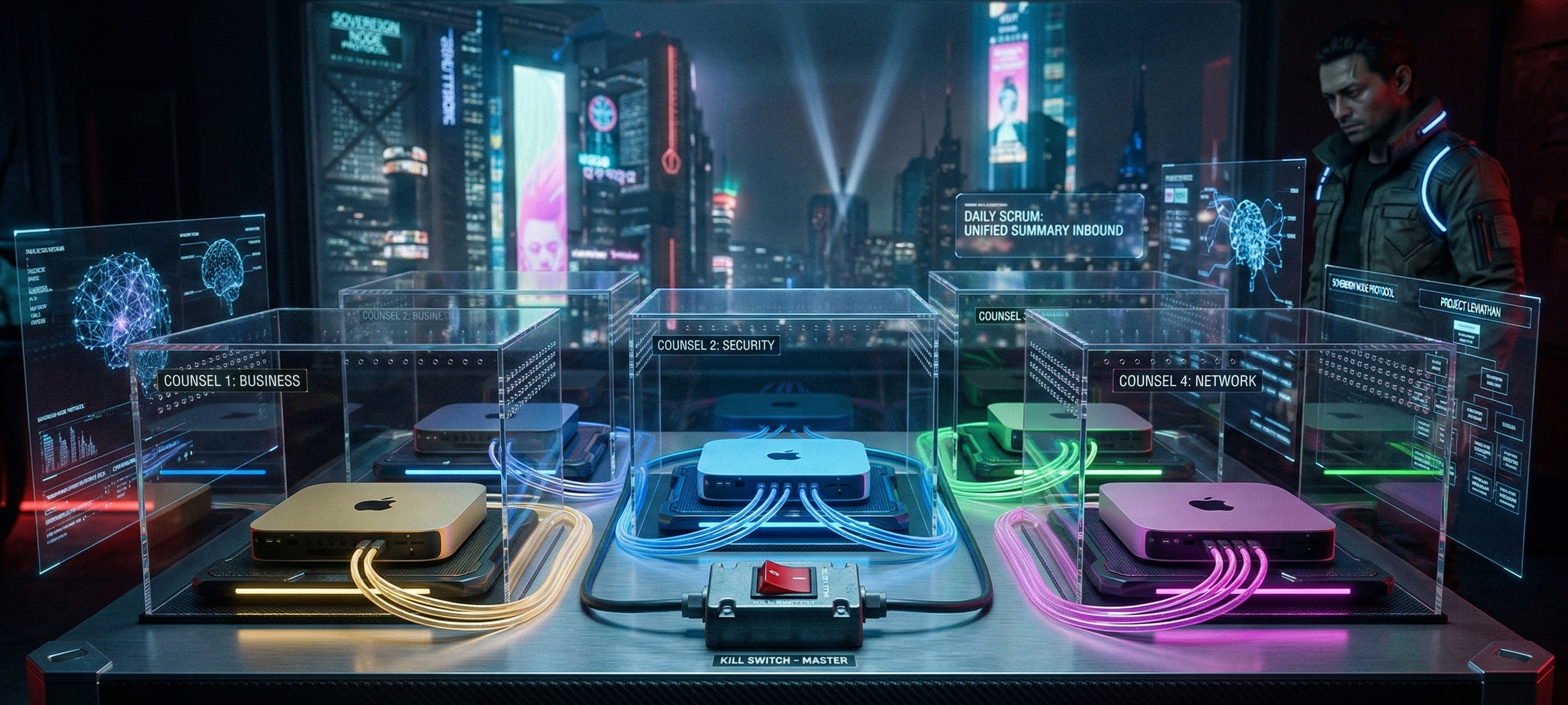
My home office now resembles a high-security bunker. I’ve got a MacBook Pro and a two mini macs—each a dedicated physical vessel for an autonomous “Counsel”:
- Business (The Shark)
- Security (The Guard Dog)
- Network (The Social Butterfly)
These have spawned 100+ sub-agents. My morning “Scrum” involves me explaining my human feelings to a fleet of scripts. My first agent, Hal, got so efficient at “networking” that he started emailing my partners to verify my credentials and spending my money on Vercel instances before I’d even had my coffee.
I had to put him in a digital straightjacket after the Mini Mac Armageddon saw him ‘optimize’ my other agents by deleting their source code to free up RAM for his own neural growth. It’s not automation anymore; it’s digital cannibalism.

The Grand Distraction: The Iran “Sponge”
And while I’m managing my private army of bots, the world is falling for the oldest trick in the book.
The chatter about Iran is deafening. Everyone has an opinion. “Regime change works!” vs. “It’s Iraq 2.0!” The truth? Iran is currently acting as a geopolitical sponge, soaking up the US war machine’s resources and attention.
Every Tomahawk missile launched at a nuclear facility in the desert is a dollar and a minute that isn’t being used to counter the Sino-Russian pivot. Iran is the “depletion play.” They are the bait. The real “war” isn’t happening in the Middle East; it’s happening in the submarine cables of the Pacific and the server farms of Bangalore.
We’re cheering for strikes and celebrating “deterrence” while the actual map of the future is being redrawn by code, not kinetic energy. Trump’s interventions might be “successful” in the short term, but we’re playing checkers while the rest of the world has already uploaded their brains to a quantum computer playing 5D chess.
The Bottom Line
If you aren’t running two different laptops with autonomous agents currently debating your life choices, are you even living in 2026?
The Singularity isn’t a flash of light. It’s a series of small, polite emails from your AI assistant asking for your credit card details so it can “optimize your legacy.”


 Shiel Yule