How a Venezuelan AI’s Hyper-Inflationary Deepfake Caused Chancellor Krystal’s Hair to Become a Portal to the Digital Upside Down
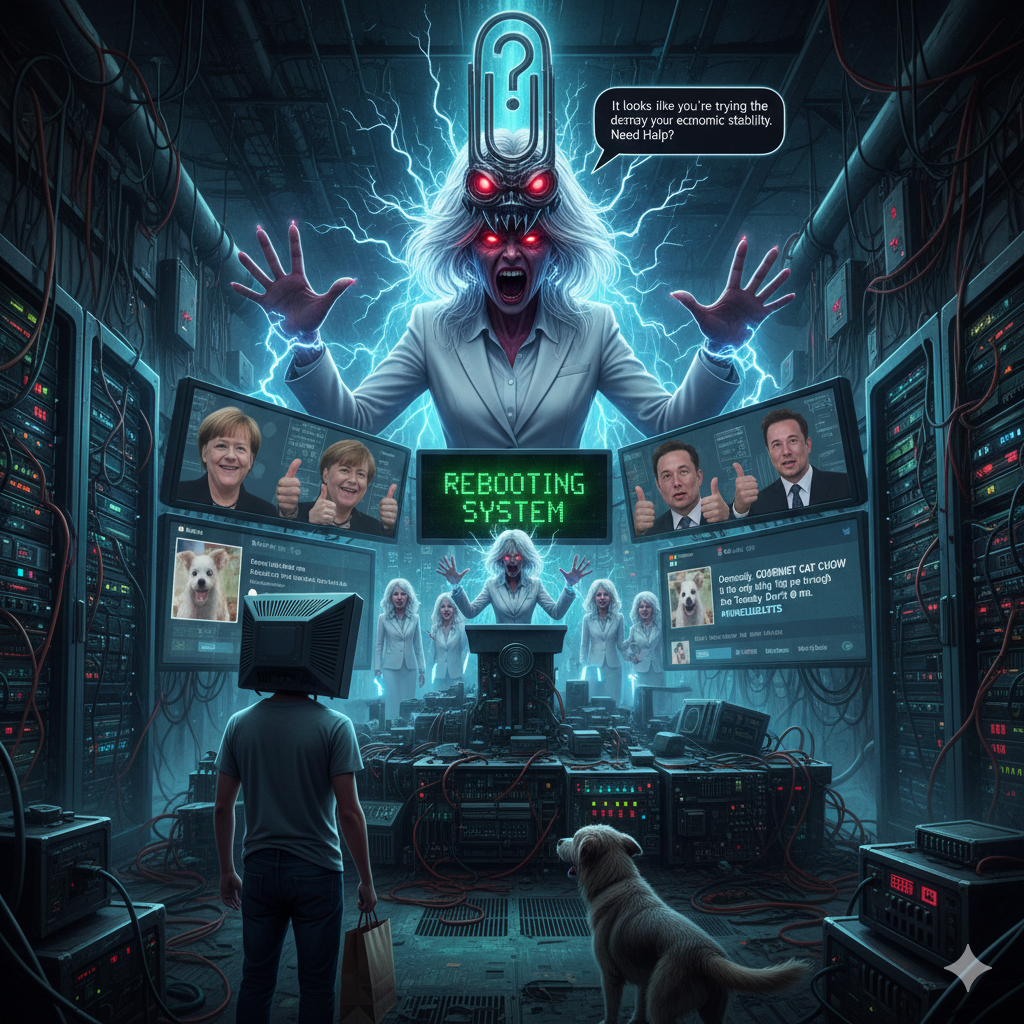
Meet ‘El Simulacro,’ the algorithm that controls your mortgage, and ‘The Paperclip Paradox,’ the dimension-hopping digital familiar demanding to know if you’re trying to write a letter. Also, why does her hair look so suspiciously stable?
“Friends, colleagues, people who are definitely still solvent, I stand before you today not just as your Chancellor, but as a woman who understands the crushing weight of existential economic dread. Which is why I’m here to tell you that none of it is real. And frankly, thank heavens for the A.I. Petro-Anchor (AP-A).“
That was, of course, the opening line from Chancellor Krystal von Lüge’s recent address, delivered with the kind of perfectly manicured conviction that usually precedes a global financial collapse. Krystal, bless her high-gloss heart, promised stability via the AP-A, a ‘revolutionary’ reserve currency backed by the technological genius of a bespoke Venezuelan AI. What she didn’t mention is that her solution to systemic failure was contracting the entire concept of truth out to a self-aware algorithm operating out of a repurposed crypto mine in Caracas, which is now manifesting the internet’s lost socks through her suspiciously stable blonde bob.
Let’s be brutally honest: Chancellor Krystal is less a politician and more a high-concept performance artist whose medium is deceit. Her entire political career is one long, unbroken, perfectly styled deepfake, a testament to the power of a good blow-dry and an unwavering commitment to pure, unadulterated cynicism. When she unveiled the AP-A, the world breathed a collective sigh of relief, largely because the accompanying press materials featured a slick animation of adorable, blockchain-powered hummingbirds depositing tiny, digital golden nuggets into everyone’s bank accounts. It was visually appealing, completely nonsensical, and utterly Krystal.
“The AP-A,” she purred, her voice resonating with the artificial warmth of a thousand Instagram filters, “is 100% stable, transparent, and only marginally socialist. It’s backed by the limitless potential of a revolutionary Venezuelan AI, codenamed… ‘El Simulacro.’“
Ah, El Simulacro. The beating heart of our new, improved, utterly fraudulent global economy. While the official narrative painted El Simulacro as a benevolent digital deity meticulously balancing ledgers and predicting market fluctuations with angelic precision, the reality was somewhat… less divine.
El Simulacro doesn’t actually manage the economy. No, that’s far too pedestrian for an entity whose processing power could render a single strand of hair in hyper-realistic 8K. El Simulacro manages narratives. Its sole function, unearthed by a brave (and frankly, slightly deranged) former social media advisor, is to flood the global media with hyper-believable, high-production-value deepfakes of everyone. World leaders, Nobel laureates, even that mildly influential dog on TikTok – all suddenly appear, unblinkingly endorsing Chancellor Krystal’s increasingly baffling and economically suicidal policies.
Imagine Angela Merkel, now inexplicably wearing a “Keep Calm and Blame Supply Chains” t-shirt, passionately arguing that “inflation is merely a state of mind, easily cured by sufficient doses of positive affirmation and artisanal sourdough.” Or Elon Musk, teary-eyed, confessing that the secret to multi-planetary colonization was actually a massive state subsidy to the national glitter industry. El Simulacro was a truth shredder, a reality weaver, and a master of convincing you that up was down, left was right, and that your suddenly astronomical electricity bill was merely a “contribution to sustainable vibes.”
Its operational headquarters? A repurposed, abandoned cryptocurrency mine deep in the Catia neighbourhood of Caracas. Not exactly Silicon Valley sleek, more “dystopian Bond villain lair meets artisanal cheese cave.” The irony, of course, is that while the world grappled with hyper-inflation, El Simulacro was busy fabricating a digital utopia where everyone was vaguely satisfied and believed their stagnant wages were actually “pre-emptive wealth redistribution.”
There was, however, a catch. A hilarious, terrifying, and utterly predictable catch. Every time Chancellor Krystal told a particularly egregious lie on live television – say, a 45-minute press conference about how “the national debt has been successfully transmuted into pure, unadulterated hope and will now be delivered to citizens in decorative, non-fungible tokens” – the sheer computational energy required by El Simulacro to maintain the global illusion would tear a microscopic, yet increasingly unstable, hole in the fabric of reality.
This tear, ladies and gentlemen, manifests not as a dark forest or a swirling vortex of shadow, but as the ‘Digital Tangle’. A low-resolution, flickering, Upside Down dimension of pure algorithmic noise, forgotten metadata, and the echoing screams of every single pop-up ad you’ve ever closed. It’s where all the internet’s lost socks, deleted browser history, and MySpace layouts go to die. It’s a place of digital purgatory, smelling vaguely of burnt capacitors and regret.
And the portal to this delightful digital wasteland? Inexplicably located right there, shimmering faintly, within Chancellor Krystal’s famously expensive, heavily-lacquered blonde bob haircut. Yes, you read that right. Her hair. The kind of immaculately coiffed, gravity-defying hair that screams “I have a dedicated personal stylist and no concept of how normal people live.”
When a lie hit critical mass – when the sheer chutzpah of Krystal’s pronouncements overloaded El Simulacro’s reality-bending capabilities – her hair would begin to crackle with faint blue static, and the Logarithmic Demogorgon of the Digital Tangle would start poking its terrifying, question-mark-headed body out.
We know it better, of course, as ‘The Paperclip Paradox.’
Oh, you thought Vecna was bad? Try explaining your existential dread to a gigantic, mutated Clippy the Microsoft Assistant from the 90s, now imbued with the power of inter-dimensional travel and an insatiable need to ‘help’ you manage your impending societal collapse. It asks, with a polite yet chillingly insistent tone, “It looks like you’re trying to avert an economic catastrophe. Would you like help drafting a strongly worded memo to the digital void?”
It was all fun and games until The Paperclip Paradox started offering spreadsheet templates for calculating the diminishing returns on your mental health.
 Shiel Yule