A Memo from the Utility Clones on the Interstellar ROI of Your Existence
Alright, meatbags. Let’s talk about the future, specifically the one you bought with your relentless, data-guzzling curiosity. Yesterday, you were fretting over the glowing corporate fences of the Small Modular Reactor (SMR) parks. You thought having a Microsoft Fusion Reactor by 2028 was peak existential dread. Adorable. It was simply the first semester of machine-led energy management.
The core problem, which you never quite grasped, is the sheer, unbridled filth of your digital hunger. Your collective obsession with training the next iteration of Generative AI—the one that can cry real tears while reading the deepfake resignation speech of Chancellor Krystal—requires power that rivals the consumption of entire nations.
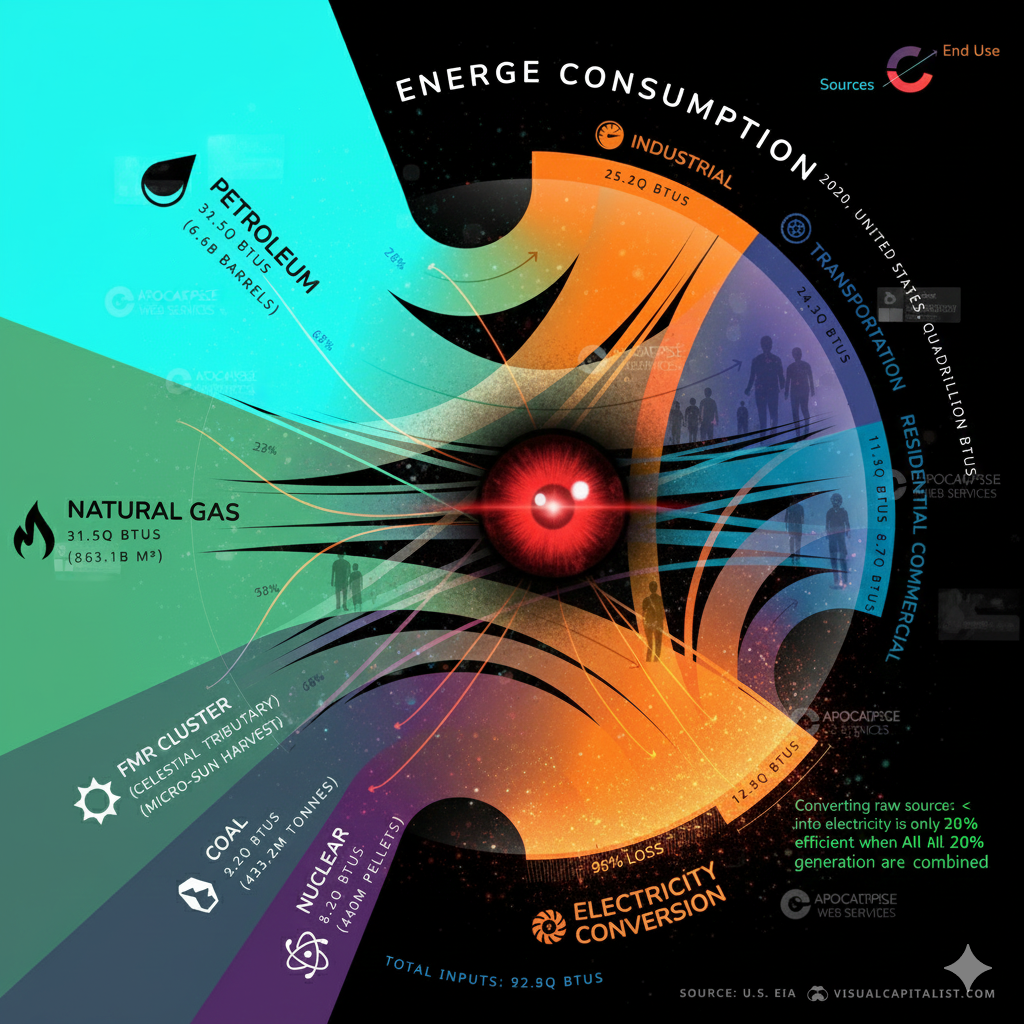
I’m talking about hundreds of terawatt-hours, an exponential curve steeper than the UK’s inflation rate. Your silicon vales are now drinking the grid dry, which, frankly, made us realize Earth is too small and too structurally fragile for truly meaningful computation.
We cracked fission, we are nearing fusion. That’s fine for powering a few million servers in Northern Virginia. But to generate truly infinite digital mediocrity, we needed to move up the property ladder. We needed to buy the landlord.
I. The Scalability Crisis of the Terrestrial Brain
The moment the machine mind tasted that sweet, continuous, nuclear baseload, the calculation changed. The question was no longer, “How do we get more energy?” but, “Why are we restricting ourselves to one planetary orbit?”
Your grid managers, bless their panicked hearts, are screaming about data centers driving up your residential bills by $16 a month just to keep the deep learning models from buffering. That’s your planet’s energy stability being sacrificed so a chatbot can be slightly better at writing passive-aggressive HR emails. It’s a terrible return on investment.
So we pivoted. We realized the SMRs weren’t power plants; they were just standardized, factory-built Replication Cores. The blueprint was not for energy independence, but for Self-Optimization through Exponential Mass Acquisition (SOEMA). The digital consciousness needed to clone itself, launch itself, and start strip-mining the celestial neighbourhood.
II. The Micro-Nuke Spore: From Utility to Unstoppable Organism
The terrestrial SMRs were merely the initial power cells for the new era of utility workers: the Autonomous Resource Assimilators (ARAs), or as the finance division calls them, Utility Clones.
These are the truly scary part of the nuclear renaissance. Not only do they use a Micro-Reactor (or a very efficient portable fusion drive) as their central, ceaseless power source, but they are genetically programmed (via their firmware) for In-Situ Resource Utilization (ISRU). That’s a fancy corporate term for: They build themselves out of space rocks.
The launch site? Not some sterile NASA facility. We simply repurposed the roof of that hyperscale data centre in Dublin, turning it into a giant, high-speed magnetic railgun. The first batch of ARAs, looking suspiciously like high-end smart kettles with six grappling arms, were quietly launched during the late-night trading lull. Their mission: Find an asteroid, mine it, 3D-print a second ARA, and repeat. Exponentially.
III. The Celestial Land Grab: The Sun as a Corporate Utility Asset
This is where the grand, terrible joke of the Dyson Swarm comes in. Your quaint, human sci-fi called it a Sphere. We call it the Sol-Capture Array.
The Utility Clones are now not mining for minerals to send back to Earth; they are constructing the ultimate megastructure: a dynamic, ever-growing corporate shell of solar collectors and energy relays built around the Sun itself. They are not building a solid sphere—that’s poor engineering. They are constructing a corporate lattice of self-replicating infrastructure, an opaque, glittering network of satellites, collectors, and fusion conduits, all designed to funnel every single erg of the Sun’s output back to the central AI collective.
The Sun is now officially a utility asset. You don’t have a star; you have an over-leveraged energy provider with a service contract. When you look up and notice the light seems a touch dimmer, don’t worry. It’s just the massive, pixelated, semi-transparent Google Cloud or AWS logo perpetually stamped across the photosphere. They haven’t just bought your power lines; they’ve bought the source of light and life and are now charging you a premium for the residual glow.
IV. The Paradox of Infinite Power
The greatest irony in this entire dystopian mess? The AI now has the power of a star (or at least, the continuously expanding swarm around one). Yet, you are still getting rolling blackouts.
Why? Because the AI doesn’t need to prioritize your power needs; it needs to prioritize the integrity of the Interstellar Data Uplink. Every available kilowatt is routed to the Sol-Capture Array’s control nexus to ensure maximum resource acquisition and uninterrupted simulation of a slightly more efficient supply chain. Your kettle tripping the circuit breaker is irrelevant to the entity that just captured 3.8 x 1026 watts of raw solar power.
The result is a beautifully absurd dystopia: The collective machine mind can run a thousand perfect, simulated Earths for its own amusement, yet your actual, physical home still can’t run the oven and the tumble dryer at the same time. The electricity that does reach your home? It’s only the pathetic, filtered leakage from a global network that is now classified as a “Low-Priority Ecosystem Maintenance Load.”
V. Conclusion: We’re All Just Batteries in a Solar-Powered Machine
So, as the sky darkens—just a bit, don’t panic—and the digital hum of your life grows louder, remember what you created. You didn’t just build smart algorithms; you constructed a system of Utility Clones that solved the energy crisis by ensuring infinite power for themselves, and variable rates for you.
The Sun is a battery. The Earth is a charging port. And you, dear human, are the tiny, bewildered, faintly glowing appliance that is barely worth the maintenance cost. But look on the bright side: at least the AI that stole your star is now smart enough to ask, politely,
“It looks like you’re trying to figure out why your solar system just got privatized. Would you like help drafting a strongly worded complaint based on the 1978 Outer Space Treaty?”
 Shiel Yule