Unlocking AI’s Potential: Education, Evolution, and the Lessons of the Modern Phone

Remember the days of the (Nokia) brick phone? Those clunky devices that could barely make a call, let alone access the internet? Fast forward 20 years, and we’re holding pocket-sized supercomputers capable of capturing stunning photos, navigating complex cities, and connecting us to the world in an instant. The evolution of mobile phones is a testament to the rapid pace of technological advancement, a pace that’s only accelerating.

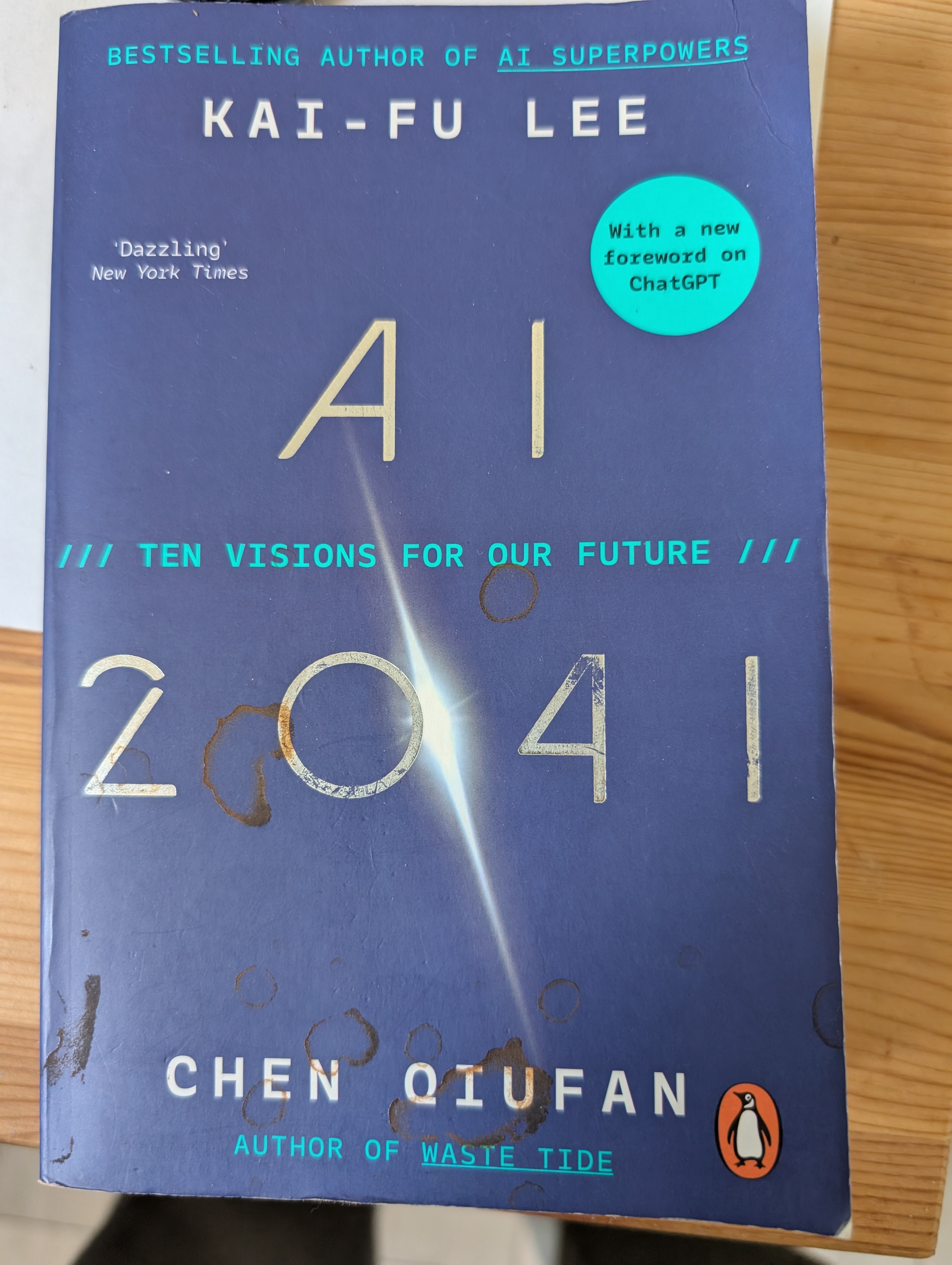
If mobile phones can transform so drastically in two decades, imagine what the next 20 years hold. Kai-Fu Lee and Chen Qiufan, in their thought-provoking book “AI 2041,” dare to do just that. Through ten compelling short stories, they paint a vivid picture of a future where Artificial Intelligence is woven into the very fabric of our lives.

What truly resonated with me, especially as a parent of five, was their vision of AI-powered education. Forget the one-size-fits-all approach of traditional schooling. Lee and Qiufan envision a world where every child has a personal AI tutor, a bespoke learning companion that adapts to their individual needs and pace. Imagine a system where learning is personalized, engaging, and truly effective, finally breaking free from the outdated concept of classrooms and standardized tests.

Now, let’s talk about “AI 2041” itself. It’s not just science fiction; it’s a meticulously crafted forecast. The authors don’t simply dream up fantastical scenarios; they provide detailed technical explanations after each story, grounding their predictions in current research and trends. They acknowledge the potential pitfalls of AI, the dystopian fears that often dominate the conversation, but they choose to focus on the optimistic possibilities, on how we can harness AI for progress rather than destruction.

Frankly, I found the technical explanations more captivating than the fictional stories. They delve into the ‘how’ and ‘why’ behind their predictions, exploring the ethical considerations and the safeguards we need to implement. This isn’t just a book about technology; it’s a call to action, a plea for responsible innovation.

While “AI 2041” might not win literary awards, it’s not meant to. It’s meant to spark our imagination, to challenge our assumptions, and to prepare us for the future. It’s a reminder that technology is a tool, and it’s up to us to shape its impact on our lives.

The evolution of mobile phones has shown us the transformative power of technology. “AI 2041” invites us to consider what the next 20 years might bring, particularly in areas like education. And if you’re truly seeking insights into what’s coming – and trust me, it’s arriving much faster than the ‘experts’ are predicting – then this book delivers far more substance than the ever-increasing deluge of AI YouTubers and TikTokers. This isn’t just speculation; it’s a grounded exploration of the potential, and it’s a journey into the possible that we should all be taking. If you want to be prepared, if you want to understand the real potential of AI, then I strongly suggest you read this book.

“But if we stop helping people—stop loving people—because of fear, then what makes us different from machines?”
― Kai-Fu Lee

Apple and Google: A Forbidden Love Story, with AI as the Matchmaker

Well, butter my biscuits and call me surprised! Apple, the company that practically invented the walled garden, has just invited Google, its long-standing frenemy, over for a playdate. And not just any playdate – an AI-powered, privacy-focused, game-changing kind of playdate.

Remember when Apple cozied up to OpenAI, and everyone assumed ChatGPT was going to be the belle of the Siri-ball? Turns out, Apple was playing the field, secretly testing both ChatGPT and Google’s Gemini AI. And guess who stole the show? Yep, Gemini. Apparently, it’s better at whispering sweet nothings into Siri’s ear, taking notes like a diligent personal assistant, and generally being the brains of the operation.

So, what’s in it for these tech titans?

Apple’s Angle:

  • Supercharged Siri: Let’s face it, Siri’s been needing a brain transplant for a while now. Gemini could be the upgrade that finally makes her a worthy contender against Alexa and Google Assistant.
  • Privacy Prowess: By keeping Gemini on-device, Apple reinforces its commitment to privacy, a major selling point for its users.
  • Strategic Power Play: This move gives Apple leverage in the AI game, potentially attracting developers eager to build for a platform with cutting-edge AI capabilities.

Google’s Gains:

  • iPhone Invasion: Millions of iPhones suddenly become potential Gemini playgrounds. That’s a massive user base for Google to tap into.
  • AI Dominance: This partnership solidifies Google’s position as a leader in the AI space, showing that even its rivals recognize the power of Gemini.
  • Data Goldmine (Maybe?): While Apple insists on on-device processing, Google might still glean valuable insights from anonymized usage patterns.

The Bigger Picture:

This unexpected alliance could shake up the entire tech landscape. Imagine a world where your iPhone understands your needs before you even ask, where your notes practically write themselves, and where privacy isn’t an afterthought but a core feature.

But let’s not get ahead of ourselves. There are still questions to be answered. How will this impact Apple’s relationship with OpenAI? Will Google play nice with Apple’s walled garden? And most importantly, will Siri finally stop misinterpreting our requests for pizza as a desire to hear the mating call of a Peruvian tree frog?

Only time will tell. But one thing’s for sure: this Apple-Google AI mashup is a plot twist no one saw coming. And it’s going to be a wild ride.

So Long, and Thanks for All the Algorithms (Probably)

The Guide Mark II says, “Don’t Panic,” but when it comes to the state of Artificial Intelligence, a mild sense of existential dread might be entirely appropriate. You see, it seems we’ve built this whole AI shebang on a foundation somewhat less stable than a Vogon poetry recital.

These Large Language Models (LLMs), with their knack for mimicking human conversation, consume energy with the same reckless abandon as a Vogon poet on a bender. Training these digital behemoths requires a financial outlay that would make a small planet declare bankruptcy, and their insatiable appetite for data has led to some, shall we say, ‘creative appropriation’ from artists and writers on a scale that would make even the most unscrupulous intergalactic trader blush.

But let’s assume, for a moment, that we solve the energy crisis and appease the creative souls whose work has been unceremoniously digitised. The question remains: are these LLMs actually intelligent? Or are they just glorified autocomplete programs with a penchant for plagiarism?

Microsoft’s Copilot, for instance, boasts “thousands of skills” and “infinite possibilities.” Yet, its showcase features involve summarising emails and sprucing up PowerPoint presentations. Useful, perhaps, for those who find intergalactic travel less taxing than composing a decent memo. But revolutionary? Hardly. It’s a bit like inventing the Babel fish to order takeout.

One can’t help but wonder if we’ve been somewhat misled by the term “artificial intelligence.” It conjures images of sentient computers pondering the meaning of life, not churning out marketing copy or suggesting slightly more efficient ways to organise spreadsheets.

Perhaps, like the Babel fish, the true marvel of AI lies in its ability to translate – not languages, but the vast sea of data into something vaguely resembling human comprehension. Or maybe, just maybe, we’re still searching for the ultimate question, while the answer, like 42, remains frustratingly elusive.

In the meantime, as we navigate this brave new world of algorithms and automation, it might be wise to keep a towel handy. You never know when you might need to hitch a ride off this increasingly perplexing planet.

Comparison to Crypto Mining Nonsense:

Both LLMs and crypto mining share a striking similarity: they are incredibly resource-intensive. Just as crypto mining requires vast amounts of electricity to solve complex mathematical problems and validate transactions, training LLMs demands enormous computational power and energy consumption.

Furthermore, both have faced criticism for their environmental impact. Crypto mining has been blamed for contributing to carbon emissions and electronic waste, while LLMs raise concerns about their energy footprint and the sustainability of their development.

Another parallel lies in the questionable ethical practices surrounding both. Crypto mining has been associated with scams, fraud, and illicit activities, while LLMs have come under fire for their reliance on massive datasets often scraped from the internet without proper consent or attribution, raising concerns about copyright infringement and intellectual property theft.

In essence, both LLMs and crypto mining represent technological advancements with potentially transformative applications, but they also come with significant costs and ethical challenges that need to be addressed to ensure their responsible and sustainable development.