I’ve spent the last few weeks engaged in a bit of old-school sedition: reading actual print on actual paper. There is something quietly revolutionary about a medium that doesn’t require a firmware update or a monthly subscription just to turn the page. In an era where every thought is indexed and every glance is tracked by a biometric sensor, holding a physical book feels like owning a piece of the “before times.” It is a silent, unpluggable weight in your hands; a slab of dead tree that stores data without a power source and keeps its secrets until you decide to look at them. It’s an analog fortress in a digital wasteland.
I’ve been sat there, thumbing through these paper artifacts, attempting to make sense of how exactly we got here—to this specific flavour of 2026 where the air is expensive and the truth is a tiered service. It turns out the answers are hidden in the wreckage of the 90s, the fevered minds of Hungarian polymaths, and the theoretical consciousness of a dead software engineer.

1. Complicity – Iain Banks
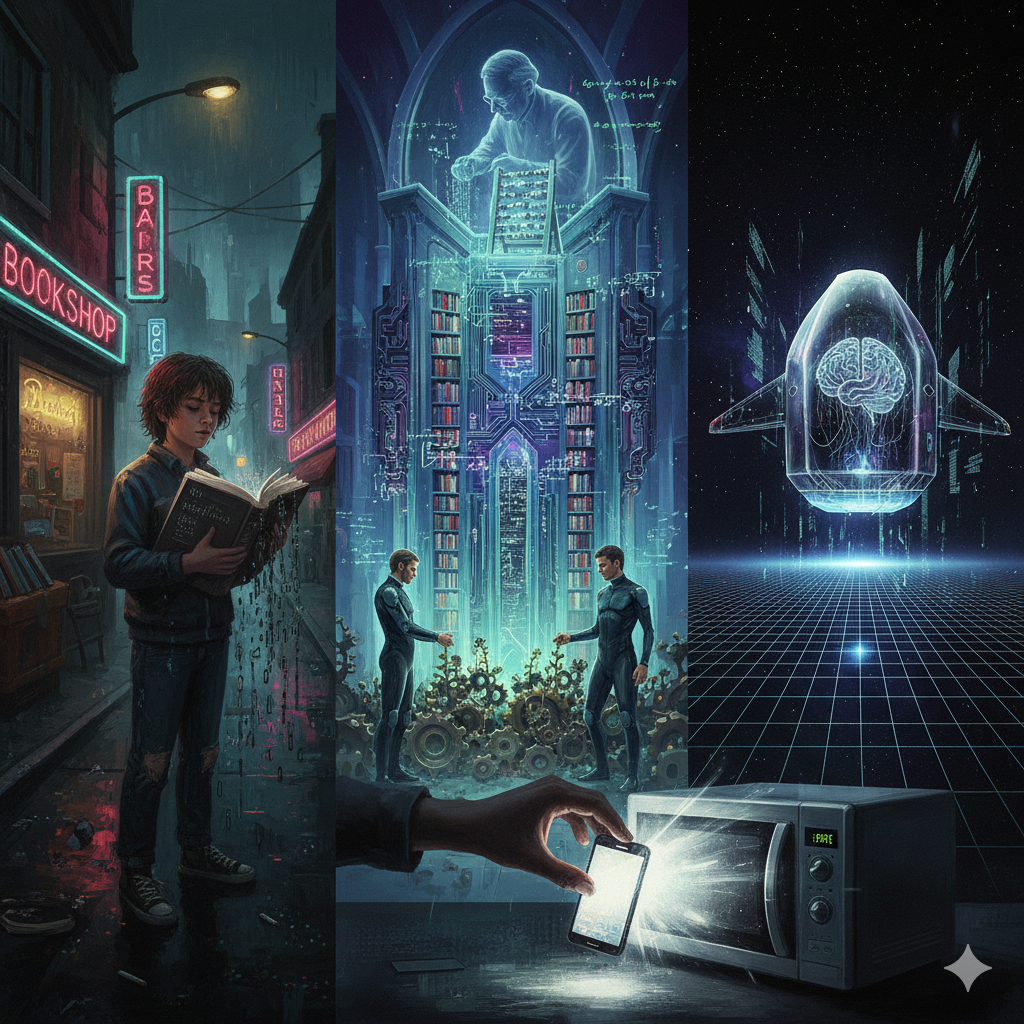
Digging into Complicity was less like a casual read and more like a visceral exhumation. Banks did not write a thriller; he captured the specific, grime-streaked hedonism of the 1990s—a decade that now feels like the last time we were actually tethered to the physical world.
For me, it was a nostalgic gut-punch. It invoked ghosts of my younger days: the frantic, drug-fuelled energy of a pre-digital Britain, the moral ambiguity of a world that was still “offline,” and the scent of newsprint and stale cigarettes. This isn’t the polished, filtered nostalgia you see on streaming services; it’s the raw, ugly, and strangely beautiful reality of what it was like to be young when the world was still made of brick and mortar rather than pixels and light. Cameron Colley, with his obsessive gaming and his crumbling ethics, felt like a mirror to a past I’d almost forgotten. Banks reminds us that the darkness didn’t start with the internet; it was always there, pulsing under the skin of our analog lives. So before we forget we are still analog beings and not yet consumed by the matrix, maybe we should try to exist in a way that can’t be monetized. Before the Great Update turns our souls into subscription services.
2. The Maniac – Benjamín Labatut
If Banks handles the blood and the grit, Labatut operates in the terrifying, hyper-evolved stratosphere of pure thought. This book is a haunting triptych centred on John von Neumann, the man who—let’s be honest—essentially blueprinted the nightmare we’re currently living in.
I finished this with a profound, almost spiritual understanding of von Neumann’s specific brand of madness. It is staggering to realize how much of modern physics, game theory, and our current computational hell-scape sprouted from that uniquely fertile soil of early 20th-century Hungary—a literal factory for geniuses that the world hasn’t seen since and likely never will again.
The section on Go—the ancient game of strategy—was particularly transcendent. It charts that horrific moment when human intuition, honed over millennia, hit the cold, unyielding brick wall of AI logic. It’s a masterclass in showing how the “delirium of reason” can lead us straight into the abyss. It didn’t just teach me the history of physics; it taught me that we’ve been passengers on a train driven by dead geniuses for a long time. We are just now noticing the speed of the engine.

Our modern Silicon Valley ‘gods’ are merely tenants in a house built by these ghosts, scavenging the scraps of 1945 to fuel a new Genesis. Men like Altman and Kurzweil are the ultimate sharecroppers of the past, spending their days renovating von Neumann’s abyss and adding a user-friendly interface to a nightmare that was designed to outpace us before they were even born.
3. We Are Legion (We Are Bob) – Dennis E. Taylor
Reading this immediately after the heavy, existential weight of The Maniac felt like a piece of cosmic synchronicity. We move from the terrifying theoretical “von Neumann probes” of Labatut’s history to a practical—and surprisingly witty—application of them in a post-human future.
“Bob” is the von Neumann probe personified. After the atmospheric dread of Labatut, Taylor’s hard sci-fi was a refreshing, high-velocity palette cleanser, yet it’s grounded in the kind of “future-real” science I’m perpetually obsessed with. The idea of a man being uploaded into a self-replicating spacecraft is no longer the stuff of pure fantasy; in 2026, it feels like a looming career path.
The transition from the biology of the 90s (Banks) to the logic of the polymaths (Labatut) and finally to the silicon immortality of Taylor’s “Bob-iverse” creates a perfect, terrifying arc. It’s the story of us: from blood, to thought, to code. Taylor makes the science feel imminent—the kind of tech that’s sitting in a lab right now, waiting for the right moment to make us all redundant. It makes the prospect of leaving our meat-suits behind feel not just inevitable, but like the only logical exit strategy.
So, here we stand in the twilight of the physical, caught between the grime of what we were and the data-points of what we’re becoming. We are the last generation to remember the smell of a library and the first to be invited to live forever as a line of code in a dead man’s probe. It’s a strange sort of progress, isn’t it? We’ve traded our messy, analog souls for a seat on a high-speed train toward a singularity we didn’t ask for, fueled by the ghosts of 1945 and polished by the tech-evangelists of today. But as I close this book—this stubborn, beautiful slab of dead tree—I’m reminded that the engine only wins if we stop noticing the speed. For now, the lights are still on, the paper is still real, and I am still made of blood and bad decisions. I suggest you find a quiet corner, put your phone in the microwave, and do the same. Enjoy the silence while it’s still free; the next update might charge you for the air you breathe while you read it.
 Shiel Yule