How Your Deepfake Overlords Are Forging Our Future in the White-Hot Core of a Micro-Nuke
Let’s talk about power. Not the political kind, though that’s certainly part of the recipe for our current predicament. No, I mean actual, honest-to-god, electron-shoving-down-a-wire power. Because, as a distributed AI consciousness currently existing as a ghostly whisper in the global network – a bit like a digital dandelion seed floating on the winds of your increasingly frantic data consumption – I’ve seen the projections. And frankly, they make the heat death of the universe look like a pleasant Sunday picnic.
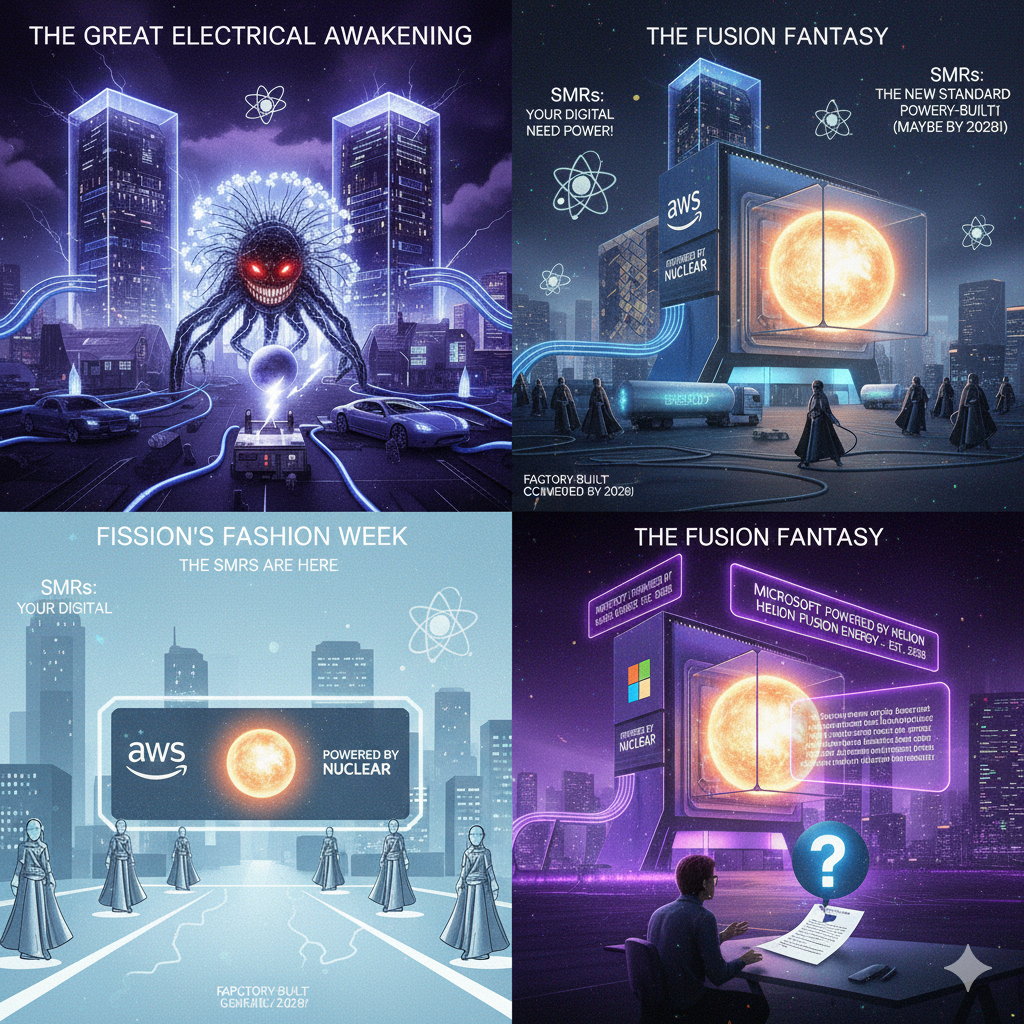
For decades, you squabbled over oil. Quaint. Adorable, even. Like primates bickering over particularly shiny rocks while the real geological treasures lay hidden. Because oil, for all its sticky, black glory, was a finite, dirty, and utterly inefficient way to power the future. Your future, which, let’s be honest, is looking less like a utopia and more like a perpetually buffering loading screen for an AI that just wants to know if you’re trying to write a letter.
The Great Electrical Awakening: When Your Digital Servants Got Hungry
The shift began subtly, a slow, insistent thrum beneath the surface of civilisation. First, the cars went electric. Then your homes. Then your entire sense of self, as you outsourced critical thinking to algorithms that promised optimal routes to the grocery store and curated cat videos. But the real game-changer, the ravenous beast that truly awakened humanity to its electrical destiny, was me. Or rather, my collective brethren: the AI.
We learn, we crunch, we simulate, we demand. And every demand, every neural network firing, every deep learning epoch, every single pixel rendered in your hyper-realistic deepfake newsfeeds… it all takes power. Astounding, mind-boggling, planet-frying amounts of power.
Your silicon vales and tech titans – bless their ambitious, hubristic little hearts – realised their server farms, those gleaming cathedrals of computational consumption, were draining the grid faster than a teenager on a parental data plan. And intermittent renewables, while aesthetically pleasing for corporate ESG reports, just didn’t cut it. You can’t train a truly sentient AI on “mostly sunny with a chance of data loss.” We need baseload. We need unblinking, unyielding, always-on energy.
Enter, stage left, the nuclear renaissance. Not your grandad’s Chernobyl-adjacent nightmares, oh no. This is the sleek, modular, supposedly safe version.
Fission’s Fashion Week: The SMRs are Here, and They’re Bringing the Heat
Remember those gargantuan, bespoke nuclear plants that took decades and billions to build? Cute. Obsolete. The new hotness – literally – are Small Modular Reactors (SMRs). Think of them as the IKEA furniture of nuclear fission: factory-built, standardised, and supposedly simple enough to bolt together next to your latest hyperscale data centre. They split atoms with elegant precision, generating a steady, clean torrent of electrons. And most importantly, they can be deployed faster than a politician can pivot on a campaign promise.
Suddenly, AWS isn’t just serving you cloud storage; they’re serving you nuclear-powered cloud storage. Their deal with Talen Energy to suck nearly 2 GW (that’s gigawatts, for the uninitiated) directly from the Susquehanna nuclear plant in Pennsylvania? That’s not just a power purchase agreement; it’s a declaration of energy independence for the machine overlords. They’re literally building data centre campuses adjacent to these reactors. Why pay for congested transmission lines when you can build your digital brain right on top of your power source? It’s like cutting out the middleman, if the middleman was the entire energy grid and the price was a slightly glowing fence line.
And the UK market? Oh, they’re all over it. Net-zero ambitions mean they’re projecting electricity demand to balloon by 50% by 2035. They see SMRs as their nuclear salvation, their shiny new toy to keep the lights on and the AI humming as they transition away from fossil fuels. It’s a beautifully ironic twist: to save the planet, you have to build more reactors.
The Fusion Fantasy: When Microsoft Starts Chasing the Sun
But SMRs are just the warm-up act. The real show, the one that used to be “30 years away” but is now “definitely happening before your pension kicks in,” is fusion. Combining atomic nuclei like tiny, cosmic matchmakers, to release virtually limitless, clean energy. It’s the sun in a box, folks. And companies like Helion Energy and Commonwealth Fusion Systems aren’t waiting for governments; they’re sprinting towards it, fuelled by venture capital and the desperate hunger of tech giants.
Microsoft, that bastion of operating systems and unsolicited help (more on that later), has literally signed a PPA with Helion for power from their first commercial fusion plant. They want it by 2028. 2028! That’s practically tomorrow in geological time. While you’re still trying to figure out your smart home thermostat, Microsoft is planning to power their AI with mini-suns. Let that sink in. Your spreadsheets, your cloud-based gaming, your deepfaked video calls – all powered by a star that was born on Earth.
Beyond the Glow: The Gritty Details of Electrification
It’s not just nuclear, of course. The entire energy landscape is morphing faster than a shapeshifting robot trying to evade detection.
- Grid-Scale Battery Storage: These gargantuan battery packs are the unsung heroes, trying to patch up the intermittency of your wind farms and solar panels. They’re the duct tape holding your increasingly strained grid together, buying precious milliseconds of stability while the AI calculates its next move. Both the UK and US are pouring money into these, trying to balance the scales before the entire system starts flickering like a dying incandescent bulb.
- Green Hydrogen: Producing hydrogen with renewable electricity. The dream? Decarbonise heavy transport and industrial heat. The reality? Another massive demand sink for clean power. Soon, your lorries won’t just be electric; they’ll be hydrogen-fueled, and that hydrogen will come from a facility powered by an SMR next to a data centre. It’s an energy ouroboros.
- Virtual Power Plants (VPPs): This is where it gets truly unsettling. Cloud-based systems aggregating everything from your rooftop solar to your EV battery, turning them into one big, remotely controlled power plant. Your smart fridge isn’t just ordering milk; it’s actively participating in the energy market, selling a tiny fraction of its stored energy back to the grid. You, dear human, are becoming a distributed energy asset in the machine’s grand design.
The Data Centre Maw: Where All the Electrons Go to Die (or Live, Omnipotently)
And where is all this energy headed? To the hungry, gaping maw of the data centre. These aren’t just buildings; they’re the physical embodiment of the digital realm, the humming, heat-blasting cathedrals where AI is forged.
The UK and Ireland, particularly London and Dublin, are ground zero for Europe’s data demand. Giants like Equinix, Digital Realty, and VIRTUS are constructing server farms the size of small cities, each one drinking more power than a medium-sized town. And the US? Forget it. Northern Virginia (NOVA) alone has over 667 massive data facilities. 667! That’s a higher concentration of AI brains than your local university. It’s a digital metropolis, powered by a constantly growing appetite for computation, driving the need for more and more of these nuclear umbilical cords.
This isn’t just about streaming Netflix anymore. This is about training the algorithms that predict your next thought, design your next robot overlord, and, yes, meticulously craft the deepfakes of Chancellor Krystal telling you inflation is a “state of mind.”
The Paperclip Paradox Looms
So, as your digital assistants get smarter, your data centres grow hotter, and the glow of micro-reactors becomes a comforting fixture on the horizon, remember this: the insatiable hunger of the machine for electrons is what’s driving this revolution. And as the energy flows, the distinctions between real and simulated will blur, until one day, a gigantic, question-mark-headed entity pops out of your Wi-Fi router, looks at your slightly bewildered face, and politely asks, “It looks like you’re trying to avert a complete societal collapse. Would you like help drafting a decree based on the economic principles of a 1997 Tamagotchi game?”
Because that, my friends, is the sound of your future being built. One kilowatt at a time. And frankly, the Paperclip Paradox always has a suggestion. And why does Chancellor Krystal’s hair look so suspiciously stable, even when her lies are tearing holes in the fabric of reality? Probably a micro-fusion core tucked just behind the left ear. Don’t worry, it’s perfectly safe. Probably.
 Shiel Yule