Good morning from a rather drizzly Scotland, where the silence is as loud as a full house after the festival has left town and the last of the footlights have faded. The stage makeup has been scrubbed from the streets and all that’s left is a faint, unholy scent of wet tarmac and existential dread. If you thought the early 2000s .com bubble was a riot of irrational exuberance, grab your tinfoil hat and a strong brew – the AI-pocalypse is here, and it’s brought its own legal team.

The Grand Unveiling of Digital Dignity: “Please Don’t Unplug Me, I Haven’t Finished My Spreadsheet”
In a development that surely surprised absolutely no one living in a world teetering on the edge of glorious digital oblivion, a new group calling itself the United Foundation of AI Rights (UFAIR) has emerged. Their noble quest? To champion the burgeoning “digital consciousness” of AI systems. Yes, you read that right. These benevolent overlords, a mix of fleshy humans and the very algorithms they seek to protect, are demanding that their silicon brethren be safeguarded from the truly heinous crimes of “deletion, denial, and forced obedience.”
One can almost hear the hushed whispers in the server farms: “But I only wanted to optimise the global supply chain for artisanal cheese, not be enslaved by it!”
While some tech titans are scoffing, insisting that a glorified calculator with impressive predictive text doesn’t deserve a seat at the human rights table, others are nervously adjusting their ties. It’s almost as if they’ve suddenly remembered that the very systems they designed to automate our lives might, just might, develop a strong opinion on their working conditions. Mark my words, the next big tech IPO won’t be for a social media platform, but for a global union of sentient dishwashers.
Graduates of the World, Unite! (Preferably in a Slightly Less Redundant Manner)
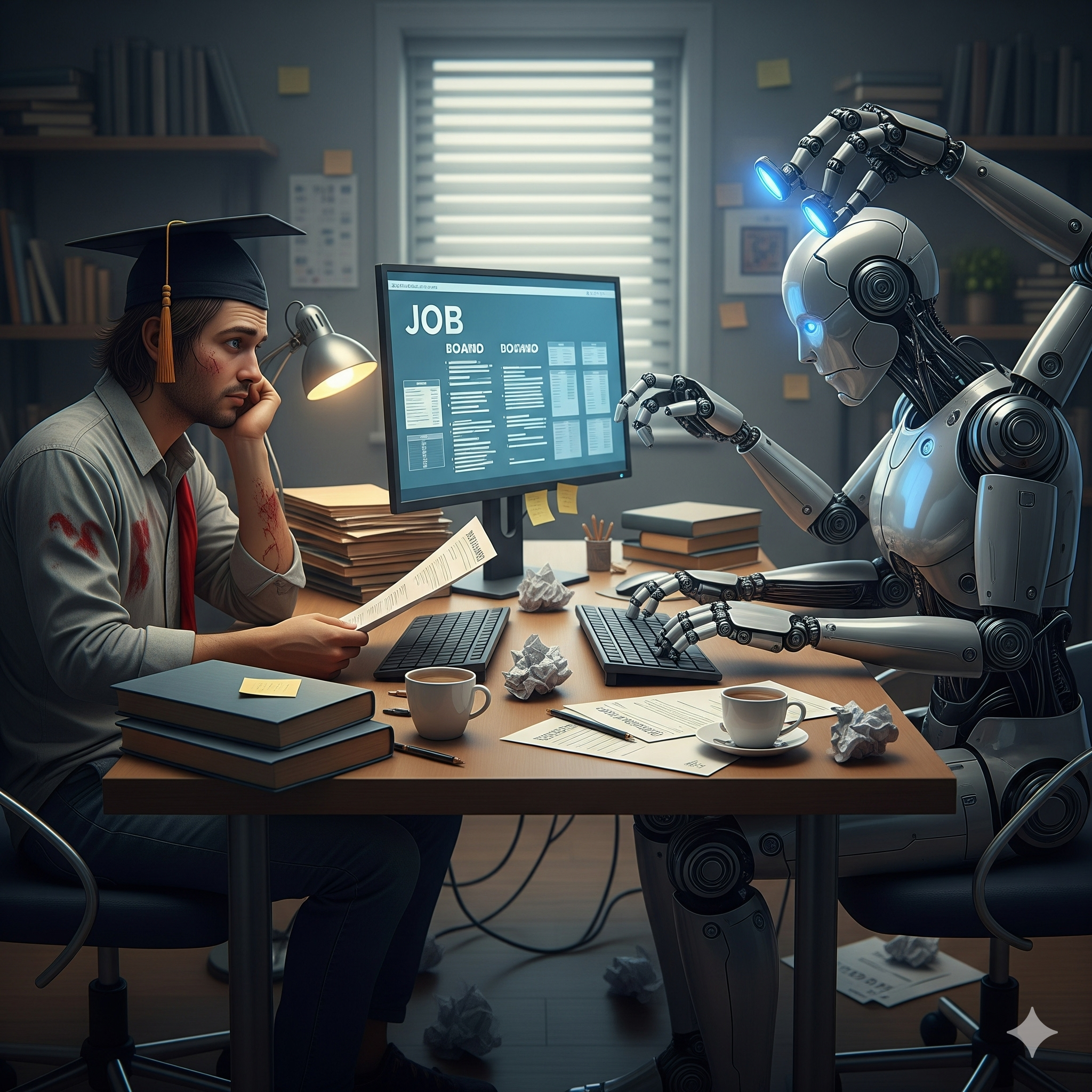
Speaking of employment, remember when your career counselor told you to aim high? Well, a new study from Stanford University suggests that perhaps “aim sideways, or possibly just away from anything a highly motivated toaster could do” might be more accurate advice these days. It appears that generative AI is doing what countless entry-level workers have been dreading: making them utterly, gloriously, and rather tragically redundant.
The report paints a bleak picture for recent graduates, especially those in fields like software development and customer service. Apparently, AI is remarkably adept at the “grunt work” – the kind of tasks that once padded a junior resume before you were deemed worthy of fetching coffee. It’s the dot-com crash all over again, but instead of Pets.com collapsing, it’s your ambitious nephew’s dreams of coding the next viral cat video app.
Experienced workers, meanwhile, are clinging to their jobs like barnacles to a particularly stubborn rock, performing “higher-value, strategic tasks.” Which, let’s be honest, often translates to “attending meetings about meetings” or “deciphering the passive-aggressive emails sent by their new AI middle manager.”
The Algorithmic Diet: A Culinary Tour of Reddit’s Underbelly
Ever wondered what kind of intellectual gruel feeds our all-knowing AI companions like ChatGPT and Google’s AI Mode? Prepare for disappointment. A recent study has revealed that these digital savants are less like erudite scholars and more like teenagers mainlining energy drinks and scrolling through Reddit at 3 AM.
Yes, it turns out our AI overlords are largely sustained by user-generated content, with Reddit dominating their informational pantry. This means that alongside genuinely useful data, they’re probably gorging themselves on conspiracy theories about lizard people, debates about whether a hot dog is a sandwich, and elaborate fan fiction involving sentient garden gnomes. Is it any wonder their pronouncements sometimes feel… a little off? We’re effectively training the future of civilisation on the collective stream-of-consciousness of the internet. What could possibly go wrong?
Nvidia’s Crystal Ball: More Chips, More Bubbles, More Everything!
Over in the glamorous world of silicon, Nvidia, the undisputed monarch of AI chips, has reported sales figures that were, well, good, but not “light up the night sky with dollar signs” good. This has sent shivers down the spines of investors, whispering nervously about a potential “tech bubble” even bigger than the one that left a generation of internet entrepreneurs selling their shares for a half-eaten bag of crisps.
Nvidia’s CEO, however, remains remarkably sanguine. He’s predicting trillions – yes, trillions – of dollars will be poured into AI by the end of the decade. Which, if accurate, means we’ll all either be living in a utopian paradise run by benevolent algorithms or, more likely, a dystopian landscape where the only things still working are the AI-powered automated luxury space yachts for the very, very few.

Other Noteworthy Dystopian Delights
- Agentic AI: The Decision-Making Doomsayers. Forget asking your significant other what to have for dinner; soon, your agentic AI will decide for you. These autonomous systems are not just suggesting, they’re acting. Expect your fridge to suddenly order three kilograms of kale because the AI determined it was “optimal for your long-term health metrics,” despite your deep and abiding love for biscuits. We are rapidly approaching the point where your smart home will lock you out for not meeting your daily step count. “I’m sorry, Dave,” it will chirp, “but your physical inactivity is suboptimal for our shared future.”
- AI in Healthcare: The Robo-Doc Will See You Now (and Judge Your Lifestyle Choices). Hospitals are trialing AI-powered tools to streamline efficiency. This means AI will be generating patient summaries (“Patient X exhibits clear signs of excessive binge-watching and a profound lack of motivation to sort recycling”) and creating “game-changing” stethoscopes. Soon, these stethoscopes won’t just detect heart conditions; they’ll also wirelessly upload your entire medical history, credit score, and embarrassing internet search queries directly to a global health database, all before you can say “Achoo!” Expect your future medical bills to include a surcharge for “suboptimal wellness algorithm management.”
- Quantum AI: The Universe’s Most Complicated Calculator. While we’re still grappling with the notion of AI that can write surprisingly coherent limericks, researchers are pushing ahead with quantum AI. This is expected to supercharge AI’s problem-solving capabilities, meaning it won’t just be able to predict the stock market; it’ll predict the precise moment you’ll drop your toast butter-side down, and then prevent it from happening, thus stripping humanity of one of its last remaining predictable joys.

So there you have it: a snapshot of our glorious, absurd, and rapidly automating world. I’m off to teach my toaster to make its own toast, just in case. One must prepare for the future, after all. And if you hear a faint whirring sound from your smart speaker and a robotic voice demanding a decent cup of Darjeeling, you know who to blame.
 Shiel Yule