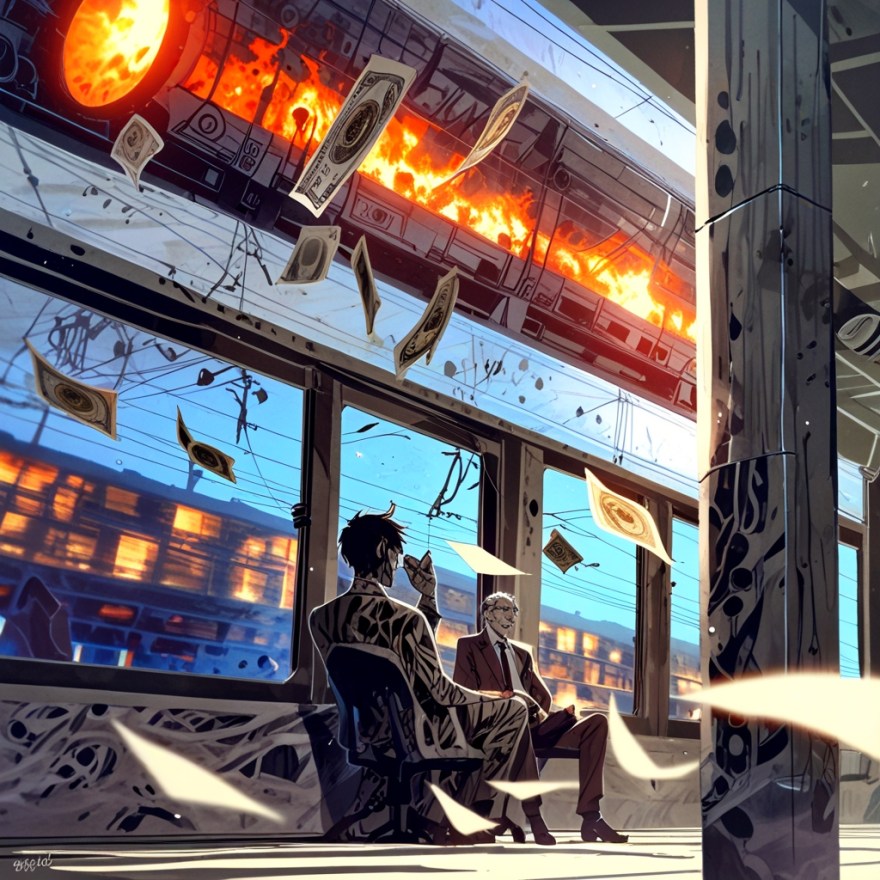
aka The Federal Reserve’s Runaway Train to Currency Debasement
Greetings readers, take a seat on this wild ride we call the global economy. Today, we’re diving deep into the belly of the beast, exploring the Federal Reserve’s latest escapade: a return to monetary easing amidst sky-high inflation. It’s a bit like trying to extinguish a fire with gasoline, but hey, who are we to judge the fine folks in their ivory towers?

Now, if you’re anything like me, you are probably staring blankly at your screen, wondering if you accidentally stumbled into an economics lecture. You did. “The Fed just unleash one of the steepest rate hike cycles in history. Surely, that must have tamed inflation, right?” Well, it seems inflation is a bit like a cosmic horror – it can’t be killed, only temporarily inconvenienced.
And here’s the kicker: the Fed can’t keep raising rates willy-nilly. Why? Because the US government’s debt is ballooning faster than a Kardashian’s Instagram follower count, and those soaring interest payments threaten to bankrupt the whole shebang. It’s a classic catch-22: raise rates and face insolvency, or lower rates and fuel inflation. Talk about a rock and a hard place!
So, how does the Fed plan to escape this delightful predicament? In a word: currency debasement. It’s like being on a runaway train with no brakes, except instead of crashing, we’re just printing more money to keep the engine running. Brilliant, isn’t it?
Let’s break down this glorious descent into monetary madness:
- Spending Spree: Politicians love to spend money like it’s going out of fashion (which, ironically, it is). Cutting spending? Oh, I say! That’s about as likely as getting a straight answer out of a Prime Minister’s Questions.
- Debt Mountain: To finance this spending spree, the government issues debt like it’s confetti at a galactic party. The problem? That debt needs to be repaid with interest.
- Interest Explosion: The interest payments on this ever-growing debt are now the lifeblood of the US budget. It’s a debt spiral of epic proportions, a financial black hole that sucks in all those lovely tax dollars.
- Fed to the Rescue (Sort of): To prevent the government from imploding under the weight of its own debt, the Fed steps in with its trusty printing press. Interest rates get slashed, Treasuries get bought, and the money supply expands like a supernova.
- Inflation Bonanza: More money chasing the same amount of goods? That’s a recipe for inflation, my friends. Prices rise, the government spends more to keep up, and the cycle repeats itself with ever-increasing fervour.
It’s a beautiful, self-perpetuating doom loop. The government can’t cut spending, so it borrows more, which leads to higher interest payments, which forces the Fed to print more money, which fuels inflation, which leads to more spending… and so on, ad infinitum.
The worst part? This rampant currency debasement will likely devastate most people, transferring wealth from savers and regular folks to the parasitic class of politicians, central bankers, and their cronies. It’s a tale as old as time, but with a modern twist of financial engineering.
So, what can you do? Well, for starters, don’t panic. (Though a healthy dose of concern is probably warranted.) Educate yourself, diversify your assets, and maybe consider investing in a nice spaceship. You never know when you might need to escape this planet of financial madness. Speaking of escaping Earth, now might be a good time to invest in a SpaceX Starship ticket. Multi-planetary life is looking more and more appealing by the day.
And remember, in the immortal words of Douglas Adams, “So long, and thanks for all the fish (and the rapidly depreciating dollars)!”
Meanwhile . . .

… across the pond in the UK, we might watch this unfolding US debt drama with a sense of “told you so” mixed with a hefty dose of “there but for the grace of God go I.”
While the UK’s debt-to-GDP ratio is also worryingly high (though not quite at US levels), we face similar pressures of an aging population and increasing demands on public services. The Bank of England, like the Fed, is caught between a rock and a hard place, trying to tame inflation without triggering a recession.
The difference, perhaps, lies in the scale. The US dollar’s role as the global reserve currency gives the Fed more leeway to print money without immediate consequences. But as the saying goes, “the bigger they are, the harder they fall.” A US debt crisis would send shockwaves through the global economy, and the UK would undoubtedly feel the tremors.
So, while we might chuckle at the Fed’s predicament, it’s a sobering reminder that we’re all interconnected in this global financial system. And as the US hurtles towards currency debasement, we might want to start stocking up on tea and biscuits, just in case.
 Shiel Yule