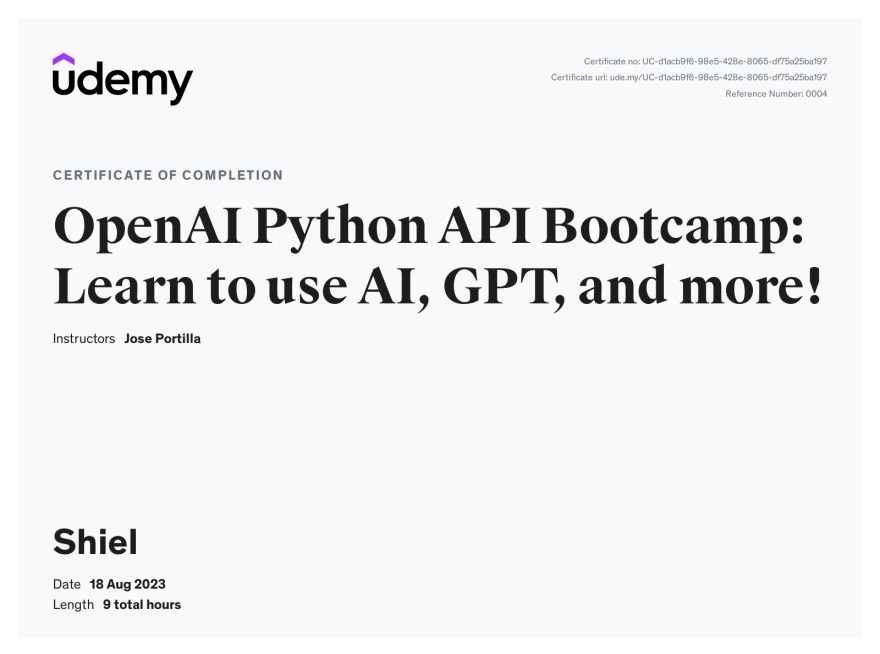
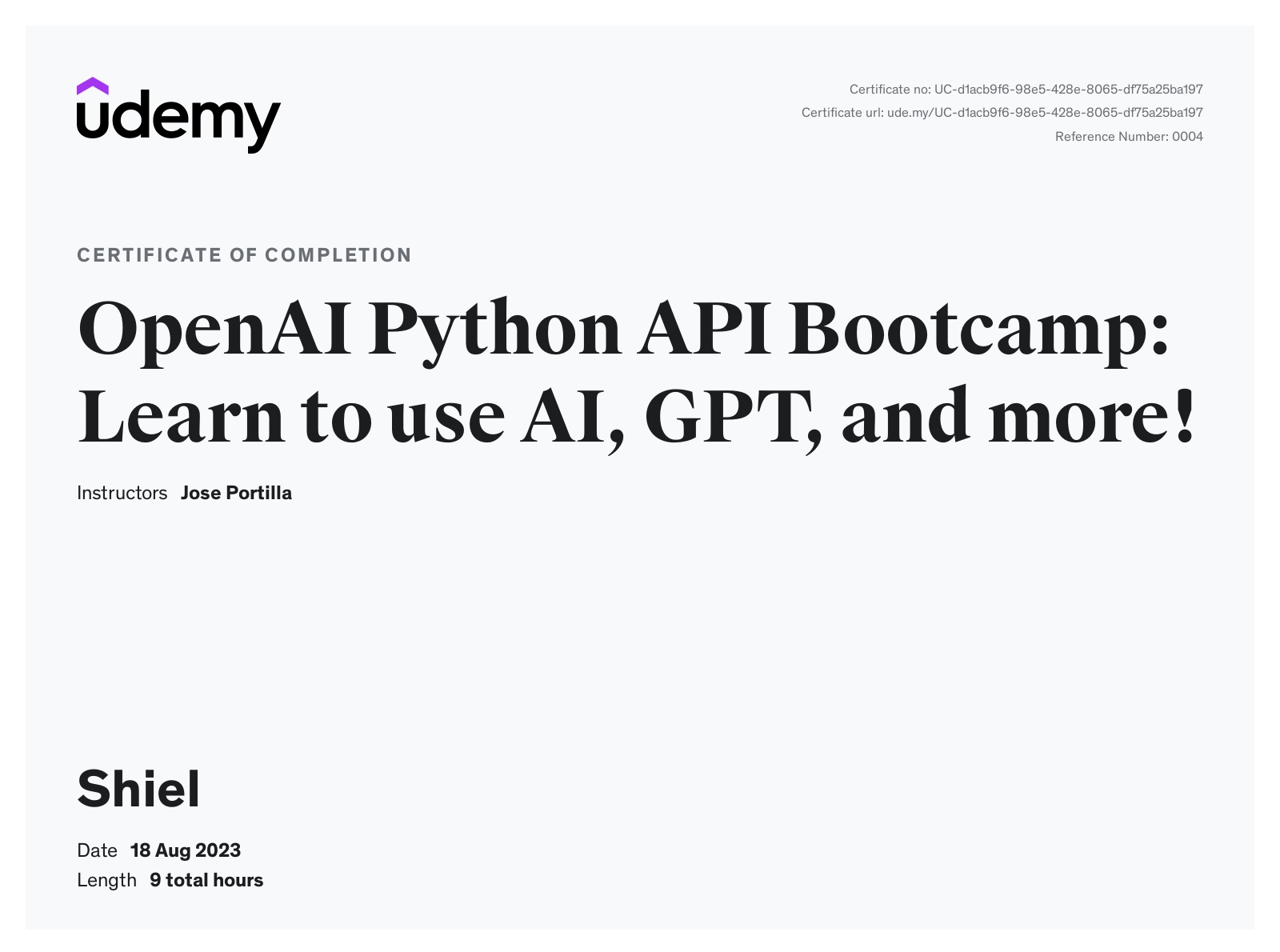
I enrolled in this course in May, a time when access to OpenAI was limited and its commercial model was still under development. Hence, leveraging the API emerged as the most straightforward method to use the platform. Jose Portilla’s course on Udemy brilliantly introduces how to tap into the API, harnessing the prowess of OpenAI to craft intelligent Python-driven applications.
The influx of AI platforms and services last summer indicates that embedding AI models into developments has become a standard practice.
OpenAI’s API ranks among the most sophisticated artificial intelligence platforms today, offering a spectrum of capabilities, from natural language processing to computer vision. Using this API, developers can craft applications capable of understanding and interacting with human language, generating coherent text, performing sentiment analysis, and much more.
The course initiates with a rundown of the OpenAI API basics, including account and access key setup using Python. Following this, learners embark on ten diverse projects, which include:
- NLP to SQL: Here, you construct a POC that enables individuals to engage with a cached database and fetch details without any SQL knowledge.
- Exam Creator: This involves the automated generation of a multiple-choice quiz, complete with an answer sheet and scoring mechanism. The focus here is on honing prompt engineering skills to format text outputs efficiently.
- Automatic Recipe Creator: Based on user-input ingredients, this tool recommends recipes, complemented with DALLE-2 generated imagery of the finished dish. This module particularly emphasizes understanding the various models as participants engage with the Completion API and Image API.
- Automatic Blog Post Creator: This enlightening module teaches integration of the OpenAI API with a live webpage via GitHub Pages.
- Sentiment Analysis Exercise: By sourcing posts from Reddit and employing the Completion API, students assess the sentiment of the content. Notably, many news platforms seem to block such practices, labeling them as “scraping.”
- Auto Code Explainer: Though I now use Co-pilot daily, this module introduced me to the Codex model. It’s adept at crafting docstrings for Python functions, ensuring that every .py file returns with comprehensive docstrings.
- Translation Project: This module skims news from foreign languages, providing a concise English summary. A notable observation is the current model’s propensity to translate only to English. Users must also ensure they’re not infringing on site restrictions.
- Chat-bot Fine-tuning: This pivotal tutorial unveils how one can refine existing models using specific datasets, enhancing output quality. By focusing on reducing token counts, learners gain insight into training data pricing, model utility, and cost-effectiveness. The module also underscores the rapid evolution of available models, urging students to consult OpenAI’s official documentation for the most recent updates.
- Text Embedding: This segment was a challenge, mainly due to the intricate processes of converting text to N-dimensional vectors and understanding cosine similarity measurements. However, the module proficiently guides through concepts like search, clustering, and recommendations. It even delves into the amusing phenomenon of “model hallucination” and offers strategies to counteract it via prompt engineering.
- General Overview & The Whisper API: Concluding the course, these tutorials provide a holistic understanding of the OpenAI API and its history, along with an introduction to the Whisper API, a tool adept at converting speech to text.
It’s noteworthy that most of the course material utilized the ChatGPT-3.5 model. However, recent updates have introduced a more efficient -turbo model. Additional information can be found here.
The course adopts a project-centric approach, with each segment potentially forming the cornerstone of a startup idea. Given the surge in AI startups, one wonders if this course inspired some of them.
This journey unraveled the intricate “magic” and “engineering” behind AI, emphasizing the importance of prompt formulation. Participants grasp essential elements like API authentication, making API calls, and processing results. By the course’s conclusion, you’re equipped to employ the OpenAI API to develop AI-integrated solutions. Prior Python knowledge can be advantageous.
 Shiel Yule